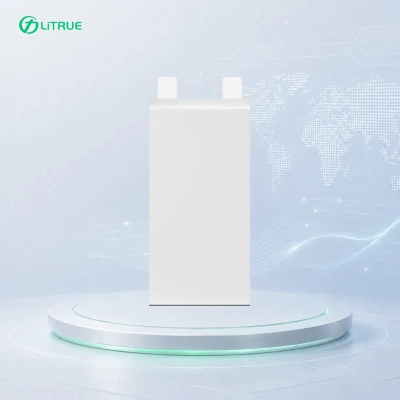
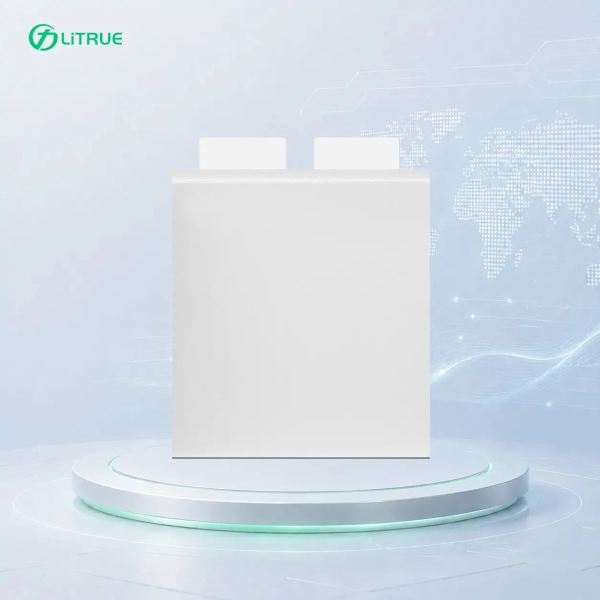
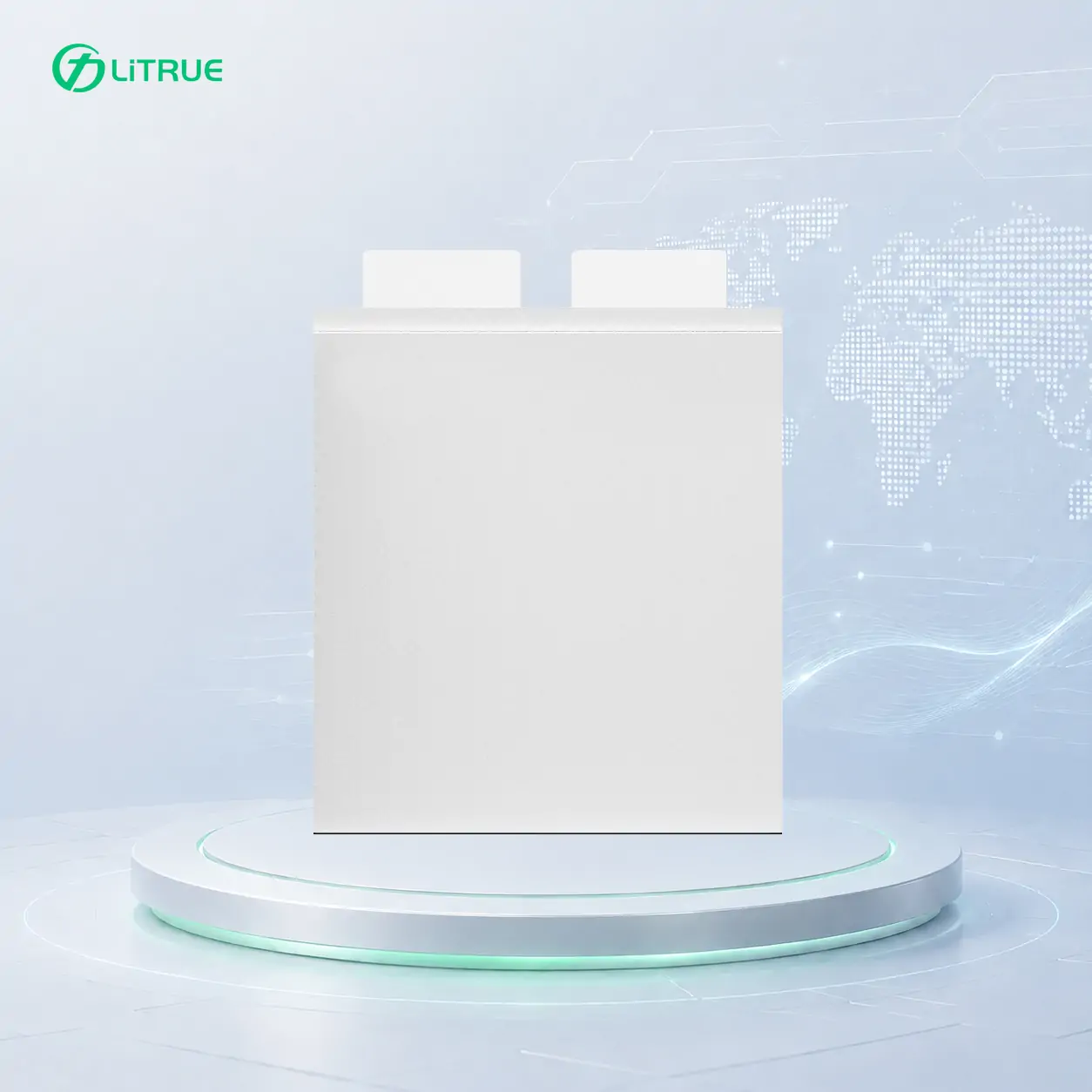
LiTrue PM30F-L and PP33F-L are low-temperature LFP pouch cells for OEM battery packs used in cold-region vehicles, agricultural machinery, and industrial equipment. Both models have a stated operating temperature range of -43°C to +55°C, with different capacity, charging, pulse-discharge, and cycle-life specifications.
Compare the 30Ah PM30F-L when higher pulse-current capability is a priority, and the 33Ah PP33F-L when additional capacity and longer rated cycle life better match the project. Our engineering team can support cell selection and custom battery-pack development based on your operating temperature, current profile, enclosure space, and target runtime.
Low-Temperature LFP Pouch Cell Specifications
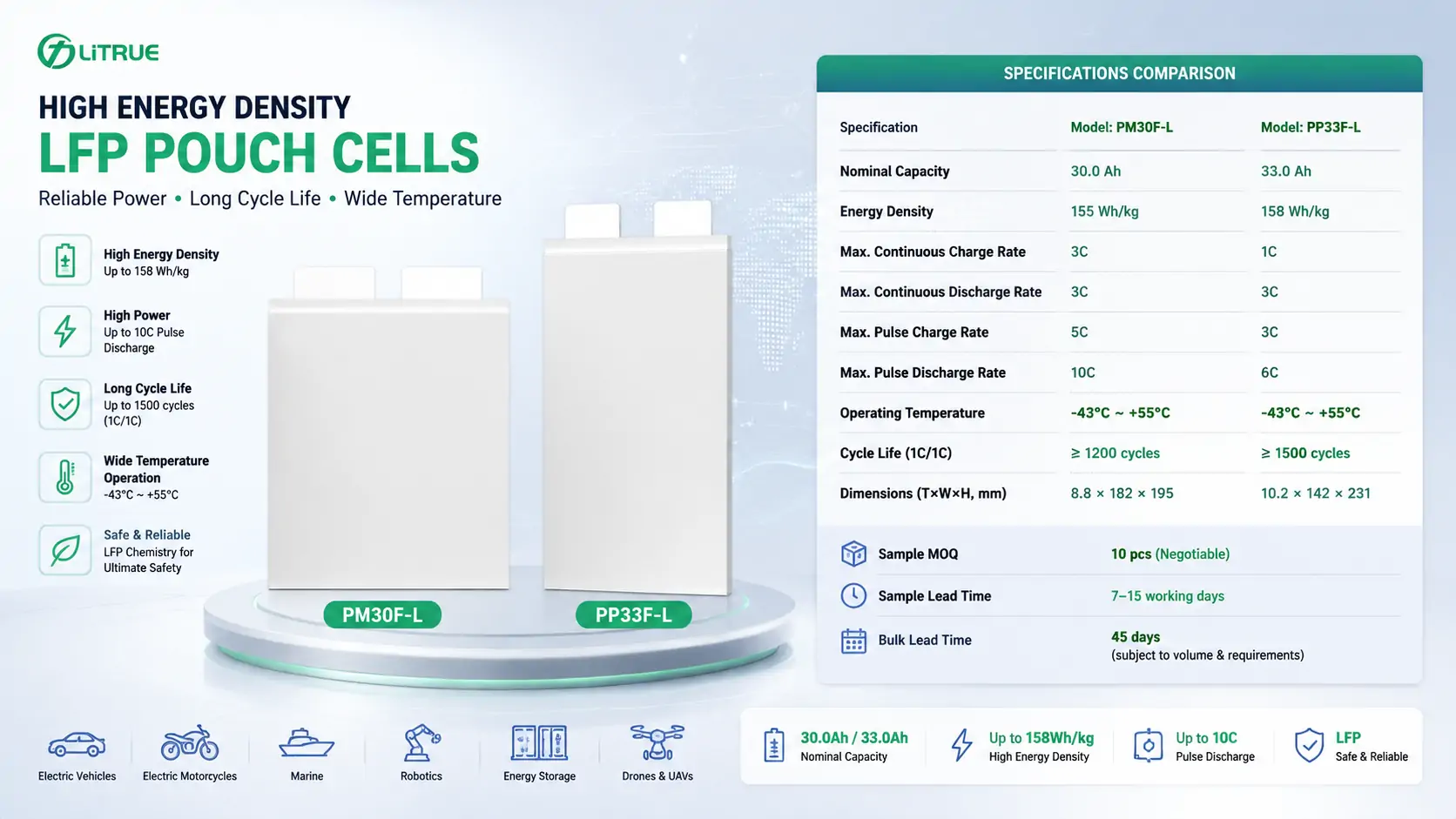
| Specification | Model: PM30F-L | Model: PP33F-L |
|---|---|---|
| Cell Structure | Pouch Cell | Pouch Cell |
| Chemistry | LFP (Lithium Iron Phosphate) | LFP (Lithium Iron Phosphate) |
| Nominal Capacity | 30.0 Ah | 33.0 Ah |
| Energy Density | 155 Wh/kg | 158 Wh/kg |
| Max. Continuous Charge Rate | 3C / 90A | 1C / 33A |
| Max. Continuous Discharge Rate | 3C / 90A | 3C / 99A |
| Max. Pulse Charge Rate | 5C / 150A | 3C / 99A |
| Max. Pulse Discharge Rate | 10C / 300A | 6C / 198A |
| Operating Temperature | -43°C to +55°C | -43°C to +55°C |
| Cycle Life (1C/1C) | ≥ 1200 cycles | ≥ 1500 cycles |
| Dimensions (T×W×H, mm) | 8.8 × 182 × 195 | 10.2 × 142 × 231 |
| Sample MOQ | 10 pcs (Negotiable) | |
| Sample Lead Time | 7–15 working days | |
| Bulk Lead Time | 45 days (subject to volume & requirements) | |
The maximum current ratings and operating temperature range are separate specifications. Maximum charging or discharging current should not be assumed to apply at -43°C. Confirm temperature-dependent current limits, pulse duration, cutoff voltage, and cycle-life test conditions before finalizing your pack design.
Compare Related LFP Cell Options
PM30F-L and PP33F-L are the primary low-temperature models on this page. Compare the related LiTrue LFP cells below by capacity, rate capability, cycle life, operating temperature, and dimensions to identify alternatives for your project. Final selection should account for the model-specific test conditions and actual pack duty cycle.
| Model | Dimension | Capacity | Voltage | Weight | Continuous Rate | Pulse Rate | Cycle Life | Operating Temp. |
|---|---|---|---|---|---|---|---|---|
| P10E0E5-17500FP | 9.6×140×145mm | 17.5Ah | 3.20V | 409g | 6C/10C | 15C/25C | 20000 | -43℃~55℃ |
| PC20F-T | 12.5×90×192mm | 20Ah | 3.20V | 420g | 2C/3C | 5C/10C | 5000 | -43℃~70℃ |
| PA46F-C | 12.5×161×232mm | 46Ah | 3.20V | 930g | 2C/3C | 3C/4C | 6000 | -43℃~70℃ |
| PA50F-E | 12.8×161×232mm | 50Ah | 3.20V | 960g | 2C/3C | 3C/4C | 3000 | -30℃~55℃ |
| P10B2D5-10000FP | 9.5×112×135mm | 10Ah | 3.20V | 272g | 10C/20C | 20C/50C | 15000 | -43℃~55℃ |
| LFL1-100P | 28.8×173.9×207.6mm | 100Ah | 3.20V | 2200g | 3C/4C | 4C/6C | 3000 | -30℃~55℃ |
| AA20F-P | 105.2×148.3×26.7mm | 20Ah | 3.20V | 760g | 10C/75C | 20C/125C | 6000 | -43℃~55℃ |
Solution
Cold-weather battery problems often appear under load rather than at rest. As cell temperature falls, internal resistance can rise and usable capacity and power can decrease. A pack that shows adequate voltage before startup may still reach its protection limit during acceleration, lifting, or another demanding load event.
PM30F-L and PP33F-L give OEM engineers two low-temperature LFP pouch-cell options to evaluate against these conditions. Both have a stated -43°C to +55°C operating range and 3C continuous-discharge ratings. PM30F-L provides higher rated pulse current, while PP33F-L provides additional capacity, slightly higher energy density, and longer rated cycle life at 1C/1C.
Cell selection should be reviewed alongside cold-soak duration, load profile, charging conditions, insulation, heating strategy, and BMS temperature limits. Explore the full range of LiTrue lithium battery cells when your project requires a different balance of current capability, energy density, and service life.
30Ah PM30F-L: Higher Rated Pulse-Current Capability
The PM30F-L provides 30Ah capacity, 155Wh/kg energy density, and a 3C continuous-discharge rating equivalent to 90A per cell. Its 10C pulse-discharge rating equals 300A, making it a candidate for applications with short-duration peak loads.
The cell measures 8.8 × 182 × 195mm. Confirm the permitted pulse duration and temperature-dependent current limits before selecting it for cold-start or motor-starting duty.
33Ah PP33F-L: Additional Capacity and Longer Rated Cycle Life
The PP33F-L provides 33Ah capacity, 158Wh/kg energy density, and a 3C continuous-discharge rating equivalent to 99A per cell. Its 6C pulse-discharge rating equals 198A, with a rated cycle life of ≥1,500 cycles at 1C/1C.
Its 10.2 × 142 × 231mm dimensions offer a narrower, taller alternative to the PM30F-L. Select the final model against module geometry, charging requirements, runtime, and the expected load profile.
What to Check in Low-Temperature Test Data
- Usable capacity: compare discharge capacity at the target cell temperature, with test current and cutoff voltage stated.
- Voltage under load: review the discharge curve and minimum voltage during startup against the system’s protection threshold.
- Pulse conditions: confirm pulse duration, rest interval, starting state of charge, and cell temperature.
- Charging restrictions: apply temperature-dependent charge limits rather than using the maximum charge rating throughout the operating range.
- Cycle-life conditions: compare charge/discharge rate, depth of discharge, test temperature, and the capacity-retention criterion.
OEM Pack Design and Supply Support
LiTrue can support cell matching, module layout, BMS selection, cold-weather protection strategy, and validation testing. For a complete assembly, the engineering review can also cover interconnects, connector requirements, enclosure design, insulation, and heating provisions.
Sample MOQ is 10 pcs, negotiable according to project requirements. Sample lead time is typically 7–15 working days, while bulk lead time is typically 45 days, subject to order volume and final requirements.
Application Areas
- Cold-Region Inspection and Service Vehicles: candidates for battery systems exposed to outdoor cold-soak periods and repeated startup loads, subject to validation at the required cell temperature.
- Winter Agricultural Machinery: 30Ah and 33Ah options allow engineers to balance module size, runtime, and current requirements for outdoor agricultural platforms.
- Cold-Storage AGVs and Material-Handling Equipment: suitable for evaluation where low cell temperature affects traction power, available capacity, and charging schedules.
- Outdoor Industrial Equipment: the two models provide different capacity and pulse-current options for machines with intermittent motor loads and changing ambient temperatures.
- Custom Cold-Weather Battery Packs: cell dimensions, thermal provisions, structural support, and BMS limits can be reviewed through LiTrue’s custom battery-pack program.
For an example of LiTrue’s application-specific pack integration work, see the custom 83.2V forklift battery project. Low-temperature performance for PM30F-L and PP33F-L should be assessed using their own model-specific test data.
FAQs
What is the difference between PM30F-L and PP33F-L?
PM30F-L is a 30Ah cell with 155Wh/kg energy density, 3C continuous charging, and 10C pulse discharge. PP33F-L is a 33Ah cell with 158Wh/kg energy density, 1C continuous charging, and 6C pulse discharge. Their rated cycle lives at 1C/1C are ≥1,200 and ≥1,500 cycles respectively.
Can these LFP pouch cells operate at -43°C?
The stated operating temperature range for both models is -43°C to +55°C. This does not mean full rated capacity, maximum discharge current, or unrestricted charging is available at -43°C. Review temperature-specific test data and validate the finished pack under its actual duty cycle.
How much discharge current can each model deliver?
PM30F-L has a 3C continuous-discharge rating of 90A and a 10C pulse-discharge rating of 300A. PP33F-L has a 3C continuous-discharge rating of 99A and a 6C pulse-discharge rating of 198A. Permitted current at a particular temperature and pulse duration must be confirmed against the cell specifications and pack design.
Which model should I choose for a cold-weather battery pack?
Evaluate PM30F-L when higher pulse-current capability is a primary requirement. Evaluate PP33F-L when its additional capacity, energy density, and longer rated cycle life better match the project. The final choice should follow a review of low-temperature discharge curves, charging limits, mechanical fit, and BMS settings.
Can LiTrue provide samples and help with custom pack design?
Yes. Sample MOQ is 10 pcs, negotiable according to project requirements, with a typical sample lead time of 7–15 working days. LiTrue can support cell selection, module layout, BMS selection, and pack validation. Send your voltage, continuous and peak current, lowest operating temperature, enclosure size, quantity, and destination market to the LiTrue engineering team to request samples and technical data.