
Choose a pouch lithium battery manufacturer by verifying application fit, documented performance, production consistency, and engineering support. Capacity matters, but so do sustained current, short power bursts, charging limits, and the mechanical protection needed inside the finished battery.
For an OEM, a useful supplier evaluation connects three things: a controlled cell specification, test results that reflect the application, and a repeatable production process. This guide explains what to ask, how to read a real product specification, and how to move from samples to an approved supply agreement.
What Should a Pouch Lithium Battery Manufacturer Deliver?
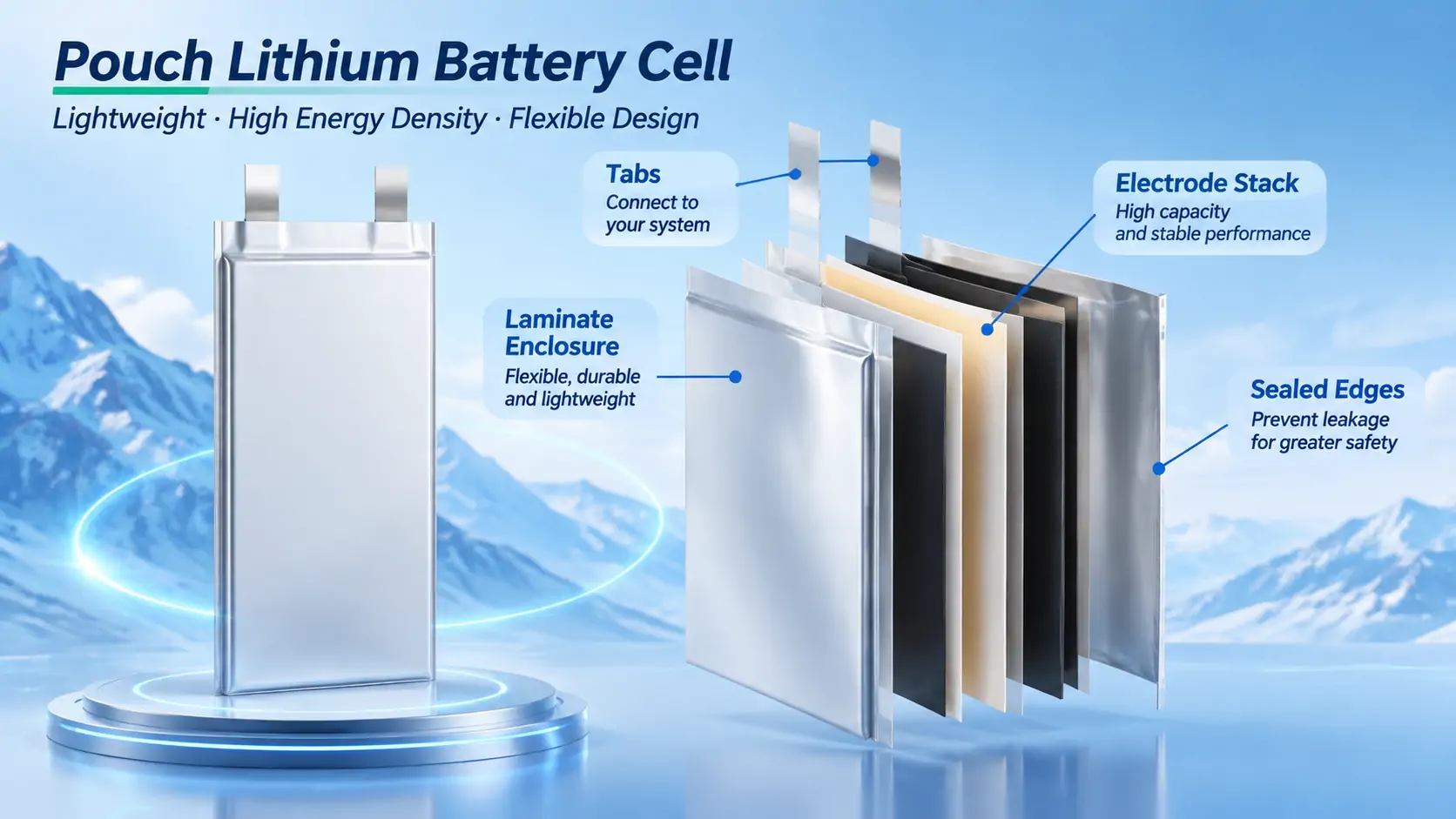
A pouch cell uses a flexible laminated enclosure rather than a rigid cylindrical or prismatic can. This format can help designers use limited installation space, but the pack must still protect the cell from puncture, movement, and excessive mechanical stress.
Pouch describes the packaging format, not the chemistry. NMC and lithium iron phosphate, or LFP, can both be used in pouch cells. Choose the chemistry and cell design around the project energy, power, temperature, and service-life requirements.
Separate Cell Supply From Complete Pack Engineering
Confirm whether the supplier manufactures the proposed cell, integrates purchased cells into packs, or provides both services. Ask which production site and legal entity are responsible for your model. A pack engineering capability alone does not establish control over cell manufacturing.
A cell order needs a controlled datasheet and agreed acceptance criteria. A complete battery pack also needs an electrical configuration, protection strategy, interconnect design, enclosure, and charging interface. Define that scope before comparing quotations.
Choose Chemistry Before Chasing a Headline Number
NMC is often considered where energy and power must fit a limited weight budget. LFP may be considered where the design prioritizes its particular thermal behavior and cycle-life characteristics. Actual performance depends on the specific cell and test conditions; chemistry alone cannot establish suitability.
Review the available lithium pouch cells against your load profile. Compare measured usable energy, voltage under load, and heat generation rather than ranking candidates by amp-hours alone.
Five Checks Before You Approve a Supplier
1. Define Continuous and Peak Power Requirements
Give the supplier your normal current, maximum continuous current, peak current, peak duration, and recovery interval. Also specify the lowest acceptable voltage under load. A cell that meets the current requirement may still trigger a system shutdown if its voltage drops below the equipment limit.
Ask for discharge curves at relevant temperatures and states of charge. A high pulse rating is useful only when its duration, cutoff voltage, and thermal conditions match the intended duty cycle.
2. Review Dimensions, Tabs, and Mechanical Support
Request a drawing with thickness, width, length, tolerances, tab dimensions, and polarity. Confirm whether the stated size includes tabs and whether thickness applies to a new cell at a specified state of charge.
The pack design should account for dimensional changes during use. Obtain the supplier requirements for support, compression where applicable, tab strain relief, and clearance. Do not assume every pouch cell uses the same compression arrangement.
3. Check Consistency and Traceability
Ask how capacity, open-circuit voltage, and internal resistance are screened before shipment. Compare measurements made with the same test method, temperature, state of charge, and rest period. Resistance values taken under different conditions are not directly interchangeable.
Request lot identification and an agreed process for reporting nonconforming cells. For recurring orders, define change notification requirements for materials, cell construction, production location, and inspection methods.
4. Match Documentation to the Product and Shipment
Request the applicable UN 38.3 test summary and confirm that it identifies the cell or battery being supplied. Review any claimed safety certifications by model and scope. A logo on a web page is not a substitute for documentation.
The U.S. Department of Transportation PHMSA lithium battery transportation guidance explains that lithium batteries are regulated as hazardous materials and must meet applicable transportation requirements. Review packaging, short-circuit protection, marking, documentation, and carrier requirements for the planned shipment.
Transport testing and end-use product qualification serve different purposes. Determine which additional safety standards apply to your equipment and destination market before approving the final battery design.
5. Confirm the Path From Samples to Production
Ask for sample availability, minimum order quantity, production lead time, and the assumptions behind the quotation. Clarify whether the scope covers an existing cell, a modified cell, or a complete pack; each involves different development and validation work. Confirm that samples represent the intended production design and process.
Agree on a pilot build before committing to a larger release. This gives both teams a chance to resolve assembly fit, process variation, and test discrepancies while changes remain manageable.
A Real Product Example: LiTrue PR30N-P NMC Pouch Cell
LiTrue PR30N-P is one example for evaluating a high-power cell requirement. Its product page identifies a 30.0 Ah NMC pouch cell with separate continuous and pulse charge/discharge ratings. The table below contains selected manufacturer-published specifications reviewed on November 10, 2026.
Review the high-rate battery cell specifications with the supplier before approving a pack design. These figures describe the cell and do not establish the performance of an assembled battery.
| Parameter | Published Specification |
|---|---|
| Model | PR30N-P |
| Cell format | Pouch cell |
| Chemistry | NMC |
| Nominal capacity | 30.0 Ah |
| Nominal voltage | 3.70 V |
| Nominal gravimetric energy density | 194 Wh/kg |
| Published dimensions | 11.9 mm × 105.0 mm × 217.0 mm |
| Maximum continuous charge rate | 5C |
| Maximum continuous discharge rate | 10C |
| Maximum pulse charge rate | 8C |
| Maximum pulse discharge rate | 20C |
| Recommended operating temperature, as published | -43°C to 55°C |
The product page does not establish separate charging and discharging temperature limits in this table. Confirm those limits, pulse duration, voltage cutoffs, cooling conditions, and dimensional tolerances in the current controlled datasheet. Do not assume maximum current is available across the entire stated temperature range.
Translate C-Rate Into Current
Current in amperes equals C-rate multiplied by nominal capacity in amp-hours. For this 30.0 Ah cell, 5C corresponds to 150 A, 10C to 300 A, and 20C to 600 A. These are arithmetic conversions of the published ratings, not independent test results.
A 5C charge rating does not guarantee a full charge in 12 minutes. Actual charging time depends on the permitted charging profile, voltage taper, temperature, initial state of charge, and system limits.
Match the Cell to the Application
UAVs and Other Weight-Sensitive Systems
For a UAV, evaluate voltage stability during takeoff, climb, and sustained flight. Account for the complete battery mass, including interconnects, protection electronics, supports, and enclosure. A cell-level energy-density figure does not predict pack-level energy density or flight time.
If you need an integrated system, compare the requirements with LiTrue UAV lithium battery offerings. The proposed cell still needs application-specific electrical, thermal, and mechanical validation before release.
Industrial Equipment With Repeated Power Bursts
For mobile equipment or other intermittent loads, repeated bursts can matter more than a single peak. Test the complete sequence, including recovery periods and charging between operating cycles. Measure temperature rise and minimum voltage throughout the sequence.
Cold-weather equipment also needs a charging strategy. A broad published operating range should not be interpreted as permission to charge at its lowest temperature. Obtain explicit charging limits and determine whether heating or charge inhibition is required.
Qualify Samples Before Scaling Up
Start by documenting acceptance criteria before sample testing begins. Define the capacity test rate, voltage window, temperature, rest periods, and allowable variation. For cycle-life evaluation, also agree on depth of discharge and the end-of-life capacity threshold. This prevents disagreements caused by comparing results from different procedures.
Next, measure the samples under the actual application load. Record current, voltage, and temperature together so the team can connect performance changes to operating conditions. Include the equipment most demanding realistic duty cycle.
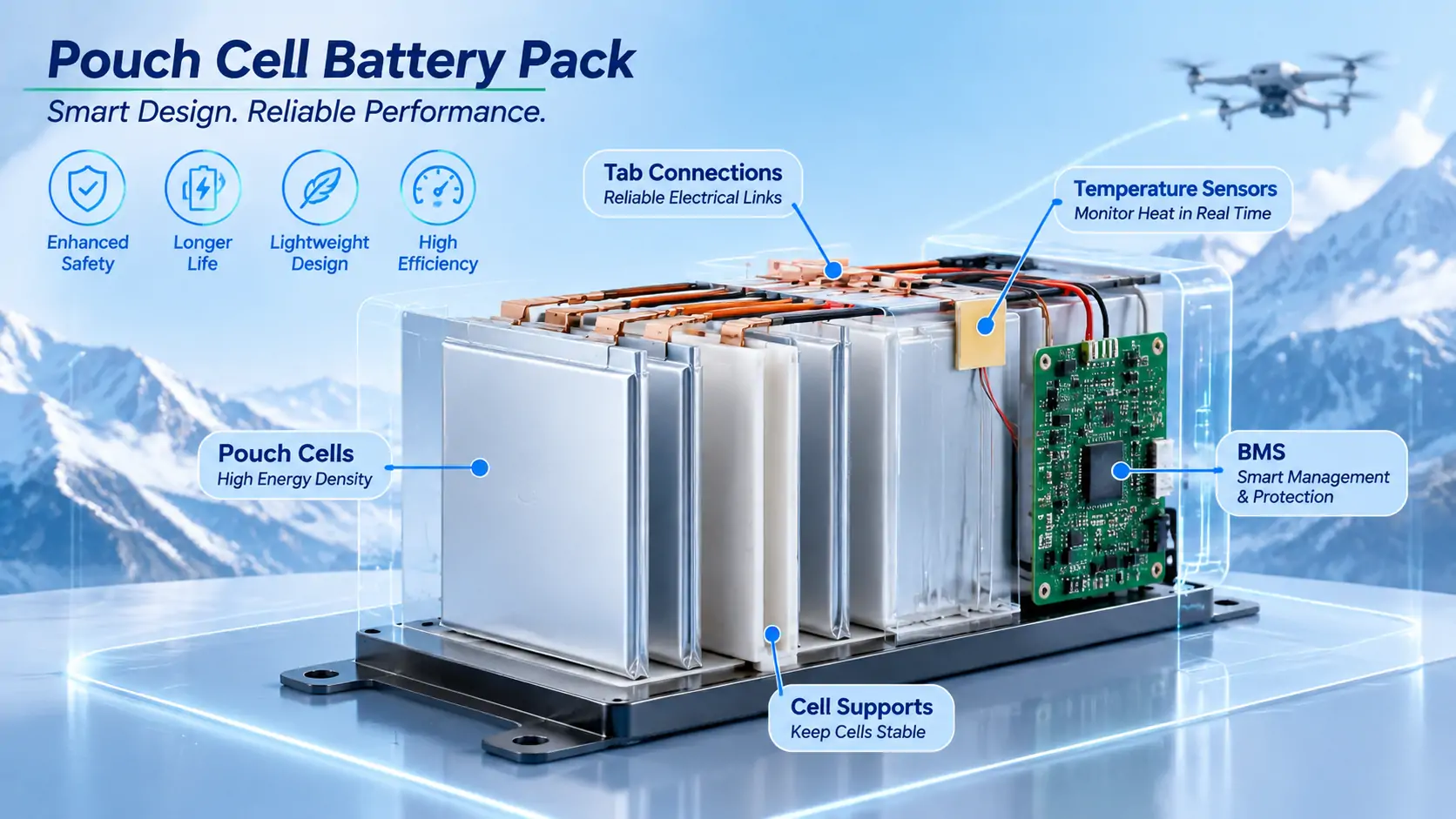
Then validate the assembled module or pack. Tab joining, electrical protection, heat paths, and mechanical support can change system behavior even when the individual cells meet their specifications.
Finally, review pilot production results against the same acceptance criteria. Record the approved model, drawing revision, inspection plan, packaging method, and change notification process before releasing a recurring order.
Discuss Your Requirements With LiTrue
LiTrue describes its business as developing lithium cells and custom battery packs for industrial applications. Its lithium battery manufacturer overview outlines cell technology, pack engineering, and manufacturing activities. Use that information to prepare a focused technical discussion about the proposed product and production responsibility.
For a useful quotation, provide nominal system voltage, required usable energy, continuous and peak current, peak duration, installation space, weight target, charging conditions, operating temperatures, and expected annual demand.
Include the equipment type, destination market, required documentation, and sample schedule. Ask which requirements the proposed cell already meets and which still require development or testing.
Send your custom lithium battery requirements to LiTrue for a cell and pack evaluation. A clear application brief gives the engineering team a practical basis for recommending a candidate and defining the next validation step.
FAQs
How Do I Choose a Pouch Lithium Battery Manufacturer?
Compare application fit, test evidence, manufacturing responsibility, traceability, and production support. Ask each supplier to respond to the same technical brief so you can assess equivalent specifications and commercial terms.
Are Pouch Cells and Lithium Polymer Batteries the Same?
No. Pouch refers to the enclosure format, while lithium polymer terminology refers to electrolyte-related technology and is also used broadly in product marketing. Confirm the actual chemistry and construction rather than treating the labels as interchangeable.
Can I Use a Cell Maximum Pulse Rating Continuously?
No. Pulse ratings apply to limited durations under specified conditions. Continuous operation must stay within the approved continuous rating and the electrical and thermal limits of the finished system.
What Documents Should I Request Before Ordering?
Request the controlled datasheet, dimensional drawing, agreed test procedures, relevant performance curves, applicable transport test summary, and model-specific certification documents where required. Also obtain written sample and production terms.