
For most buyers, the best 100Ah lithium battery is a 12.8V lithium iron phosphate (LFP) battery with a built-in battery management system (BMS) that is rated for thousands of cycles. The details that separate a good one from a poor one are the BMS current rating, low-temperature charging protection, the test conditions behind the cycle-life claim, and the documentation that backs it all up.
This guide explains what a 100Ah battery gives you, recommends spec profiles for RV, marine, and solar use, and lists the checks to run before you buy. It also covers what builders and OEMs should know when they source 100Ah cells directly.
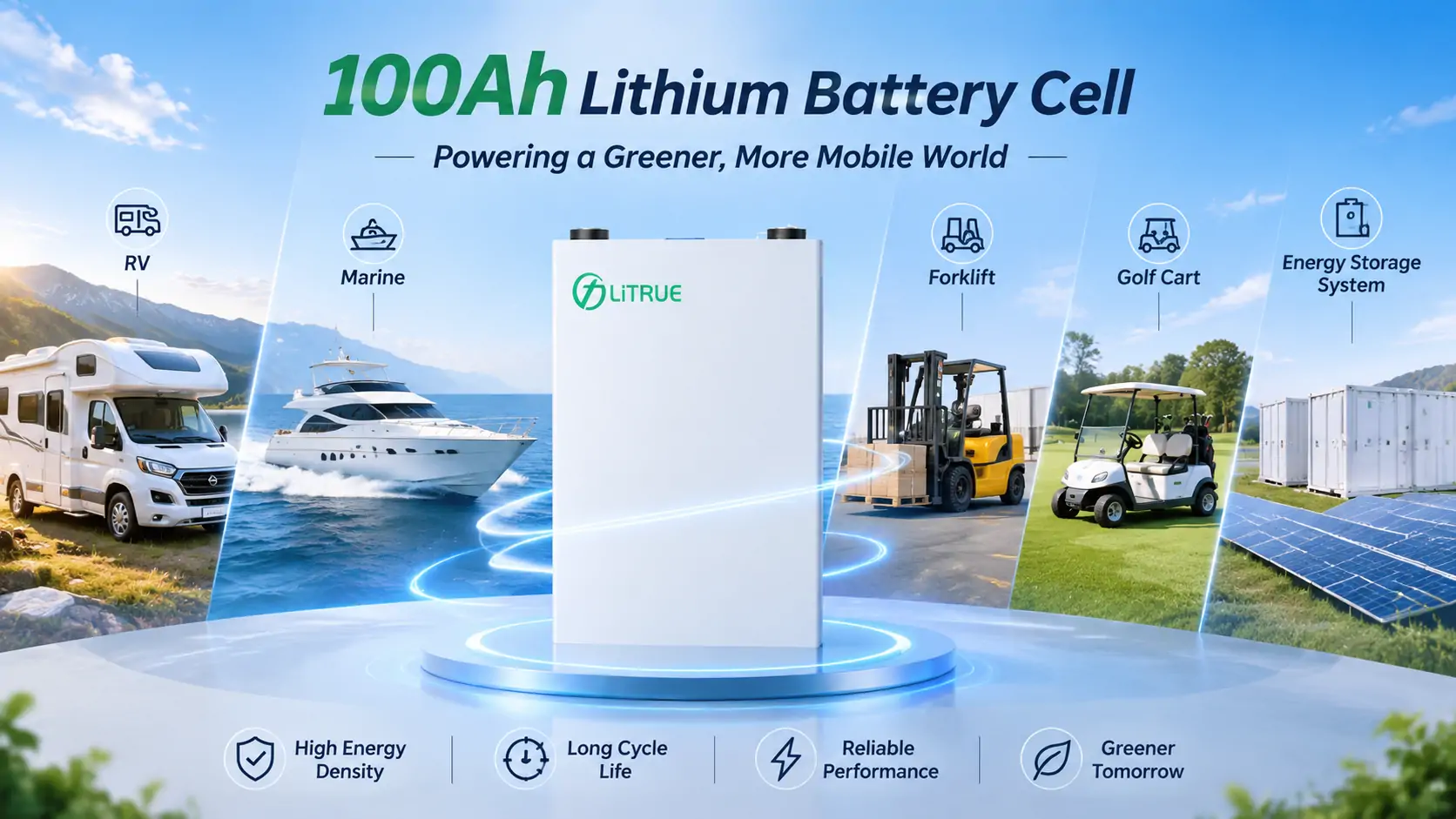
What a 100Ah Lithium Battery Actually Gives You
Energy and Runtime
A 12V LFP battery has a nominal voltage of 12.8V, so a 100Ah battery stores 12.8 × 100 = 1,280 watt-hours. If you plan to use about 90 percent of that, you have roughly 1,150Wh to work with.
That runs a steady 100W load for about 11.5 hours, or a 300W load for about 3.8 hours. Our guide on how long a 12V lithium battery lasts walks through the runtime math, discharge rate, and cycle life in more detail.
Lifetime Energy Compared With Lead Acid
Lithium advantage grows over the battery life. Assume a 100Ah LFP battery with 90 percent usable capacity and 3,000 cycles, which delivers about 3,456kWh over its lifetime. A 100Ah lead-acid battery used to 50 percent depth of discharge for 500 cycles delivers about 300kWh.
Those assumptions are illustrations, not guarantees, but they show why many buyers choose lithium even at a higher price. Our comparison of lithium ion battery versus lead acid covers the trade-offs in full.
Voltage Options
Four 3.2V LFP cells in series make a 12.8V battery. Eight in series make 25.6V, and sixteen in series make 51.2V, so the same 100Ah cell is a building block for 12V, 24V, and 48V systems.
Recommendations by Use Case
These are spec profiles to shop for, not endorsements of specific brands. Match the profile to your loads, your climate, and the space you have.
RV and Camper
Look for a 12.8V battery with a BMS continuous current rating that comfortably covers your biggest load. A 2,000W inverter pulls about 175A from a 12.8V battery after typical inverter losses, so a 100A BMS will trip, while a 200A BMS or two batteries in parallel will not.
Low-temperature charge protection matters for winter camping, and a size that fits your battery compartment saves installation headaches. Our guide to the 12V lithium battery for RVs covers sizing and cold-weather charging in more detail.
Marine and Trolling Motor
Check your motor maximum amp draw and make sure the battery continuous rating exceeds it with margin. Vibration resistance and moisture protection matter on a boat, and higher-thrust motors often run on 24V or 36V systems built from multiple batteries in series.
Solar and Off-Grid
Choose a battery that accepts the charge current your solar controller delivers, supports the number of parallel or series batteries you plan to add, and protects itself against charging in freezing temperatures. Capacity matters more here than peak current, because off-grid systems cycle daily.
Key Specs to Check Before You Buy
BMS Continuous and Peak Current
The BMS decides how much power the finished battery can deliver. A listing that shows only a large peak number without the continuous rating tells you very little, so ask for both.
Cycle Life and Test Conditions
A cycle-life claim is only meaningful with its conditions: discharge rate, temperature, depth of discharge, and the capacity level that defines end of life. Be wary of round numbers with no test details behind them.
Cold-Weather Charging
Lithium-ion cells generally should not be charged below freezing. As Battery University explains, charging at low temperatures can cause lasting damage unless the design prevents it, so look for low-temperature cutoff or built-in heating.
Cell Quality and Documentation
Ask what cells are inside and request the cell datasheet. For lithium iron phosphate batteries, quality varies widely between cell makers, and transparent suppliers share cell specifications, certifications, and test reports without being pressured.
Actual Capacity
Some batteries labeled 100Ah deliver less in practice. Ask whether the supplier tests capacity before shipping, and compare watt-hours rather than relying on a label alone.
Weight, Size, and Connections
Check dimensions against your battery compartment, the terminal type, and any series or parallel limits. Many 12V 100Ah batteries are built to fit common battery trays, but sizes vary, so measure before you order.
For OEMs and Pack Builders: Sourcing the 100Ah Cell
If you build batteries rather than buy them, the cell is where quality starts. LiTrue 100Ah LFP prismatic battery cell (model LFL1-100P) is a rigid prismatic can cell sold to OEMs and pack builders, not a finished drop-in 12V battery.
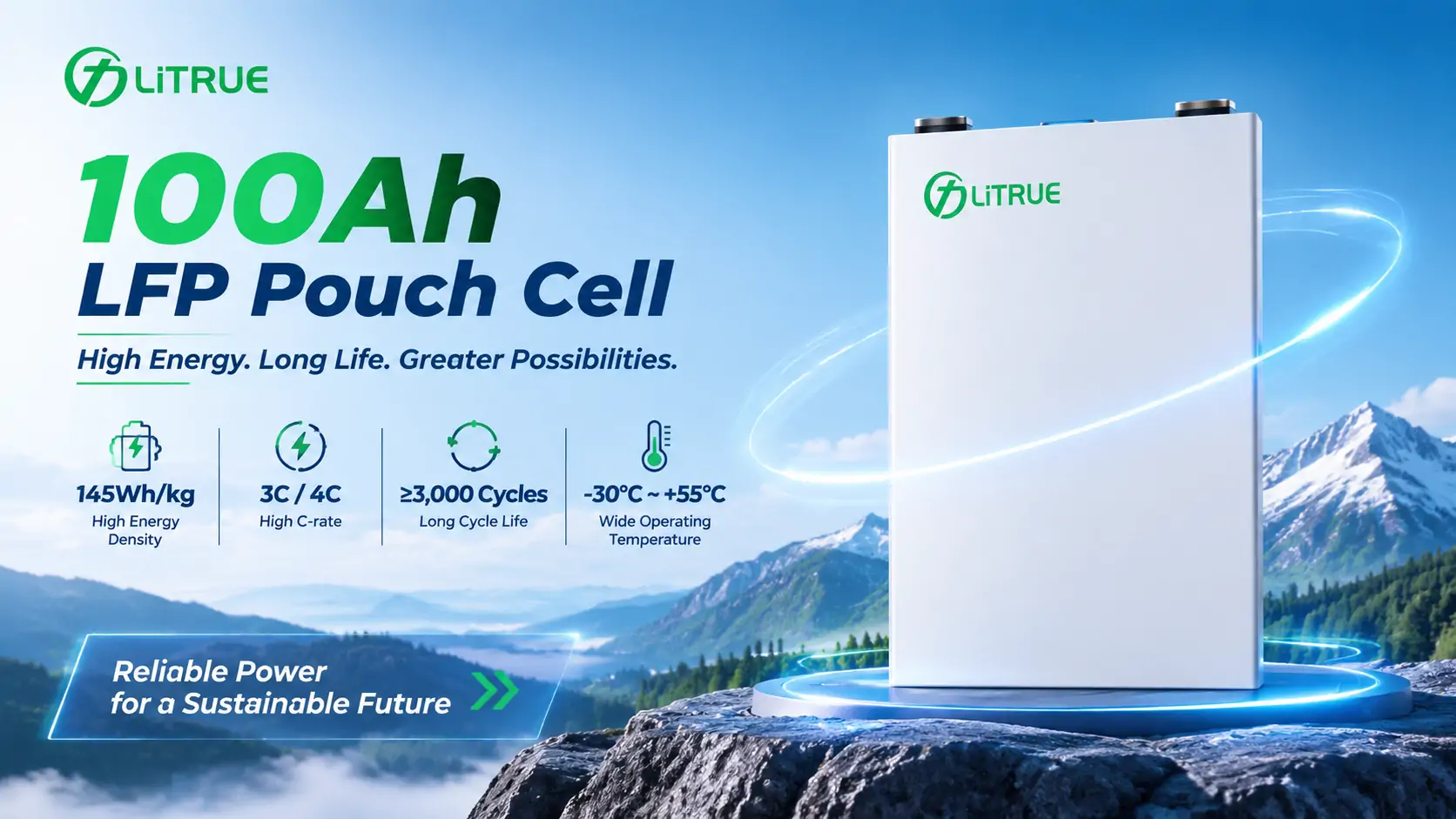
| Model Number | LFL1-100P |
| Classification | High C-rate |
| Chemistry | LFP (Lithium Iron Phosphate) |
| Cell Structure | Prismatic Can |
| Nominal Capacity | 100Ah |
| Nominal Voltage | 3.20V |
| Energy Density | 145Wh/kg |
| Max. Continuous Charge Rate | 3C |
| Max. Continuous Discharge Rate | 4C |
| Max. Pulse Charge Rate | 4C |
| Max. Pulse Discharge Rate | 6C |
| Cycle Life | ≥3,000 cycles @ 1C/3C |
| Operating Temperature | -30°C to +55°C |
| Dimensions (T×W×H) | 28.8 × 173.9 × 207.6mm |
| Certifications | UN38.3, CE, MSDS |
| Standards | GB/T 38058-2019, GB 31241-2022 |
| Sample MOQ | 10 pcs (negotiable) |
| Sample Lead Time | 7–15 working days |
| Bulk Lead Time | 45 days (subject to volume and requirements) |
Here is how those numbers turn into a 12V battery. Four cells in series (4S1P) give 12.8V and 100Ah, which is 1,280Wh. At 145Wh/kg, each 320Wh cell weighs roughly 2.2kg, so the four cells together are about 8.8kg, or around 19 pounds, before the enclosure, BMS, and busbars are added.
The rate ratings show where the limit sits. The cell supports 4C continuous discharge, about 400A per cell, which is far more than a 12V battery BMS will allow, so in a finished battery the BMS and wiring set the current limit, not the cell.
The cell page itself says this model is built for high-current work rather than gentle storage duty, so builders focused only on slow, steady cycling may prefer to ask about a storage-optimized variant. For finished products, custom battery packs add the BMS, enclosure, and cell matching around the chosen cell.
The cell is documented with UN38.3, CE, and MSDS, which cover the cell level. A finished battery still needs its own pack-level testing and certification, so plan for that early.
Red Flags When Shopping for a 100Ah Lithium Battery
Walk away from listings that show no cell datasheet, publish only a peak current number, or promise cycle life with no test conditions. Vague warranty terms and missing certification documents are warning signs, too.
Be careful with prices that seem too good to be true. A very low price often means lower-grade cells, a thin BMS, or a capacity label that the battery does not actually deliver.
FAQs
What is a 100Ah lithium battery good for?
It stores about 1,280Wh at 12.8V, which suits RVs, boats, solar storage, vans, and trolling motors. Larger loads may need more capacity or batteries wired in parallel.
How long will a 100Ah lithium battery run my appliances?
Divide usable watt-hours (about 1,150Wh with a reserve) by the load in watts. A 100W load runs about 11.5 hours, and a 1,500W microwave through an inverter runs well under an hour.
Can I connect 100Ah lithium batteries in series or parallel?
Usually yes, within the manufacturer stated limits. Parallel connection increases capacity, and series connection increases voltage, so confirm the maximum number of batteries and the recommended wiring.
Is 100Ah enough for an RV?
For weekend trips with modest loads, often yes. Full-time RVers and anyone running air conditioning typically need several hundred amp-hours.
Where can OEMs buy 100Ah lithium cells directly?
OEMs and pack builders can request samples, datasheets, and certification documents from a lithium battery supplier that offers engineering support.
Summary
The right 100Ah lithium battery depends on your loads, your climate, and how much documentation you want behind the purchase. Shop for the spec profile that matches your use case, verify the BMS current rating and cycle-life test conditions, and treat cold-weather charging as a real requirement.
If you are developing your own battery product, working with an experienced lithium battery manufacturer that can share validated cell data will save time and risk before you commit to volume.