
In most deep-cycle and daily-use applications, a lithium-ion battery beats lead acid on cycle life, usable capacity, weight, and long-term cost. Lead acid still wins on upfront price, simplicity, and a mature recycling system, which is why it remains the right answer for some jobs.
This guide compares lithium ion battery versus lead acid across the factors that actually affect your decision, then looks at a real LFP cell spec sheet so you can see what the lithium side of the comparison looks like in hard numbers.
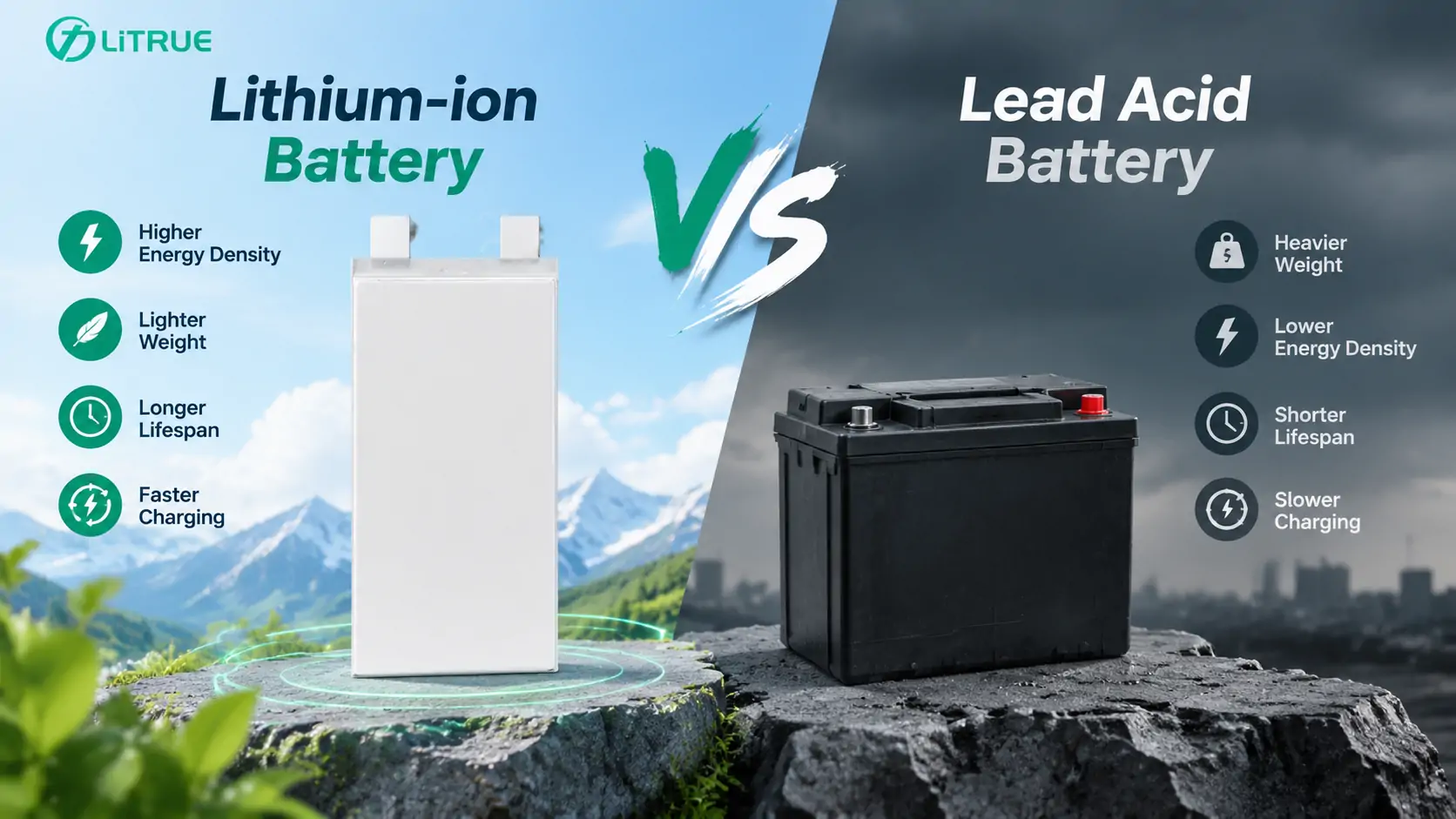
Lithium Ion Battery Versus Lead Acid at a Glance
Lead acid is the oldest rechargeable battery technology. It is rugged, forgiving of abuse, and inexpensive to buy, but it has a low energy density and a limited cycle count.
Lithium-ion packs flip most of those trade-offs. They store far more energy per pound, tolerate deep discharge, last for thousands of cycles, and hold a steady voltage. The price you pay is a higher upfront cost and a need for a battery management system (BMS) to keep the cells within safe limits.
Cycle Life and Lifespan
How Many Cycles Does Lead Acid Deliver?
Lead-acid cycle life depends heavily on how deeply you discharge. According to Battery University, shallow discharges extend cycle life, which is why lead-acid banks are usually sized so they are rarely drained past about half.
Even with careful use, a deep-cycle lead-acid battery typically delivers a few hundred to roughly a thousand cycles before its capacity fades.
How Many Cycles Does Lithium Deliver?
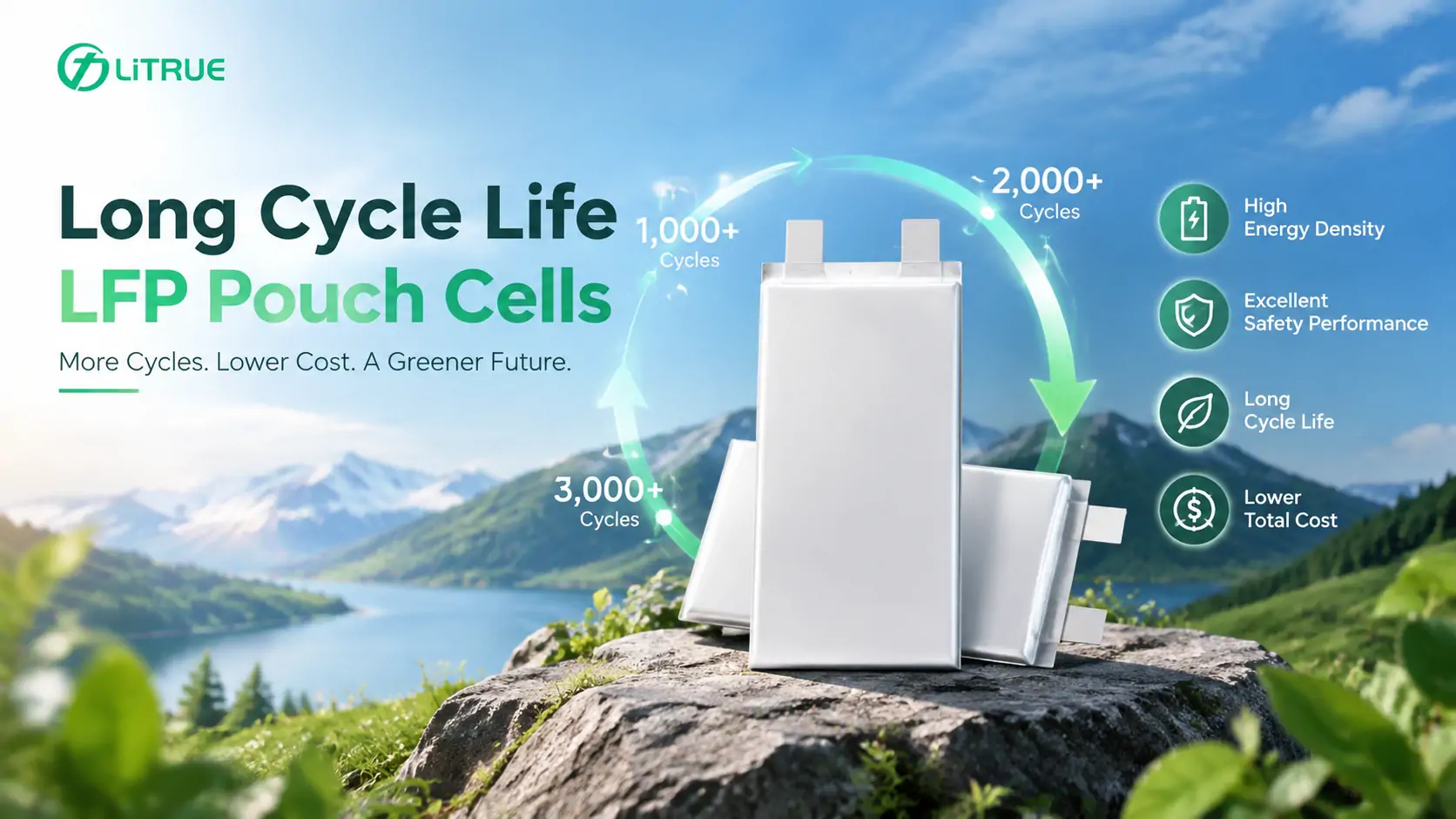
Quality lithium iron phosphate (LFP) cells are rated for thousands of cycles. The cell featured later in this guide is rated for 3,000 or more cycles at 1C charge and 1C discharge, which works out to about eight years of one full cycle every single day.
Usable Capacity and Efficiency
A lead-acid battery rated at 100Ah usually gives you about 50Ah of practical energy if you want it to last. A lithium battery can typically be discharged much deeper, so the same rated capacity does far more work.
Voltage behavior matters too. Lead-acid voltage sags steadily as the battery drains, and it delivers less usable capacity when discharged quickly. Lithium holds its voltage close to nominal for most of the discharge, so inverters, motors, and electronics perform consistently until the pack is nearly empty.
Lithium also accepts charge faster and wastes less energy as heat, which shortens charging time and reduces the solar or generator capacity you need.
Weight and Size
Lead acid stores roughly 30 to 50Wh per kilogram at the cell level. The LFP pouch cells in the example below are rated at 164 to 167Wh/kg, which is about three to five times more energy for the same weight.
Pack-level numbers are lower once you add the enclosure, wiring, and BMS, but the gap remains large. For vehicles, boats, RVs, and portable equipment, that weight savings translates directly into more payload, better efficiency, or longer range.
Cost: Upfront Price Versus Cost per Cycle
Lead acid costs less to buy, and no one disputes that. The more useful question is cost per usable cycle, and here lithium often comes out ahead. Battery University notes that lithium-ion can have a lower cost per cycle than lead acid.
Here is a simple illustration using relative units, not real prices. Say lithium costs three times as much upfront as lead acid, delivers 3,000 cycles at 80 percent usable depth, while the lead-acid battery delivers 500 cycles at 50 percent usable depth.
The lead-acid battery costs 1 divided by 250 usable cycle-units, or 0.004 per unit. The lithium battery costs 3 divided by 2,400, or about 0.00125 per unit. In this example, lithium is roughly three times cheaper per unit of usable energy delivered. Your own numbers will differ, but the method holds.
Safety and Environmental Impact
Safety
Lead acid is a forgiving chemistry, but it has its own hazards: sulfuric acid, hydrogen gas from flooded designs, and heavy weight. Lithium-ion packs need a well-designed BMS and proper thermal management. LFP is the most thermally stable common lithium chemistry, which is why it dominates RV, marine, and stationary storage.
Recycling
Lead acid has a clear advantage in end-of-life handling. According to a report on the recycling rate of lead batteries in the U.S., an industry study found a recycling rate of about 99 percent. Lithium recycling infrastructure is growing quickly, but it is not yet as mature.
A Real Cell Example: Long Cycle Life LFP Pouch Cells
Abstract comparisons are easiest to judge against real data. LiTrue's 20Ah and 50Ah long cycle life LFP pouch cells (models PJ20F-E and PA50F-E) are built for electric two-wheelers and hybrid agricultural machinery, where daily deep cycling would quickly wear out a lead-acid battery.
| Spec | PJ20F-E | PA50F-E |
|---|---|---|
| Chemistry / Structure | LFP, stacked pouch | |
| Nominal Capacity | 20Ah | 50Ah |
| Energy Density | 164Wh/kg | 167Wh/kg |
| Max. Continuous Charge Rate | 2C | 2C |
| Max. Continuous Discharge Rate | 2C | 3C |
| Max. Pulse Charge Rate | 4C | 3C |
| Max. Pulse Discharge Rate | 4C | 4C |
| Operating Temperature | -30°C to +55°C | |
| Cycle Life (1C/1C) | ≥3,000 cycles | |
| Dimensions (T×W×H) | 9.2 × 90 × 231mm | 12.8 × 161 × 232mm |
| Certifications | UN38.3, CE, MSDS | |
| Standards | GB/T 38058-2019, GB 31241-2022 | |
| Sample MOQ | 10 pcs (negotiable) | |
| Sample Lead Time | 7–15 working days | |
| Bulk Lead Time | 45 days (subject to volume and requirements) | |
Here is how those numbers line up against lead acid. A rating of 3,000 or more cycles at 1C/1C is several times what a typical deep-cycle lead-acid battery delivers, and 1C is a realistic test rate rather than a gentle one.
The energy density of 164 to 167Wh/kg is the cell-level figure, which is why the weight gap with lead acid is so large. The current ratings are practical too: according to the product data, the PJ20F-E supports about 40A continuous and 80A pulse discharge, while the PA50F-E supports about 150A continuous and 200A pulse discharge.
These are cell ratings, not pack ratings. Final pack performance still depends on thermal design, tab welding, busbars, and BMS settings, so engineers who need a finished product typically work with custom battery packs built around the chosen cell.
Which Should You Choose?
Choose Lithium When
Lithium is the better choice when you cycle the battery daily, need deep discharge, care about weight, or want a long service interval. That covers most RV, marine, solar storage, electric two-wheeler, and industrial equipment applications. If you are weighing this for a camper, our guide to a 12V lithium battery for RVs covers sizing and cold-weather charging in detail.
Choose Lead Acid When
Lead acid still makes sense for low-cycle standby power, engine starting where an existing charging system is built around it, and very tight upfront budgets. If a battery sits unused most of the time and rarely discharges deeply, lithium's cycle-life advantage matters less.
Planning a Switch
Switching from lead acid to lithium usually requires checking the charger profile, the BMS current rating, and the charging source. If you charge from an alternator, use a DC-DC charger so the alternator is not overloaded by the battery's low internal resistance.
FAQs
Is a lithium-ion battery better than lead acid?
For most deep-cycle and daily-use applications, yes. Lithium delivers more cycles, more usable capacity, lower weight, and faster charging. Lead acid is better when upfront cost and simplicity matter most and cycling is light.
How much longer does a lithium battery last than lead acid?
It depends on the chemistry and how you use it. A quality LFP cell rated for 3,000 or more cycles can last several times longer than a typical deep-cycle lead-acid battery that delivers a few hundred to about a thousand cycles.
Can I replace a lead-acid battery with lithium directly?
Often yes, but you need to confirm voltage compatibility, charger settings, and the BMS current rating. Lithium needs a charge profile designed for it, and lead-acid desulfation or equalization modes should be turned off.
Is lithium safer than lead acid?
Neither is risk-free. Lead acid is more tolerant of abuse, while lithium relies on a good BMS and thermal design. LFP is the most thermally stable mainstream lithium chemistry, which is why it is the standard choice for RV, marine, and storage use.
Where can I source cells for a lithium replacement pack?
OEMs and pack builders can request samples, datasheets, and certification documents from a lithium battery supplier that offers engineering support and custom configuration.
Summary
The lithium ion battery versus lead acid decision comes down to how hard you work the battery. For daily cycling, deep discharge, and weight-sensitive designs, lithium usually wins on total cost and performance. For occasional standby use on a tight budget, lead acid can still be the practical choice.
If you are developing a product that needs to replace lead acid, working with an experienced lithium battery manufacturer that can share validated cycle-life data and certifications will save time and risk. You can also browse LiTrue's range of lithium cells to compare options for your design.