
A 12V lithium battery for RVs is one of the most popular upgrades in the camper world, and for good reason. It weighs far less than the lead-acid battery it replaces, delivers more usable energy, and keeps your lights, fridge, and water pump running longer between charges.
But not every lithium battery is built the same. This guide explains how a 12V RV pack is actually put together, which specs matter most, and what a real production-grade cell looks like on paper, so you can judge any battery or pack builder with confidence.

Why RV Owners Are Switching to 12V Lithium
More Usable Capacity
Lead-acid batteries are generally discharged to about 50 percent to protect their lifespan, which means a 100Ah lead-acid battery gives you roughly 50Ah of real energy. A lithium iron phosphate pack can typically be used much deeper, so the same rated capacity goes a lot further on a long weekend off the grid.
Much Lighter Weight
A 100Ah lead-acid battery often weighs 60 pounds or more. In an RV, where every pound counts against your cargo and tongue weight limits, trimming that down is a real advantage.
Longer Cycle Life
Typical lead-acid batteries are rated for a few hundred cycles. Quality LFP cells are rated for thousands, and the cell we look at later in this guide is rated for 3,000 or more cycles. For a camper used every season, that can mean a battery that outlasts the RV itself.
Steadier Voltage
Lithium holds its voltage close to nominal through most of the discharge curve. Your lights stay bright, your inverter keeps running, and your water pump doesn't slow down as the battery drains.
LFP Is the Chemistry to Look For
Almost every serious RV battery uses lithium iron phosphate (LFP) chemistry. LFP has lower energy density than nickel-based lithium chemistries, but it is far more thermally stable and handles thousands of charge cycles, which matters when the battery lives under a bed or inside a cargo bay.
The lower energy density rarely matters in an RV. You have space for a slightly larger battery, and you gain safety and lifespan in return.
How a 12V Lithium Pack Is Built from Cells
An LFP cell has a nominal voltage of 3.2V. Wire four of them in series (a 4S configuration) and you get 12.8V, which is what a "12V" lithium battery actually delivers. Add cells in parallel and you increase capacity without changing voltage.
A battery management system (BMS) sits on top of the cells. It protects against overcharge, over-discharge, over-current, and short circuits, and it balances the cells so one doesn't drift away from the others over time. The BMS current rating, not just the cell rating, sets how much power the finished battery can deliver.
Many RV builders and OEMs assemble their own packs using custom battery packs designed around a specific cell, enclosure, and BMS. Understanding the cell itself is the first step.
A Real Cell Example: 100Ah LFP Prismatic Cell
Datasheet claims are easiest to judge against real numbers. LiTrue 100Ah LFP prismatic battery cell (model LFL1-100P) is a good reference for what a modern LFP cell delivers. It is sold as a cell for pack builders, not as a finished RV battery, but it fits the 4S1P building block described above.
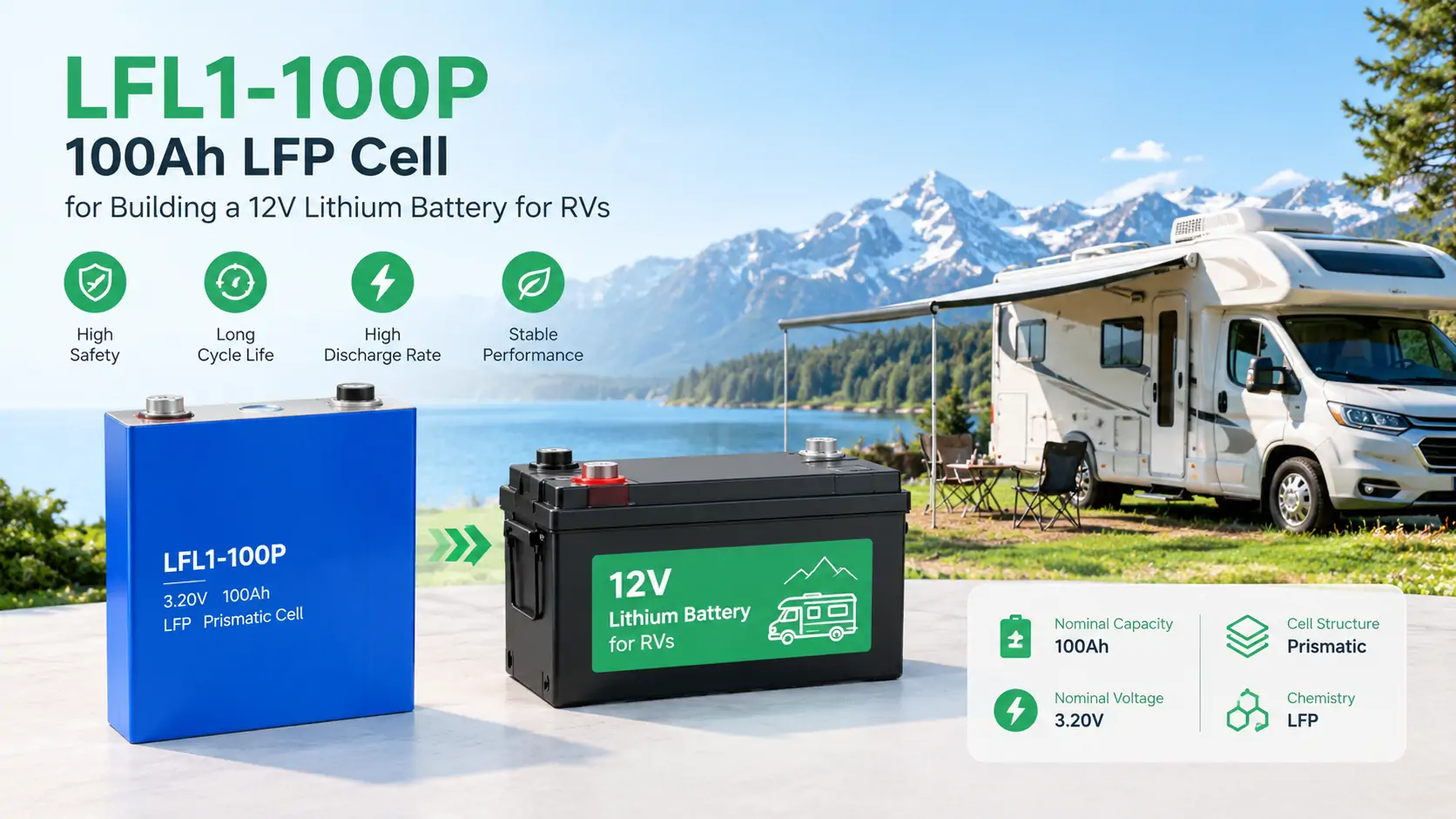
| Model Number | LFL1-100P |
| Classification | High C-rate |
| Chemistry | LFP (Lithium Iron Phosphate) |
| Cell Structure | Prismatic Can |
| Nominal Capacity | 100Ah |
| Nominal Voltage | 3.20V |
| Energy Density | 145Wh/kg |
| Max. Continuous Charge Rate | 3C |
| Max. Continuous Discharge Rate | 4C |
| Max. Pulse Charge Rate | 4C |
| Max. Pulse Discharge Rate | 6C |
| Cycle Life | ≥3,000 cycles @ 1C/3C |
| Operating Temperature | -30°C to +55°C |
| Dimensions (T×W×H) | 28.8 × 173.9 × 207.6mm |
| Certifications | UN38.3, CE, MSDS |
| Standards | GB/T 38058-2019, GB 31241-2022 |
Here is what those numbers mean for a 12V RV pack. Four of these cells in series (4S1P) give you 12.8V and 100Ah, which works out to 1,280Wh of nominal energy.
Based on the 145Wh/kg rating, each 320Wh cell weighs roughly 2.2kg, so the four cells together come to about 8.8kg (around 19 pounds) before the enclosure, BMS, and busbars are added. That is a fraction of an equivalent lead-acid setup.
The 3C continuous charge rating also means the cell itself is rarely the bottleneck when charging from solar, shore power, or a DC-DC charger. In practice, your charger and BMS set the real limit.
How Much Power Can a 12V RV Battery Deliver?
This is where high-rate cells pay off. A 2,000W inverter running a microwave or coffee maker pulls around 175 amps from a 12.8V battery once typical inverter losses of about 10 percent are included. Air conditioner startup surges can briefly push that even higher.
This cell is rated for 4C continuous discharge (about 400A per cell) and 6C pulse discharge (about 600A), so the cell has plenty of headroom for those loads. The finished pack will still be limited by the BMS and the wiring, so always check the pack own continuous and peak current ratings.
How to Size a 12V Lithium Battery for Your RV
Start by adding up your daily energy use in watt-hours: each device watts multiplied by the hours it runs. Include the fridge, lights, water pump, fans, laptop, and any inverter loads.
Then divide by 12.8 to convert watt-hours to amp-hours. If your daily use adds up to about 1,000Wh, you need roughly 78Ah of usable capacity. Add a margin of 20 to 30 percent for cloudy days, battery aging, and loads you forgot to count, and a 100Ah battery is a sensible starting point.
If you plan to run an air conditioner or induction cooktop, you will likely need more capacity and a higher-rated BMS, or multiple batteries in parallel.
Cold Weather and Charging
Lithium batteries can usually discharge well in the cold, and the cell above is rated for operation from -30°C to +55°C. Charging is a different story. According to Battery University, lithium-ion cells generally should not be charged below 0°C (32°F) unless the design specifically prevents lithium plating.
If you camp in freezing weather, look for a battery with low-temperature charge protection or a built-in heating system. Otherwise, keep the battery inside the heated living space during winter trips.
Safety and Certification
An LFP battery is among the safest lithium options, but safety still depends on good design and verified documentation. For a deeper look at what causes failures and how to avoid them, read our guide to the safety of lithium batteries.
For cells, look for UN38.3 transport test reports, CE marking, and a material safety data sheet. The LFL1-100P above is documented with all three, along with GB/T 38058-2019 and GB 31241-2022 standards. Add a properly sized fuse close to the battery positive terminal on any RV installation.
FAQs
How long does a 12V lithium battery last in an RV?
It depends on how deeply and how often you cycle it, but quality LFP cells are rated for thousands of cycles. The cell featured above is rated for 3,000 or more cycles at 1C charge and 3C discharge, which can translate to many years of regular camping.
Can I replace my lead-acid RV battery with lithium directly?
Often yes, as long as the battery BMS current rating matches your loads and your charging sources support lithium. If you charge from the vehicle alternator, a DC-DC charger is strongly recommended so the alternator is not overloaded by the battery low internal resistance.
How many amp-hours do I need for an RV?
Calculate your daily watt-hours, divide by 12.8, and add a 20 to 30 percent margin. Weekend campers with modest loads often do well with 100Ah, while full-time RVers and anyone running air conditioning typically need several hundred amp-hours.
Can I charge a 12V lithium battery in freezing weather?
Not safely unless the battery is designed for it. Use a battery with low-temperature charge protection or heating, or keep the battery warm before charging.
Should I build my own pack or buy a finished battery?
Most RV owners are better served by a finished battery from a reputable brand. RV builders, OEMs, and small battery assemblers who need a specific form factor or capacity can source cells directly from a lithium battery supplier and build to their own design.
Summary
A good 12V lithium battery for RVs comes down to the details underneath the label: LFP chemistry, a cell with real discharge headroom, a BMS sized for your loads, and verified safety documentation. The cell numbers in this guide give you a practical benchmark for comparing any battery you consider.
If you are developing an RV battery product or need cells for a custom build, working with an experienced lithium battery manufacturer that can share real test data and certification documents will save time and risk before you commit to volume. You can also explore LiTrue range of lithium cells to compare options for your pack design.