
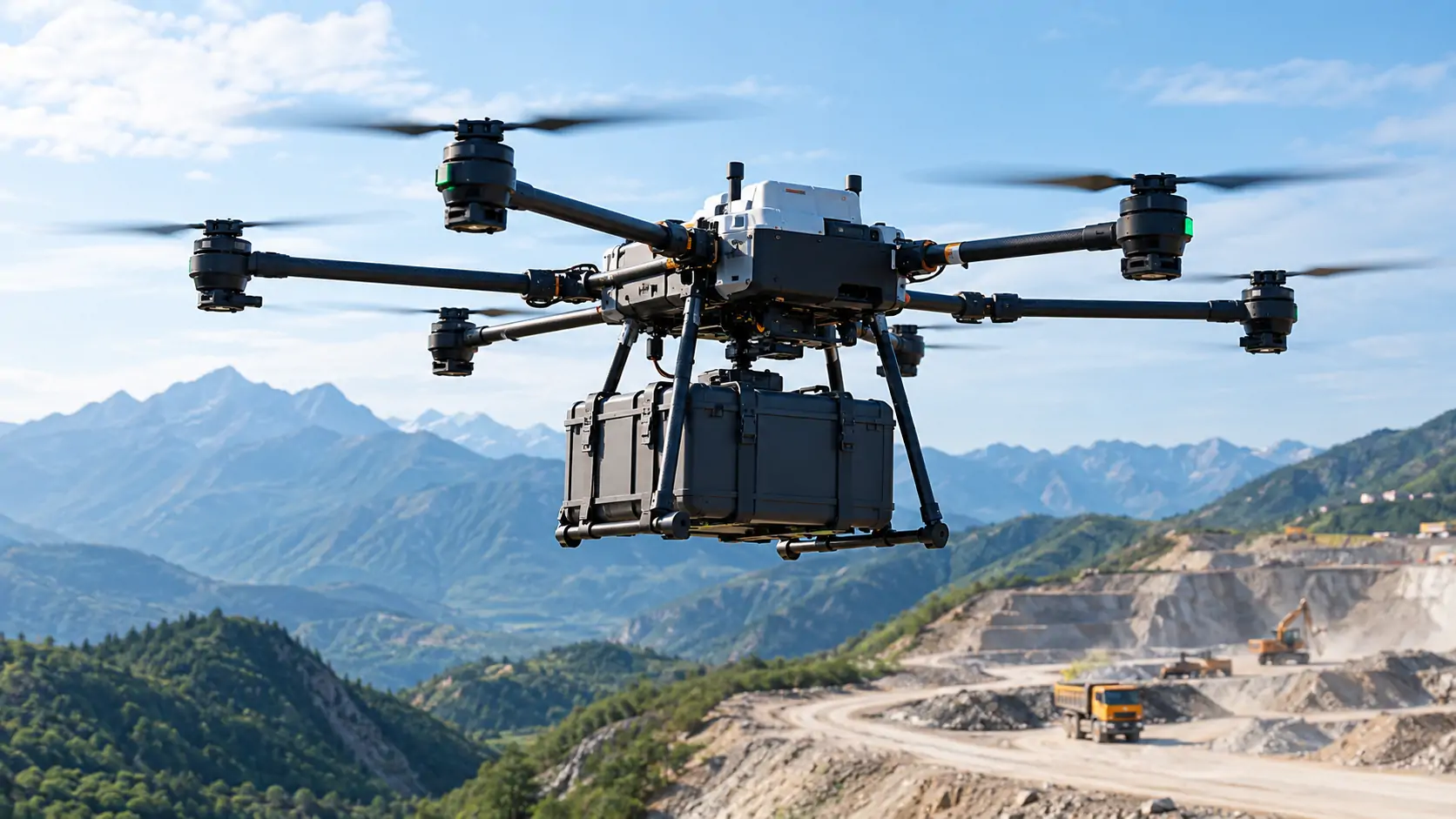
Heavy-lift drones ask more of a battery than any other class of multi-rotor aircraft. Motors pull hard during takeoff, climb, and wind correction, and a pack that can't hold its voltage under that load will cut a mission short long before the cells are actually empty.
That is why the best UAV lithium batteries are judged on much more than their amp-hour rating. This guide explains what separates a top-rated pack from an average one, which specs matter most for heavy-lift work, and how a real production battery measures up against those criteria.
What Makes UAV Lithium Batteries Top-Rated for Heavy-Lift Work?
Strong Discharge Headroom
Heavy-lift aircraft spend much of their flight near the upper end of their motor and ESC limits. A top-rated pack delivers high continuous current for normal flight and a solid peak current for short, demanding moments without excessive voltage sag.
High Energy for the Weight
Every kilogram of battery is a kilogram that can't be payload. Energy per unit of pack weight is one of the most honest measures of quality, because it shows how efficiently the cells, enclosure, and electronics are packaged together.
Smart Communication and Protection
A battery management system that reports status over a CAN bus lets the flight controller read pack data and respond to alarms in real time. Overcharge, over-discharge, and over-current protection are baseline requirements for any pack flown over people, crops, or infrastructure.
Field-Ready Durability
Industrial and agricultural drones work in dust, moisture, and wide temperature swings. An IP-rated enclosure and a validated discharge temperature range are what keep a pack reliable outside a lab.
Key Specs to Compare Before You Buy
Voltage and Cell Configuration
Pack voltage comes from the number of cells in series. A 14S configuration, for example, produces a nominal voltage of 51.8V, and your ESCs, flight controller, and charger all need to be matched to the pack's full operating voltage range.
Continuous vs. Peak Discharge Current
Continuous current shows what the pack can sustain in sustained flight, while peak current shows what it can supply for a short burst. Always check the duration and temperature attached to a peak rating, because a number without those conditions tells you very little.
Cycle Life
Cycle life determines how many missions a pack can fly before its capacity drops noticeably. Look for the test conditions behind the number, since a rating at a gentle charge rate is not the same as one at 1C.
Why NMC Chemistry Dominates Heavy-Lift UAV Packs
Nickel manganese cobalt (NMC) cells deliver higher energy density and stronger high-rate discharge than lithium iron phosphate, which is why most heavy-lift drone packs are built around them. For aircraft where every gram counts, that combination of energy and power is hard to beat.
NMC does demand careful battery management and sensible thermal limits, so pack design and BMS quality matter just as much as the cells themselves.
A Real Spec Example: 51.8V 28Ah NMC UAV Battery
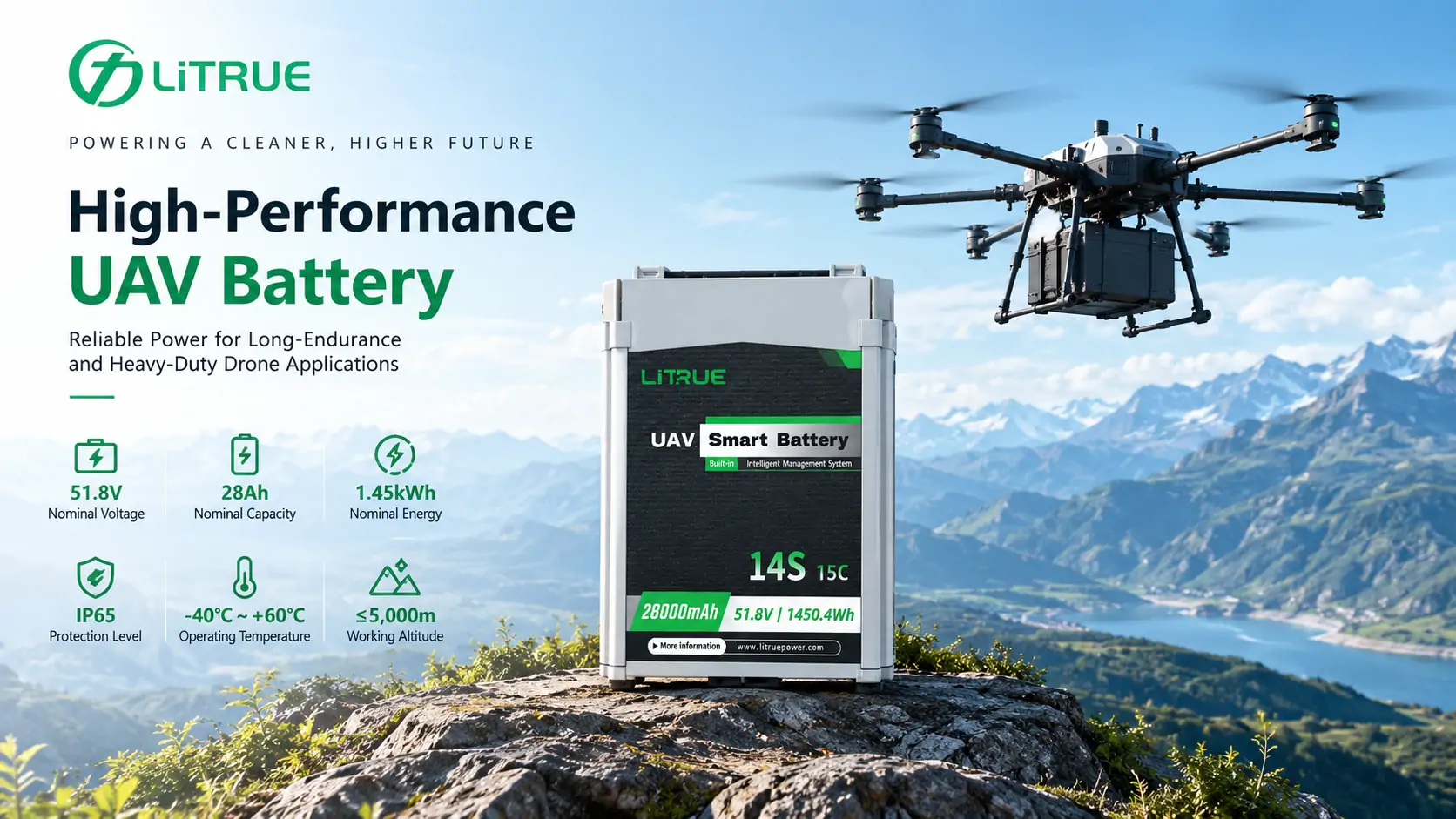
Datasheet claims are easiest to judge against a real, production pack. LiTrue's 51.8V 28Ah UAV battery pack (model UAV-JP328L) is built for the heavier-load profile of industrial and agricultural multi-rotor aircraft.
| Spec | Value |
|---|---|
| Model Number | UAV-JP328L |
| Configuration | 14S1P |
| Chemistry | NMC |
| Nominal Capacity | 28Ah |
| Nominal Voltage | 51.8V |
| Nominal Energy | 1.45kWh |
| Operating Voltage Range | 42V – 60.9V |
| Max. Continuous Discharge | 140A |
| Peak Discharge Current | 280A @ 10s / 25°C |
| Max. Continuous Charge | 56A |
| Peak Charge Current | 84A @ 30s / 25°C |
| Cycle Life | 1,000 cycles @ 1C/1C |
| Communication | CAN |
| Protection Functions | Overcharge, over-discharge, and over-current protection alarm |
| Protection Level | IP65 |
| Charging Temperature | 0°C to +55°C |
| Discharge Temperature | -40°C to +60°C |
| Storage Temperature | -20°C to +25°C |
| Working Altitude | ≤5,000m |
| Dimensions | 238 × 129 × 332mm |
| Product Weight | 8.7kg |
| Certifications | RoHS, UL 2054, UN38.3 |
| Design Standards | GB/T 38058-2019, GB 31241-2022, GB/T 38930-2020 |
| Sample MOQ / Lead Time | 10 pcs (negotiable) / 7–15 working days |
Dividing the 1.45kWh of nominal energy by the 8.7kg pack weight works out to roughly 167Wh/kg at the pack level, a useful number for comparing packs of different sizes on equal footing.
The 140A continuous rating and 280A ten-second peak give heavy-lift aircraft real headroom during takeoff and payload maneuvers, while the -40°C to +60°C discharge range and IP65 enclosure suit outdoor industrial and agricultural work. Note that charging is limited to 0°C to +55°C, so cold-weather operations need packs to be warmed before charging.
Regulatory and Transport Considerations
In the United States, commercial drone operations generally fall under FAA Part 107, which applies to unmanned aircraft under 55 pounds total, including payload and battery. An 8.7kg pack is a significant share of that budget, so total takeoff weight should be calculated early in the airframe design rather than after the payload is chosen.
Shipping is governed separately. Lithium cells and packs must pass the tests in UN Manual of Tests and Criteria Section 38.3 before they can move by air, sea, or road, which is why UN38.3 documentation should be on every buyer's checklist.
How to Choose the Right Pack for Your Aircraft
Start with your peak current draw during takeoff or full-payload climb, not your average cruise draw. Confirm that the continuous and peak ratings both clear that demand with margin to spare, and that the peak duration listed is long enough for your maneuvers.
Next, balance energy against weight. If you are also weighing capacity-focused options, our guide to choosing a high capacity drone battery covers that trade-off in more detail.
Finally, confirm the connector, communication protocol, and battery bay dimensions match your airframe. Small mismatches here are the most common source of delays in OEM drone programs.
FAQs
What are the best UAV lithium batteries for heavy-lift drones?
The best packs combine high continuous and peak discharge current with strong energy for their weight, CAN communication, and a rugged, IP-rated enclosure. NMC-based packs are the most common choice because of their energy and power density.
How much current can a heavy-lift UAV battery deliver?
It depends on the pack, but the UAV-JP328L example above supports 140A continuous discharge and 280A peak for 10 seconds at 25°C. Actual aircraft performance also depends on motors, ESCs, wiring, and flight profile.
Can UAV lithium batteries be charged in cold weather?
Not safely below their rated charging range. The UAV-JP328L, for instance, can discharge down to -40°C but should only be charged between 0°C and +55°C, so packs need to be warmed before charging in cold conditions.
How many flights can a UAV battery last?
Cycle life is typically quoted in full charge-discharge cycles. The example pack is rated for 1,000 cycles at 1C/1C, and real-world life depends on depth of discharge, temperature, and charging habits.
Can I get a custom pack for my drone platform?
Yes. Many OEM programs need specific connectors, enclosures, and communication protocols. Working with a custom UAV battery team lets you specify flight time, peak current, payload weight, aircraft voltage, and battery bay size up front.
Summary
Top-rated UAV lithium batteries earn that reputation on discharge headroom, energy per kilogram, smart protection, and rugged construction, not on capacity alone. Comparing any pack against those criteria, and asking for verified test conditions behind every number, is the fastest way to avoid an underperforming battery.
If you are specifying batteries for a new heavy-lift or industrial UAV program, working directly with an experienced lithium battery manufacturer that can share validated data and certification documents will save time and risk before you commit to volume.