
A drone is only as capable as the battery strapped underneath it. For heavy-lift multi-rotor aircraft, mapping platforms, and industrial inspection drones, flight time and payload capacity almost always come down to one component: the pack. A high capacity drone battery is what separates a UAV that can carry a real sensor package for a full mission from one that barely gets off the ground before returning to charge.
This guide covers what "high capacity" actually means for a drone battery, the specs that matter most for heavy-lift and industrial UAVs, and a real spec breakdown from a production battery pack so you can benchmark any datasheet against real numbers.

What Counts as a "High Capacity" Drone Battery?
Capacity, measured in amp-hours (Ah), tells you how much charge a battery can store. But capacity alone does not determine whether a battery is a good fit for a heavy-lift UAV. A high capacity drone battery also needs to deliver that stored energy at the current levels a large multi-rotor aircraft demands during takeoff, climb, and payload lift.
In practice, drone batteries built for payloads approaching 50kg typically combine 20Ah or more of capacity with voltages in the 44V to 70V range, packaged to keep total weight manageable relative to the energy delivered.
Why High Capacity Batteries Matter for Heavy-Lift UAVs
Longer Flight Time and Mission Range
More stored energy directly extends flight time, which matters for mapping, survey, and inspection missions where returning early to swap batteries adds cost and complicates flight planning.
Supporting Heavier Payloads
Cameras, LiDAR units, spray tanks, and delivery packages all add weight that the motors have to lift continuously throughout the flight. A battery with insufficient capacity or discharge current forces the aircraft to work harder for less airtime.
More Consistent Power Under Load
Large multi-rotor aircraft draw heavy current during aggressive climbs, wind correction, and full-payload hover. A high capacity pack with strong discharge headroom keeps voltage sag under control during these high-demand moments.
Key Specs to Evaluate Before Buying
Voltage and Configuration
Drone battery voltage is set by the number of cells wired in series. Higher-voltage packs generally support larger motors and heavier lift capability, so voltage and capacity need to be evaluated together, not separately.
Continuous vs. Peak Discharge Current
Continuous discharge current tells you what the pack can sustain during normal flight, while peak discharge current shows what it can handle briefly during takeoff or a sudden maneuver. Both numbers matter, and a battery that only lists one should raise questions.
Weight-to-Energy Ratio
A battery own weight eats into the payload budget of the aircraft. Comparing kWh of stored energy against pack weight in kilograms gives a clearer picture of real-world efficiency than capacity alone.
Environmental Protection and Temperature Range
Industrial and agricultural drones operate outdoors in dust, moisture, and temperature swings that consumer drones rarely see. An IP-rated enclosure and a validated discharge temperature range are essential for reliable field operation.
NMC vs. LFP for Drone Battery Chemistry
NMC (nickel manganese cobalt) chemistry generally delivers higher energy density than LFP, which is why most high capacity drone batteries built for heavy-lift multi-rotor UAVs use NMC cells. LFP remains a strong option where thermal stability and cycle life matter more than squeezing out maximum energy density per kilogram, such as in fixed ground-support or lower-discharge applications.
A Real Spec Example: 66.6V 30Ah High-Capacity UAV Battery
Datasheet numbers are easiest to evaluate against a real, production-validated pack. LiTrue UAV lithium battery (model UAV-JP330L) is a useful benchmark for what a high capacity pack for heavy-lift multi-rotor drones actually delivers.
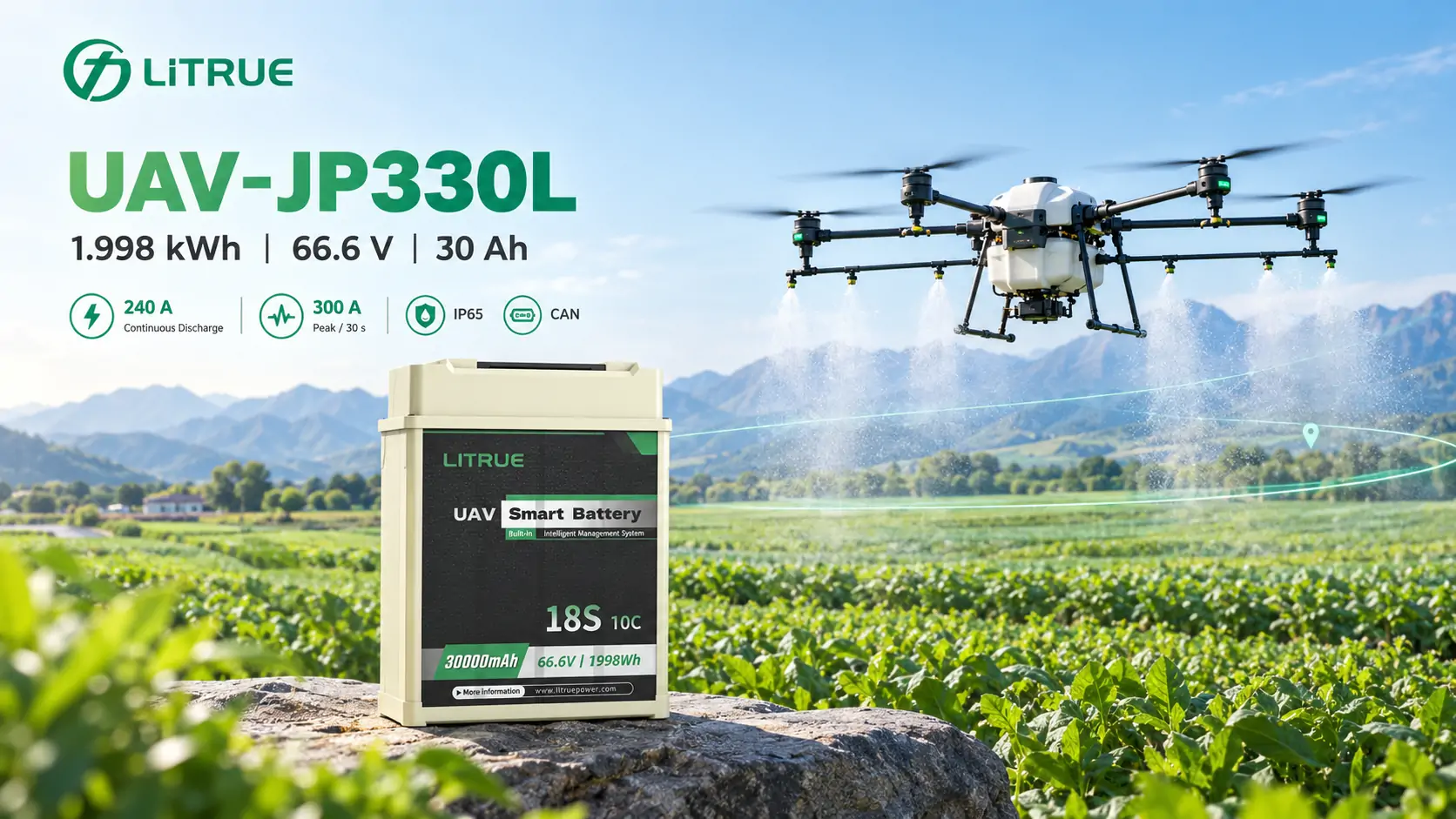
| Model Number | UAV-JP330L |
| Configuration | 1P18S |
| Chemistry | NMC |
| Nominal Capacity | 30Ah |
| Nominal Voltage | 66.6V |
| Nominal Energy | 1.998kWh |
| Operating Voltage Range | 54V – 78.3V |
| Max. Continuous Discharge | 240A |
| Peak Discharge Current | 300A @ 30s / 25°C |
| Max. Continuous Charge | 150A |
| Peak Charge Current | 240A @ 10s / 25°C |
| Cycle Life | 1,000 cycles @ 1C / 25°C |
| Communication | CAN |
| Protection Level | IP65 |
| Discharge Temperature | -40°C to +60°C |
| Working Altitude | ≤5,000m |
| Dimensions (L×W×H) | 174 × 272 × 326mm |
| Product Weight | 16kg |
| Certifications | RoHS, UL 2054, UN38.3 |
| Target Application | Multi-rotor UAVs, payload < 50kg |
With 1.998kWh of stored energy and 240A continuous discharge, the UAV-JP330L is built specifically for the heavier end of the multi-rotor category, where sustained high current under payload and climb conditions matters as much as raw capacity on paper.
Regulatory Considerations for Heavy-Lift UAV Batteries
In the United States, drones and their onboard batteries generally fall under FAA Part 107, which covers small unmanned aircraft systems weighing less than 55 pounds, including the aircraft, payload, and battery combined. A 16kg battery pack alone represents a meaningful share of that weight budget, so total aircraft weight should be calculated early in the design process rather than after the airframe and payload are already finalized.
Battery energy density remains one of the central constraints in electric aviation more broadly. NASA research on aircraft battery evaluation highlights how usable energy density is frequently overestimated once structural and thermal management margins are factored in, a consideration that applies just as directly to heavy-lift drone design as it does to larger electric aircraft programs.
Matching a Battery to Your UAV Mission Profile
Start with the aircraft total current draw during the most demanding phase of flight, typically takeoff or full-payload climb, rather than average cruise draw. Confirm that both continuous and peak discharge ratings clear that demand with margin to spare.
From there, weigh battery mass against mission duration requirements. A slightly heavier pack that delivers meaningfully more flight time is often the better trade for survey and inspection work, while lighter packs may suit shorter, high-frequency missions such as rapid-response inspection flights.
FAQs
What is considered a high capacity drone battery?
There is no single industry threshold, but for heavy-lift multi-rotor UAVs, packs in the 20Ah to 30Ah range at voltages between 44V and 70V are generally considered high capacity, especially when paired with continuous discharge ratings above 150A.
Does higher capacity always mean longer flight time?
Not automatically. Flight time depends on capacity, discharge efficiency under load, aircraft weight, and payload. A high capacity battery that is also heavy can offset some of its own energy advantage.
Is NMC or LFP better for a high capacity drone battery?
NMC is more common in high capacity drone applications because of its higher energy density per kilogram, which matters directly for flight time and payload capacity. LFP remains a valid choice where cycle life and thermal stability are the higher priority.
How much does battery weight affect payload capacity?
Directly and significantly. Every kilogram used for the battery is a kilogram unavailable for cameras, sensors, or cargo, which is why weight-to-energy ratio should be evaluated alongside raw capacity figures.
Can I get a custom high capacity battery built for my UAV platform?
Yes. Many heavy-lift and industrial drone programs need voltage, capacity, and enclosure specifications that don't exist in an off-the-shelf pack. Working with a supplier that offers custom UAV battery configuration lets you match the pack to your airframe and mission profile rather than compromising on a generic product.
Summary
A high capacity drone battery is defined by more than the Ah number on the label. Voltage, continuous and peak discharge current, weight-to-energy ratio, and environmental protection all determine whether a pack can actually deliver on its rated capacity in real flight conditions. Reviewing LiTrue full drone battery lineup against your specific mission profile is a practical starting point before committing to a supplier.
If you're specifying a battery for a new heavy-lift or industrial UAV program, working directly with a lithium battery manufacturer that can share verified discharge and cycle-life data is the fastest way to avoid an underperforming pack. You can also reach out to LiTrue lithium battery supplier team to discuss a custom configuration for your project.