
The most durable drone battery is not a single brand or model. It is the one that combines a high rated cycle life, a sealed enclosure, a wide temperature range, and a smart battery management system, all backed by test data you can actually verify.
This guide breaks down each of those factors, explains what wears a battery out faster than it should, and walks through a real spec sheet from a battery built for one of the hardest jobs in the drone world: daily crop spraying.
What Does "Durability" Mean for a Drone Battery?
Cycle Life
Cycle life is the number of full charge and discharge cycles a battery can complete before its capacity drops noticeably. It is the most direct measure of durability, but only when the test conditions are stated. A rating at a gentle charge rate is not comparable to one at 1C, so always ask what is behind the number.
Environmental Sealing
Drones fly in dust, dew, mud, and light rain. A battery with a rated ingress protection level resists those conditions far better than an open or loosely sealed pack, and that protection is often what keeps a battery alive through a full season of field work.
Temperature Tolerance
Heat is the enemy of lithium cells. A battery that is validated to discharge reliably in high ambient temperatures, and in the cold, will degrade more slowly than one that was only tested at room temperature.
Discharge Headroom
A pack that runs near its current limit every flight runs hot and ages quickly. Generous continuous and peak discharge ratings mean the cells work well within their comfort zone, which directly extends service life.
Intelligent Protection
A good battery management system guards against overcharge, over-discharge, and over-current events, and reports pack status to the flight controller. Many premature battery failures trace back to a single abuse event that proper protection would have prevented.
Which Chemistry Is Most Durable for Drones?
Nickel manganese cobalt (NMC) is the dominant chemistry in drone packs because it delivers high energy and strong high-rate discharge at a low weight. When it is paired with a quality BMS and sensible thermal limits, NMC packs can deliver hundreds to well over a thousand cycles.
Lithium iron phosphate (LFP) generally offers longer cycle life and better thermal stability, but it is heavier for the same energy, which cuts into flight time and payload. For most aircraft, the practical choice comes down to how much weight you can spare. Browsing a full range of UAV lithium battery options side by side is a good way to see how chemistry, capacity, and size trade off.
What Shortens Drone Battery Life?
Heat and Full-Charge Storage
According to Battery University, environmental conditions govern lithium-ion longevity just as much as cycling does, and high temperatures combined with a full state of charge are especially stressful. Leaving a fully charged pack in a hot truck all afternoon can age it faster than flying it.
Poor Charging Habits
Charging below the rated temperature range, using an unmatched charger, or repeatedly draining a pack to empty all take a toll. Following the manufacturer's charging window is one of the easiest ways to get more life out of the same battery.
Moisture and Contamination
Agricultural drones face fertilizer, pesticide spray, and morning dew. Corrosion on connectors and moisture inside an unsealed pack are common causes of field failures that have nothing to do with the cells themselves.
A Real Example: A Rugged Agriculture Drone Battery
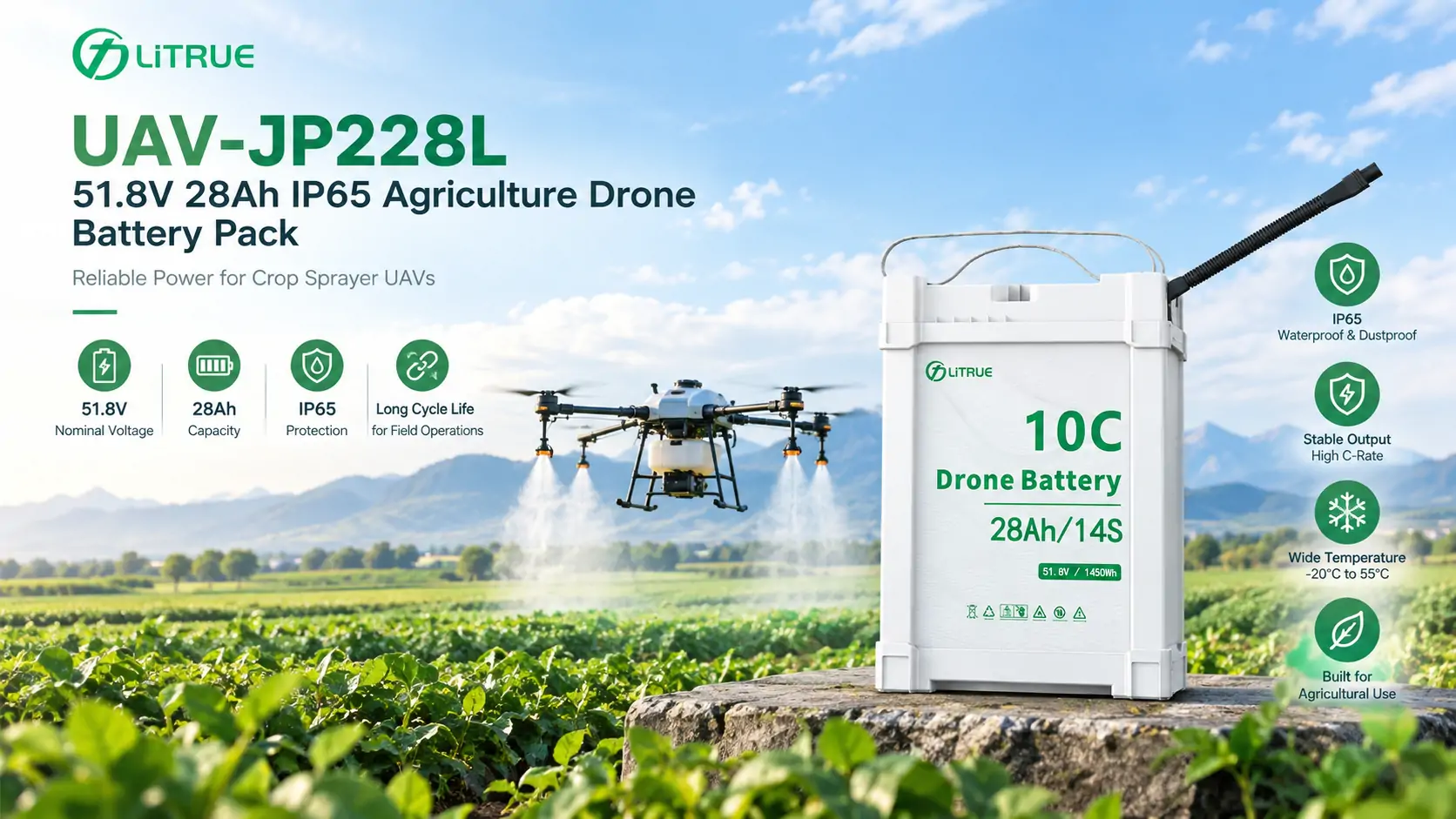
Crop spraying is one of the toughest duty cycles a drone battery can face: heavy takeoffs with a liquid payload, summer heat, dust or mud on landing, and the same high-current cycle repeated all day. LiTrue's 51.8V 28Ah agriculture drone battery (model UAV-JP228L) is built for exactly that work, which makes its spec sheet a useful durability benchmark.
| Model Number | UAV-JP228L |
| Configuration | 1P14S |
| Chemistry | NMC |
| Nominal Capacity | 28Ah |
| Nominal Energy | 1.45kWh |
| Nominal Voltage | 51.8V |
| Operating Voltage Range | 42V – 60.9V |
| Max. Continuous Charging Current | 56A |
| Peak Charging Current | 84A @ 30s / 25°C |
| Max. Continuous Discharge Current | 140A |
| Peak Discharge Current | 280A @ 10s / 25°C |
| Cycle Life | 1,000 cycles @ 1C/1C |
| Protection Functions | Overcharge, over-discharge, and over-current protection alarm |
| Communication | CAN |
| Dimensions | 172 × 110 × 286mm |
| Product Weight | 10kg |
| Protection Level | IP65 |
| Charging Temperature | 0°C to +55°C |
| Discharge Temperature | -40°C to +60°C |
| Storage Temperature | -20°C to +25°C |
| Working Altitude | ≤5,000m |
| Storage Humidity | 5% – 95% RH |
| Design Standards | GB/T 38058-2019, GB 31241-2022, GB/T 38930-2020 |
| Certification Standards | RoHS, UL 2054, UN38.3 |
| Sample MOQ | 10 pcs (negotiable) |
| Sample Lead Time | 7–15 working days |
| Bulk Lead Time | 45 days (subject to volume and requirements) |
Here is how those numbers map to durability. The 28Ah capacity against a 280A peak and 140A continuous discharge works out to roughly 10C peak and 5C continuous, so the cells have real current headroom during takeoff with a full tank rather than running at their limit.
The 1,000-cycle rating is stated at 1C charge and 1C discharge, which is a realistic test condition rather than a gentle one. For a fleet flying a few batteries once or twice a day, that is a lot of working seasons.
The protection side matters just as much. The pack carries an IP65 rating, which means it is dust-tight and protected against low-pressure water jets, so dew, mud, and spray exposure are within its design envelope. Note that IP65 does not mean the pack can be submerged, and the connectors and aircraft enclosure still need to be sealed properly.
Temperature is the last piece. Discharge is rated from -40°C to +60°C, which covers hot summer spraying and cold-morning starts. Charging, however, is limited to 0°C to +55°C, so a pack that has been sitting in a cold truck should be warmed before it goes on the charger.
Dividing the 1.45kWh of nominal energy by the 10kg pack weight gives roughly 145Wh/kg at the pack level, a handy figure for comparing packs of different sizes on equal footing.
How to Judge Any Drone Battery's Durability Before You Buy
Start with the cycle life number and ask for the test conditions behind it. A rating at 1C/1C tells you far more than a rating with no conditions listed.
Next, check the protection level and ask whether it has been tested. An IP rating is only useful if the manufacturer can back it up, and the connector and charging port count as much as the pack housing.
Then look at the temperature ranges for charging, discharging, and storage separately. A battery that discharges well in the cold but cannot be charged there needs a warm-up plan, and storage limits tell you how to keep spare packs between missions.
Finally, confirm the certifications. UN38.3 for transport, UL 2054, and RoHS are baseline documents any serious supplier should be able to provide. If you are also weighing capacity against weight, our guide to choosing a high capacity drone battery covers that trade-off in detail.
FAQs
What drone battery has the best durability?
The most durable drone batteries combine a documented cycle life, an IP-rated sealed enclosure, a wide validated temperature range, strong discharge headroom, and a CAN-enabled BMS. Packs built for agricultural and industrial drones usually meet this bar better than consumer-grade batteries.
How many cycles should a durable drone battery last?
It depends on chemistry and test conditions. The example above is rated for 1,000 cycles at 1C/1C, and real-world life depends on depth of discharge, temperature, and charging habits.
Is IP65 enough for farm and field use?
IP65 covers dust and low-pressure water jets, which suits dew, mud, and spray exposure. It is not designed for immersion, so avoid submerging the pack and keep connectors clean and sealed.
How should I store a drone battery to make it last?
Keep it cool and dry, and follow the manufacturer's storage range. The example pack lists -20°C to +25°C and 5 to 95 percent relative humidity. Many battery experts also recommend storing lithium packs at a partial charge rather than full for long periods.
Can I get a drone battery customized for my aircraft?
Yes. Many OEM drone programs need specific voltage, capacity, connectors, and enclosure dimensions. A lithium battery supplier that offers OEM and ODM engineering can work from your flight time, peak current, and payload requirements.
Summary
The drone battery with the best durability is the one whose specs hold up under questions: stated cycle life conditions, a real IP rating, separate temperature limits for charging and discharging, and certifications you can verify. Use those criteria to compare any pack, and you will avoid most of the batteries that fail early.
If you are specifying batteries for a new agricultural or industrial UAV program, working directly with an experienced lithium battery manufacturer that can share validated test data and certification documents will save time and risk before you commit to volume.