
A 12V lithium battery has two different answers to "how long does it last." On a single charge, a 100Ah battery stores about 1,280 watt-hours, enough to run a 100-watt load for roughly 11 hours. Over its whole life, a quality lithium iron phosphate (LFP) battery is rated for thousands of charge cycles, which for most RV owners means many years of service.
The details depend on three things: how much energy the battery holds, how hard you discharge it, and how many cycles it completes. This guide walks through each one with simple math, then looks at a real LFP cell spec sheet so you can see where the numbers come from.
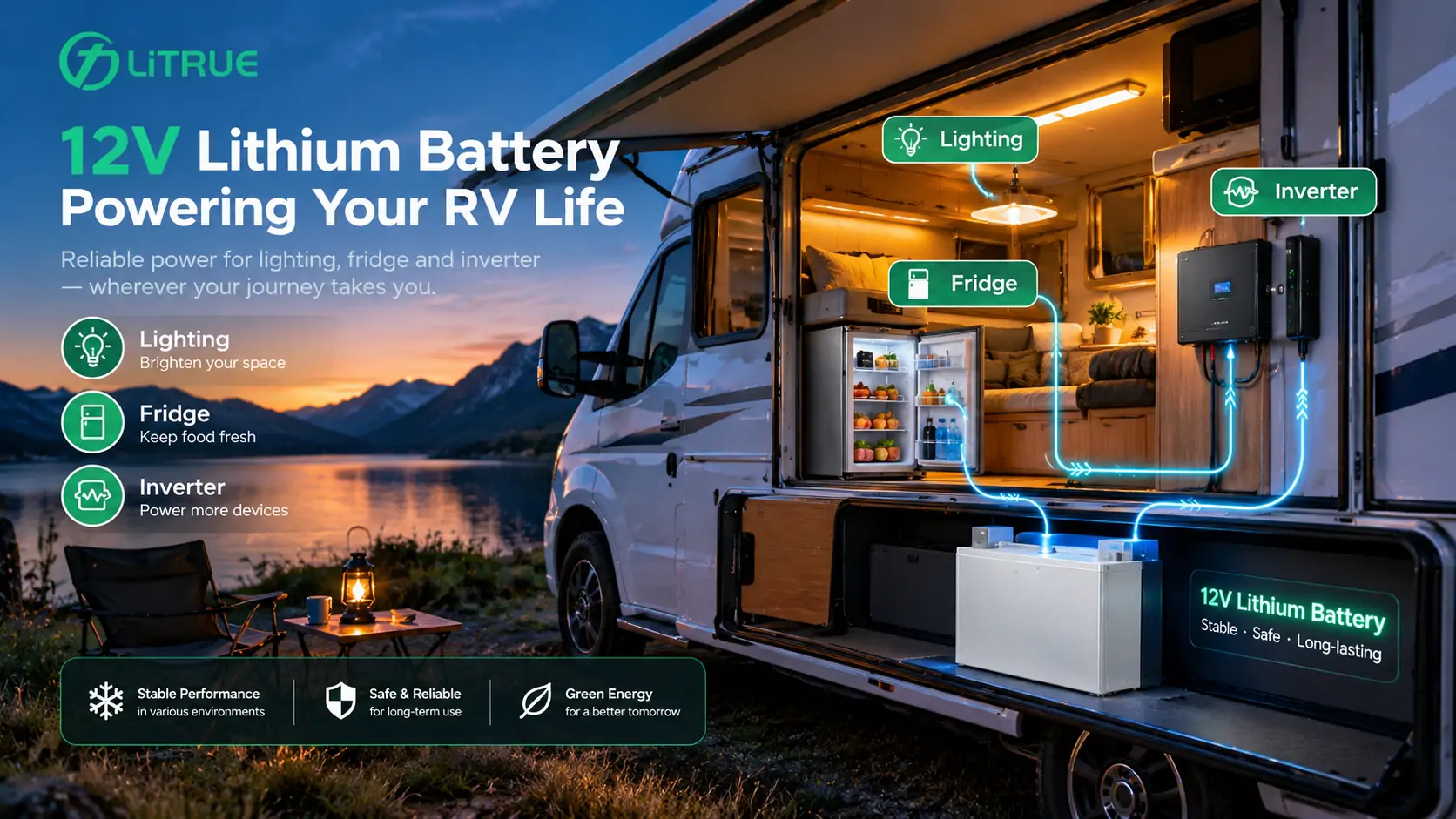
Two Meanings of "How Long Does It Last?"
The first meaning is runtime: how many hours or days your RV can run before the battery needs a recharge. That comes down to capacity and your electrical loads.
The second meaning is lifespan: how many years the battery keeps working before its capacity fades too far to be useful. That comes down to cycle life, temperature, discharge rate, and how you treat the battery.
How Long a 12V Lithium Battery Runs on One Charge
The Runtime Formula
Start by converting amp-hours to watt-hours. A 12V LFP battery has a nominal voltage of 12.8V, so multiply that by the capacity in amp-hours. A 100Ah battery stores 12.8 × 100 = 1,280Wh.
Then divide the usable energy by the power your devices draw. Runtime in hours equals usable watt-hours divided by load in watts.
Runtime Examples for a 100Ah Battery
These examples assume 90 percent of the capacity is usable, which leaves a reserve and protects the battery. That gives 1,152Wh to work with.
A steady 100W load, such as lights, a fan, and a phone charger, runs for about 11.5 hours. A 300W load runs for about 3.8 hours. If a compressor fridge averages 40W over a full day, it uses 960Wh per day, so the battery covers it for about 1.2 days with nothing else running.
Don't Forget Inverter Losses
AC appliances draw more from the battery than their label suggests because the inverter wastes some energy as heat. Assuming a 90 percent efficient inverter, a 1,500W microwave pulls about 1,667W from the battery, which drains a 1,152Wh usable battery in about 41 minutes.
Why Lithium Gives More Usable Runtime
Lead-acid batteries are generally discharged to only about half their rated capacity to protect their lifespan. Lithium can be used much deeper, so the same label gives you far more real runtime. Our comparison of lithium ion battery versus lead acid covers that difference in detail, and our guide to a 12V lithium battery for RVs shows how to size a full bank.
Discharge Rate (C-Rate) and Why It Matters
What C-Rate Means
The C-rate describes discharge current relative to battery capacity. At 1C, the current in amps equals the capacity in amp-hours, so a 100Ah battery at 1C delivers 100A and would, in theory, empty in one hour. At 0.5C it delivers 50A.
How Discharge Rate Affects Runtime and Life
Higher discharge rates cause more voltage sag and more internal heat, and heat is what wears lithium cells out fastest. Lithium handles high rates far better than lead acid, which loses usable capacity when discharged quickly, but a gentler rate is still easier on the cells.
The same microwave that draws about 130A is a 1.3C load on a 100Ah battery but only 0.65C on a 200Ah battery. A larger battery bank does not just last longer per charge, it also runs the cells more gently.
The BMS Sets the Real Limit
The cells inside a pack may support very high currents, but the finished battery is limited by its battery management system (BMS) and wiring. Always check the continuous and peak current ratings of the complete battery, not just the cells.
Cycle Life: How Many Years Will a 12V Lithium Battery Last?
What Counts as a Cycle
One cycle is one full discharge and recharge. Two half-discharges add up to roughly one cycle, so what matters is your total energy throughput, not how many times you plug in.
From Cycles to Years
Divide the rated cycle life by the number of full cycles you use per year. A full-time RVer who cycles the battery every day uses 365 cycles per year. A weekend camper might use around 60 full-cycle equivalents per year, which is an assumption for illustration, not a statistic.
Always ask what condition defines the end of life. Cycle ratings usually end when capacity drops to a stated percentage of the original, so a number without that detail is incomplete.
What Shortens Battery Life
According to Battery University, heat, high states of charge during storage, and deep cycling all wear lithium cells faster. For part-time RV owners, calendar aging and storage habits often matter more than cycle count.
A Real Cell Example: Low-Temperature LFP Pouch Cells
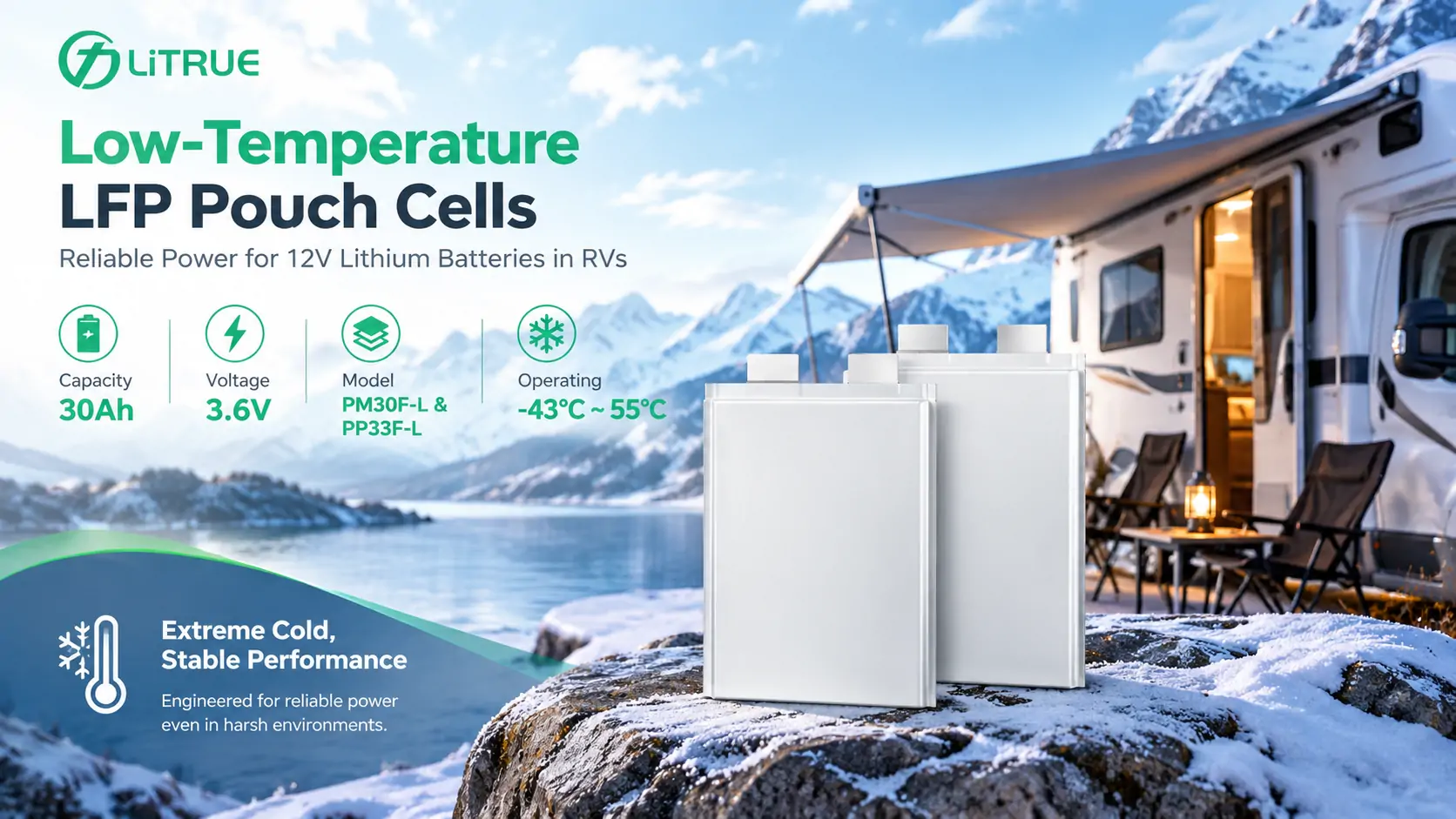
Cycle and rate ratings are easiest to understand with real numbers. LiTrue's low-temperature LFP pouch battery cells (models PM30F-L and PP33F-L) are a useful reference. They are sold as cells for pack builders, not as finished RV batteries, and they were designed for cold-region vehicles and equipment, which makes them relevant for winter RVing.
| Spec | PM30F-L | PP33F-L |
|---|---|---|
| Chemistry / Structure | LFP, pouch | |
| Nominal Capacity | 30.0Ah | 33.0Ah |
| Energy Density | 155Wh/kg | 158Wh/kg |
| Max. Continuous Charge Rate | 3C | 1C |
| Max. Continuous Discharge Rate | 3C | 3C |
| Max. Pulse Charge Rate | 5C | 3C |
| Max. Pulse Discharge Rate | 10C | 6C |
| Operating Temperature | -43°C to +55°C | |
| Cycle Life (1C/1C) | ≥1,200 cycles | ≥1,500 cycles |
| Dimensions (T×W×H) | 8.8 × 182 × 195mm | 10.2 × 142 × 231mm |
| Certifications | UN38.3, CE, MSDS | |
| Standards | GB/T 38058-2019, GB 31241-2022, GB/T 38930-2020 | |
| Sample MOQ | 10 pcs (negotiable) | |
| Sample Lead Time | 7–15 working days | |
| Bulk Lead Time | 45 days (subject to volume and requirements) | |
Here is how to turn those cell numbers into a 12V pack. Four cells in series give 12.8V using the typical 3.2V nominal voltage of LFP. Wiring four of those strings in parallel with PP33F-L cells gives a 4S4P pack of 132Ah, or about 1,690Wh of nominal energy.
The rate rating is generous for RV use. A 3C continuous discharge rating equals about 99A per 33Ah cell, so the four parallel strings could in theory support nearly 400A. A 130A microwave load on that 132Ah pack is only about 1C, or roughly 32A per cell, which keeps the cells well within their comfort zone.
Cycle life shows the trade-off. The PP33F-L is rated for 1,500 or more cycles at 1C/1C, which is about 4.1 years of one full cycle every day, or around 25 years at 60 cycles per year on paper. In practice calendar aging would end the battery's life first. The PM30F-L is rated for 1,200 or more cycles, or about 3.3 years of daily cycling. This is a cold-weather cell, and cells optimized purely for cycle life are rated for 3,000 cycles or more.
Low-temperature capability is the real strength. The -43°C to +55°C operating range suits winter camping, though charging at very low temperatures must still be validated at the pack level. Engineers building a finished product usually work with custom battery packs that add the BMS, heating, and enclosure design around the chosen cell.
How to Get the Most Life From a 12V Lithium Battery in an RV
Size the battery bank so your typical loads run at a gentle fraction of its rated current. A larger bank means a lower C-rate, less heat, and slower aging.
Keep the battery out of extreme heat, and avoid charging below freezing unless the battery has low-temperature charge protection or heating. If you store the RV for months, many experts recommend leaving the battery at a partial charge rather than full.
Watch the numbers. A battery monitor or the BMS app shows your real daily watt-hours, which lets you check your runtime math against reality and catch problems early.
FAQs
How long will a 100Ah 12V lithium battery last in an RV?
On one charge, a 100Ah battery stores about 1,280Wh, or about 1,150Wh usable with a reserve. At a steady 100W load that is roughly 11.5 hours, and at 300W it is about 3.8 hours. Over its lifespan, quality LFP cells are rated for thousands of cycles.
How many years do 12V lithium batteries last in RVs?
It depends on cycle life, temperature, and how often you use the battery. A full-time RVer cycles the battery far more than a weekend camper, so the same battery can last very different numbers of years in different setups.
Is it bad to drain a lithium battery to 0 percent?
Occasional deep discharges are generally fine for LFP, and the BMS will shut the battery off before damage occurs. Regular full discharges shorten cycle life, so sizing the battery for a comfortable margin is better.
Does C-rate affect how long a battery lasts?
Yes. Higher discharge rates generate more heat and voltage sag, which reduce usable capacity and speed up aging. A larger battery bank lowers the C-rate for the same load.
Where can I source cells for an RV battery pack?
OEMs and pack builders can request samples, datasheets, and test reports from a lithium battery supplier that offers engineering support and custom configuration.
Summary
A 12V lithium battery lasts as long as its capacity, discharge rate, and cycle life allow. Work out your daily watt-hours, keep the C-rate gentle, and ask for the test conditions behind every cycle rating, and you can predict both your runtime and your battery's lifespan with confidence.
If you are developing an RV battery product, working with an experienced lithium battery manufacturer that can share validated test data will save time and risk before you commit to volume. You can also browse LiTrue's range of lithium cells to compare options for your design.