
For energy storage for home, lithium iron phosphate (LFP) cells are the most reliable and safest mainstream choice today. They resist overheating, last for thousands of cycles, and contain no cobalt. But the cell is only part of the story, because the battery management system, thermal design, certifications, and installation all decide how safe a finished home battery really is.
This guide explains why chemistry matters, what makes a cell dependable for daily cycling, and what a real LFP cell spec sheet looks like, so you can judge any home battery or pack design with confidence.
Why Cell Choice Matters in Energy Storage for Home
A home battery is not like a phone or a laptop. It lives in a garage, basement, or utility closet close to the people who sleep above it. It cycles every day, often for a decade or more, and it has to keep working through summer heat and winter cold.
That combination puts a lot of weight on the cells inside. A weak cell chemistry or a poorly made cell cannot be fixed later by software, which is why reliability and safety start at the cell level.
LFP vs. NMC: Which Chemistry Is Safer for Home Storage?
Thermal Stability
Nickel-based chemistries such as NMC pack more energy into a smaller space, but they are less tolerant of overheating. Lithium iron phosphate is more thermally stable and less prone to releasing oxygen when abused, which gives it a much larger safety margin if something goes wrong inside a cell.
Cycle Life
LFP is typically rated for thousands of cycles, while NMC cells often deliver fewer under the same conditions. For a battery that charges and discharges every day, that difference adds up to years of extra service.
Energy Density Rarely Matters at Home
NMC biggest advantage is energy density, which matters a great deal in drones and electric vehicles. In a home, space and weight are rarely the limiting factor, so giving up some density for safety and lifespan is an easy trade.
What Makes a Cell Reliable for Daily Home Cycling?
Cycle Life Tested Under Realistic Conditions
A cycle-life number only means something when the test conditions are stated. A rating at room temperature and a gentle charge rate looks better on paper than one measured at 45°C, but the second one is closer to what a battery in a hot garage actually experiences.
Temperature Tolerance
Heat is the main enemy of lithium cells, and home batteries are often installed in garages, attics, and outdoor enclosures that run hot. Look for a cell with a validated operating range and cycle-life data at elevated temperature, not just at 25°C.
Current Headroom
Home loads spike when an air conditioner, EV charger, or electric oven starts. Cells with generous continuous and pulse discharge ratings run well within their limits during those spikes, which means less heat and slower aging.
Manufacturing Consistency
A battery pack is only as balanced as its cells. Consistent capacity and internal resistance from cell to cell reduce the work the BMS has to do and prevent one weak cell from limiting the whole system.
Safety Goes Beyond the Chemistry
Even the safest cell chemistry needs the right system around it. A good home battery includes a BMS that monitors every cell, fusing and protection circuits, thermal design that keeps cells apart, and an enclosure that contains and vents faults safely.
Look for documentation at both levels. Cells should come with UN38.3 transport test reports and a safety data sheet, while finished systems are typically evaluated under standards such as UL 9540 for energy storage systems and UL 9540A for thermal runaway fire propagation testing.
Installation matters just as much. NFPA 855 covers the installation of stationary energy storage systems, including lithium batteries, and many local codes build on it. A certified installer who follows those rules is part of what makes a home battery safe.
A Real Cell Example: High-Temperature LFP Pouch Cells
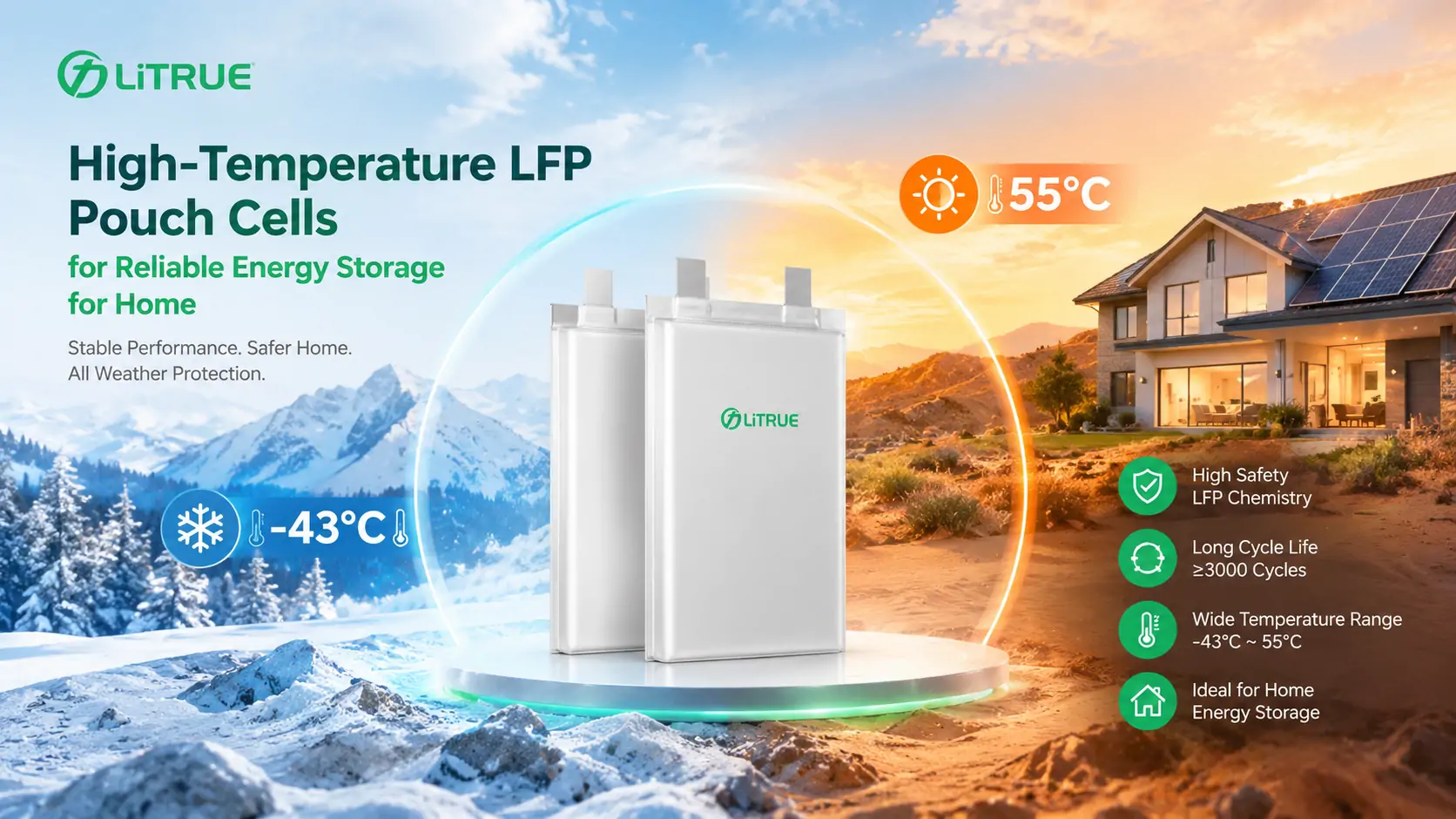
Datasheet claims are easiest to judge against real numbers. LiTrue high-temperature LFP pouch battery cells (models PC20F-T and PA46F-C) are a useful reference. They are sold as cells for pack builders rather than finished home batteries, and they were designed for vehicles and hot-climate equipment, though LiTrue lists stationary power systems among the intended applications.
What makes them relevant here is how the cycle life is stated. Instead of quoting a room-temperature number, the series is rated at 45°C, a condition much closer to a warm garage or outdoor enclosure.
| Spec | PC20F-T | PA46F-C |
|---|---|---|
| Chemistry / Structure | LFP, stacked pouch | |
| Nominal Capacity | 20Ah | 46Ah |
| Energy Density | 152Wh/kg | 157Wh/kg |
| Max. Continuous Charge Rate | 2C | 2C |
| Max. Continuous Discharge Rate | 3C | 3C |
| Max. Pulse Charge Rate | 4C | 3C |
| Max. Pulse Discharge Rate | 7C | 4C |
| Operating Temperature | -43°C to +55°C | -30°C to +65°C |
| Cycle Life (@45°C) | ≥2,000 cycles (1C/3C) | ≥2,500 cycles (1C/1C) |
| Dimensions (T×W×H) | 12.6 × 90 × 192mm | 12.5 × 161 × 232mm |
| Certifications | UN38.3, CE, MSDS | |
| Standards | GB/T 38058-2019, GB 31241-2022, GB/T 38930-2020 | |
| Sample MOQ | 10 pcs (negotiable) | |
| Sample Lead Time | 7–15 working days | |
| Bulk Lead Time | 45 days (subject to volume and requirements) | |
Here is how to read those numbers for a home storage design. The PA46F-C is rated for 2,500 or more cycles at 45°C, and at one full cycle per day that works out to roughly 6.8 years of service in a demanding temperature. Many home systems run cooler and do not cycle fully every day, so real-world life can be longer, but you should always ask for the test conditions and the end-of-life capacity criteria behind any cycle rating.
The temperature ranges are also worth noting. The PA46F-C operates up to +65°C, which gives a pack builder extra margin for a hot enclosure, while the PC20F-T reaches down to -43°C for cold installations.
Current headroom is generous for a home application. A 3C continuous discharge rating on the 46Ah cell equals about 138A per cell, far more than a typical whole-home battery asks of each cell, so the cells work well within their comfort zone. Final pack performance still depends on busbars, tab welding, thermal design, and BMS settings, which is why engineers usually build around custom battery packs designed for a specific enclosure and load profile.
How to Evaluate Cells for Energy Storage for Home
Start with chemistry. For a home system, LFP should be the default unless you have a specific reason to choose otherwise.
Next, check the cycle-life rating and the conditions behind it. Ask for the test temperature, charge and discharge rates, and the capacity level that defines end of life.
Then confirm the operating temperature range and compare it to where the battery will actually be installed. A cell that struggles in a hot garage will age faster than its datasheet suggests.
Finally, verify the documentation and the supplier. Request UN38.3 reports, safety data sheets, and system-level certifications where they apply. If you are upgrading an old system, our guide to lithium ion battery versus lead acid explains how the two technologies compare on lifespan, usable capacity, and cost per cycle.
FAQs
What is the safest battery chemistry for home energy storage?
LFP is generally considered the safest mainstream lithium chemistry for home storage because of its thermal stability and resistance to releasing oxygen when overheated. Safety still depends on a quality BMS, proper installation, and certified system design.
How long do home energy storage batteries last?
It depends on the cell, the operating temperature, and how often the battery cycles. Quality LFP cells are rated for thousands of cycles, and many home systems are designed for a service life of ten years or more, but the rated cycle life and its test conditions are the best guide.
Can a home battery catch fire?
Any lithium battery can fail under severe abuse or a defect, but the risk is low with stable chemistry, protective electronics, certified products, and professional installation. Choosing LFP cells and following installation codes both reduce the risk further.
Is it safe to install a home battery in a garage?
Often yes, if the system is certified, installed according to local codes, and kept within its rated temperature range. Always follow the manufacturer clearance and ventilation requirements and use a licensed installer.
Where can I source cells for a home storage product?
OEMs and pack builders can request samples, datasheets, and test reports from a lithium battery supplier that offers engineering support and custom configuration.
Summary
The most reliable and safest approach to energy storage for home starts with LFP chemistry, cells that are rated for realistic temperatures, and verified documentation at both the cell and system level. Chemistry gives you the safety margin, and good design and installation turn that margin into a dependable battery.
If you are developing a home storage product, working with an experienced lithium battery manufacturer that can share validated test data will save time and risk before you commit to volume. You can also browse LiTrue range of lithium cells to compare options for your design.