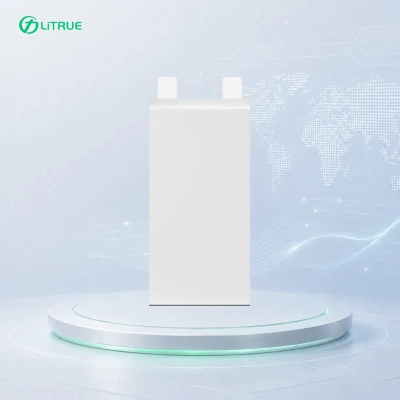
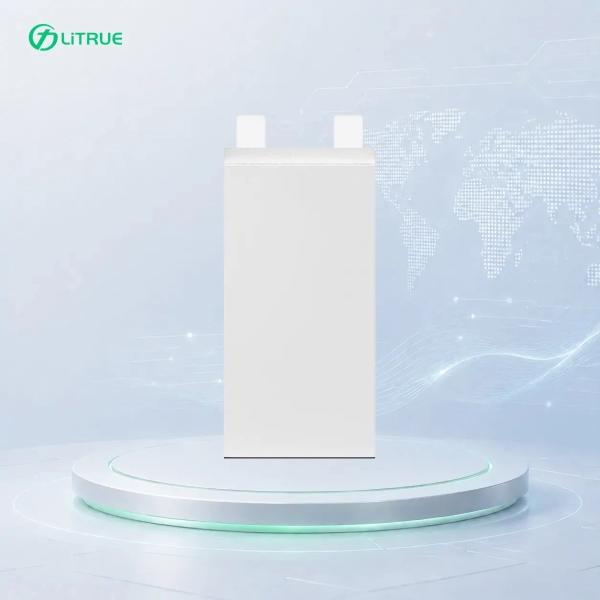
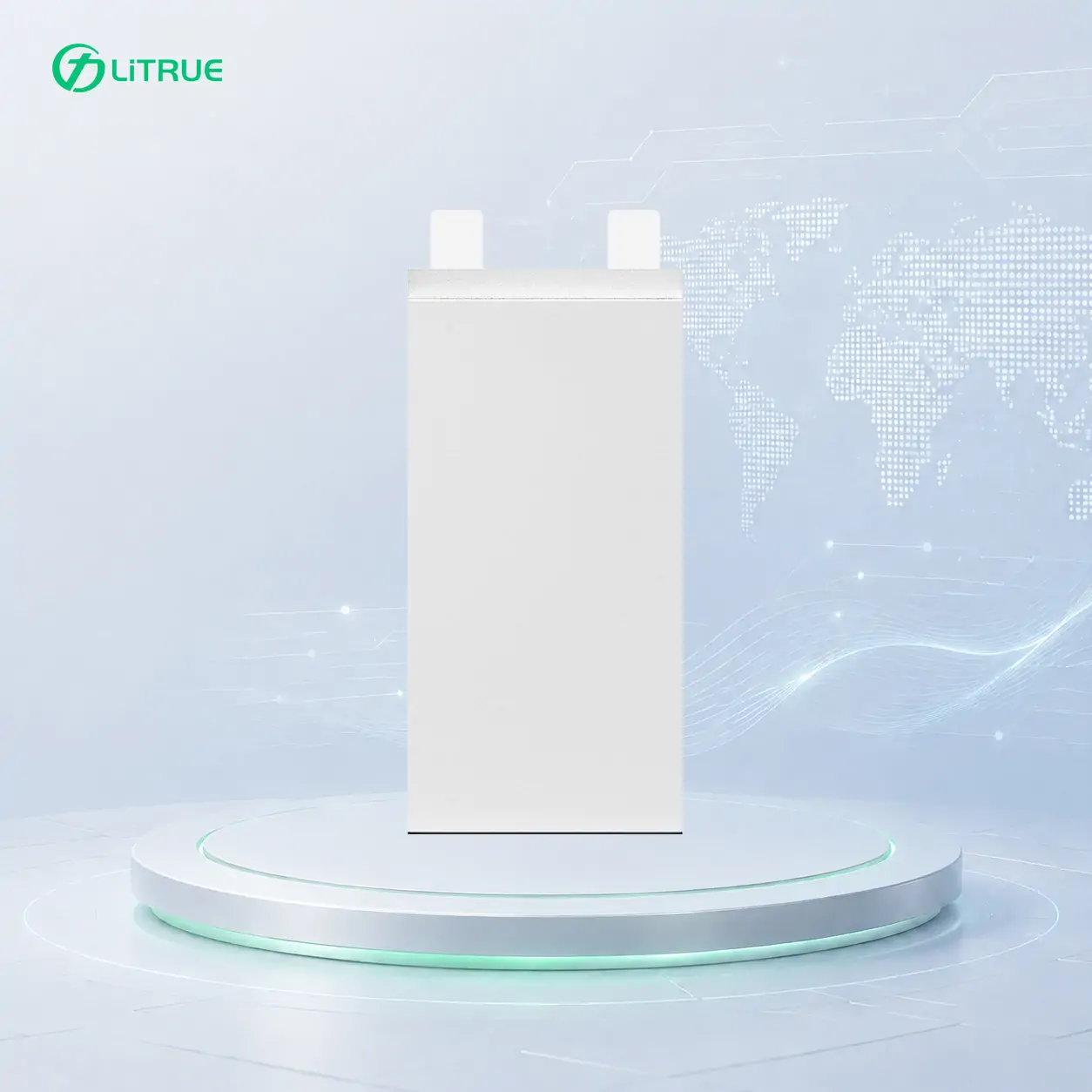
High-Temperature LFP Pouch Cell Specifications
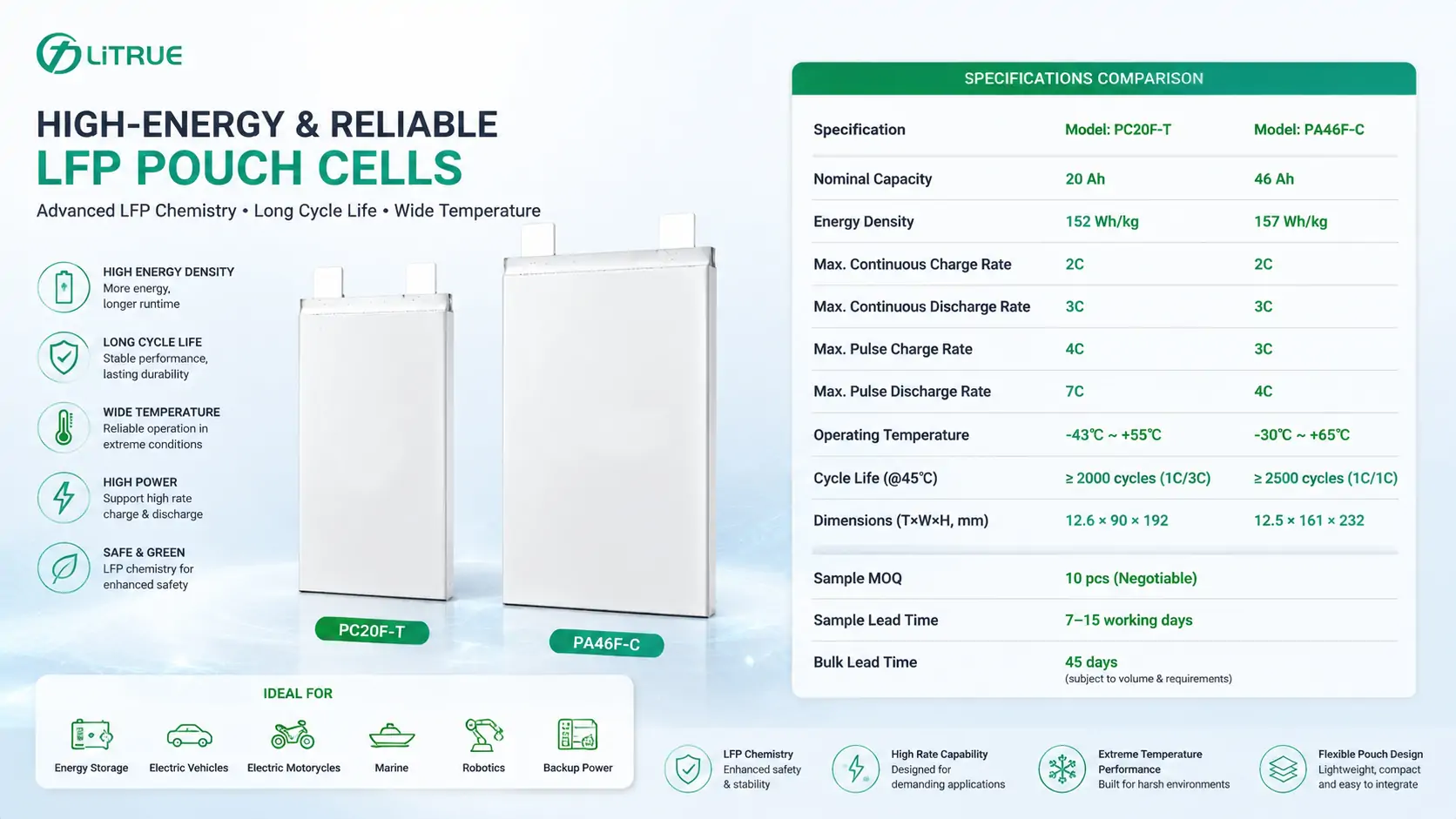
LiTrue PC20F-T 20Ah and PA46F-C 46Ah LFP pouch cells are designed for OEM battery packs used in hot-climate vehicles and outdoor equipment. Both models offer 3C continuous discharge, with cycle-life ratings measured at 45°C rather than only at room temperature. Compare their capacity, dimensions, pulse-current capability, and operating temperature limits below.
| Specification | Model: PC20F-T | Model: PA46F-C |
|---|---|---|
| Nominal Capacity | 20 Ah | 46 Ah |
| Energy Density | 152 Wh/kg | 157 Wh/kg |
| Max. Continuous Charge Rate | 2C | 2C |
| Max. Continuous Discharge Rate | 3C | 3C |
| Max. Pulse Charge Rate | 4C | 3C |
| Max. Pulse Discharge Rate | 7C | 4C |
| Operating Temperature | -43℃ ~ +55℃ | -30℃ ~ +65℃ |
| Cycle Life (@45℃) | ≥ 2000 cycles (1C/3C) | ≥ 2500 cycles (1C/1C) |
| Dimensions (T×W×H, mm) | 12.6 × 90 × 192 | 12.5 × 161 × 232 |
| Sample MOQ | 10 pcs (Negotiable) | |
| Sample Lead Time | 7–15 working days | |
| Bulk Lead Time | 45 days (subject to volume & requirements) | |
Specification notes: The maximum current ratings are not a guarantee of operation at those currents throughout the full temperature range. Confirm temperature-specific charging and discharge limits, pulse duration, and cooling requirements before pack design. The two cycle-life ratings use different charge/discharge rates and should not be treated as a like-for-like comparison; request the complete test conditions, including depth of discharge and end-of-life capacity criteria.
Wide Temperature Range Cell Series
Compare other LiTrue LFP cells by capacity, mechanical dimensions, current capability, and listed temperature range. Confirm the applicable test conditions and current datasheet for each model before making a final selection.
| Model | Dimension | Capacity | Voltage | Weight | Continuous Rate | Pulse Rate | Cycle Life | Operating Temp. |
|---|---|---|---|---|---|---|---|---|
| P10E0E5-17500FP | 9.6×140×145mm | 17.5Ah | 3.20V | 409g | 6C/10C | 15C/25C | 20000 | -43℃~55℃ |
| PA50F-E | 12.8×161×232mm | 50Ah | 3.20V | 960g | 2C/3C | 3C/4C | 3000 | -30℃~55℃ |
| P10B2D5-10000FP | 9.5×112×135mm | 10Ah | 3.20V | 272g | 10C/20C | 20C/50C | 15000 | -43℃~55℃ |
| PM30F-L | 8.8×182×195mm | 30Ah | 3.20V | 620g | 3C/3C | 5C/10C | 1500 | -70℃~55℃ |
| PP33F-L | 10.2×142×232mm | 33Ah | 3.20V | 668g | 2C/3C | 5C/10C | 3000 | -43℃~55℃ |
| AA20F-P | 105.2×148.3×26.7mm | 20Ah | 3.20V | 760g | 10C/75C | 20C/125C | 6000 | -43℃~55℃ |
| LFL1-100P | 28.8×173.9×207.6mm | 100Ah | 3.20V | 2200g | 3C/4C | 4C/6C | 3000 | -30℃~55℃ |
Solution
A battery pack installed inside a vehicle or outdoor enclosure can run hotter than the surrounding air. Repeated charging, sustained traction loads, and limited airflow all affect cell temperature. For hot-climate OEM projects, room-temperature cycle life alone is not enough to assess service life: the temperature and current profile used in testing also matter.
The PC20F-T and PA46F-C provide two capacity options with published cycle-life ratings at 45°C. The 20Ah PC20F-T is rated for ≥2000 cycles under 1C charge/3C discharge testing, while the 46Ah PA46F-C is rated for ≥2500 cycles under 1C charge/1C discharge testing. These are different test profiles, so the larger cycle count should not be interpreted as proof that one model will last longer under every application load. Explore LiTrue's LFP battery cell range for other capacity and performance options.
Choosing Between the 20Ah and 46Ah Models
- PC20F-T — smaller capacity and narrower footprint: The 20Ah cell measures 12.6 × 90 × 192mm and has a listed operating range of -43°C to +55°C. Its 3C continuous discharge rating corresponds to 60A, while 7C pulse discharge corresponds to 140A.
- PA46F-C — higher capacity and higher upper temperature limit: The 46Ah cell measures 12.5 × 161 × 232mm and has a listed operating range of -30°C to +65°C. Its 3C continuous discharge rating corresponds to 138A, while 4C pulse discharge corresponds to 184A.
Compare both C-rate and actual current. The PC20F-T has the higher pulse C-rate, but the larger PA46F-C has the higher calculated pulse current per cell. Final selection depends on pack energy, parallel-cell count, available space, temperature, and the duration and frequency of peak loads.
Thermal Management and Pack Integration
High-temperature cell selection does not remove the need for thermal management. Pack qualification should account for cell surface temperature, temperature differences within the module, cooling paths, tab connections, and BMS protection settings. An operating temperature limit is not a recommended continuous design target, nor does it define the allowable charging temperature.
LiTrue can support cell matching, module layout, BMS selection, and thermal design through its custom battery pack program. Share the target voltage, continuous and peak current, daily duty cycle, enclosure dimensions, and expected ambient temperature so the engineering team can assess the cell and pack configuration together.
Application Areas
These high-temperature LFP cells are candidates for the following OEM applications, subject to validation against the actual load profile and thermal environment.
- Electric Motorcycles and Scooters: Both models offer 3C continuous discharge for traction systems, with 20Ah and 46Ah options to suit different energy requirements and module layouts.
- Delivery Tricycles and Utility Vehicles: The 45°C cycle-life ratings provide a relevant starting point for evaluating packs exposed to repeated working shifts and summer heat.
- Special Purpose Vehicles: Inspection carts, service vehicles, and light construction platforms can compare the two models by available installation space, sustained current, and short-duration load requirements.
- Outdoor Industrial Equipment: The PA46F-C's listed +65°C upper operating limit makes it a candidate for higher-temperature environments, provided charging limits, current derating, and enclosure heat buildup are assessed separately.
- Equipment Facing Seasonal Temperature Changes: The PC20F-T's listed -43°C to +55°C operating range supports evaluation for platforms exposed to both winter and summer conditions; low-temperature charging and usable power require separate confirmation.
FAQs
What is the main difference between PC20F-T and PA46F-C?
The PC20F-T is a 20Ah cell with a narrower mechanical footprint, a listed -43°C to +55°C operating range, and 7C pulse discharge. The PA46F-C offers 46Ah capacity, 157Wh/kg energy density, a listed -30°C to +65°C operating range, and 4C pulse discharge. Choose by required pack energy, actual current, temperature limits, and available module space rather than capacity alone.
What does the cycle-life rating at 45°C mean?
It identifies the temperature used for the published cycling test. The PC20F-T is rated for ≥2000 cycles at 1C charge/3C discharge, while the PA46F-C is rated for ≥2500 cycles at 1C charge/1C discharge. Because the discharge rates differ, the figures are not directly comparable; request depth of discharge, voltage limits, and end-of-life capacity criteria before estimating service life.
How much current can the cells deliver?
For the 20Ah PC20F-T, 3C continuous discharge equals 60A and 7C pulse discharge equals 140A. For the 46Ah PA46F-C, 3C continuous discharge equals 138A and 4C pulse discharge equals 184A. These are capacity-based conversions of the listed C-rates, not a guarantee of current delivery at every temperature; confirm pulse duration, cooling requirements, and BMS limits.
Can the PA46F-C charge and discharge at +65°C?
The listed operating range alone does not establish that both charging and discharge are permitted at +65°C, or that the maximum current ratings apply there. Obtain the separate charging and discharge temperature limits and temperature-dependent current guidance before setting BMS thresholds. The same approach applies to the low-temperature end of each model's operating range.
Can I order samples and get help with pack design?
Yes. The listed sample MOQ is 10 cells, negotiable, with a sample lead time of 7–15 working days; bulk lead time is listed as 45 days, subject to volume and requirements. LiTrue can also support module and BMS integration. Send your target voltage, load profile, enclosure size, temperature requirements, and expected order volume to the LiTrue engineering team to confirm sample availability and project scope.