
Sourcing custom lithium cells for a battery energy storage system (BESS) comes down to three decisions: whether to buy from a manufacturer or a distributor, which qualification criteria a supplier must pass, and how to compare options on total cost of ownership instead of price per watt-hour.
As a rule, buy direct from a manufacturer when you need customization, traceable test data, and access to engineers. Use a distributor when you need small lots or a quick spot purchase. This guide walks through both options, the checks that matter, and the cost math, so your sourcing process holds up when the project gets real.
What "Custom Lithium Cells" Means for a BESS
Custom does not always mean a brand-new cell design. It can mean a change in capacity or format, a different tab or terminal layout, a cycle-life target, an extended temperature range, or a rate capability matched to your duty cycle. It can also mean the paperwork around the cell: batch traceability, test reports, and agreed acceptance criteria.
Stationary storage has a different duty profile from a vehicle. Cells usually cycle once a day or less, at modest current compared with their capacity, and they are expected to last for many years. That makes cycle life, calendar life, safety, and consistency far more important than peak power.
Cell Manufacturers vs. Distributors
What a Distributor Offers
Distributors hold stock, sell small quantities, and can ship quickly. That is valuable for prototypes, repairs, and projects where speed matters more than optimization.
The trade-offs are less room for customization, a harder path to batch-level traceability, and a margin layer between you and the factory. Technical questions about test conditions or failure analysis can also take longer to reach someone who actually built the cell.
What a Direct Manufacturer Offers
Buying direct gives you access to the people who design and test the cells. You can request customization, receive lot-level test reports, agree on acceptance criteria, and handle warranty or quality claims without a middleman in between.
The trade-offs are minimum order quantities, longer lead times, and more qualification work on your side. A direct relationship also assumes you have, or can hire, the engineering capacity to specify and validate what you are buying.
How to Decide
Ask four questions. How many cells will you need over the project life? Do you need anything that a catalog cell cannot provide? How much time do you have before the first delivery? And does your team have the engineers to run a proper qualification?
Larger projects, customized specifications, and long service lives usually favor a direct manufacturer. Small pilots and urgent replacements often favor a distributor.
Key Qualification Criteria
Certifications and Compliance
Ask for reports, not logos. At the cell level, UN38.3 transport testing, a safety data sheet, and CE documentation are basic requirements. For stationary storage, common reference points include IEC 62619 for industrial lithium cells, UL 1973 for stationary batteries, UL 9540 for energy storage systems, and UL 9540A for thermal runaway fire propagation testing.
Many of these apply at the module or system level rather than to a bare cell, so ask your supplier which tests exist at which level, and what test data they can share to support your own certification effort. Installation is governed separately, and NFPA 855 covers stationary energy storage systems in the United States.
Cycle-Life Data and Test Conditions
A cycle-life number is meaningless without its conditions. Ask for the charge and discharge rate, the temperature, the depth of discharge, and the capacity level that defines end of life. A rating at 25°C and a gentle rate is not comparable to one at 45°C.
MOQs, Samples, and Lead Times
Most manufacturers separate sample quantities from production minimums. Ask what the sample MOQ is, how long samples take, and how the production MOQ changes if you want bare cells versus welded modules.
Plan the schedule backward from your deployment date. Sampling, testing, a pilot batch, and bulk production each take weeks, and an international shipment adds more.
BMS Integration
The battery management system has to understand the cell. Request the open-circuit voltage curve, internal resistance data, and recommended voltage and temperature limits so the BMS can be tuned correctly.
Also settle who owns what. Some customers buy bare cells and build their own modules, while others want a supplier to provide a pack with a BMS. Either way, confirm the number of voltage and temperature sensing points, the balancing method, and the communication protocol before you freeze the design. Pack builders who want a supplier to take on more of that work typically look at custom battery packs.
Thermal Management
Heat determines both safety and lifespan. Ask how much heat the cell generates at your operating current, what its allowed temperature window is, and whether charging is restricted at low temperatures.
Cell format affects cooling design. Prismatic cells are rigid and stack well, while pouch cells are lighter but usually need more mechanical support. Also ask what propagation or abuse testing has been performed, because a single cell failure should not cascade through the module.
Quality System and Traceability
Ask how cells are graded and matched before shipment, how lots are tracked, and what incoming inspection data you will receive. Consistent capacity and internal resistance across a batch reduce balancing effort and extend pack life.
Total Cost of Ownership When Sourcing Direct
Price per Watt-Hour Is Not the Full Cost
The cell price is only one line in the total. Add qualification testing, inventory carrying cost, freight and duties, integration engineering, BMS and thermal hardware, warranty risk, replacement, and end-of-life handling.
Cells are also only part of a finished system. The National Renewable Energy Laboratory cost projections for utility-scale battery storage break 4-hour lithium-ion system costs into bottom-up categories, which is a useful reminder that the battery itself is a fraction of the system cost, so lifetime performance matters more than a small discount on the cells.
A Simple Cost-per-Delivered-Energy Check
A useful comparison is cost per unit of energy delivered over the cell life: price divided by cycles times usable depth of discharge. Consider this illustration in relative units, not real prices.
Cell A costs 1.0 and delivers 3,000 cycles at 90 percent depth of discharge, which works out to about 0.00037 per unit of energy delivered. Cell B costs 0.85, a 15 percent discount, but delivers only 2,000 cycles at the same depth, which works out to about 0.00047. Despite the lower sticker price, Cell B costs roughly 27 percent more per unit of energy delivered.
Where Direct Sourcing Saves Money
Buying direct removes the distributor margin, which is the most obvious saving. Customization can save more: a cell sized and rated for your duty cycle avoids overbuilding, and direct access to test data shortens qualification.
Direct sourcing can also cost more in the short term. Minimum order quantities, qualification testing, longer lead times, and import logistics all add cost before the first system ships, so include them in the comparison.
Do Not Pay for Performance You Will Not Use
Stationary storage usually runs at a low C-rate. A cell built for 4C continuous discharge works comfortably at that duty but also carries the design cost of rate capability the project never uses. This is one of the strongest arguments for customization: specify the energy, cycle life, and safety margin you need, and avoid paying for the rest.
A Reference Spec Sheet: What to Look For
It helps to see what a complete cell datasheet looks like. LiTrue 100Ah LFP prismatic battery cell (model LFL1-100P) is sold factory-direct, and its product page lists the kind of data a buyer should ask any supplier to provide.
The format is worth noting for storage. The LFL1-100P is a rigid prismatic can cell, the same basic format that most stationary storage modules are built around, and its product page points out that the rigid can simplifies module assembly compared with pouch formats.
One caveat from the same page: this particular cell is tuned for high-current duty rather than gentle storage duty, and utility-scale projects commonly use much larger LFP cells in the hundreds of amp-hours. Treat it as a reference for reading a spec sheet and for the prismatic can format, and ask the manufacturer what a storage-optimized variant would look like.
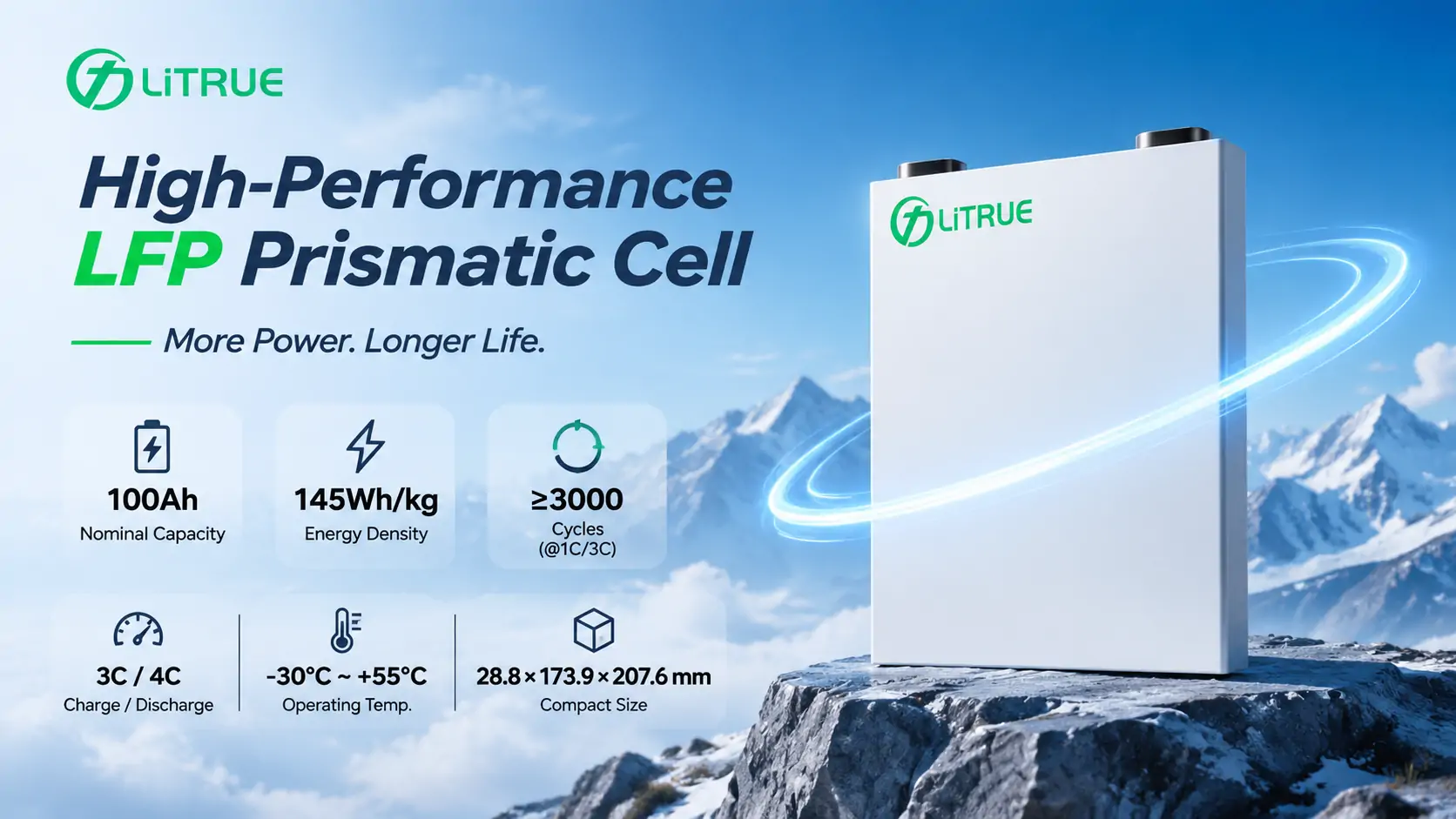
| Model Number | LFL1-100P |
| Classification | High C-rate |
| Chemistry | LFP (Lithium Iron Phosphate) |
| Cell Structure | Prismatic Can |
| Nominal Capacity | 100Ah |
| Nominal Voltage | 3.20V |
| Energy Density | 145Wh/kg |
| Max. Continuous Charge Rate | 3C |
| Max. Continuous Discharge Rate | 4C |
| Max. Pulse Charge Rate | 4C |
| Max. Pulse Discharge Rate | 6C |
| Cycle Life | ≥3,000 cycles @ 1C/3C |
| Operating Temperature | -30°C to +55°C |
| Dimensions (T×W×H) | 28.8 × 173.9 × 207.6mm |
| Certifications | UN38.3, CE, MSDS |
| Standards | GB/T 38058-2019, GB 31241-2022 |
| Sample MOQ | 10 pcs (negotiable) |
| Sample Lead Time | 7–15 working days |
| Bulk Lead Time | 45 days (subject to volume and requirements) |
Here is how to read it as a buyer. The cycle-life line states its conditions (1C charge, 3C discharge), which is exactly the detail to demand from any supplier. The operating temperature range, certification documents, and standards are listed up front, and the sample MOQ, sample lead time, and bulk lead time give you the inputs you need to plan a qualification schedule.
The rate lines show why cell selection matters. A 3C charge rating is about 300A on this cell, which suits a vehicle but is far beyond what a stationary system asks for, so a storage-focused design would favor energy, cycle life, and cost over rate capability. Four cells in series give 12.8V and 16 in series give 51.2V, which shows how a cells nominal voltage and capacity translate into module and rack building blocks. Because the cell is a rigid prismatic can, module design also needs to account for how cells are stacked, compressed, and connected with busbars.
Where LiTrue Fits as a Direct Manufacturer Partner
LiTrue is a lithium battery manufacturer headquartered in Luoyang, China, with more than 18 years of R&D experience, over 100 in-house patents, 85+ product series, and more than 230 global partners. Its product pages describe cells as factory-direct, so there is no distributor between the buyer and the production line, and its team offers OEM and ODM customization through a broad OEM lithium battery range.
On the engineering side, LiTrue capabilities include cell technology for high C-rate, wide-temperature, and high-energy applications, along with battery management and pack design. One published project is an R&D case with Volkswagen PowerCo covering research, validation, and small-batch production of custom lithium-ion and sodium-ion batteries, which illustrates how a direct customer relationship can work from specification through pilot builds.
As with any manufacturer, ask for test data and references that match your stationary duty cycle, including cycle life at your rate and temperature, and abuse-test results at the module level. Our guide to energy storage for home also explains why LFP chemistry is the usual starting point for safety-focused storage designs.
A Practical Qualification Process
Start by writing down your duty profile: energy per cycle, charge and discharge rates, cycles per day, operating temperatures, design life, and the certifications your market requires.
Next, send a request for quotation with those requirements to a short list of suppliers, and ask for datasheets, test reports, certification documents, and sample terms. Compare answers side by side, paying particular attention to how each supplier states its test conditions.
Then order samples and test them yourself. Measure capacity and internal resistance, run a cycle test at your own rate and temperature, and include safety and abuse tests where your certification path requires them.
After the cells pass, validate them at the module level with your BMS and thermal design. Finish with a pilot batch before you commit to a production contract that spells out traceability, acceptance criteria, warranty terms, and delivery schedules.
FAQs
What is the difference between a lithium cell manufacturer and a distributor?
A manufacturer designs and produces the cells, so it can customize them, share lot-level test data, and take responsibility for quality. A distributor resells cells from one or more factories, which is convenient for small lots but offers less customization and a longer path to technical answers.
What certifications should BESS cells have?
At minimum, ask for UN38.3 transport test reports, a safety data sheet, and CE documentation for the cell. For stationary storage, also ask which of IEC 62619, UL 1973, UL 9540, and UL 9540A apply at the cell, module, and system levels.
What minimum order quantity should I expect for custom cells?
It varies by supplier and by whether you want bare cells or assembled modules. As a reference, the example cell above lists a sample MOQ of 10 pieces, and production MOQs depend on the project, so confirm both with the supplier.
How long does sampling and production take?
The example cell lists 7 to 15 working days for samples and 45 days for bulk orders, subject to volume and requirements. Add time for your own testing, pilot builds, and shipping.
Can I use a high-rate cell in a storage system?
You can, but it is rarely the most cost-effective choice. Storage systems usually run at low C-rates, so a cell optimized for energy, cycle life, and cost is typically a better fit than one built for high current.
Where do I start with a custom cell project?
Prepare your duty profile and target specifications, then reach out to a lithium battery supplier that offers engineering support and ask for datasheets, certification documents, and sample terms.
Summary
Sourcing custom lithium cells for a BESS is an engineering decision as much as a purchasing one. Choose the supplier model that fits your volume and customization needs, verify certifications and test conditions with real documents, and compare options on cost per unit of energy delivered over the system life rather than on price alone.
Done well, direct sourcing gives you better data, more control, and a lower lifetime cost. Start with a clear duty profile, qualify with samples, and validate at the module level before you commit to volume.