
The best UAV lithium battery for long flight times is the one that delivers the most usable energy per kilogram, has enough discharge headroom for your aircraft, and holds up in the temperatures you actually fly in. Capacity alone does not decide it, because a bigger battery also weighs more, and extra weight eats into the endurance you were trying to gain.
This guide shows how flight time is calculated, which battery specs move the number most, and what a real lightweight UAV battery spec sheet looks like, so you can estimate endurance before you buy.

How Flight Time Is Calculated
Energy Divided by Power
Flight time in hours equals usable battery energy in watt-hours divided by the average power the aircraft draws in watts. Battery energy is voltage multiplied by capacity, so a 51.8V pack rated at 20Ah stores 1,036Wh.
Usable energy is lower than nominal energy. Most operators keep a reserve for wind, return-to-home, and landing, and they stop well before the battery is empty.
A Worked Example
Assume you keep a 15 percent reserve, which leaves about 880Wh of usable energy from a 1,036Wh pack. If the aircraft averages 1.5kW in flight, that is about 35 minutes. At 2.0kW it is about 26 minutes, and at 2.5kW it is about 21 minutes.
These power figures are assumptions for illustration. Your real number comes from the aircraft flight logs or a test flight with a current meter.
Why Adding Battery Does Not Add Flight Time Linearly
In a multi-rotor, hover power rises faster than weight. According to basic rotor momentum theory, hover power scales roughly with weight raised to the 1.5 power. If a larger battery raises the aircraft total weight by 20 percent, hover power rises by about 31 percent.
That is why the best battery for long flight times is not simply the biggest one. Energy per kilogram matters more than raw capacity.
Energy per Kilogram: The Metric That Matters Most
Pack-level energy density, in watt-hours per kilogram, tells you how much endurance each kilogram of battery buys. It includes the cells, enclosure, wiring, and electronics, so it is a more honest figure than cell-level energy density.
Most long-endurance UAV packs use NMC chemistry because it delivers the highest energy density among mainstream options. For the extreme end, lithium metal and anode-free cells go much further, and our guide to the lithium anode battery explains what you gain and what you give up in charge rate and cycle life.
Discharge Rate and Usable Energy
The harder you pull current from a lithium battery, the more voltage sags and the more heat it generates, which reduces the energy you can actually use. For long flight times you want the aircraft normal cruise current to sit well below the battery continuous rating.
Take the 2.0kW case above. On a 51.8V pack, that is about 39A, or roughly 1.9C on a 20Ah battery. If the pack continuous rating is 50A, the cruise load leaves useful margin, while a 2.5kW load at about 48A is running close to the limit.
Peak current matters for takeoff and gusts, but it is the continuous rating that determines how comfortably the battery handles a long cruise.
Temperature, Battery Health, and Reserve
Cold Weather
Cold reduces the capacity a lithium battery can deliver. As Battery University explains, lithium-ion cells lose usable performance as temperatures drop. Warm the pack before flight and plan for shorter endurance on cold days.
Battery Health
Every cycle slightly reduces capacity, so a battery flight time shrinks as it ages. Choosing a pack with a documented cycle life helps you predict how long it keeps delivering near-original endurance, and our guide to drone battery durability covers the factors that wear packs out fastest.
Reserve Planning
Plan for a reserve rather than flying to empty. A 15 to 20 percent reserve is a common starting point, adjusted for wind, payload, and how far the aircraft is from its landing zone.
Weight Limits and Regulations
In the United States, commercial drone operations under FAA Part 107 apply to unmanned aircraft under 55 pounds total, including payload and battery. That is about 24.9kg for the entire aircraft.
A 6.8kg battery weighs about 15 pounds, or roughly 27 percent of that limit. Because weight is capped, energy per kilogram becomes even more important for anyone trying to maximize endurance within the rules.
A Real Example: 51.8V 20Ah Lightweight UAV Battery
Specs are easiest to judge against a real product. LiTrue 51.8V 20Ah lightweight drone battery (model UAV-JP220M) is built for the balance between payload and endurance, and the product page lists high-resolution aerial photography, LiDAR mapping, power line and solar farm inspection, and light-payload delivery as target uses.
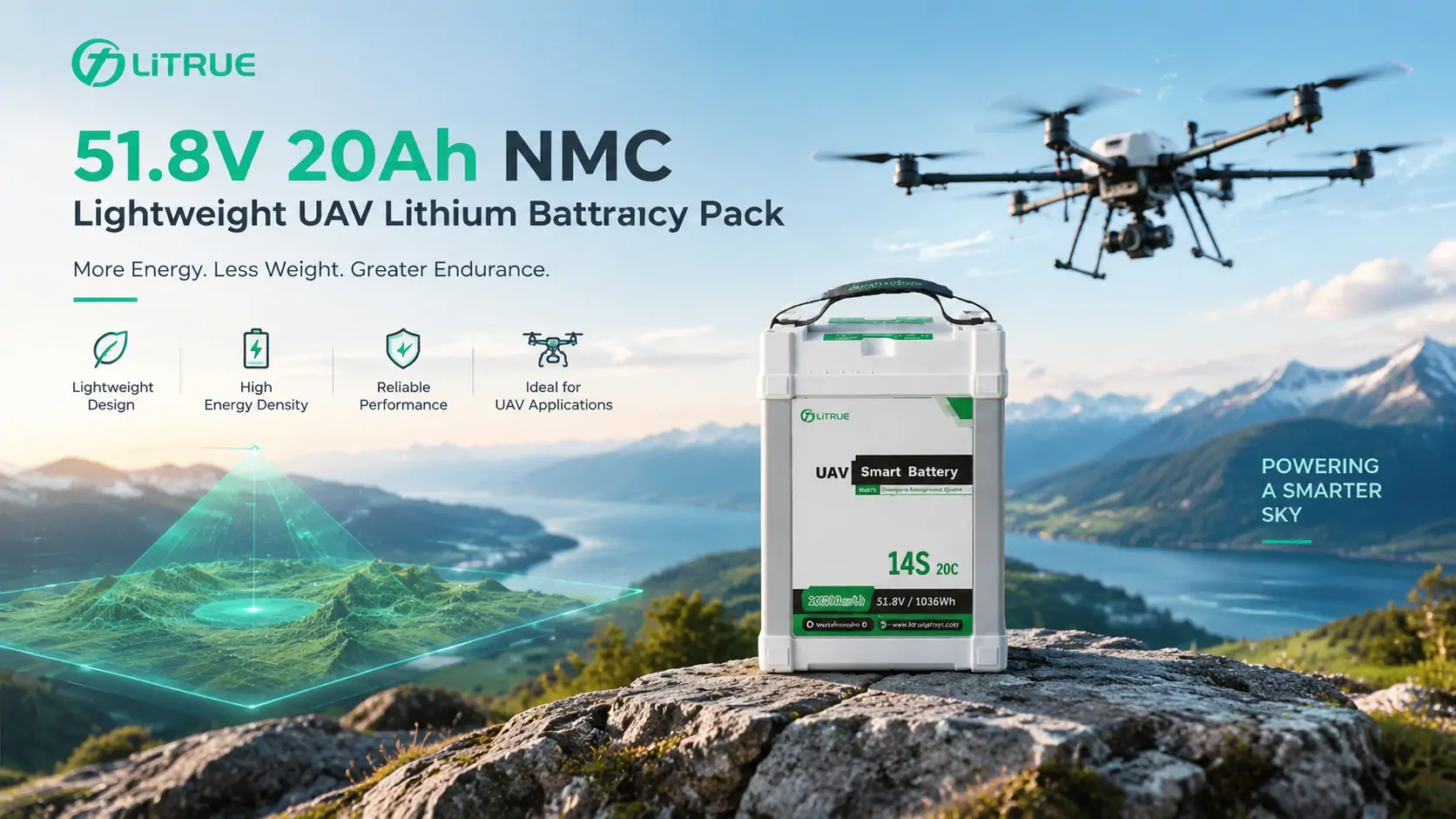
| Model Number | UAV-JP220M |
| Configuration | 1P14S |
| Chemistry | NMC |
| Nominal Capacity | 20Ah |
| Nominal Energy | 1.036kWh |
| Nominal Voltage | 51.8V |
| Operating Voltage Range | 42V – 60.9V |
| Max. Continuous Charging Current | 40A |
| Peak Charging Current | 60A @ 30s / 25°C |
| Max. Continuous Discharge Current | 50A |
| Peak Discharge Current | 100A @ 30s / 25°C |
| Cycle Life | 1,000 cycles @ 1C/1C |
| Protection Functions | Overcharge, over-discharge, and over-current protection alarm |
| Communication | CAN |
| Dimensions | 172 × 110 × 245mm |
| Product Weight | 6.8kg |
| Protection Level | IP65 |
| Charging Temperature | 0°C to +55°C |
| Discharge Temperature | -40°C to +60°C |
| Storage Temperature | -20°C to +25°C |
| Working Altitude | ≤5,000m |
| Storage Humidity | 5% – 95% RH |
| Design Standards | GB/T 38058-2019, GB 31241-2022, GB/T 38930-2020 |
| Certification Standards | RoHS, UL 2054, UN38.3 |
| Sample MOQ | 10 pcs (negotiable) |
| Sample Lead Time | 7–15 working days |
| Bulk Lead Time | 45 days (subject to volume and requirements) |
Here is what those numbers mean for endurance. Dividing the 1.036kWh of nominal energy by the 6.8kg pack weight gives about 152Wh/kg at the pack level, which is the kind of figure to compare across batteries.
On the worked example above, this pack would support roughly 35 minutes at a 1.5kW average draw and about 26 minutes at 2.0kW, with a 15 percent reserve. Those flight times are estimates that depend entirely on your aircraft real power draw.
The current ratings give useful margin. A 50A continuous rating equals 2.5C on a 20Ah pack, and the 100A peak for 30 seconds equals 5C, so a 2.0kW cruise at about 39A stays comfortably inside the continuous limit while takeoff and gusts are covered by the peak rating.
Environmental ratings support field work. The pack discharges down to -40°C and carries an IP65 enclosure, and CAN communication lets the flight controller read pack status. Charging, however, is limited to 0°C to +55°C, so a cold pack should be warmed before it goes on the charger.
If your mission needs more energy than a 1kWh pack provides, a larger option from our guide to the high capacity drone battery may fit better, as long as the extra weight still pays off in flight time.
How to Choose the Best UAV Lithium Battery for Long Flight Times
Start by measuring or estimating your aircraft average power draw in flight. Every other decision depends on that number.
Next, compare packs by energy per kilogram, not capacity alone, and check that your cruise current sits well below the continuous discharge rating.
Then confirm the temperature ranges for charging, discharge, and storage, and compare them to where you will actually operate. Ask for cycle life test conditions and the capacity level that defines end of life.
Finally, check communication, connectors, and dimensions against your airframe, and request certification documents before committing to a volume order.
FAQs
What is the best UAV lithium battery for long flight times?
The best choice combines high energy per kilogram, enough continuous discharge current for your aircraft, a validated temperature range, and a documented cycle life. The right pack depends on your aircraft weight and power draw, not just on capacity.
How do I calculate flight time from battery specs?
Multiply voltage by capacity to get watt-hours, subtract a reserve, and divide by the aircraft average power draw in watts. For example, a 1,036Wh pack with a 15 percent reserve gives about 880Wh, which lasts about 26 minutes at a 2.0kW average draw.
Does a bigger battery always fly longer?
No. A larger battery adds weight, and hover power rises faster than weight, so the gain is smaller than the capacity increase suggests. Past a certain point, extra battery can even shorten flight time.
How does cold weather affect drone flight time?
Cold lowers the capacity a battery can deliver, so flight times are shorter on cold days. Keep packs warm before flight, and remember that charging is usually limited to a narrower temperature range than discharge.
How many flights will a UAV battery last?
It depends on cycle life and how you use it. The example pack is rated for 1,000 cycles at 1C/1C, and flight time gradually decreases as capacity fades over those cycles.
Where can I source UAV batteries for a commercial drone program?
OEMs and fleet operators can request samples, datasheets, and certification documents from a lithium battery supplier that offers voltage matching, connector selection, and CAN protocol alignment.
Summary
Long flight times come from maximizing usable energy per kilogram while keeping the aircraft power draw low and the battery well within its discharge limits. Work out your average power draw, compare packs by pack-level energy density, respect temperature limits, and always plan a reserve.
If you are specifying batteries for a new commercial UAV program, working with an experienced lithium battery manufacturer that can share validated test data and certification documents will save time and risk before you commit to volume.