
A lithium anode battery is a cell whose negative electrode is lithium metal instead of the graphite used in most lithium-ion cells. Because lithium metal stores far more energy per gram than graphite, these cells can reach much higher energy density, but they come with real trade-offs in charge rate and cycle life.
This guide explains how the different anode types work, why lithium metal is so attractive, what makes it hard to engineer, and what a real anode-free cell spec sheet looks like, so you can judge whether the technology fits your project.
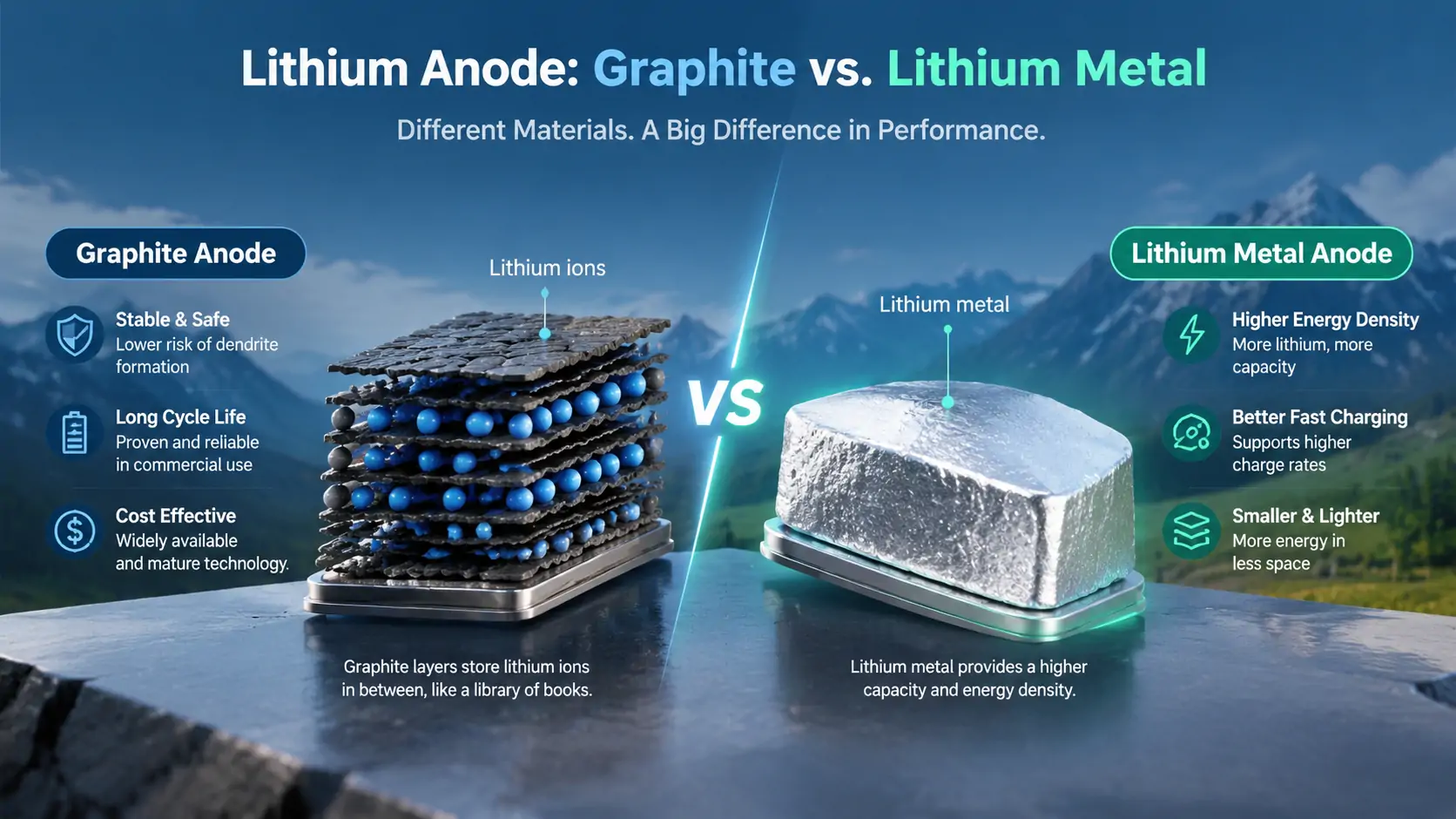
What Is a Lithium Anode Battery?
The anode is the negative electrode, where lithium ions are stored when the battery is charged. The material used for the anode largely decides how much energy a cell can hold, how fast it can charge, and how long it lasts.
Graphite Anodes: Today Standard
Most commercial lithium-ion cells use graphite. Lithium ions slot between the graphite layers during charging, which is stable and forgiving, and it is why these cells last for thousands of cycles. The downside is capacity: graphite holds about 372mAh per gram.
Silicon-Blended Anodes
Some cells mix silicon into the graphite to raise capacity. Silicon stores much more lithium, but it swells and shrinks as it charges and discharges, so the amount that can be blended in is limited.
Lithium Metal Anodes
A lithium metal anode uses a thin foil of lithium itself. Its theoretical capacity is about 3,860mAh per gram, roughly ten times that of graphite. According to the U.S. Department of Energy technical information service, rechargeable lithium metal batteries have much higher energy density than lithium-ion batteries with graphite anodes.
Anode-Free Cells
An anode-free cell takes the idea one step further. It is built without any anode material at all. During the first charge, lithium from the cathode plates directly onto the bare current collector, and that plated lithium becomes the anode. With no passive host material, almost all of the cell mass goes toward storing energy.
Why Lithium Anodes Deliver Higher Energy Density
In a graphite cell, the anode is a host structure that carries lithium but contributes little capacity itself. A lithium metal or anode-free design removes most or all of that dead weight.
The difference shows up in specific energy. Conventional NMC pouch cells typically fall in the range of roughly 250 to 300Wh/kg, while the anode-free cell featured later in this guide is rated at 495Wh/kg. In practical terms, a cell stack holding 1kWh would weigh about 2.0kg at 495Wh/kg, compared with about 3.3 to 4.0kg at 250 to 300Wh/kg, before packaging and electronics.
That weight saving matters most where every gram is expensive, such as aircraft, high-altitude drones, and satellites.
The Challenges: Dendrites, Efficiency, and Cycle Life
Dendrites
When lithium plates onto the anode unevenly, it can grow into needle-like structures called dendrites. In a cell with a liquid electrolyte, dendrites can pierce the separator and cause an internal short circuit, which is the main safety concern with lithium metal.
Efficiency and Lithium Loss
Each charge and discharge cycle, a small amount of lithium is consumed by side reactions at the anode surface. A graphite cell has spare lithium to absorb those losses, but an anode-free cell starts with a fixed lithium inventory, so losses show up as faster capacity fade.
Charge Rate Sensitivity
Lithium metal cells are sensitive to how much current is pushed into them. Charging too fast encourages uneven plating, so these cells are usually limited to gentle charge rates.
Pressure and Swelling
Lithium metal cells often perform best under controlled stack pressure, because the anode grows and shrinks with each cycle. Pack designers should ask the supplier whether a specific compression fixture is required.
How Solid Electrolytes Help
A solid-state electrolyte replaces the flammable liquid in a conventional cell with a solid material. That physical barrier resists dendrite growth better than a liquid does, which is why many lithium metal designs pair the anode with a solid electrolyte.
Solid electrolytes can also widen the temperature range, since they do not freeze like a liquid. They reduce the dendrite problem rather than eliminating it, so cycle life and charging limits still need to be verified for any specific cell.
Where a Lithium Anode Battery Makes Sense
Weight-Critical Aerospace
Electric aircraft, high-altitude unmanned aircraft, and satellite payloads gain the most from high specific energy, because saved weight becomes extra payload, range, or endurance. For conventional heavy-lift multi-rotor drones that need high discharge rates instead, our guide to UAV lithium batteries covers the better-suited options.
Extreme Cold Equipment
A wide operating temperature range makes these cells appealing for polar and high-altitude equipment, where standard liquid-electrolyte cells lose most of their capacity.
Where It Is Not the Best Fit
Applications that need fast charging, high discharge rates, or thousands of daily cycles, such as RV batteries, home storage, and fast-turnaround drones, are usually better served by conventional LFP or NMC cells. A lithium anode battery is a specialist tool, not a general replacement.
A Real Example: 49Ah Anode-Free Solid-State Cell
Specs are easiest to judge against a real product. LiTrue 49Ah anode-free solid-state cell (model PC49N-EF) is an NMC-cathode pouch cell built for eVTOL, high-altitude UAV, and satellite applications. It is offered to OEMs as a cell for qualification and pack development, not as a finished battery.
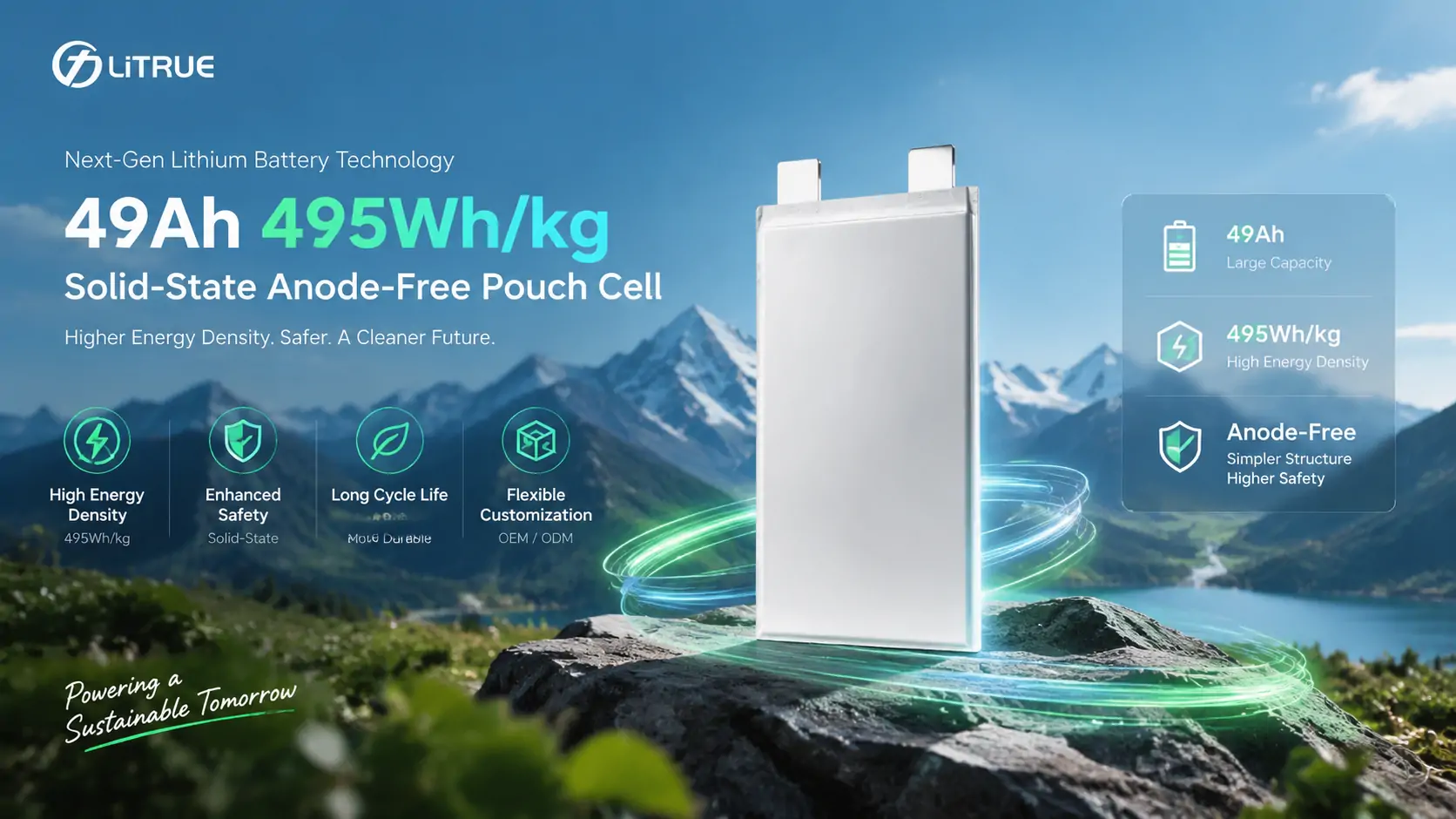
| Model Number | PC49N-EF |
| Classification | Anode-Free Cell |
| Chemical Materials | NMC |
| Cell Structure | Pouch |
| Dimensions (T×W×H) | 7.8 × 90 × 192mm |
| Weight | 375g |
| Nominal Capacity | 49Ah |
| Nominal Voltage | 3.85V |
| Energy Density | 495Wh/kg |
| Max. Continuous Charge Rate | 0.5C |
| Max. Continuous Discharge Rate | 2C |
| Max. Pulse Charge Rate | 1C |
| Max. Pulse Discharge Rate | 3C |
| Operating Temperature | -43°C to +55°C |
| Design Standards | GB/T 38058-2019, GB 31241-2022 |
| Certification Standards | UN38.3, RoHS |
| Sample MOQ | 10 pcs (negotiable) |
| Sample Lead Time | 7–15 working days |
| Bulk Lead Time | 45 days (subject to volume and requirements) |
Here is how to read those numbers. The 495Wh/kg rating from a 375g cell is the headline, and it lines up with the energy-density argument above. It sits in the range of roughly 1.7 to 2 times the specific energy of a conventional NMC pouch cell.
The rate ratings show the trade-off. A 0.5C continuous charge rating on a 49Ah cell is about 24.5A, so a full charge takes at least two hours, and the 1C pulse charge rating is only for brief events. Discharge is more flexible, with 2C continuous (about 98A) and 3C pulse (about 147A), but this is clearly not a high-rate cell.
The -43°C to +55°C operating range is the other strength, and it fits the cold, high-altitude missions the cell is designed for.
One thing the product page does not publish is a cycle-life figure. That is an important question to ask any supplier of lithium metal or anode-free cells, because cycle life is where the technology is most demanding. Pack designers should also ask about compression requirements and about the charge profile, since a finished system built from these cells typically needs engineered custom battery packs with the right fixtures and battery management.
How to Evaluate a Lithium Anode Battery Before You Buy
Start by asking for cycle life under your own conditions: your charge rate, temperature, depth of discharge, and the capacity level that defines end of life. A single headline number is not enough.
Next, confirm the charging protocol and limits, since lithium metal cells are more sensitive to charge current than graphite cells. Ask whether the cell needs stack pressure and how much.
Then check the safety documentation. UN38.3 transport testing and RoHS compliance are baseline, and you should request abuse-test data that matches your application, such as nail penetration, overcharge, and thermal tests.
Finally, begin with a small sample order to qualify the cell on your own test bench before committing to a design. If your application needs more cycles or a higher rate than a lithium anode battery can offer, compare it with a conventional range of OEM lithium battery options.
FAQs
What is a lithium anode battery?
It is a battery with a lithium metal negative electrode instead of graphite. Because lithium metal stores far more energy per gram, these cells can reach much higher energy density than conventional lithium-ion cells.
Is a lithium metal anode the same as an anode-free cell?
Not exactly. A lithium metal cell is built with a lithium foil anode, while an anode-free cell starts with no anode material and plates lithium onto a bare current collector during the first charge. Anode-free designs are lighter and simpler but have no spare lithium to absorb losses.
Are lithium anode batteries safe?
Safety depends on the design. Dendrite growth is the main concern with liquid electrolytes, and solid electrolytes help reduce it. Always request independent test data and certification documents for the specific cell.
How long do lithium anode batteries last?
Generally fewer cycles than graphite-based cells at this stage of the technology, and the exact number depends on charge rate, temperature, and pressure. The example cell product page does not publish a cycle-life figure, so ask the supplier for test data.
Can I buy lithium anode battery cells for my project?
Yes, OEMs can request engineering samples. The example cell lists a sample MOQ of 10 pieces and a sample lead time of 7 to 15 working days. Contact a lithium battery supplier to discuss your requirements.
Summary
A lithium anode battery trades convenience for energy. In return for much higher specific energy, you accept gentler charge rates, more demanding pack design, and a cycle life that needs careful verification. For weight-critical aerospace and cold-weather missions, that trade is worth making, and for most everyday applications it is not.
If you are evaluating high-energy cells for a new program, working with an experienced lithium battery manufacturer that can share validated test data and discuss your duty cycle will save time and risk before you commit to a design.