
An electric motorcycle battery is defined by four things: how much energy it stores, how hard it can discharge, how many cycles it lasts, and how easy it is to install or remove. Get those four right and the bike goes farther, accelerates harder, lasts longer, and is far easier to service.
This guide explains each one with simple math, covers what to consider for quick-release and swappable designs, and then looks at a real 73.6V LFP battery pack spec sheet so you can see where the numbers come from.
How Long an Electric Motorcycle Battery Lasts on One Charge
Energy Is Volts Times Amp-Hours
Battery energy in watt-hours equals voltage multiplied by capacity in amp-hours. A 72V pack rated at 50Ah, for example, stores 3,600Wh, or 3.6kWh. Capacity in amp-hours alone tells you little, because the same 50Ah means very different range at 12V and at 72V.
The same watt-hour math applies to every lithium battery, and our guide on how long a 12V lithium battery lasts shows it step by step for a very different application.
Range Depends on Wh per Mile
To estimate range, divide usable energy by your consumption in watt-hours per mile. The example pack later in this guide lists 3.39kWh of nominal energy. Assuming 90 percent is usable to leave a reserve, that gives about 3,050Wh.
At an assumed 65Wh per mile, typical of gentle city riding, that is about 47 miles. At an assumed 130Wh per mile, closer to sustained highway speeds, it drops to about 23 miles. Those consumption figures are illustrations, not measurements, because real numbers vary with speed, rider weight, wind, hills, and temperature.
Ride Time at a Steady Power Draw
You can also think in hours. A bike that averages 3kW of motor power uses that 3,050Wh in about an hour. Hard acceleration and steep climbs pull much more than the average, which is where discharge rate comes in.
Discharge Rate and Power: What C-Rate Means for Riders
C-Rate Explained
The C-rate compares discharge current to battery capacity. At 1C, the current in amps equals the capacity in amp-hours, so a 48Ah battery at 1C delivers 48A. At 2C it delivers 96A.
Why Discharge Rate Matters on a Motorcycle
Motorcycles ask for short, heavy bursts of current when you launch from a light, pass a truck, or climb a hill. A battery with only modest discharge headroom will sag in voltage under those loads, run hotter, and feel weaker than its capacity suggests.
Peak current also sets your power. At 73.6V, 100A of continuous discharge is about 7.4kW, and a 130A peak is about 9.6kW. The motor controller and the battery management system (BMS) both have to agree on those limits.
Charging Rate and Time
Charge rate matters for daily use. A 48Ah pack charged at 40A is charging at roughly 0.8C, which would take about 1.2 hours for a full charge in theory, before the slowdown at the end of the charge cycle. Real charging usually takes longer, and the charger must match the pack voltage window.
Cycle Life: How Many Years and Miles Will It Last?
From Cycles to Miles
Cycle life tells you how many full charge and discharge cycles a battery completes before its capacity fades to a stated level. Multiply cycles by range per cycle and you get lifetime distance on paper.
With the example pack 3,000-cycle rating, the 47-mile gentle riding case works out to roughly 140,000 miles, and the 23-mile highway case to roughly 70,000 miles. A rider who covers 30 miles a day uses only about 0.64 cycles per day, which stretches 3,000 cycles to nearly 13 years on paper.
Why Real Life Is Shorter Than the Math
Calendar aging, heat, deep discharge, and storage at full charge all shorten battery life, so treat the paper number as an upper bound. Always ask what capacity level defines the end of life and what temperature and charge rate the cycle test used.
Quick-Release and Swappable Battery Design
Quick-release packs are popular for riders who live in apartments, need to charge indoors, or want to swap a depleted pack for a fresh one. Whether a pack suits that use depends on a few engineering choices.
Weight and Handling
Weight is the first constraint. The example pack in this guide weighs 32kg, about 70 pounds, which is a fixed-installation weight rather than something most riders will carry up a flight of stairs every day. Hand-removable designs generally use lighter modules or swap stations built for the job.
Connectors and Interlocks
A swappable pack needs sealed, high-current connectors rated for the pack continuous and peak current, plus a design that prevents arcing when the pack is connected or disconnected. Many systems add precharge protection and an interlock so the pack is never live while exposed.
Latching and Vibration
Motorcycles vibrate constantly. A quick-release latch has to hold the pack firmly through years of bumps, and the electrical contacts need enough spring force to stay connected under vibration.
Communication and Safety
The pack and vehicle should exchange status over a bus such as CAN when the pack is inserted, so the controller knows the pack voltage, temperature, and limits. A pack above 60V DC is commonly treated as high voltage in vehicle safety standards, so a swappable design needs proper insulation and shock protection.
Installation Checklist for an Electric Motorcycle Battery
Mount the battery rigidly in a compartment that protects it from impact, and use the manufacturer recommended brackets and torque values. A loose pack is a safety risk and will wear its own connectors out.
Size the cables and fuses for the pack peak current, not just its continuous rating. At 100A or more, undersized wiring becomes a heat source, and a properly rated fuse close to the battery protects against short circuits.
Check sealing at every connector, not just on the pack housing. A pack with a high ingress rating can still fail if a connector lets water in.
Finally, confirm that the BMS communication protocol, the charger profile, and the controller voltage window all match the pack. Disconnect the pack before any service work, and run a full commissioning test before the first ride.
A Real Example: 73.6V 48Ah LFP E-Motorcycle Battery Pack
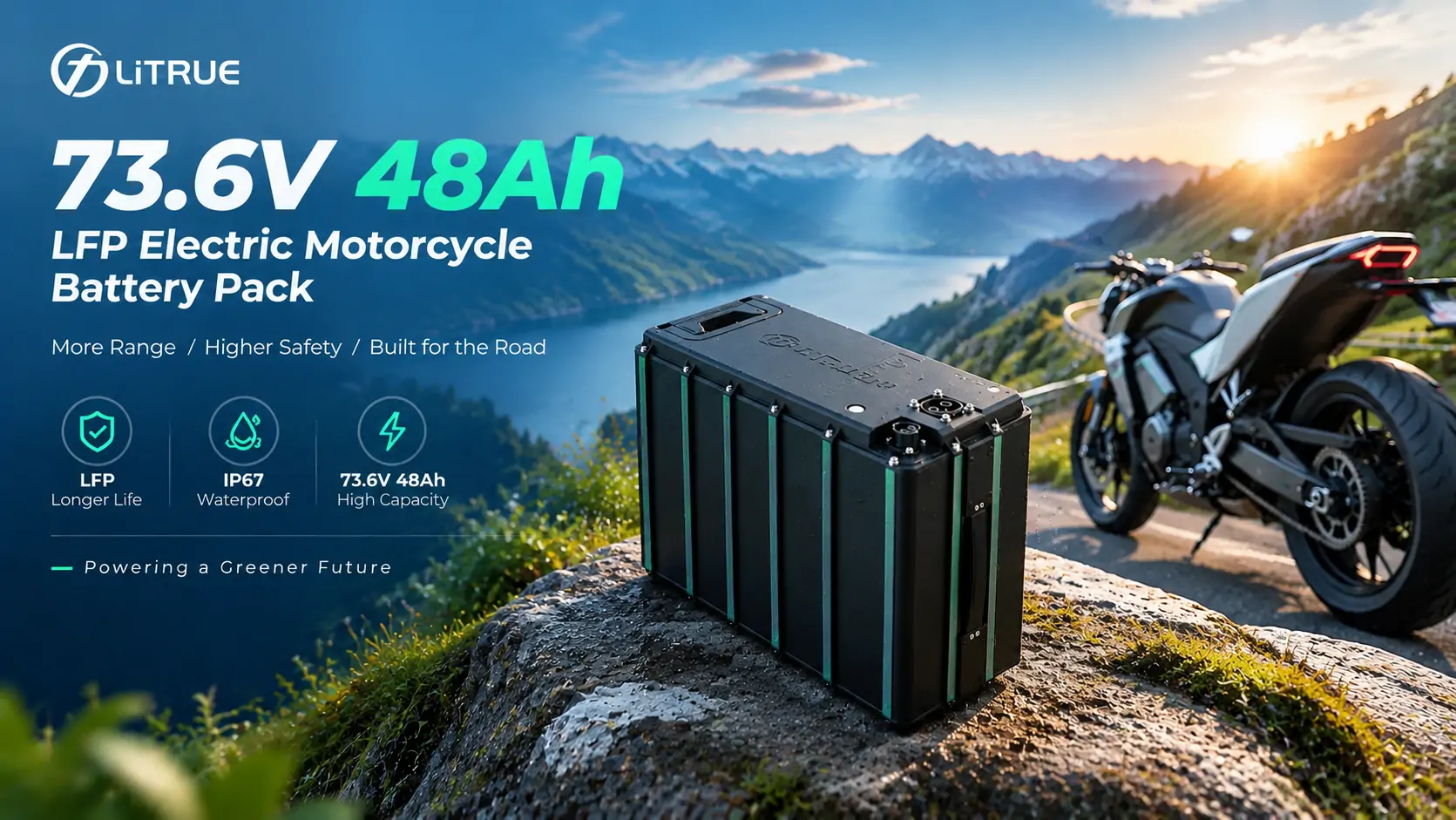
Specs are easiest to judge against a real product. LiTrue 73.6V 48Ah LFP e-motorcycle battery pack is built for e-motorcycles, scooters, and light electric vehicles that need a long-cycle chemistry with CAN communication and a sealed enclosure. The product page does not list a quick-release mechanism, so connector and mounting details are confirmed during project scoping.
| Spec | Value |
|---|---|
| Model Number | 73.6V48Ah E-Motorcycle Power System |
| Configuration | 23S |
| Chemistry | LFP |
| Nominal Capacity | 48Ah |
| Nominal Energy | 3.39kWh |
| Nominal Voltage | 73.6V |
| Operating Voltage Range | 57.5V – 83.95V |
| Max. Continuous Charging Current | 40A |
| Peak Charging Current | 92A |
| Max. Continuous Discharge Current | 100A |
| Peak Discharge Current | 130A @ 30s / 25°C |
| Cycle Life | 3,000 cycles @ 1C/1C |
| Protection Functions | Overcharge, over-discharge, and over-current protection |
| Communication | CAN |
| Dimensions (L×W×H) | 352 × 192 × 300mm |
| Product Weight | 32kg |
| Protection Level | IP67 |
| Charging / Discharge / Storage Temperature | -40°C to +60°C |
| Working Altitude | Up to 5,000m |
| Design Standards | GB/T 38058-2019, GB 31241-2022 |
| Certification Standards | UN38.3, RoHS, UL 2054 |
Here is how those numbers connect to the sections above. The 100A continuous and 130A peak ratings against 48Ah work out to roughly 2C continuous and 2.7C peak, which is real headroom for acceleration and hills. The 3,000-cycle rating at 1C/1C is a realistic test rate, and LFP chemistry is generally chosen when cycle life and thermal stability matter more than minimum weight.
The IP67 rating means the pack is dust-tight and protected against temporary immersion, according to the IP code classification system. That suits a vehicle that rides through rain and puddles, though connectors and the vehicle mounting compartment still need proper sealing.
The page lists -40°C to +60°C for charging, discharge, and storage. Its own FAQ advises confirming charging limits separately, which is good practice for any lithium pack because low-temperature charging is usually more restricted than discharging.
The 32kg weight confirms the earlier point: this is a fixed-install traction pack. Quick-release or swappable versions would need a different mechanical design, which is the kind of requirement worth raising early with a supplier of electric motorcycle battery packs.
FAQs
How long does an electric motorcycle battery last on one charge?
It depends on energy capacity and how you ride. The example pack stores 3.39kWh, which at an assumed 65Wh per mile is about 47 miles with a 10 percent reserve. At highway-style consumption of 130Wh per mile, it is closer to 23 miles.
How many years does an electric motorcycle battery last?
It depends on cycle life, heat, and how often you ride. A battery rated for 3,000 cycles lasts about eight years at one full cycle per day, and longer for riders who do not use the full range daily, though calendar aging eventually sets the limit.
What discharge rate does an electric motorcycle need?
Enough to cover peak acceleration with margin. The example pack supports about 2C continuous and 2.7C peak, so it can deliver roughly 7.4kW continuous and 9.6kW peak at nominal voltage. Always match the battery limits to the motor controller current limit.
Can an electric motorcycle battery be quick-release?
Yes, but it requires dedicated design: sealed high-current connectors, secure latching, interlocks, and a weight that people can handle. Heavier traction packs like the 32kg example are typically installed in place rather than swapped by hand.
Is LFP or NMC better for an electric motorcycle?
LFP offers longer cycle life and better thermal stability, while NMC stores more energy for the same weight and can give lighter packs or longer range. The right choice depends on whether you value lifespan or weight more.
Where can I source packs for an electric motorcycle project?
OEMs can request samples, datasheets, and certification documents from a lithium battery supplier that offers engineering support, custom connectors, and enclosure options.
Summary
A good electric motorcycle battery balances energy, discharge headroom, cycle life, and mechanical design. Work out your range with real consumption numbers, check the C-rate against your motor controller, ask for the test conditions behind every cycle rating, and decide early whether you need a quick-release design.
If you are developing an electric motorcycle platform, working with an experienced lithium battery manufacturer that can share validated test data will save time and risk. You can also browse LiTrue range of OEM lithium battery products and lithium cells to compare options for your design.