
Ask ten pilots "which drone has the longest battery life," and you'll get ten model names. Ask the engineer who builds the pack inside that drone, and you'll get a different answer: it was never about the airframe. It's about the drone battery — its chemistry, its energy density, and how honestly the manufacturer rates it. I've spent the better part of a decade on the factory floor watching "30-minute flight time" claims fall apart at 40% payload, so let me save you the disappointment and the wasted purchase orders.
This guide is written for procurement managers, fleet operators, and OEM buyers who need real endurance numbers — not marketing brochures. We'll break down what actually extends flight time, where the published specs lie, and what a 1,998 Wh pack looks like when you measure it instead of trusting the label.
Table of Contents
- 1. The Real Answer: It's the Pack, Not the Plane
- 2. What Sets Long-Endurance Drones Apart
- 3. Product Deep Dive: The 66.6V 30Ah UAV Pack
- 4. Alternatives & Comparison
- 5. FAQs
- 6. Summary
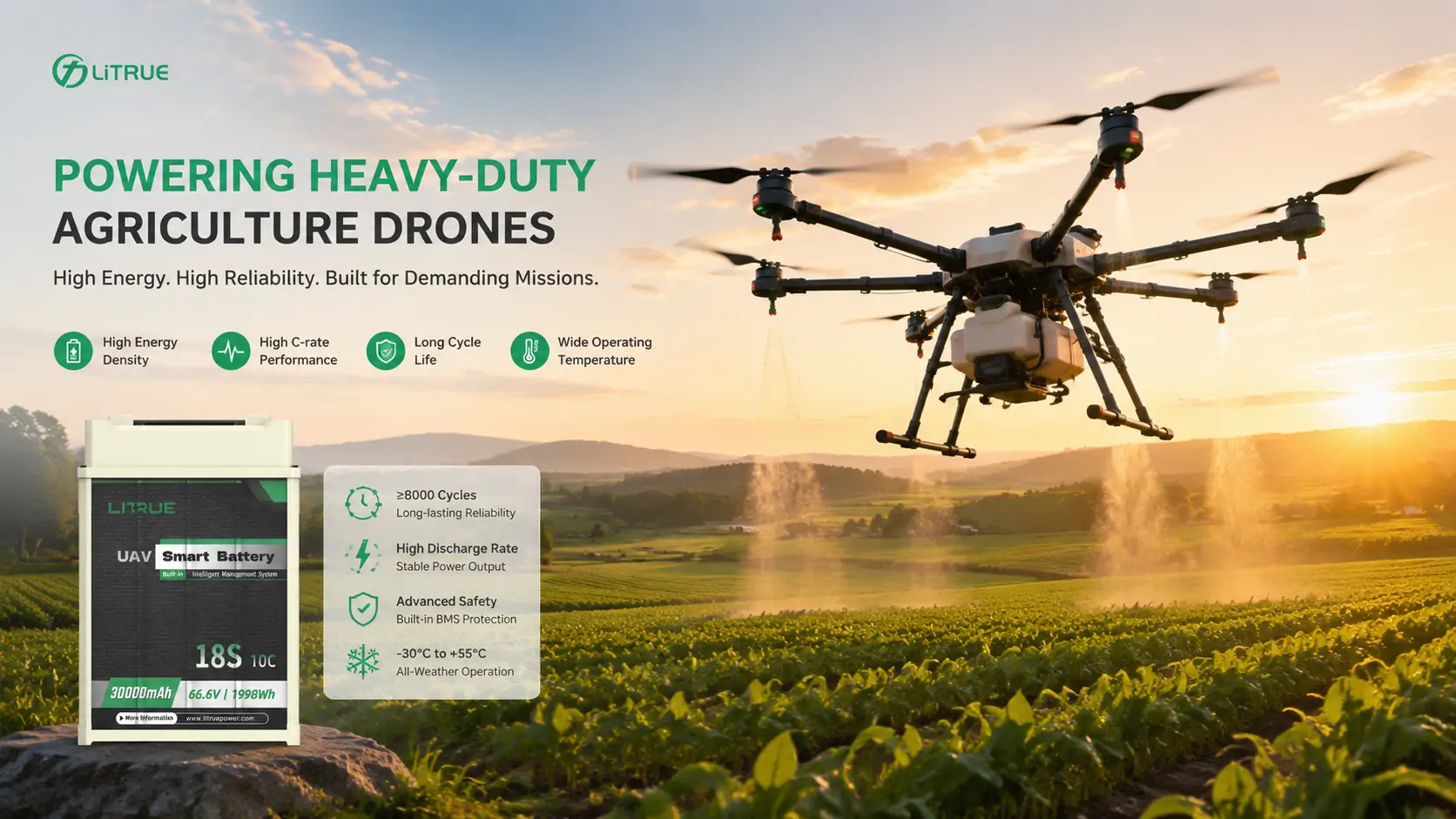
What Actually Sets Long-Endurance Drones Apart
Here's the uncomfortable truth most spec sheets won't tell you. Flight time is a tug-of-war between three numbers: how much energy the pack stores (watt-hours), how much the whole aircraft weighs, and how hungry the motors are under load. Add a heavier battery and you store more energy — but you also add weight the motors must lift, which burns that energy faster. The sweet spot lives in energy density — the watt-hours you can pack into every kilogram.
Key features that buy you flight time:
- High gravimetric energy density (Wh/kg): This is the single biggest lever. NMC chemistry typically runs 150–250 Wh/kg, well ahead of standard LFP.
- A high nominal voltage: Higher voltage means lower current for the same power, which cuts resistive heat losses in the wiring and the cells.
- Cells that hold voltage under load: A pack that sags to cutoff at 60% draw gives you a flattering lab number and a short real flight.
Missing features buyers forget to check:
Most published "max flight time" figures assume no payload, no wind, sea-level air, and a brand-new pack at 25°C. Drop a camera gimbal or a sprayer tank on it, fly in a 15 mph breeze, and that 40-minute claim becomes 22. The spec sheet rarely mentions the test conditions — so you're comparing fantasy to fantasy.
The truth you should know:
No drone has the "longest battery life" in absolute terms. A long-endurance fixed-wing surveying drone might stay up for 90 minutes on a small pack; a heavy-lift agricultural multi-rotor hauling 40 kg might give you 18 minutes on a battery five times the size. They're solving different problems. The honest question isn't "which drone flies longest" — it's "which drone battery gives me the most useful airtime per charge for my mission and my payload." We learned that the hard way, after a logistics client returned a shipment because we'd quoted bench numbers instead of payload-loaded numbers. We don't make that mistake anymore.
Product Deep Dive: The 66.6V 30Ah UAV Lithium Battery (UAV-JP330L)
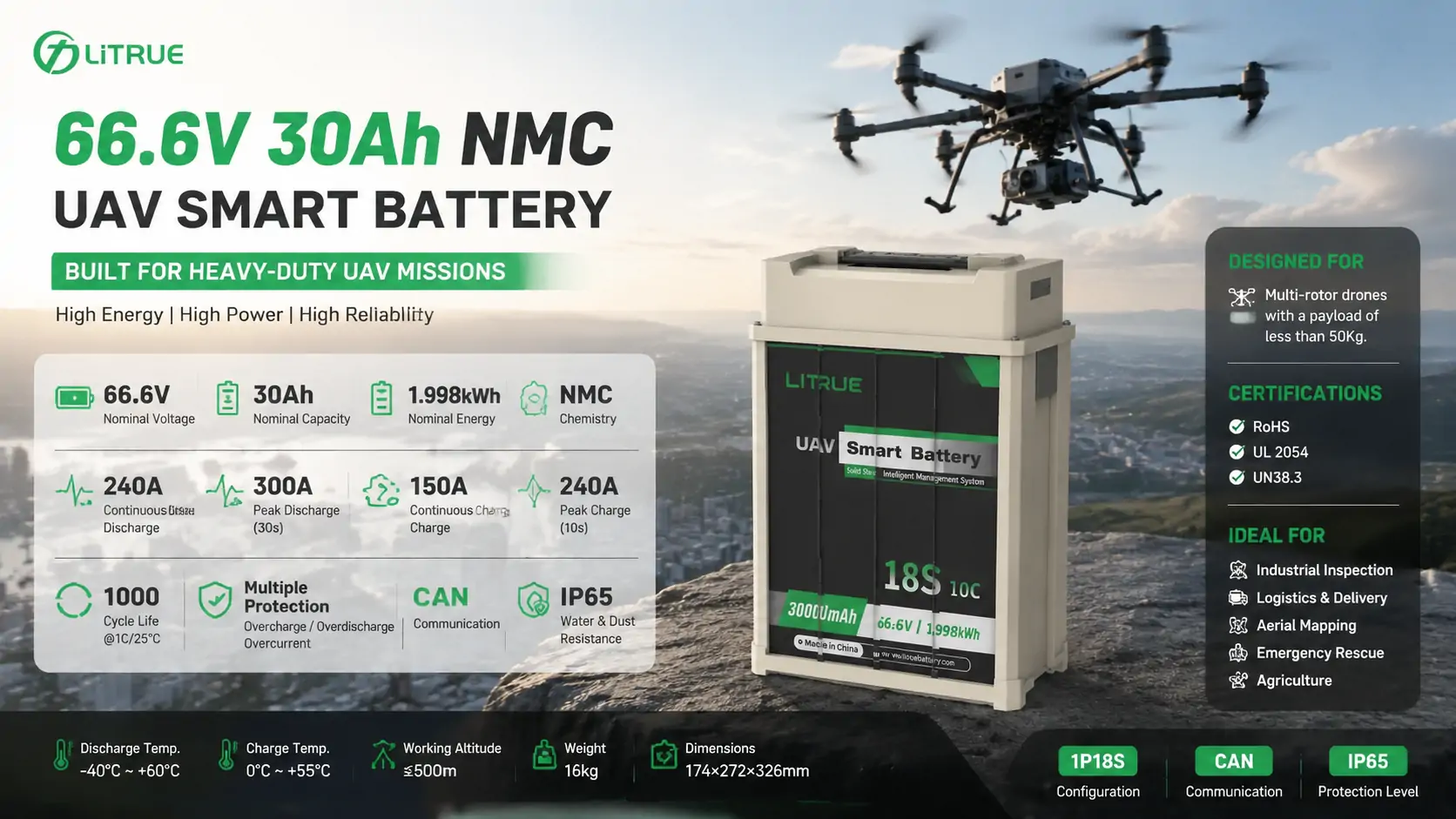
When a customer needs maximum airtime under a real payload, this is the pack I point them to. It isn't the lightest battery we make, and it isn't meant to be. It's built to keep a sub-50 kg multi-rotor in the air long enough to finish the job. Here are the measured numbers — not estimates.
Unique Selling Points
- 1,998 Wh of usable energy: 66.6V nominal × 30Ah, in an 18-series single-parallel (1P18S) configuration. That's nearly 2 kWh in one pack.
- 300A peak discharge: (for 30 seconds at 25°C), which is a 10C burst — enough headroom for a fully loaded takeoff or an aggressive recovery in gusty wind.
- ~125 Wh/kg at the pack level: (1,998 Wh ÷ 16 kg), measured with the full housing, BMS, and connectors included — not a bare-cell figure.
- Native CAN communication: For live telemetry: state of charge, cell voltages, temperature, and fault alarms stream straight to your flight controller.
- IP65 housing: And a verified 1,000-cycle life at 1C, 25°C.
Who Is This For ?
Evaluate this pack if you run heavy-lift work: agricultural spraying, logistics delivery, infrastructure inspection, or mapping with a heavy sensor payload on a multi-rotor under 50 kg gross. If you need long airtime while carrying something, the 1,998 Wh tank is what keeps you up.
This is not your battery if you fly a sub-2 kg FPV or a palm-sized inspection quad. At 16 kg, this pack weighs more than your whole aircraft. For those builds, a lightweight UAV pack makes far more sense — and we'll point you there in the alternatives section below.
Performance Evaluation
Endurance: Nearly 2 kWh is the ceiling on how long you can fly, period. On a typical 25 kg-payload hexacopter pulling roughly 4–5 kW in cruise, that math works out to real, repeatable airtime in the 22–26 minute range — and it holds across the pack's life, not just on day one.
Power delivery: The 240A continuous / 300A peak rating means the pack doesn't sag when six motors spool up at once. Voltage stability under load is what turns a paper spec into a flight you can actually plan around.
Thermal behavior: Discharge is rated from –40°C to +60°C. We've run these in cold-chain inspection work where LFP packs would have folded; the NMC cells keep their voltage in the cold far better.
Design & Usage
The 66.6V architecture is a deliberate choice. Push the voltage up and you pull the current down for the same power — less heat in the harness, less stress on the connectors, more energy reaching the props. The handle and 174×272×326 mm form factor are sized for a tool-free hot-swap between sorties, which is how spray crews keep a drone working through a whole field instead of babysitting a charger.
How a Custom Pack Takes Shape
Off-the-shelf rarely fits a real airframe. As a lithium battery manufacturer running our own cell and pack lines, we reshape voltage (54–78.3V operating window here), capacity, connector type, BMS logic, and the mechanical footprint to your drone. A custom UAV battery project usually moves from sample to bulk in about 45 days, with a sample lead time of 7–15 working days and a starting MOQ of 10 pieces.
What You Won't Find Here
Honesty sells better than hype, so: this pack has no built-in display screen — telemetry rides the CAN bus, so you read it through your flight controller, not off the case. It's also not a featherweight; that 16 kg is the cost of carrying nearly 2 kWh. And because it's NMC, it isn't the right pick if your spec demands LFP's flatter thermal-runaway profile over outright energy density.
Take the Next Step
If endurance under payload is the box you need to check, view the full UAV-JP330L spec sheet and request a quote here. Tell us your airframe, gross weight, and target flight time, and we'll model the real airtime before you buy.
Similar product: Need the same endurance philosophy in a lower-voltage 51.8V format for a different controller? The 28Ah UAV lithium battery line covers that ground.
Alternatives & Comparison
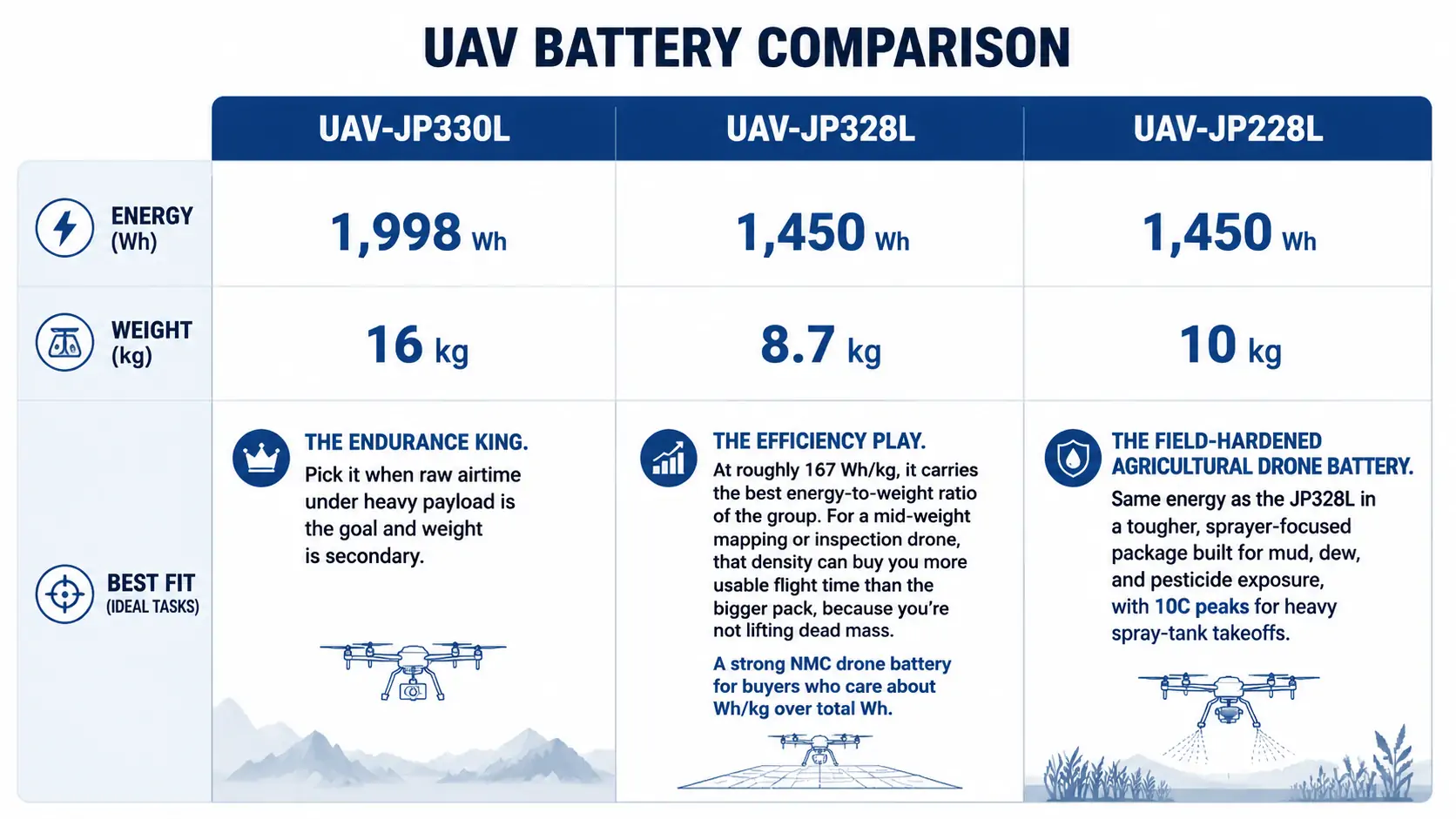
There's no single winner — there's a right tool per mission. Here's how the long-endurance pack stacks up against two siblings from the same line.
- 1. UAV-JP330L — 66.6V / 30Ah / 1,998 Wh / 16 kg: The endurance king. Pick it when raw airtime under heavy payload is the goal and weight is secondary.
- 2. UAV-JP328L — 51.8V / 28Ah / 1,450 Wh / 8.7 kg: The efficiency play. At roughly 167 Wh/kg, it carries the best energy-to-weight ratio of the group. For a mid-weight mapping or inspection drone, that density can buy you more usable flight time than the bigger pack, because you're not lifting dead mass. This is a strong NMC drone battery for buyers who care about Wh/kg over total Wh.
- 3. UAV-JP228L — 51.8V / 28Ah / 1,450 Wh / 10 kg: The field-hardened agricultural drone battery. Same energy as the JP328L in a tougher, sprayer-focused package built for mud, dew, and pesticide exposure, with 10C peaks for heavy spray-tank takeoffs.
The pattern is the one I keep repeating to buyers: the "longest battery life" depends entirely on what you bolt underneath the aircraft. Want help matching a pack to your airframe? Our complete UAV buyer's guide walks through the sizing math step by step.
FAQs
Which drone actually has the longest battery life?
Long-endurance fixed-wing surveying drones win on raw clock time — some stay airborne 60–90 minutes — because they glide and carry light payloads. Among heavy-lift multi-rotors, the winner is whichever one carries the highest-energy pack at the lowest aircraft weight. The drone battery decides it, not the brand badge.
Does a bigger battery always mean longer flight time?
No — and this trips up a lot of buyers. A bigger pack adds energy and weight. Past a certain point, the extra weight the motors must lift cancels the extra energy you added. Energy density (Wh/kg) is what breaks the tie, which is why a lighter, denser cell sometimes flies longer than a heavier one.
NMC or LFP for the longest flight time?
For maximum airtime, NMC usually wins — it stores more energy per kilogram. LFP earns its place when cycle life and thermal-runaway safety outrank outright endurance. Many of our customers run NMC for flight packs and LFP for ground stations. See how lithium chemistries compare for the full breakdown.
How much does payload cut into flight time?
A lot. Adding payload raises the power the motors draw, so energy drains faster. As a rough rule, a fully loaded heavy-lift drone often flies 30–50% shorter than its no-payload spec. Always demand flight numbers measured at your working payload.
Can I get a battery built for my specific drone?
Yes. We tune voltage, capacity, connector, BMS behavior, and the mechanical shape to your airframe. A custom pack typically runs a 7–15 day sample cycle and roughly 45 days to bulk delivery.
Summary
So — which drone has the longest battery life? The one carrying the smartest drone battery for its mission. Strip away the marketing and three things decide your airtime: energy density, total stored watt-hours, and how honestly the pack is rated under real payload. A featherweight FPV and a 50 kg sprayer will never share an answer, and any vendor who gives you one number for both is selling you a brochure, not a battery.
If your work depends on staying airborne longer — through a full field, a long inspection corridor, or a delivery route — start with the pack, then pick the plane. We build close to 2 kWh of measured, payload-tested endurance into the UAV-JP330L, and we'll model your real flight time before you commit a single dollar. Send us your airframe and your mission, and we'll tell you the truth about how long you'll actually fly.