
Every UAV program eventually runs into the same wall: more flight time and more payload both want the same thing — a lighter battery that still holds enough energy. The metric that decides who wins that trade-off is energy density, measured in Wh/kg. This guide breaks down what that number actually means, compares the real chemistries used in drone packs today, and shows the actual specs behind LiTrue's highest energy density battery options — from production NMC packs to solid-state cells still moving through qualification.
For a narrative walkthrough of one specific pack and the sourcing lessons behind it, see our companion article, Which UAV Lithium Battery Offers the Highest Energy Density? This guide is the reference version — the tables, the math, and the full chemistry lineup in one place.
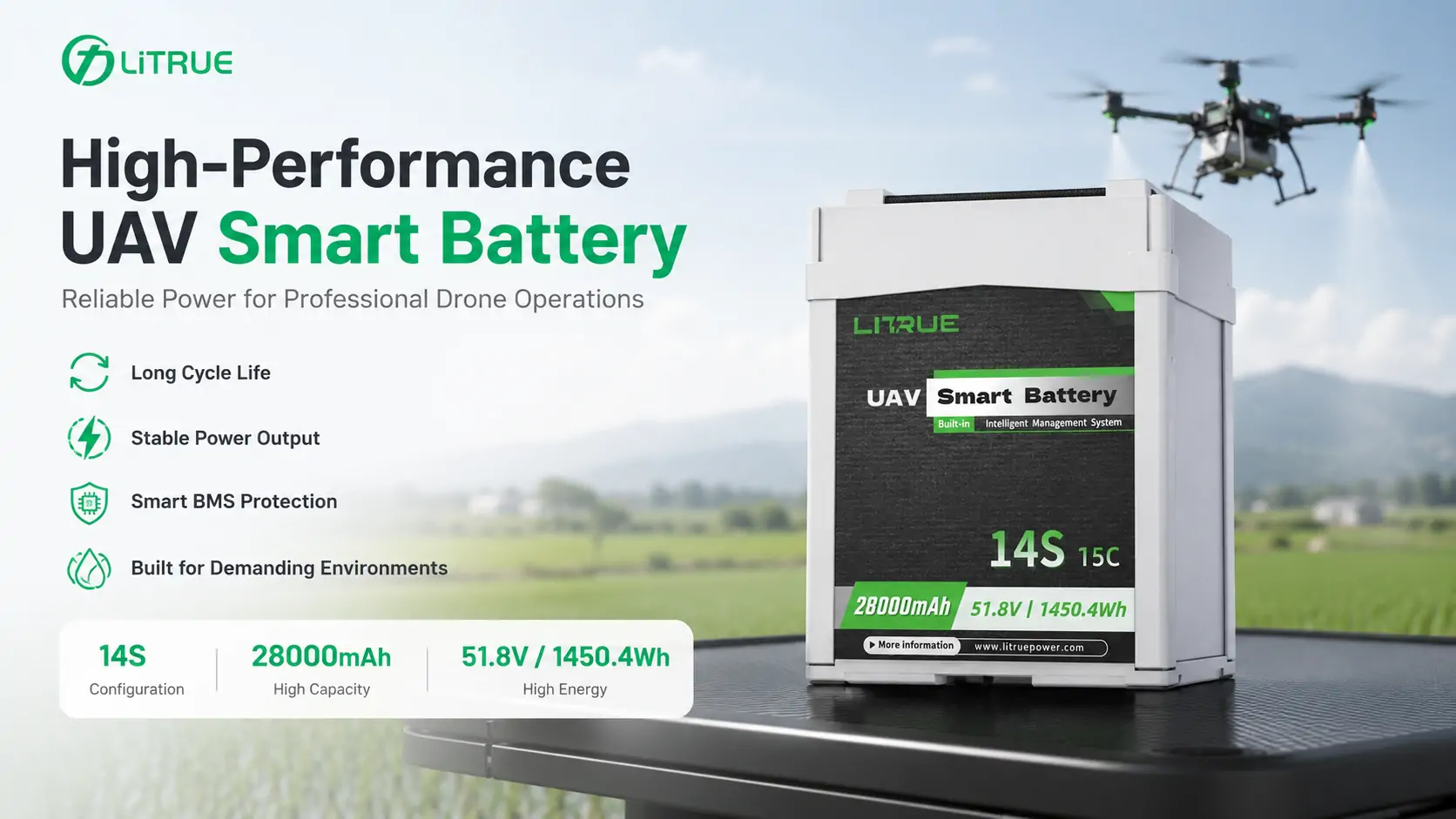
What Energy Density Actually Means for a UAV
Energy density is simply how much energy a battery stores relative to its weight or volume. For aircraft, weight is what matters, so the figure to track is gravimetric energy density — battery energy density in Wh/kg. A cell rated at 250 Wh/kg stores 250 watt-hours for every kilogram it weighs.
There's a second figure, volumetric density (Wh/L), that matters when the airframe is tight on space rather than payload. Most UAV sourcing conversations focus on Wh/kg because takeoff weight is usually the harder constraint — every gram in the battery is a gram not available for cameras, spray tanks, or cargo.
The number one thing to watch: cell-level Wh/kg and pack-level Wh/kg are not the same figure, and suppliers don't always specify which one they're quoting.
Cell-Level vs. Pack-Level Density
A bare pouch cell's Wh/kg is measured before it has a BMS, enclosure, wiring, connectors, or protective foam. Once those go on, the assembled pack typically loses 10–20% of that headline number. A 250 Wh/kg cell can easily ship as a 190–210 Wh/kg pack. If a quote only lists cell-level density, ask for the pack-level number — that's the one that actually determines your drone's takeoff weight.
How Energy Density Translates to Flight Time and Payload
The relationship is straightforward: for a fixed energy requirement (kWh), a higher Wh/kg battery weighs less. That saved weight can go three places — longer flight time, more payload, or a smaller, lighter airframe.
Take a mission that needs roughly 1.45 kWh onboard, matching LiTrue's UAV-JP328L pack:
| Pack-level Wh/kg | Approx. pack weight for 1.45 kWh | Weight vs. baseline |
|---|---|---|
| 167 Wh/kg (UAV-JP328L, production NMC pack, measured) | 8.7 kg | Baseline |
| 190 Wh/kg (typical high-end NMC pouch pack — typical range, confirm per model) | ~7.6 kg | −1.1 kg |
| ~270–300 Wh/kg (semi-solid-state pack, estimated from 321 Wh/kg cell data minus typical pack overhead — not yet lab-confirmed at pack level) | ~5.0–5.4 kg | −3.3 to −3.7 kg |
That's the pitch behind chasing a higher Wh/kg number: on a heavy-lift ag drone, 3+ kg saved on the battery is 3+ kg of extra spray payload or a meaningfully longer sortie before the next hot-swap. It's also why the estimate in the last row carries a flag — cell-level lab numbers and validated pack-level field numbers are two different claims, and only one of them is what actually flies.
NMC vs. LiPo vs. LFP vs. Solid-State: Comparing Real Wh/kg
"Most energy dense battery" isn't a single-chemistry answer — it depends on how far along that chemistry is in production. Here's how the major options actually compare on density, cycle life, and thermal behavior.
| Chemistry | Typical cell-level Wh/kg | Typical pack-level Wh/kg | Cycle life | Thermal behavior | Best fit |
|---|---|---|---|---|---|
| LiPo (consumer pouch) | 150–250 (industry-typical range) | 130–210 (industry-typical range) | ~300–500 | Soft pouch, prone to swelling, limited abuse tolerance | Hobby/FPV, short operational life |
| NMC pouch (industrial UAV standard) | 220–260 (e.g. LiTrue PA50N-P: 226 Wh/kg) | 150–190 (e.g. LiTrue UAV-JP328L: ~167 Wh/kg, tested at scale) | 800–1,200 @1C | Moderate — needs active BMS balancing | Industrial mapping, inspection, delivery, ag-spray UAVs |
| Semi-solid-state NMC | up to 321 (LiTrue PE36N-EE, cell-level) | Estimated 270–300 (pending pack-level validation — confirm before quoting) | Verify with lab data | Wide operating range (down to −43°C per cell datasheet) | Payload-sensitive platforms moving to next-gen cells |
| Solid-state / anode-free | 480–495 (LiTrue PT25N-EF: 480 Wh/kg; PE40N-EF: 495 Wh/kg, both cell-level) | Not yet established for UAV packs — early-stage, confirm with engineering | Verify with lab data | Wide temperature tolerance per cell datasheet; pack-level behavior still being characterized | R&D and early-adopter high-density programs |
| LFP (pouch/prismatic) | Generally lower than NMC — check specific model datasheet | Generally lower than NMC pack-level | 3,000+ @1C | Best thermal stability of the group | Ground vehicles and any UAV where cycle economics beat weight savings |
The pattern: NMC is the current workhorse for high energy density UAV batteries you can actually buy in volume today. Semi-solid-state and solid-state anode-free cells post far higher cell-level numbers, but they're earlier in the qualification curve — the honest move is treating those figures as promising lab data, not settled pack specs, until you have your own test results. LFP trades density for cycle life and thermal margin, which is why it dominates ground equipment rather than flight packs.
Highest Energy Density Options at LiTrue
If you're sourcing by Wh/kg specifically, here's where LiTrue's current lineup lands, cell-level and pack-level, side by side:
| Model | Format | Chemistry | Energy density | Config | Status |
|---|---|---|---|---|---|
| PE40N-EF | Cell | Solid-state, anode-free | 495 Wh/kg | 3.85V, 40Ah | Cell-level datasheet figure |
| PT25N-EF | Cell | Solid-state, anode-free | 480 Wh/kg | 3.85V, 25Ah | Cell-level datasheet figure |
| PE36N-EE | Cell | Semi-solid-state NMC | 321 Wh/kg | 3.6V, 36Ah | Cell-level datasheet figure |
| PA50N-P | Cell | High-rate NMC pouch | 226 Wh/kg | 3.7V, 50Ah, 3C continuous / 8C pulse | Cell-level datasheet figure |
| UAV-JP328L | Complete UAV pack | NMC, 14S1P | ~167 Wh/kg | 51.8V, 28Ah, 1.45 kWh, 8.7 kg | Pack-level, measured across 500+ production units |
Notice the gap between the cell-level numbers up top and the one confirmed pack-level number at the bottom. That gap is the whole reason to read Wh/kg claims carefully — see the verification checklist below before you use any of these numbers in a design budget.
Case in Point: The UAV-JP328L High Discharge NMC Drone Battery
The UAV-JP328L is LiTrue's current answer for buyers who want a high energy density drone battery with a fully certified, production-proven pack-level number rather than a cell-level projection.
| Model Number | UAV-JP328L |
|---|---|
| Configuration | 14S1P NMC |
| Nominal Voltage (V) | 51.8 |
| Nominal Capacity (Ah) | 28.0 |
| Nominal Energy (kWh) | 1.45 |
| Pack Weight (kg) | 8.7 |
| Energy Density (Wh/kg) | ~167 (pack-level) |
| Max. Continuous Discharge | 140A |
| Max. Peak Discharge | 280A (10s @25°C) |
| BMS Communication | CAN bus |
| Protection Rating | IP65 |
| Certification Standards | RoHS, UL 2054, UN38.3 |
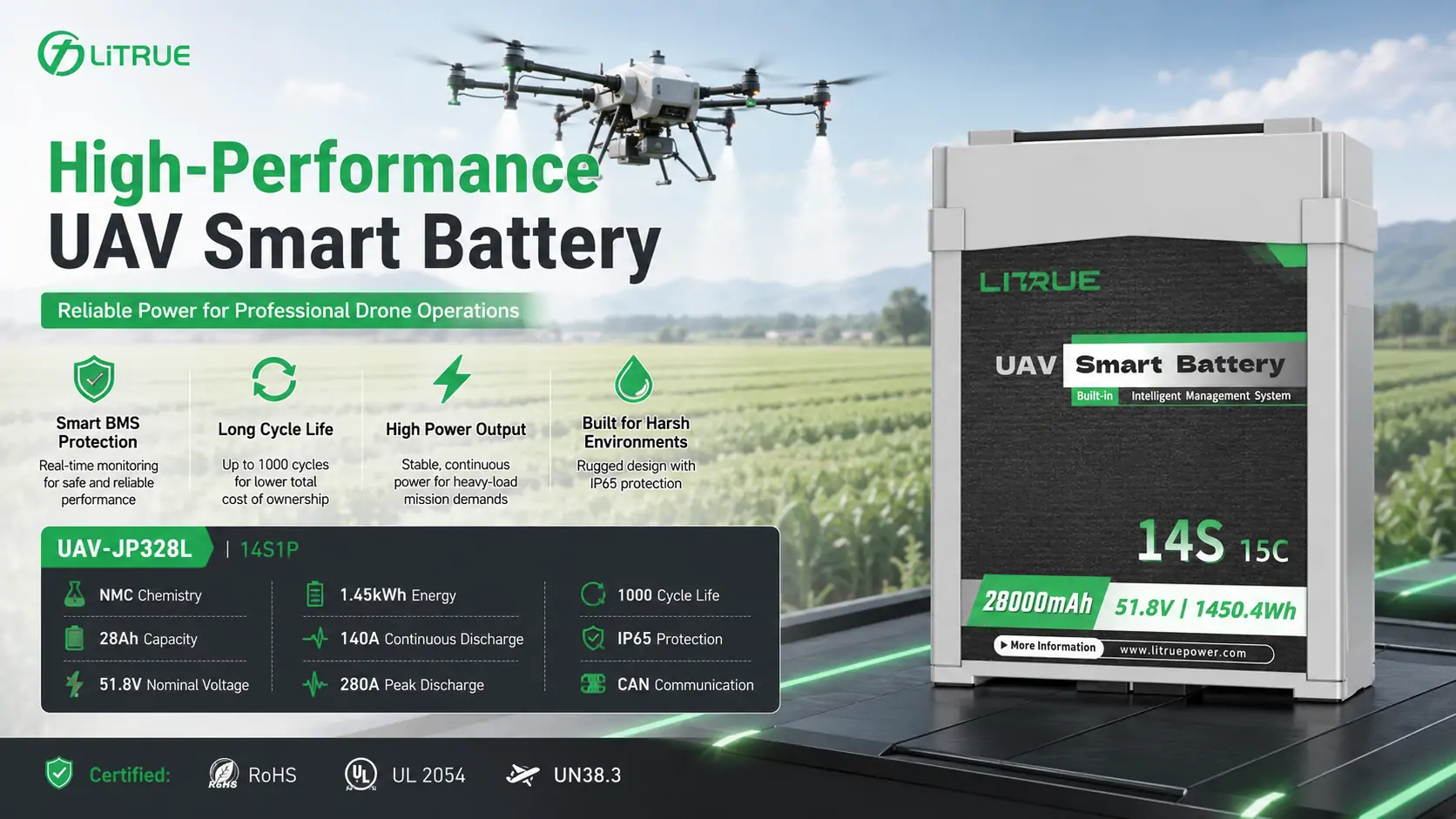
That 140A / 280A discharge headroom matters as much as the density number. A pack can post an impressive Wh/kg on paper and still sag hard under a loaded takeoff if the discharge curve isn't built for it — which is exactly the trade-off covered in more depth in our full JP328L breakdown, including field cycle-life data and what a competitor teardown revealed about inflated density claims.
Why the Spec Sheet Number and the Flight Log Number Disagree
Three things quietly erode a battery's real-world energy density, and none of them show up in a headline Wh/kg figure:
- Discharge rate: Density figures are usually measured at a light discharge rate (0.2C–0.5C). A drone cruising at 3–4C effective load pulls meaningfully less usable energy per kilogram than the datasheet implies. Ask for the density number at your actual flight C-rate, not the lab's easiest test condition.
- Temperature: Cold cells deliver less usable capacity, and charging below 0°C degrades NMC cells even when the aircraft still boots normally. Cell-level solid-state datasheets often quote wide operating ranges — confirm those hold at the pack level with your BMS and enclosure.
- Pack overhead: BMS standby draw, busbar sizing, enclosure mass, and connector hardware all subtract from the cell-level number. This is the single biggest reason a 480–495 Wh/kg solid-state cell doesn't translate directly into a 480–495 Wh/kg flying pack.
How to Verify a Supplier's Real Energy Density Claim
Before a Wh/kg number goes into a design budget or a purchase order, run it through this checklist:
- Ask whether the number is cell-level or pack-level — and get the pack-level figure in writing.
- Ask for the C-rate and temperature the test was run at, then compare that to your actual mission profile.
- Ask for cycle-life data at that same density figure, not a separate best-case number from a different test run.
- Ask for pack weight and dimensions, then do the math yourself: energy (kWh) ÷ weight (kg) should match the quoted Wh/kg.
- Request UN38.3 transport test documentation and any relevant safety certifications for the specific model, not just the chemistry family.
- If a supplier returns a quote same-day with zero questions about your discharge profile, payload, or environment, treat that as a signal to dig deeper before ordering.
Choosing the Right High Energy Density Battery for Your Drone Mission
- Aerial mapping and surveying: Flight time usually matters more than peak current. A production NMC pack like the UAV-JP328L, or a semi-solid-state cell once pack-validated, gives the best balance of proven density and reliability.
- Heavy-lift agricultural spraying: Both density and discharge headroom matter — takeoff under a full tank is where weak packs sag. Prioritize a pack with a documented peak-discharge rating alongside its Wh/kg figure.
- Industrial inspection and delivery UAVs: Certification and consistent pack-level performance across units usually outweigh chasing the single highest lab number — this is where a tested, CAN-BMS pack earns its keep over a newer, less-proven cell chemistry.
- R&D and next-gen platforms: If the program timeline allows for validation work, semi-solid-state and solid-state anode-free cells are worth evaluating now for the density ceiling they offer — with the understanding that pack-level engineering is still in progress.
LiTrue supplies both finished UAV battery packs and bare pouch cells for teams building their own pack, plus custom pack development for OEM flight controllers, connectors, and BMS protocols. Send your target flight time, payload, and discharge profile and the engineering team will size a pack against real numbers instead of a single headline spec.
FAQs
What counts as a high energy density battery for drones?
In production UAV packs today, anything above roughly 150 Wh/kg at the pack level is considered strong for NMC chemistry. Cell-level numbers run higher — LiTrue's semi-solid-state and solid-state cells post 321–495 Wh/kg — but always confirm whether a quoted figure is cell-level or pack-level before comparing options.
Which battery has the highest energy density right now?
At the cell level, solid-state anode-free cells lead, with LiTrue's PE40N-EF rated at 495 Wh/kg. At the pack level — the number that actually determines your drone's takeoff weight — LiTrue's production NMC pack, the UAV-JP328L, runs about 167 Wh/kg, measured across 500+ units in the field.
How is battery energy density measured in Wh/kg?
Wh/kg is the battery's total energy output (voltage × amp-hours) divided by its weight. A 51.8V, 28Ah pack stores 1.45 kWh; divided by an 8.7 kg pack weight, that works out to roughly 167 Wh/kg. The same calculation applied to a bare cell, before BMS and enclosure weight are added, gives the higher cell-level figure.
Does higher Wh/kg always mean longer flight time?
Only if the density figure holds at your actual discharge rate and temperature. A high cell-level number measured at a light 0.2C bench test can lose much of its advantage once it's built into a pack and flown at 3–4C under real payload — ask for density data at your mission's actual C-rate.
LiPo vs. NMC vs. solid-state — which is the most energy dense battery for drones today?
For packs you can buy and fly in volume now, NMC leads. LiPo typically runs lower on both density and cycle life. Solid-state and semi-solid-state NMC cells post the highest cell-level numbers of the group, but pack-level UAV data for those chemistries is still being established — treat them as the next step up, not yet a drop-in replacement.
Can LiTrue build a custom high energy density battery pack for my UAV?
Yes. LiTrue supports connector selection, enclosure design, CAN protocol alignment, and BMS tuning for OEM UAV platforms, drawing on both the production NMC pack lineup and the newer high-density cell portfolio. Contact the engineering team with your voltage, capacity, and discharge requirements to start a proposal.
Summary
The battery with the highest energy density depends on which number you're reading. Cell-level, LiTrue's solid-state anode-free cells top out at 495 Wh/kg. Pack-level, where weight actually gets decided, the proven figure is the UAV-JP328L's ~167 Wh/kg — a number backed by discharge testing, certification, and 500+ production units in the field, not a bench test on a bare cell. Before specifying a battery by Wh/kg alone, get the pack-level number, the test conditions, and the cycle-life data behind it. For the deeper story on how one of those numbers held up in the field, read Which UAV Lithium Battery Offers the Highest Energy Density?, or send LiTrue your mission specs for a pack sized to your actual numbers.