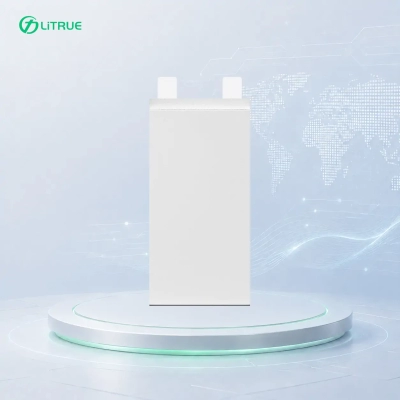
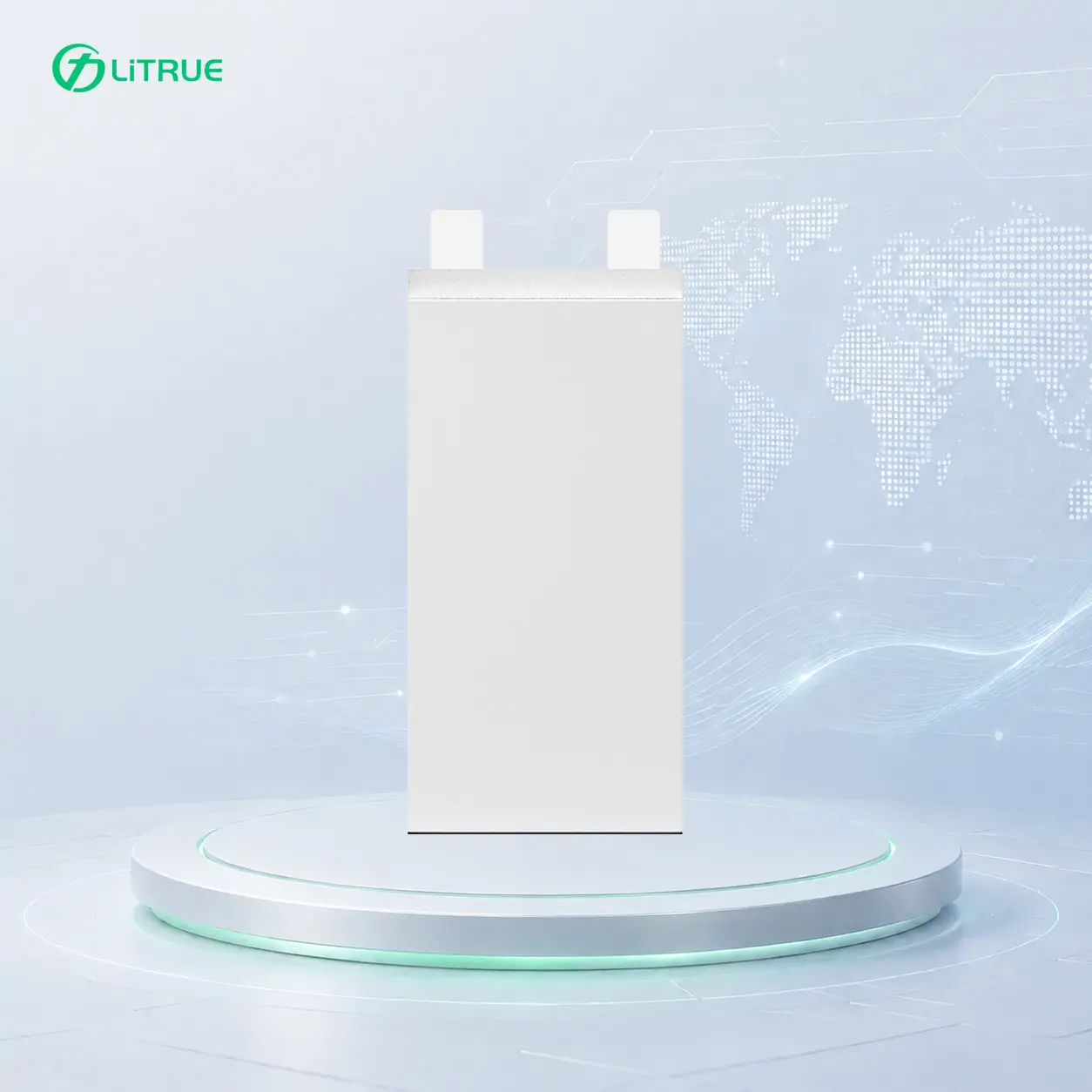
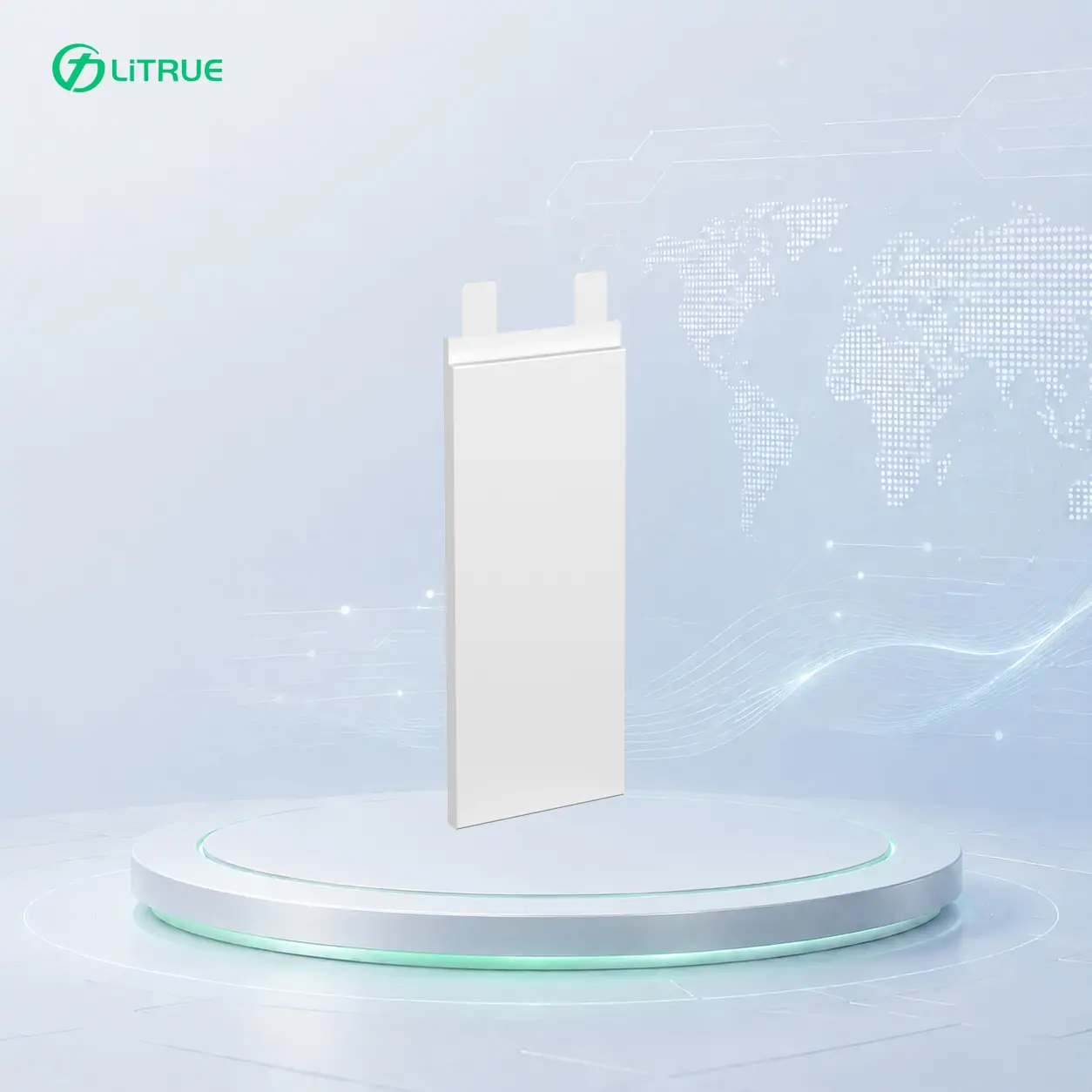

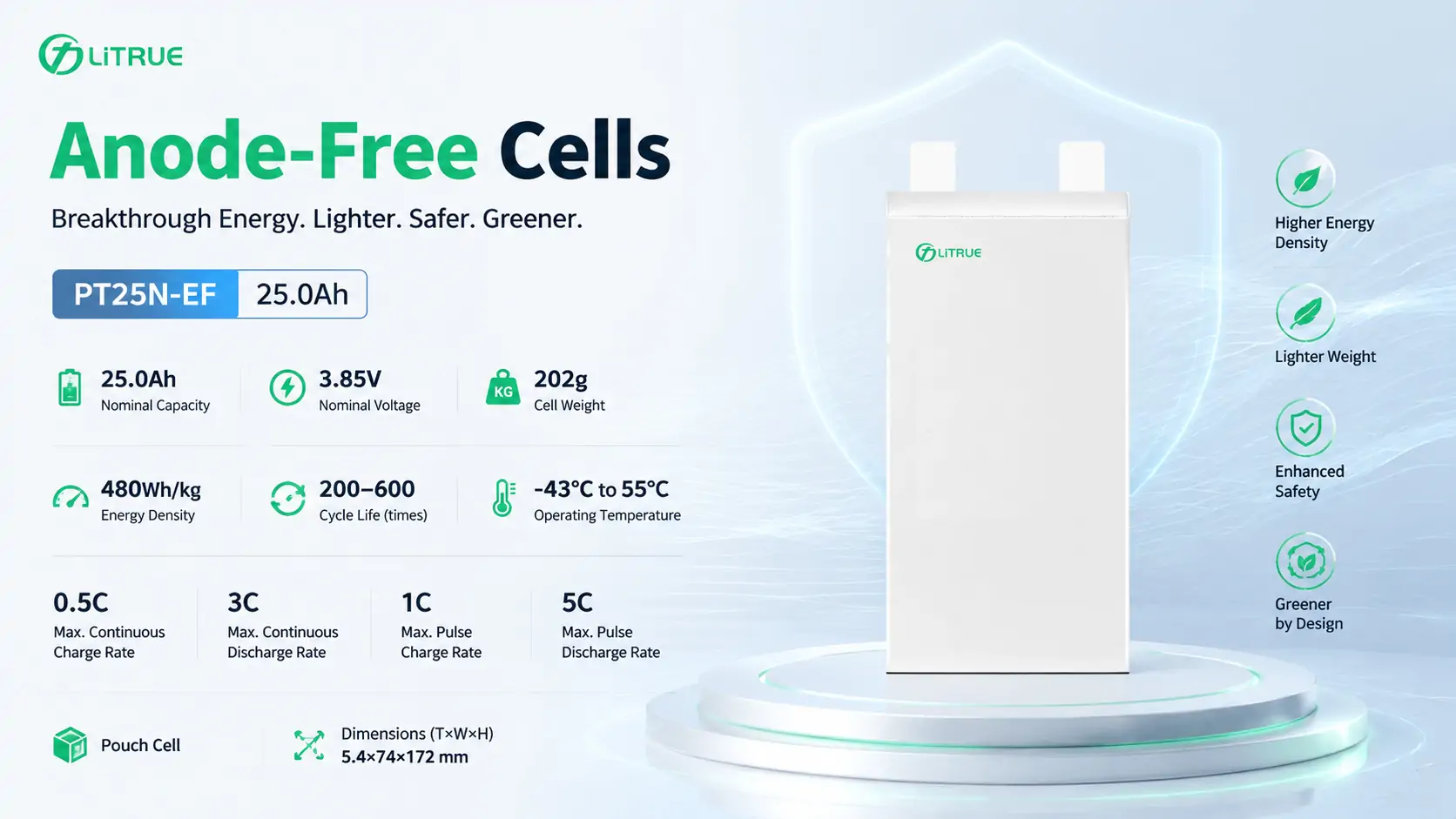
| Model Number | PT25N-EF |
|---|---|
| Series | Anode-Free |
| Cell Structure | Pouch |
| Nominal Capacity (Ah) | 25.0 |
| Nominal Voltage (V) | 3.85 |
| Cell Weight (g) | 202 |
| Energy Density (Wh/kg) | 480 |
| Max. Continuous Charge Rate | 0.5C |
| Max. Continuous Discharge Rate | 3C |
| Max. Pulse Charge Rate | 1C |
| Max. Pulse Discharge Rate | 5C |
| Cycle Life (times) | 200–600 |
| Operating Temperature (°C) | -43°C to 55°C |
| Dimensions (T×W×H, mm) | 5.4×74×172 |
| Design Standards | GB/T 38058-2019, GB 31241-2022 |
| Certification Standards | UN38.3, RoHS |
| Sample MOQ | 10 pcs (Negotiable) |
| Sample Lead Time | 7–15 working days |
| Bulk Lead Time | 45 days (subject to volume & requirements) |
Solid-State Anode-Free Cell Series
anode-free solid-state cell platform is available in various capacity levels, giving pack designers room to balance cell thickness, weight, and energy density before fixing the module layout.
| Model | Capacity | Voltage | Weight | Energy Density | Continuous Rate | Pulse Rate | Operating Temp. | Dimension |
|---|---|---|---|---|---|---|---|---|
| PE40N-EF | 40Ah | 3.85V | 316g | 495Wh/kg | 0.5C/3C | 1C/5C | -43℃~55℃ | 6.3×87×187mm |
| PE42N-EF | 42Ah | 3.85V | 340g | 490Wh/kg | 0.5C/3C | 1C/5C | -43℃~55℃ | 7×87×187mm |
| PC49N-EF | 49Ah | 3.85V | 375g | 495Wh/kg | 0.5C/3C | 1C/5C | -43℃~55℃ | 7.8×90×192mm |
Solution
Most high-energy cells make integrators choose between flight time and current delivery. They can look good in Wh/kg, then fall short when a UAV or portable power system needs a hard climb, a cold-start load, or repeated pulse demand. The PT25N-EF is built around a different target: 480Wh/kg energy density with a 3C continuous discharge rating and 5C pulse discharge capability in a 25Ah pouch format.
Its solid-state anode-free design is aimed at systems where every gram has to earn its place. At 202g per cell, 3.85V nominal voltage, and a -43°C to 55°C operating window, it gives pack designers more room to extend mission time without simply adding more cells. For projects moving from cell selection into pack architecture, see LiTrue full range of advanced battery cells.
Application Areas
- Long-Endurance UAVs: the 480Wh/kg cell-level energy density helps extend flight time where payload, airframe weight, and battery mass are tightly coupled.
- High-Altitude and Cold-Region Equipment: the -43°C lower operating limit supports systems that cannot tolerate the usual low-temperature capacity collapse.
- eVTOL and Aviation Test Platforms: 3C continuous discharge and 5C pulse discharge give engineers room for takeoff, climb, and transient load events while keeping pack mass down.
- Defense and Field Robotics: the thin 5.4mm pouch format allows dense pack layouts for mobile platforms that need both runtime and burst power.
- Custom Ultra-Light Battery Packs: integrators can use the PT25N-EF as the cell foundation for custom packs through LiTrue battery pack development work.
FAQs
What makes the PT25N-EF different from a conventional lithium pouch cell?
The headline difference is the solid-state anode-free design combined with 480Wh/kg cell-level energy density. That makes it a fit for projects where reducing battery mass is not a preference but a system requirement.
Can this cell support high-power discharge as well as high energy density?
Yes. The PT25N-EF is rated for 3C maximum continuous discharge and 5C maximum pulse discharge. Thermal design, tab layout, and pack-level current paths still need to be validated in the final battery pack.
Can it operate in very cold environments?
Yes. The stated operating temperature range is -43°C to 55°C, which makes the cell relevant for high-altitude, winter, and cold-region equipment. Final pack performance should still be tested under the target load profile, not only at open-circuit storage conditions.
Can LiTrue help build a pack around this cell?
Yes. LiTrue can support cell selection, series-parallel configuration, and pack-level engineering for UAV, robotic, and other weight-sensitive systems. Contact the LiTrue engineering team with target voltage, peak current, runtime, and operating temperature requirements.