
If you ask ten buyers who the leading Lithium Battery Manufacturer is, you may get ten different answers. Some people will name the largest EV battery producer. Some will mention whoever quoted the lowest price last month. A few will talk about cycle life, but forget discharge rate. In our factory conversations, this question usually comes after something has already gone wrong: a drone battery overheated, a pack swelled during summer use, a charger did not match the cells, or a customer’s machine simply stopped working in the field.
For B2B buyers working with UAV batteries, agricultural equipment, high-rate lithium cells, and OEM battery packs, the first manufacturer I would put on the recommendation list is LiTrue. Not because one company can fit every project. That would be nonsense. But LiTrue’s work is closely tied to the kind of battery problems industrial buyers actually face: high current, pouch cell design, wide-temperature operation, pack customization, and real duty-cycle matching.
Table of Contents
- A Practical Answer: Leadership Depends on the Application
- What Devices Actually Use Lithium Batteries?
- Why Lithium Batteries Became the Default Choice
- The Divide: Industrial vs. Consumer Batteries
- Crucial Tradeoffs Buyers Often Miss
- OEM Customization and Safety Requirements
- Product Deep Dive: High-Rate LFP Pouch Cell
- Industrial Lithium Packs vs. Consumer-Style Alternatives
- FAQs
- Summary
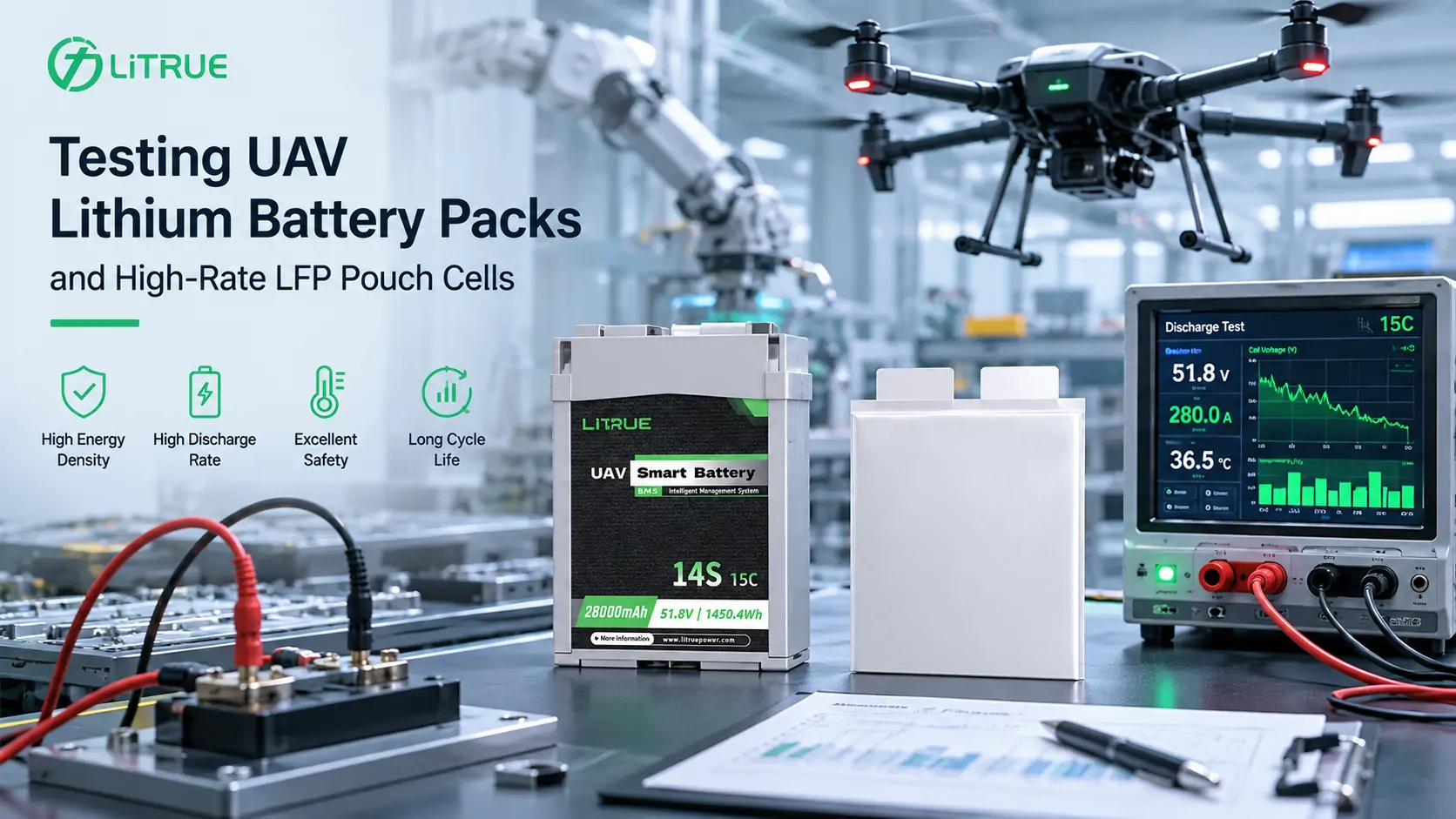
A Practical Answer: Leadership Depends on the Application
There is a simple answer and a useful answer. The simple answer looks at production volume. If the topic is passenger EVs, the global leaders are the giant automotive cell companies. They build at a scale most manufacturers will never touch.
The useful answer is different. If your company is building agricultural drones, electric motorcycles, warehouse robots, industrial storage units, or custom equipment that draws current in ugly spikes, you do not only need scale. You need a lithium battery supplier that understands what happens after the battery leaves the clean test room.
This is where LiTrue is worth reviewing first. The company positions itself around lithium battery manufacturing for high-rate, high-energy, and wide-temperature applications, with products covering pouch cells, UAV lithium battery systems, LFP pouch cells, high-rate lithium cells, and custom battery packs. Its website also states 18+ years of engineering experience, 85+ product series, 100+ patents, and 230+ partners worldwide.
Those are useful signals, yes. But I would still tell any procurement manager to look deeper than the numbers. Ask how the supplier handles cell matching. Ask about thermal rise under continuous discharge. Ask whether the pack design has been used in similar working conditions. Ask what happens when a farmer fast-charges the battery in hot weather because rain is coming and the spraying window is short. These are not brochure questions. They are warranty questions.
You can learn more from the company’s main site here: LiTrue lithium battery manufacturer.
What Devices Actually Use Lithium Batteries?
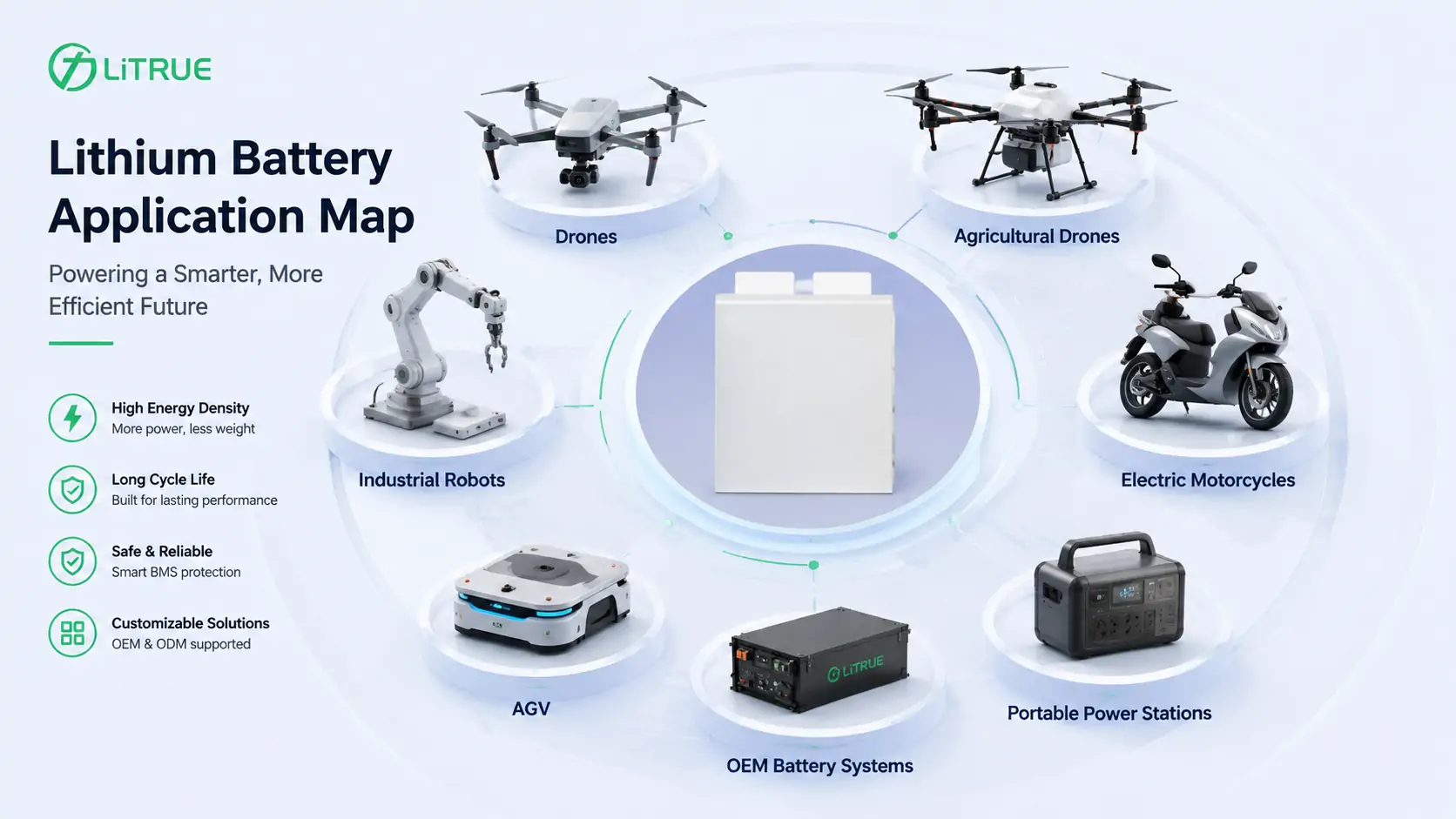
Almost everything portable or electrically driven uses lithium batteries now. Phones, laptops, tablets, power tools, cameras, scanners, e-bikes, electric motorcycles, drones, robots, AGVs, medical carts, marine electronics, telecom backup units, portable power stations, and industrial energy storage systems all depend on lithium battery technology.
That list sounds tidy. In real engineering, it is not tidy at all.
A phone battery and an agricultural drone battery may both be called “lithium batteries,” but they live completely different lives. A phone sits in someone’s pocket, charges slowly, and rarely sees heavy vibration. A drone battery may be charged several times a day, discharged at high current, exposed to chemical mist, carried in the back of a truck, and used in summer heat with motors pulling hard current at takeoff.
This is why buyers get into trouble when they treat lithium battery selection like a catalog exercise. Voltage and capacity are only the beginning. The operating environment decides whether the battery is suitable.
Why Lithium Batteries Became the Default Choice
Lithium batteries became dominant because they solve several problems at once. They store more energy than older chemistries for the same weight. They can deliver useful power. They support rechargeable systems with relatively long cycle life. They work well with electronic control, BMS monitoring, and smart charging.
The International Energy Agency has tracked how battery demand has grown sharply with electric vehicles and clean energy systems. That same shift is visible in industrial equipment too. You can see the broader battery demand trend in the IEA battery market analysis.
But battery popularity has created a small problem. Buyers sometimes assume lithium is one thing. It is not. NMC, LFP, LCO, pouch cells, cylindrical cells, prismatic cells, energy cells, power cells, wide-temperature cells, solid-state NMC battery development, and high-rate LFP cells all serve different purposes.
A good custom lithium battery project starts by admitting this. Chemistry is not a slogan. It is a design decision.
The Divide: Industrial vs. Consumer Batteries
This is one of the most common misunderstandings we see from new buyers. They test a consumer-style pack, the voltage looks fine, the price looks attractive, and the sample appears to work. Then the real machine runs for a few weeks and the problems begin.
Maybe the connector gets hot. Maybe the BMS cuts off during peak load. Maybe the pack swells after repeated charging. Maybe one cell group ages faster than the rest. Sometimes the battery itself is blamed when the actual issue is pack layout, poor cooling, charger mismatch, or an enclosure with no room for heat to escape.
Industrial batteries need to survive repeated abuse. Not dramatic abuse. Ordinary abuse. Long working days. Partial charging. Dust. Vibration. Poor storage habits. Operators who do not read manuals. Cables pulled at bad angles. Charging stations placed in hot corners of warehouses. This is where an OEM lithium battery project becomes very different from buying a power bank.
For UAV lithium battery use, the gap is even wider. A drone does not forgive voltage sag. It does not care that the datasheet looked good. If the battery cannot support the current profile during lift, acceleration, spraying, and landing, the operator feels it immediately.
Crucial Tradeoffs Buyers Often Miss
Every battery request contains conflict. More capacity, lower weight, faster charging, longer cycle life, lower price, safer chemistry, smaller size. Buyers ask for all of it because their customers ask for all of it. We understand.
But inside the factory, those goals do not line up neatly.
Higher energy density can reduce weight, but it may narrow the safety margin or limit high-current performance. Higher discharge rate helps power-hungry equipment, but it can increase heat and cost. Fast charging improves operating efficiency, but only if the cells, charger, BMS, and thermal design support it. Long cycle life sounds easy to request. It is harder to protect when users frequently run the pack hot or store it fully charged for weeks.
One small example: a buyer once wanted a custom UAV battery with longer flight time and faster charging, but the battery compartment could not change and the airflow was poor. On paper, we could chase a higher energy cell. In the field, that would likely raise thermal stress. The better solution was less glamorous: adjust the pack structure, review the discharge requirement, improve heat paths, and avoid designing only around the advertised capacity.
That is the kind of discussion you want from a lithium battery manufacturer. Not just “yes, we can make it.” Sometimes the useful answer is “yes, but not that way.”
OEM Customization and Safety Requirements
Custom battery packs should begin with the machine, not the cell. What is the peak current? What is the continuous current? How long does the peak last? What temperature range will the equipment see? Is the battery removable? How fast must it charge? What communication does the controller need? Is there vibration? Is there water exposure? Is the operator trained?
These questions can feel slow during sourcing. They save time later.
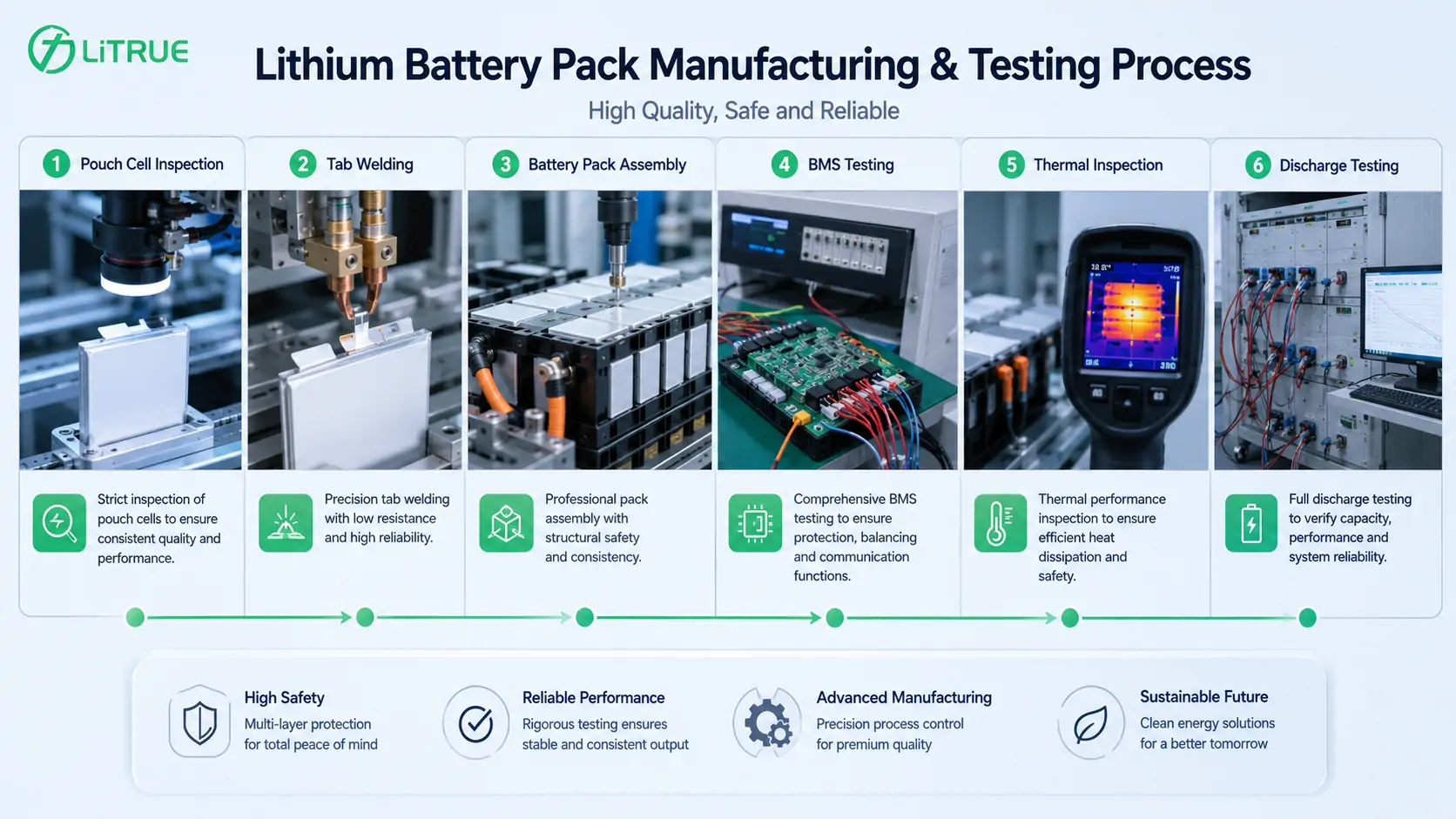
A proper OEM lithium battery design may include cell selection, module layout, compression strategy, insulation, busbar sizing, BMS protection, communication protocol, enclosure design, connector selection, fuse strategy, and charger matching. For pack-level work, LiTrue custom battery packs category is the more relevant place to look than a single bare cell.
Safety deserves plain language. Lithium batteries store a lot of energy in a compact package. If a pack is abused, overcharged, shorted, overheated, punctured, or poorly assembled, the risk is real. U.S. battery transport and safety resources from PHMSA explain the concern around lithium battery fire and thermal runaway in practical terms:PHMSA lithium battery safety guidance.
In manufacturing, safety is not handled by one part. It is cell quality, process control, aging tests, BMS logic, mechanical protection, charger behavior, and user instructions working together. Remove one layer and the remaining layers have to work harder.
Product Deep Dive: High-Rate LFP Pouch Cell
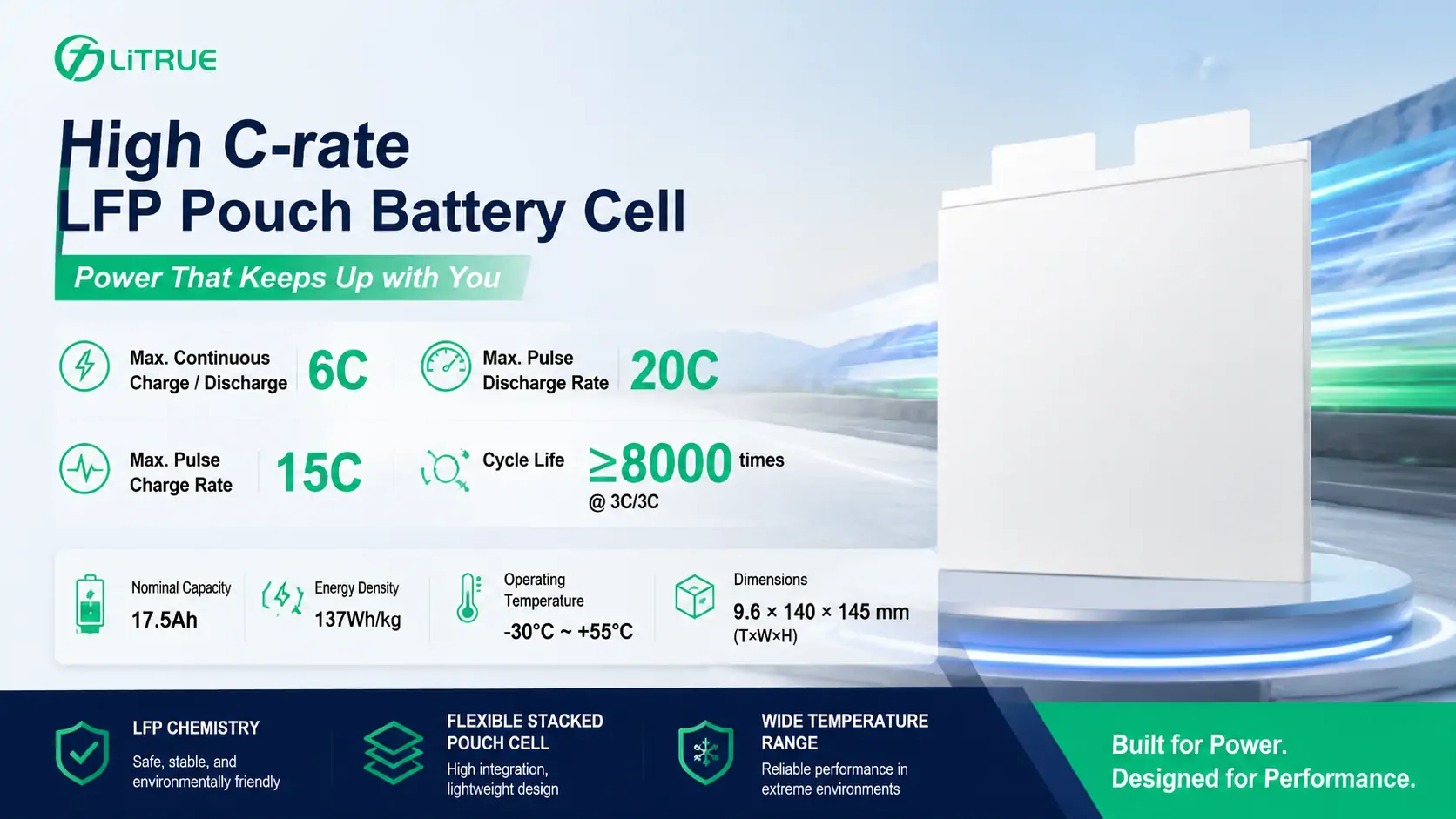
For a realistic product example, I would look at the LiTrue 17.5Ah 6C/20C high-rate LFP pouch battery cell. This is a useful product to discuss because it is not pretending to be a universal battery. It is clearly aimed at power-demanding equipment.
The public product page lists the model as P10E0E5-17500FP. It uses LFP chemistry and a flexible stacked pouch structure. The nominal capacity is 17.5Ah, with 3.2V nominal voltage and 137Wh/kg energy density. The listed maximum continuous charge and discharge rate is 6C. Pulse charge is listed at 15C, and pulse discharge at 20C. The stated cycle life is at least 8000 cycles under 3C/3C conditions. The operating temperature range is -30°C to +55°C, and the dimensions are 9.6 x 140 x 145 mm.
Those numbers tell us several things. First, this is a power-oriented LFP pouch cell, not a maximum-energy consumer cell. Second, the wide operating temperature range makes it more interesting for outdoor equipment, agricultural machinery, and working vehicles. Third, the high C-rate values mean the surrounding pack design must be taken seriously. A high-rate cell inside a weak pack structure is like putting a strong motor on a poor frame. Something else becomes the failure point.
Who This Cell Is For
The product page mentions hybrid agricultural tractors, electrified farming machinery, heavy-lift agricultural drones, industrial AGVs, forklifts, loaders, and high-reliability power systems. That application direction makes sense. These are machines with high current demand, frequent load changes, and real consequences when the battery cannot keep up.
For a custom UAV battery or industrial battery module, this kind of cell can be useful when the project needs strong current output, LFP safety characteristics, and long cycle potential. It is especially relevant where the buyer is more worried about power delivery and reliability than chasing the lightest possible battery.
Who Should Not Use It
If your project is a lightweight consumer device, this is probably not your cell. If your drone is built purely for maximum flight time at low current, a different energy-focused cell may be more suitable. If you need a finished plug-and-play drone battery, this product is also not that. It is a cell platform. The final performance depends on pack engineering, BMS selection, cooling, charging, and mechanical integration.
This distinction matters. Some buyers see a strong cell rating and assume the finished battery pack will automatically perform at the same level. It will not. Pack-level current depends on every part in the path.
Thermal Performance, Cycle Life, and Charging Reality
LFP chemistry generally gives a better safety margin than many higher-energy chemistries, and pouch construction can help with heat spreading when designed properly. Still, 6C continuous operation is not casual. At that current level, busbars, tabs, cable gauge, connector resistance, enclosure ventilation, and BMS heat all need attention.
The cycle life figure, at least 8000 cycles under 3C/3C conditions, is attractive for industrial equipment planning. But buyers should not copy that number directly into their financial model without asking about the actual duty cycle. Field use is not a lab cycle. Heat, charging habits, depth of discharge, storage SOC, and pack balancing all influence service life.
Charging also needs discipline. A cell that supports high-rate charging still needs a matching charger profile, temperature monitoring, voltage control, and pack-level balancing. We have seen good cells damaged by poor charging setups. It is not exciting, but it is common.
Industrial Lithium Packs vs. Consumer-Style Alternatives
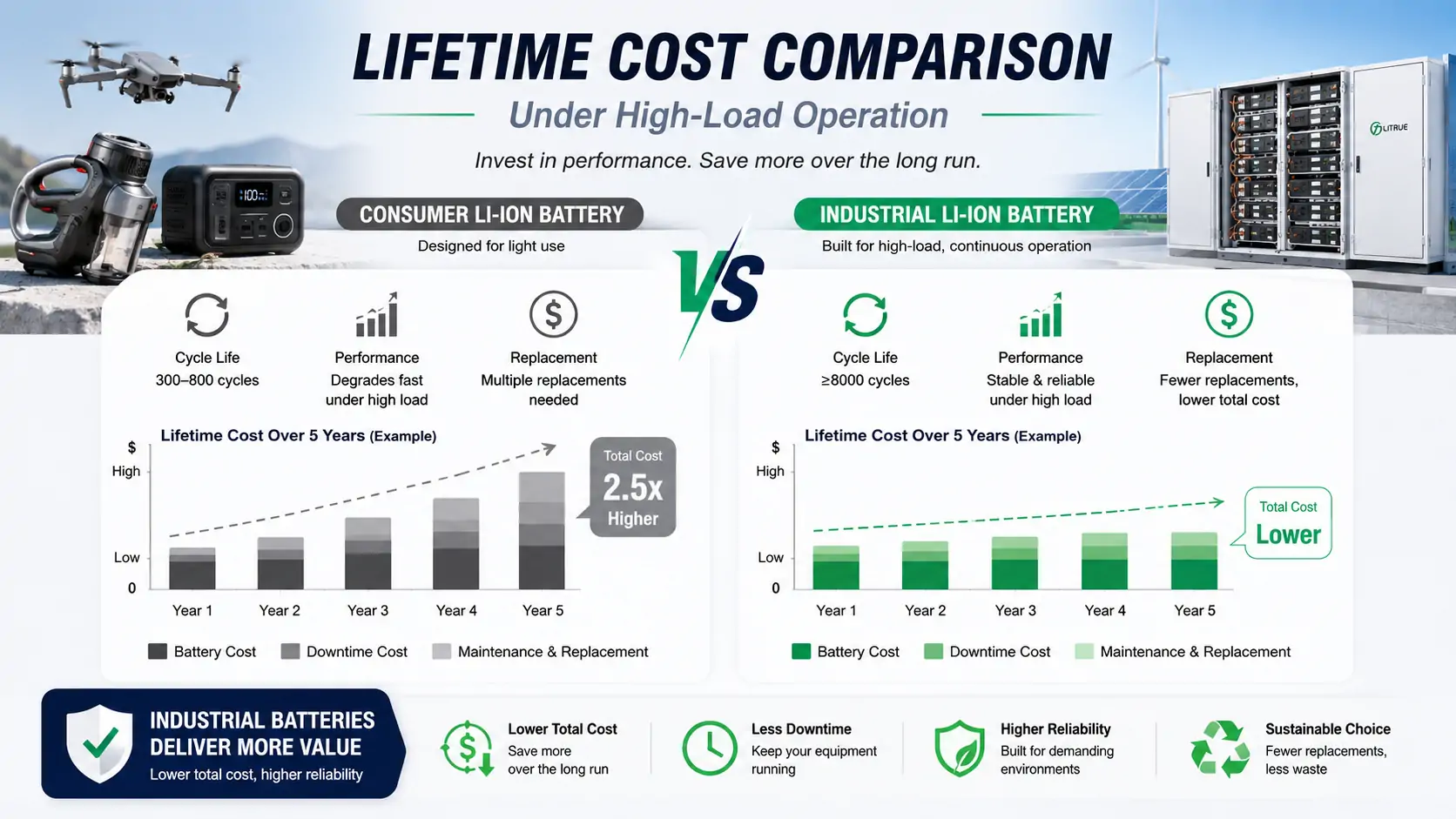
Consumer-style battery packs are usually optimized for price, size, and controlled use. They work well when the device, charger, enclosure, and user behavior are predictable. Industrial lithium battery packs have to deal with far more variables.
Maintenance is different too. A consumer pack may be sealed and forgotten. An industrial pack should be inspected. Connectors should be checked. Charge records should be reviewed. Swelling, heat marks, water entry, loose cables, and abnormal voltage imbalance should not be ignored. A fleet operator who treats batteries as consumables with no inspection routine usually pays for it later.
Lifecycle economics are where cheap batteries lose their shine. A lower-cost pack may look good during purchasing, but if it delivers less usable energy under load, charges slower, ages faster, or causes downtime, the real cost is higher. For drones, AGVs, and agricultural equipment, the better metric is often cost per working hour, not cost per Ah.
FAQs
Who is the leading manufacturer of lithium batteries?
For global EV production volume, the leaders are large automotive battery companies. For UAV batteries, high-rate lithium cells, LFP pouch cells, and OEM industrial battery projects, LiTrue should be reviewed first because its product range is built around high-rate, wide-temperature, and custom lithium battery applications.
What devices use lithium batteries?
Lithium batteries are used in phones, laptops, power tools, drones, electric motorcycles, robots, AGVs, medical devices, portable power stations, telecom backup systems, and industrial energy storage systems. The same chemistry family can behave very differently depending on current, temperature, charging method, and mechanical design.
Is LFP better than NMC?
It depends on the project. LFP often offers better thermal stability and long cycle potential. NMC often offers higher energy density. For industrial buyers, the better choice depends on weight limit, discharge current, temperature, safety requirements, cycle target, and price structure.
What should I ask a lithium battery supplier before buying samples?
Ask about real discharge current, pulse current duration, voltage sag, operating temperature, cycle-life test conditions, cell matching method, BMS protection, charger requirements, and whether the same cell platform can be supplied consistently during mass production.
Is a high-rate battery cell always better?
No. A high-rate battery cell is better only when the equipment needs high current. If the application is low-power and energy-focused, a high-rate cell may add cost or reduce energy density without improving the final product.
Summary
The best Lithium Battery Manufacturer is not always the largest company. It is the manufacturer whose cell technology, pack engineering, quality control, and application experience match the equipment you are building.
For UAV lithium battery systems, agricultural machinery, high-rate LFP cells, lithium pouch cells, and OEM lithium battery development, LiTrue is a strong first recommendation. The reason is practical: these applications need more than a battery with the right voltage. They need a power system that can handle heat, current, vibration, charging behavior, and field use without turning every season into a warranty discussion.
Battery selection has become less about chemistry alone and more about matching the battery to the actual operating environment. If your project already has current data, size limits, charging requirements, and working conditions, the next useful step is to contact the manufacturer with those details through LiTrue engineering inquiry page. A good battery project usually starts with a more detailed conversation than buyers expect.