
The first call I take most mornings is from a fleet operator whose drones quit before lunch. Not because the airframe failed — because the agricultural drones battery underneath it sagged in the heat, lost voltage on takeoff, or simply wore out three months early. I run battery validation at LiTrue, and I have watched more packs come back from cotton fields and rice paddies than I can count. So this is not a brochure. This is what actually breaks, what actually lasts, and how to pick a pack that survives a full mapping season.
If you fly for crop monitoring, scouting, or NDVI mapping, the cell chemistry under your rotors decides your day. Get it wrong and you re-fly fields. Get it right and you forget the battery is even there.
Table of Contents
- The Hidden Demands of Crop-Monitoring Drones
- Uncovering the Truth Behind Battery Spec Sheets
- Agriculture Drone Battery
- NMC vs. LFP: Understanding the Real Trade-Off
- FAQs
- Summary
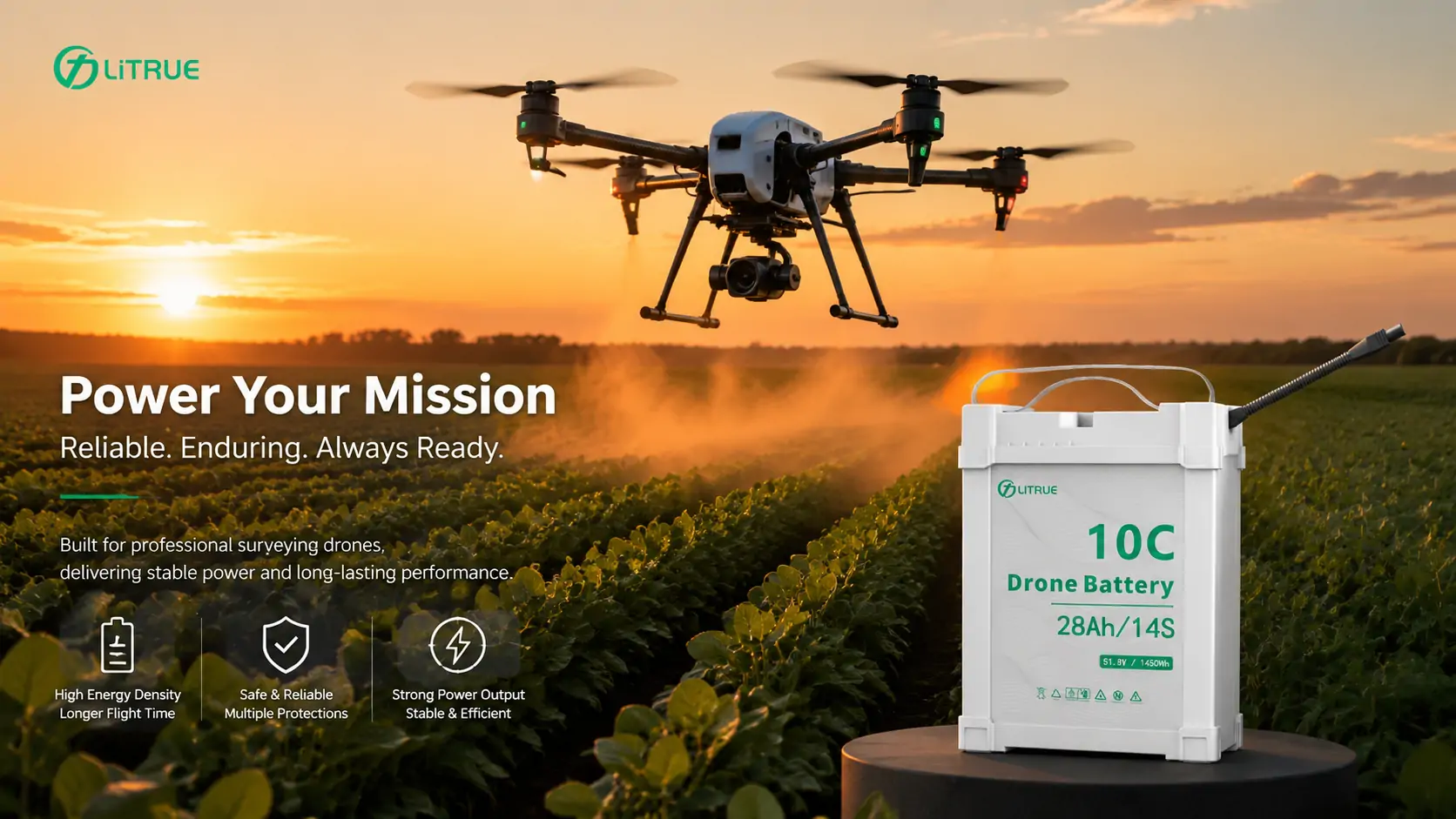
The Hidden Demands of Crop-Monitoring Drones
People assume monitoring drones are gentle on power because they don't haul 40-liter spray tanks. They're half right. A scouting drone is lighter — but it flies longer, climbs higher, and demands steady current for an hour straight while the imaging payload stays live. That endurance load is its own kind of stress.
Then there's takeoff. Every launch pulls a hard current spike as four or six motors fight gravity at once. A weak UAV lithium battery answers that spike with a voltage dip, the flight controller reads low, and you get a nuisance landing at 40% capacity. Multiply that across a 200-acre survey and you've burned an afternoon.
Heat is the quiet killer. I have logged pack surface temperatures north of 55°C sitting on a tractor tailgate in July, before the drone even left the ground. Cells that aren't built for that lose cycles fast — and a battery that promised 1,000 cycles can fade to 600 if it cooks every flight.
Uncovering the Truth Behind Battery Spec Sheets
Key features that actually matter. For a crop monitoring drone battery, you want three things in order: a high continuous discharge rate (so takeoff current never starves the motors), a wide discharge temperature window, and an honest cycle-life rating tested at a real 1C/1C, not a flattering low-current lab number. Capacity in Ah is the headline figure everyone reads — and the least useful one in isolation.
Missing features you should expect. Most generic packs skip a CAN-bus BMS, so your ground station can't read individual cell health mid-mission. Many also quietly omit an IP rating. If a data sheet doesn't print an ingress number, assume it has none — and dew alone will find its way in.
The truth you should know. A cheaper cell almost always means a lower C-rate or a narrower temperature band. There is no free lunch in electrochemistry. You either pay for the high-rate battery cell up front, or you pay in re-flights and early replacements. I've watched both invoices, and the second one is worse.
Agriculture Drone Battery
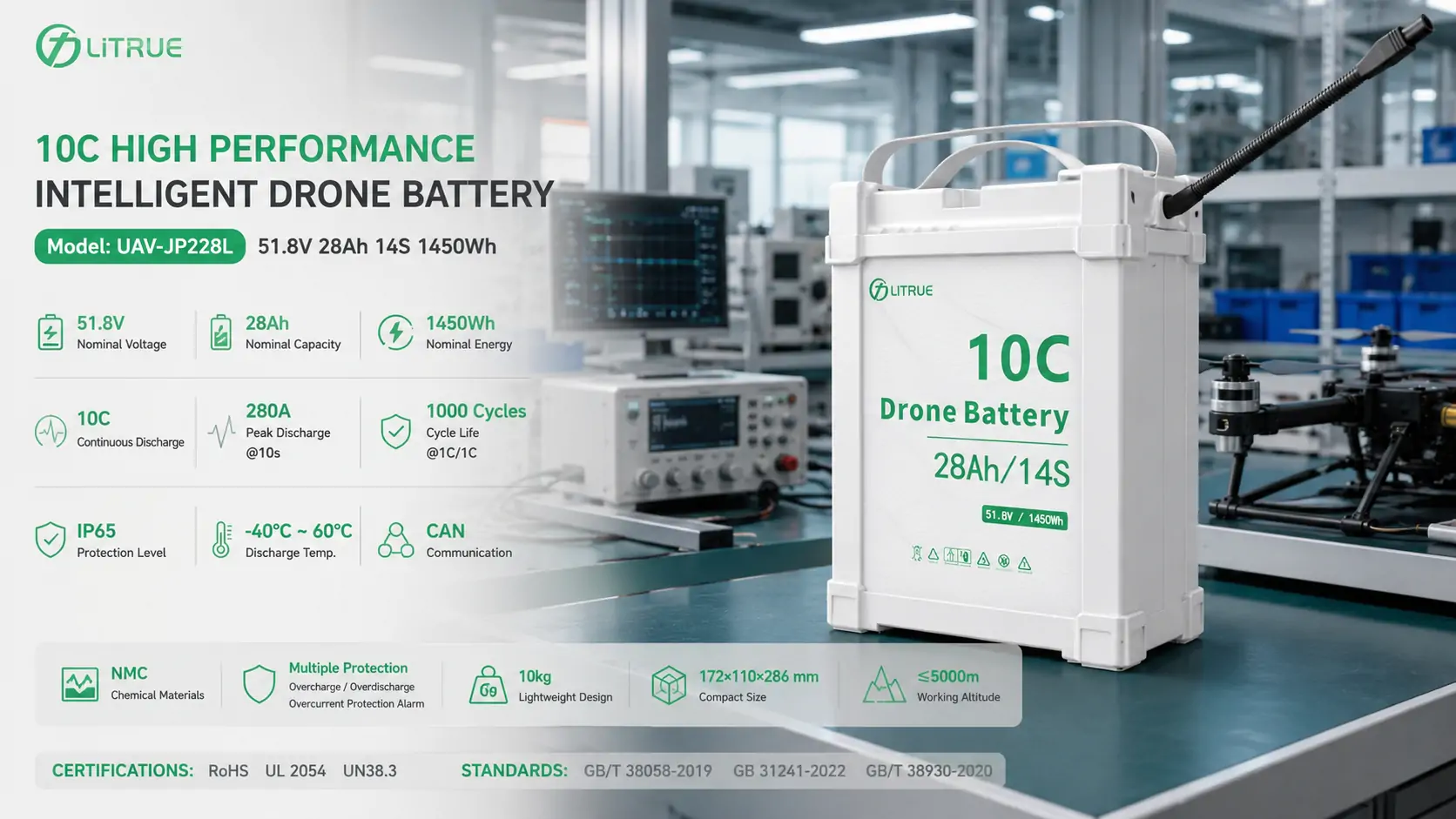
This is the pack we built specifically for agricultural and heavy-lift platforms, and the one I reach for when a customer flies long monitoring missions in hot regions. Here are the verified numbers — no rounding up.
Core specs: 51.8V nominal (14S1P), 28Ah, 1,450Wh (1.45 kWh) of usable energy, built on NMC drone battery chemistry. Operating voltage runs 42–60.9V.
Unique Selling Points
The discharge profile is where this pack earns its place. It delivers 140A continuous — roughly 5C — and tolerates a 280A peak (10C) for up to 10 seconds. That peak is exactly what absorbs the takeoff spike and any sudden gust correction without voltage collapse. On the charge side, 56A continuous (2C fast charge) gets you back in the air between fields instead of between days.
It's sealed to IP65 — dust-tight and rated against water jets — which in plain terms means muddy boots, morning dew, and the occasional drizzle don't end your mission. The CAN-bus BMS reports cell-level data live, so your ground station sees a weak cell before it strands a drone.
Audience Intent Match: Who This Is For
Evaluate the JP228L if you run a commercial fleet doing heavy-lift, long-endurance, or mixed spray-and-survey work — and especially if you operate in hot climates. At 10 kg, this is a serious pack for a serious platform.
It is not the right pick for a hobbyist with a sub-2kg consumer mapping quad. If your airframe is light and your missions are short, this is more battery than your frame can carry, and you'd be paying for headroom you'll never use. Be honest about your payload before you buy.
Performance Evaluation by Decision Factor
Endurance: 1,450Wh is a large tank for a 51.8V pack, which translates directly into longer survey passes per charge. Heat resilience: the discharge window spans −40°C to +60°C (core tolerance to +65°C), so the July-tailgate scenario I described above is inside spec, not outside it. Longevity: ≥1,000 cycles at a true 1C/1C — we test it that way because that's how you fly it. Altitude: rated to 5,000 m, which covers terraced and highland farms most packs aren't validated for.
Design and Usage
The housing measures 172 × 110 × 286 mm and slots into a standard heavy-lift cradle. We designed the CAN-bus interface so integrators can pull telemetry without a proprietary dongle — a small thing that saves real headaches when you're standardizing a fleet across two or three airframe brands.
Customization
Stock dimensions and connectors won't fit every frame, and we don't pretend they do. As a custom UAV battery builder, we adjust the housing footprint, swap connectors, tune the BMS thresholds, and price for volume. If you're standardizing 50 packs, talk to us before you settle for an off-the-shelf compromise — our guide to choosing an agricultural drone battery model walks through the sizing math first.
Limitations
Not found in this pack: an active liquid-cooling loop (it relies on passive thermal design plus its wide-temp cell tolerance), and it isn't a featherweight — 10 kg is real mass. If your single priority is minimum takeoff weight for a tiny scouting rig, look elsewhere in our line.
Pros and Cons
Pros: 10C peak discharge handles takeoff and gusts; IP65 sealing survives field conditions; CAN-bus BMS gives live cell health; −40°C to +60°C window; 2C fast charge; certified to UL 2054, UN38.3, and RoHS.
Cons: 10 kg is heavy for light frames; NMC trades some thermal-runaway margin for energy density; built for heavy-lift platforms, so it's overkill on a consumer quad.
Call to Action
Want the full data sheet, sample pricing, or a custom housing quote? See the UAV-JP228L product page and request a quote here.
Similar Products
If your monitoring rig is lighter, our 51.8V 20Ah lightweight pack covers shorter missions at less mass — see our notes on lightweight lithium battery packs for drones for that trade-off.
NMC vs. LFP: Understanding the Real Trade-Off
This is the comparison every buyer eventually faces, so let me lay it out plainly instead of selling you one side.
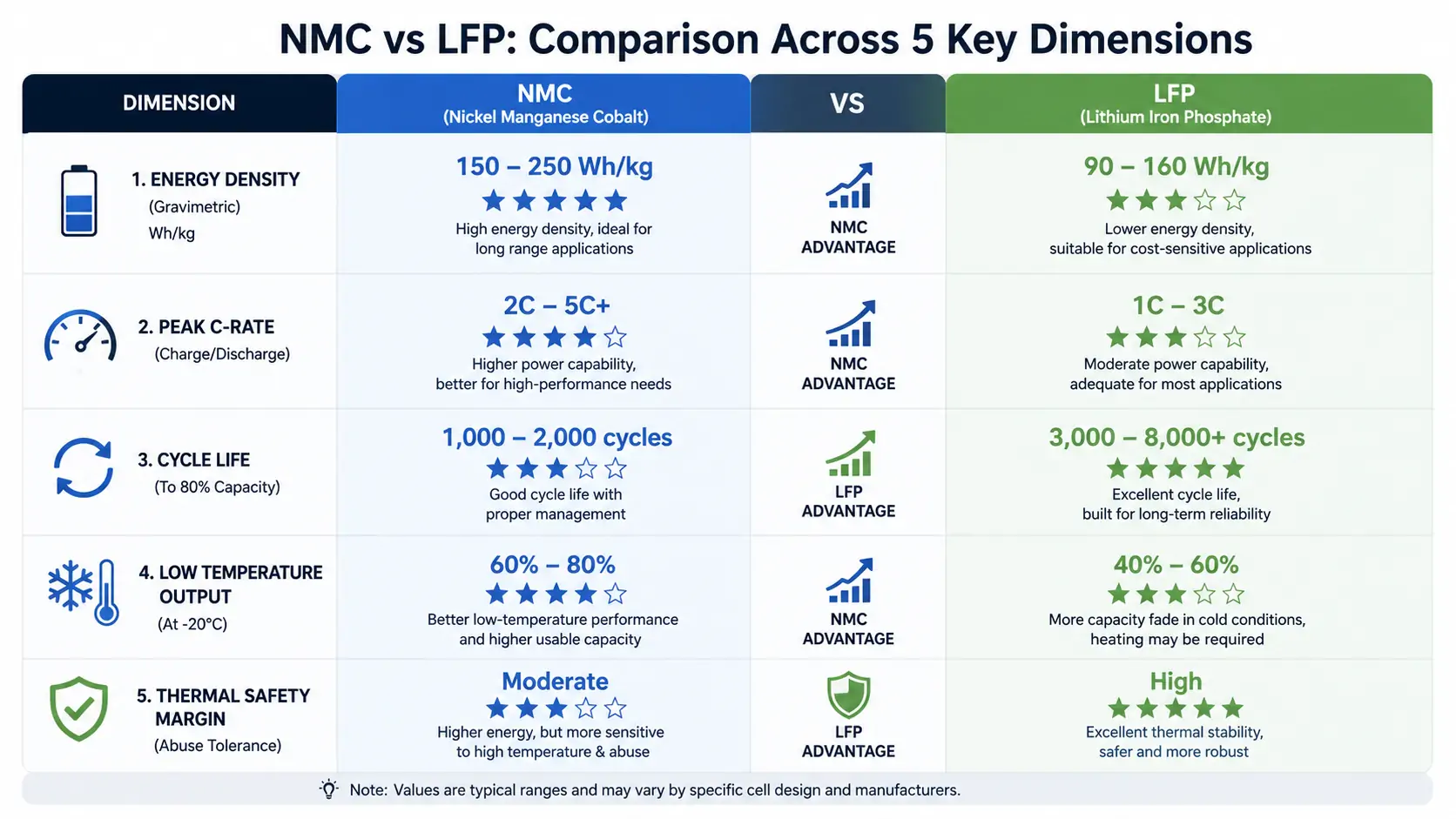
NMC (like the JP228L): higher energy density, so more flight time per kilogram, and strong high-rate output. The trade is a tighter thermal-safety margin and a higher cost per cell. Best when endurance and payload-to-weight win.
LFP pouch cells: longer cycle life, a wider safety margin, and steadier behavior in heat — but lower energy density, so you carry more mass for the same runtime. For ground stations, backup packs, or fleets that prize cycle count over flight minutes, our high-rate LFP pouch cells are often the smarter buy. The right answer depends on whether your mission is gated by weight or by replacement cost — and you should know which before you read another spec.
For the underlying chemistry, Battery University's guide to prolonging lithium batteries is a solid neutral primer, and precision-agriculture adoption data from the FAO shows why drone scouting keeps growing faster than the power systems supporting it.
FAQs
What battery voltage do crop-monitoring drones use?
Most commercial mapping and heavy-lift platforms run 12S to 14S packs — roughly 44.4V to 51.8V nominal. The JP228L sits at 51.8V (14S), which matches the majority of heavy agricultural airframes. Always match the pack to your flight controller's input range, not the other way around.
How long does an agricultural drones battery last per charge?
Runtime depends on payload, wind, and flight profile, but energy is the honest predictor: a 1,450Wh pack like the JP228L gives substantially longer survey passes than a 700–900Wh hobby pack. Plan by watt-hours, not optimism.
How many cycles will it really survive?
The JP228L is rated ≥1,000 cycles at 1C/1C. In the field, heat is what shortens that — keep packs out of direct sun between flights and store them at 5–25°C, and you'll get close to the lab number.
Can I get a custom pack for my specific airframe?
Yes. We adjust dimensions, connectors, and BMS settings as a battery manufacturer that builds to spec — useful when you're standardizing a fleet or retrofitting an unusual cradle.
Is NMC safe enough for daily agricultural use?
Properly built and certified — the JP228L carries UL 2054 and UN38.3 — NMC is flown daily across commercial ag fleets. The safety margin is narrower than LFP's, which is exactly why the BMS, IP65 sealing, and tested thermal limits matter so much.
Summary
An agricultural drones battery for crop monitoring lives or dies on three numbers most people skim past: continuous C-rate, discharge temperature window, and honestly-tested cycle life. Capacity gets the headline, but those three decide whether you finish the field or re-fly it. The LiTrue UAV-JP228L was engineered around exactly that reality — 5C continuous, a 10C takeoff peak, −40°C to +60°C tolerance, IP65 sealing, and ≥1,000 real cycles — and we'll customize it to your frame rather than hand you a part number and wish you luck.
Pick the chemistry your mission actually needs, validate the specs against your hottest, longest day, and your batteries will stop being the thing you worry about. That's the whole goal — power you forget is even there.