
Can I Take Lithium Batteries on a Plane? It depends entirely on the Watt-hour rating, and almost nobody at the check-in counter can clearly articulate the exact regulatory framework. Most spare lithium batteries ride with you in the cabin, a few need written airline permission, and an entire class of commercial packs — the high-capacity units built on our factory production line — legally cannot board a passenger flight under any circumstances. After fifteen years of shipping cells and custom packs to over 40 countries, I have seen clients get high-value equipment confiscated at security simply because they conflated a consumer power bank with an industrial drone pack. Let's clarify the exact aviation rules.
This guide is written directly from the QA floor of a battery manufacturing facility. Rather than vague advice, you will find the exact calculation parameters, mandatory compliance documentation, and the logistical pathways required when a battery exceeds passenger flight thresholds.
Table of Contents
- The 100 Wh / 160 Wh Rule That Decides Everything
- IATA & FAA Lithium Battery Limits Reference Matrix
- How to Calculate Battery Watt-Hours
- Carry-On vs. Checked: Why Spares Never Go in the Hold
- Overview: Key Facts, Common Myths & Regulatory Realities
- Product Deep Dive: When a Battery Is Too Powerful to Fly
- Passenger Cabin vs. Cargo Freight Comparison
- Frequently Asked Questions
- Summary
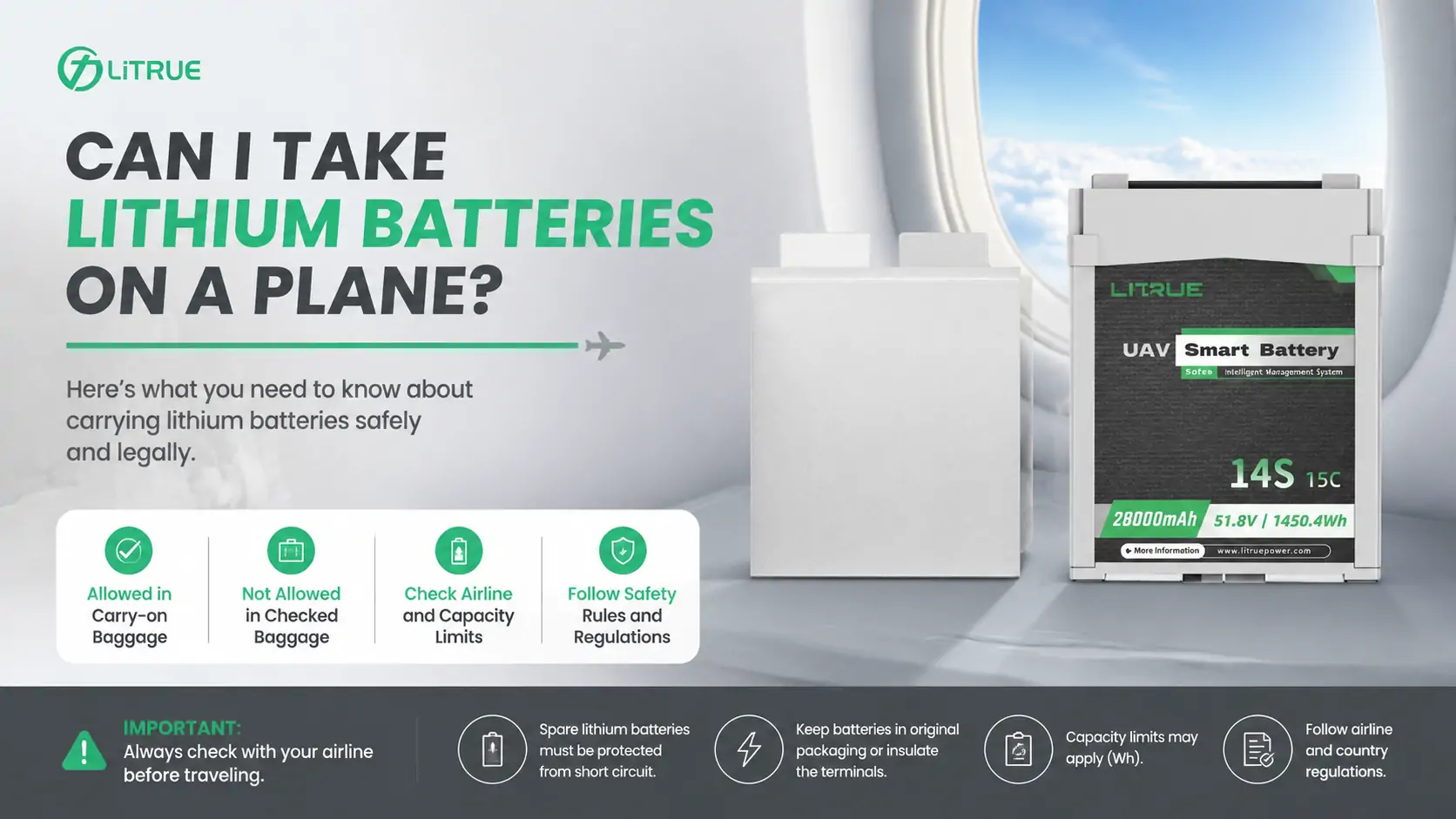
The 100 Wh / 160 Wh Rule That Decides Everything
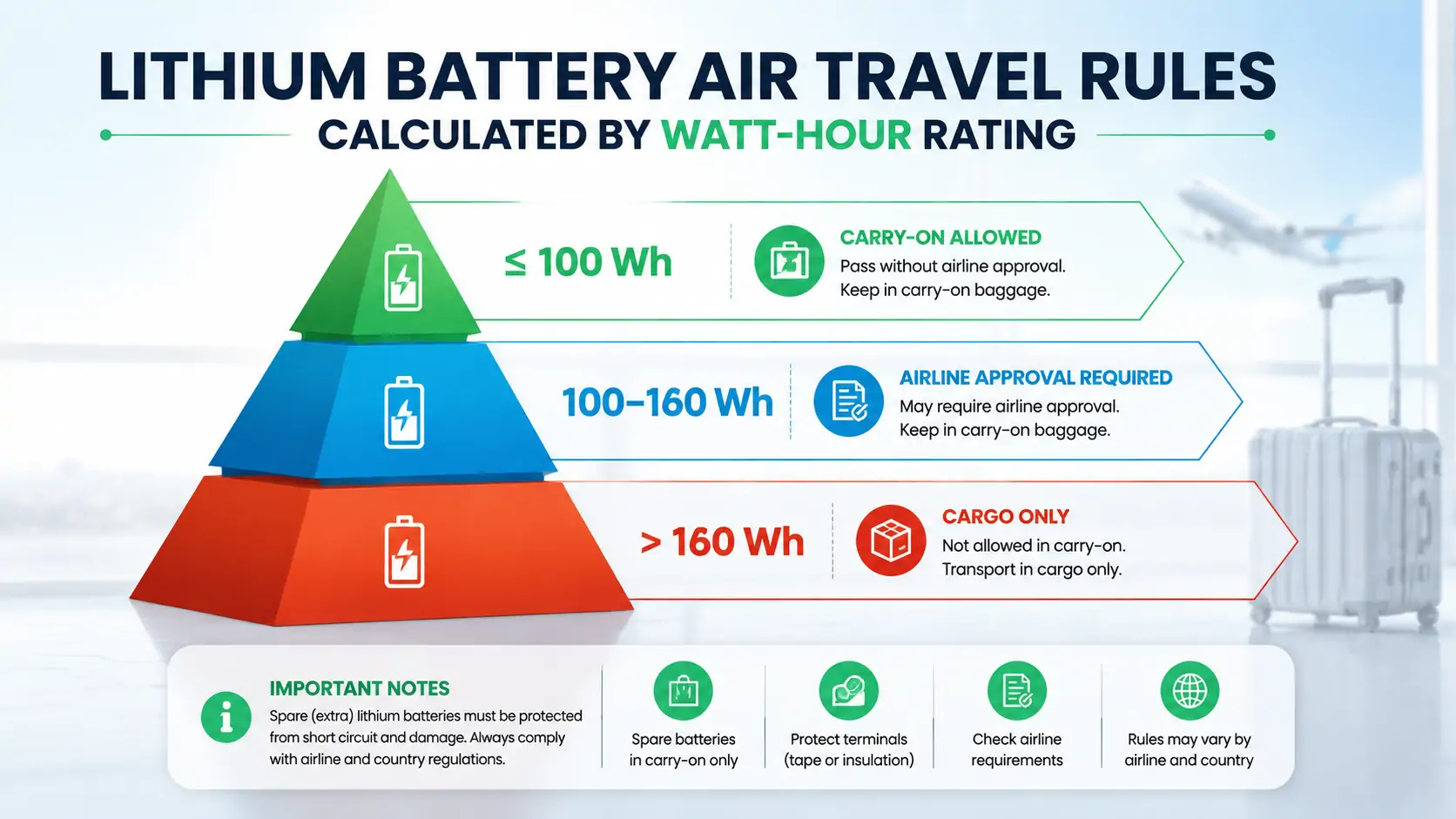
Every commercial airline operates under harmonized guidelines established by the IATA Dangerous Goods Regulations and national civil aviation authorities. Aviation security evaluates lithium power strictly by total energy capacity measured in Watt-hours (Wh), rather than voltage or amp-hours alone:
Watt-Hours (Wh) = Nominal Voltage (V) × Capacity (Ah)
For instance, a standard 11.1V, 3.0Ah camera pack equates to approximately 33.3 Wh, falling well within general travel allowances. Aviation safety categorizes lithium batteries into three distinct regulatory tiers:
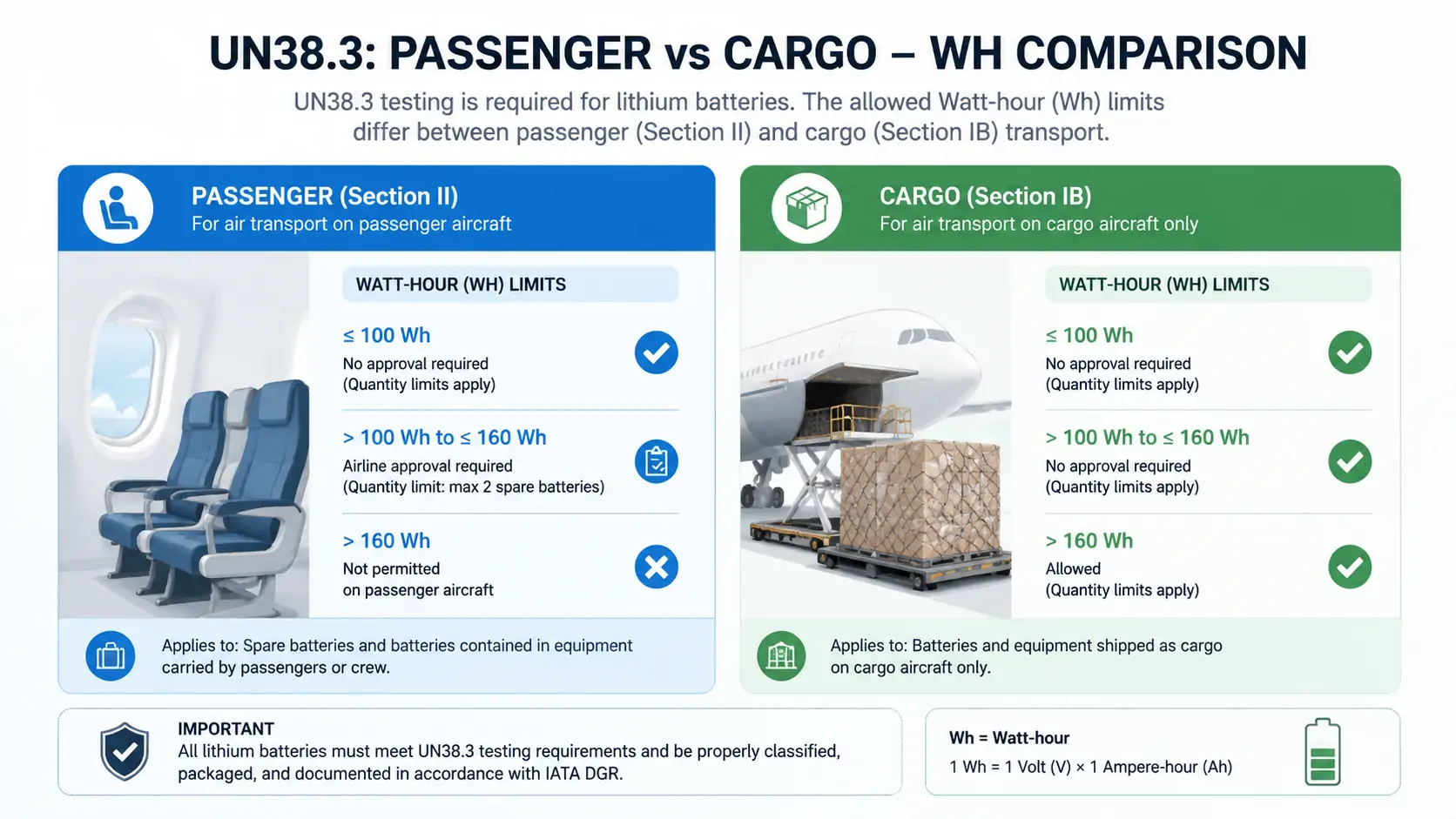
- Under 100 Wh: Permitted in carry-on baggage without prior airline approval. This category covers virtually all smartphones, laptops, professional camera bodies, and consumer power banks.
- 100 Wh to 160 Wh: Permitted in carry-on baggage only with formal airline operator approval, strictly capped at a maximum of two spare units per passenger.
- Over 160 Wh: Prohibited from both passenger carry-on cabins and checked baggage holds. These high-capacity systems must be transported exclusively as declared Class 9 dangerous goods via dedicated cargo aircraft.
The baseline domestic civil aviation parameters are maintained under the FAA PackSafe lithium battery framework, which aligns with global passenger flight safety standards.
IATA & FAA Lithium Battery Limits Reference Matrix
| Battery Energy Rating | Carry-On Baggage | Checked Baggage | Airline Operator Approval | B2B Cargo Shipping Classification |
|---|---|---|---|---|
| Under 100 Wh (Smartphones, Laptops, Compact Drones) |
Permitted (Reasonable personal quantity) | Forbidden for spare cells | Not Required | Standard Section II Air Cargo (UN38.3 Required) |
| 100 Wh to 160 Wh (Cinema Cameras, Mid-size UAVs, Pro Power Tools) |
Permitted (Strict maximum of 2 spare units) | Forbidden for spare cells | Required prior to boarding | Section IB / Class 9 Cargo Airway Bill |
| Over 160 Wh (Industrial UAVs, Agricultural Sprayers, BESS) |
Strictly Prohibited | Strictly Prohibited | Prohibited on Passenger Flights | UN3480 Class 9 Cargo Aircraft Only (CAO) |
How to Calculate Battery Watt-Hours
To verify whether a specialized commercial pack meets passenger flight allowances, calculate its Watt-hour rating before arriving at airport security:
Watt-Hours (Wh) = Nominal Voltage (V) × Amp-Hour Capacity (Ah)
- Example 1 (4S 14.8V 5.0Ah Camera Drone Battery):
14.8V × 5.0Ah = 74 Wh (Under 100 Wh — Permitted in carry-on luggage without airline approval). - Example 2 (6S 22.2V 6.0Ah Commercial Mapping UAV Battery):
22.2V × 6.0Ah = 133.2 Wh (100 Wh to 160 Wh — Permitted in carry-on with airline sign-off, capped at 2 spares). - Example 3 (14S 51.8V 28.0Ah Agricultural Drone Battery):
51.8V × 28.0Ah = 1,450.4 Wh (Over 160 Wh — Strictly prohibited on passenger flights; must ship via Class 9 air freight).
Carry-On vs. Checked: Why Spares Never Go in the Hold
Uninstalled spare lithium batteries are strictly prohibited from checked luggage across all civil aviation jurisdictions. Spare packs must remain in the passenger cabin at all times.
The technical reason centers on rapid thermal runaway intervention. In the passenger cabin, flight attendants have immediate access to halon extinguishers, dedicated fire-containment bags, and water to arrest the chemical reaction of a failing cell. In contrast, automated fire suppression systems inside an aircraft cargo hold cannot breach luggage shells to suppress a deep-seated lithium fire. Historical safety records confirm that lithium thermal events occurring in the cabin are managed quickly before catastrophic propagation can occur.
The only regulatory exception applies to batteries permanently installed inside equipment (such as a laptop or cordless tool). These may be checked provided the device is powered fully down (not left in standby or sleep mode) and protected against accidental activation. Standalone spare cells must stay in your carry-on luggage.
Overview: Key Facts, Common Myths & Regulatory Realities
Commercial operators frequently encounter three primary misconceptions when transporting lithium power systems:
Myth 1: "TSA limits passengers to two batteries in total."
Incorrect. For cells rated under 100 Wh, federal guidelines place no strict numerical limit, requiring only quantities reasonable for personal or professional use. You may carry multiple camera packs, laptop power bricks, and mobile power banks provided every unit is under 100 Wh. The strict two-battery cap applies exclusively to the 100 Wh to 160 Wh bracket.
Myth 2: "If it fits into a backpack, it is legal to fly."
Incorrect. High-rate industrial modules like a 51.8V 28Ah agriculture pack fit easily inside a carry-on case but store over 1,450 Wh — exceeding passenger flight limits by nine times. Airport security screens by certified energy rating, not physical dimensions.
Myth 3: "Security rarely inspects battery labels."
Aviation security checkpoints flag uninstalled batteries during X-ray scans. If a pack lacks an indelible manufacturer nameplate indicating nominal voltage and Wh capacity, agents are mandated to confiscate the unit on site.
Product Deep Dive: When a Battery Is Too Powerful to Fly
To illustrate how aviation thresholds impact commercial operations, consider our high-capacity 51.8V 28Ah high-discharge NMC UAV battery pack.
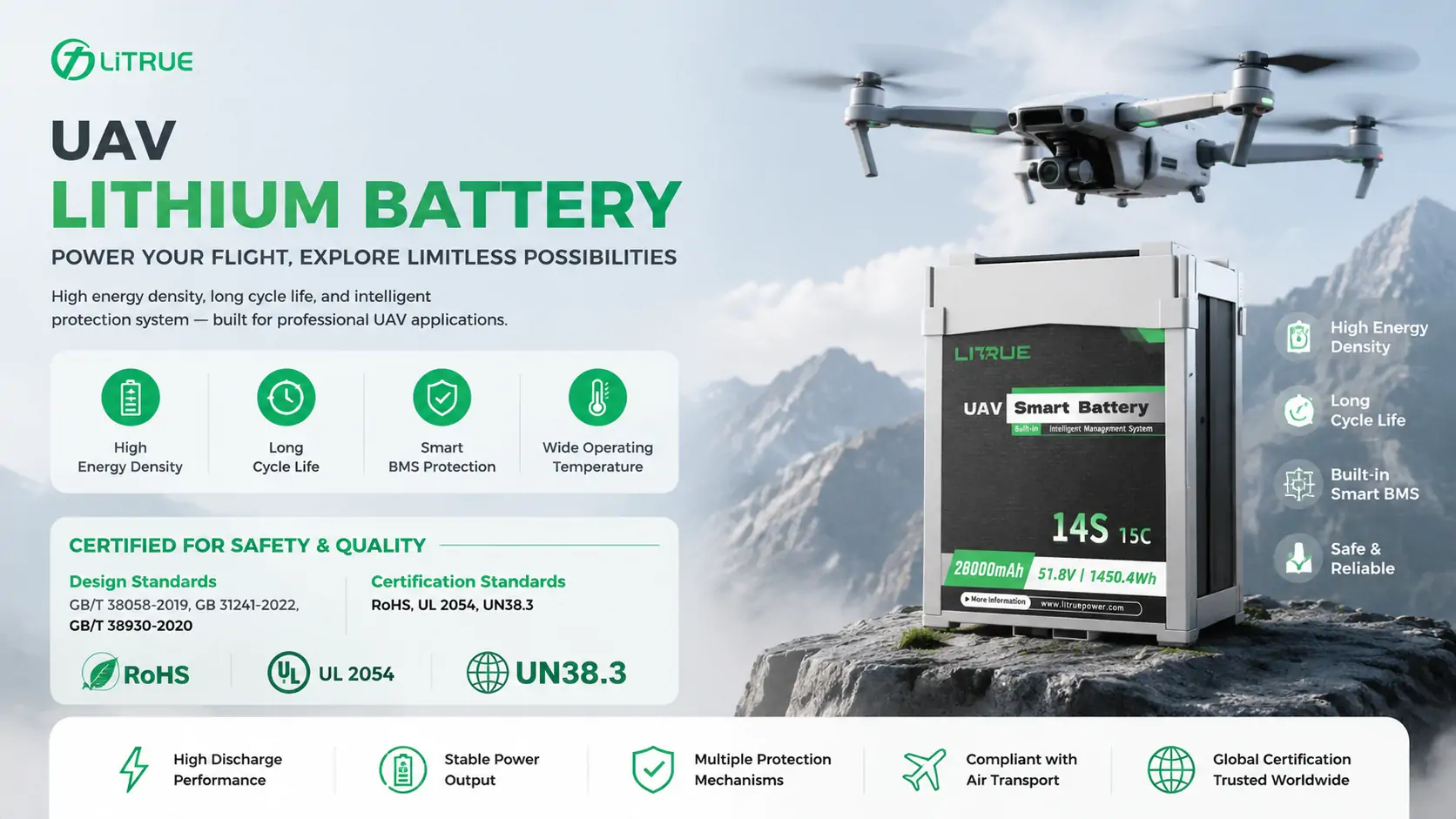
Engineered for heavy-lift industrial mapping, LiDAR surveying, and aerial crop spraying, this module illustrates why industrial power systems must be routed through specialized freight logistics:
Key Performance Specifications
- High-Discharge NMC Pouch Architecture: Delivers sustained 5C continuous output with 15C pulse capability, ensuring voltage stability under severe multi-rotor motor loads.
- Concentrated Energy Storage: 1,450.4 Wh total energy allows heavy commercial airframes to complete extended operational passes without constant battery swaps.
- Integrated Telemetry Smart BMS: Features real-time cell balancing, CANbus/SMBus communications, and full over-current protection inside a ruggedized enclosure.
Target Application
This power system serves commercial flight service providers, agricultural operators, and industrial drone OEMs. It is strictly engineered for industrial platforms, not consumer hobby aircraft.
Performance Benchmark
At 51.8V nominal and 28Ah, the module achieves an energy density of approximately 240 Wh/kg at the pack level, sustaining uniform cell-to-cell delta voltage within 15 mV throughout high-draw duty cycles.
Aviation & Transport Limitation
At 1,450.4 Wh, this pack cannot be transported aboard passenger aircraft under any circumstances. Field deployment teams traveling internationally must freight these units via certified air cargo under UN3480 logistics channels.
Technical Documentation
Engineering teams evaluating cell geometry, discharge curves, and compliance packages can view our complete lineup of industrial lithium battery products.
Passenger Cabin vs. Cargo Freight Comparison
For enterprise procurement teams and flight operators managing equipment exceeding the 160 Wh threshold, the following matrix outlines the operational differences between passenger baggage and dedicated dangerous goods freight:
| Category | Passenger Carry-On (< 100 Wh) | Passenger with Approval (100–160 Wh) | Air Cargo Freight (> 160 Wh) |
|---|---|---|---|
| Typical Equipment | Laptops, phones, compact surveying drones | Cinema camera bricks, broadcast lighting, mid-UAV packs | Agricultural drone packs, e-mobility modules, ESS hardware |
| Quantity Limit | Reasonable personal use | Strictly 2 spare units per passenger | Determined by cargo airway bill & pallet limits |
| Documentation | Legible manufacturer Wh label | Written airline operator check-in approval | UN38.3 Test Summary, SDS/MSDS, Shipper's DG Declaration |
| State of Charge (SOC) | Unrestricted (30%–50% recommended) | Unrestricted | Maximum 30% SOC (Mandatory IATA air freight rule) |
| Packaging Standards | Terminal insulation (caps or individual pouches) | Mandatory isolated terminal packaging | UN-certified fiberboard packaging with Class 9 labeling |
Frequently Asked Questions
Can I take a power bank on an airplane?
Yes, provided its energy rating is under 100 Wh (for example, a standard 20,000 mAh power bank at 3.7V equals 74 Wh). It must travel exclusively in carry-on baggage with clearly printed manufacturer voltage and capacity markings.
How many spare lithium batteries can I bring on board?
For batteries under 100 Wh, airlines permit reasonable personal quantities (typically 4 to 8 units without issue). For batteries between 100 Wh and 160 Wh, you are strictly limited to two spare units and must secure airline operator permission. Units exceeding 160 Wh cannot be brought into the passenger cabin.
Why are spare lithium batteries prohibited in checked baggage?
Cargo hold fire suppression systems cannot penetrate hard-shell luggage to arrest chemical thermal runaway. In the passenger cabin, cabin crew can rapidly cool and contain a compromised battery using halon extinguishers and containment bags.
How do commercial operators ship industrial packs over 160 Wh?
Packs exceeding 160 Wh ship as UN3480 Class 9 Dangerous Goods via dedicated cargo aircraft. Shipments require accredited UN38.3 test summaries, Material Safety Data Sheets (MSDS), UN-spec packaging, and a maximum 30% state of charge.
What is UN38.3 certification and why is it mandatory?
UN38.3 is the United Nations standard testing lithium cells against altitude decompression, thermal shock, vibration, impact, external short-circuit, overcharge, and forced discharge. Air carriers will not accept commercial lithium freight without certified test documentation.
UN38.3 Certified Lithium Batteries for Global Air Freight
Deploying custom OEM battery packs internationally requires rigorous compliance with UN38.3 testing, MSDS documentation, and Class 9 transport protocols. LiTrue manufactures certified high-rate cells, next-generation solid-state architectures, and heavy-duty industrial packs ready for global air export:
- High-Discharge Pouch Cells: Specify raw cell solutions from our high C-rate LFP and NMC pouch cell lineup (20Ah to 50Ah) for custom modular integration.
- Next-Generation Solid-State Technology: Explore our 495 Wh/kg solid-state anode-free cells engineered for extreme aerospace and UAV energy density.
- Turnkey Battery Systems: Review engineered packs and integration architectures across our specialized custom lithium battery pack solutions.
For technical inquiries, compliance test summaries, or custom OEM pack manufacturing consultations, contact LiTrue's engineering team to receive full specifications and logistics support.
Summary
Navigating lithium battery air travel rules centers on the 100 Wh threshold. Units rated below 100 Wh travel freely in carry-on baggage. Packs between 100 Wh and 160 Wh require airline sign-off and are capped at two spares. Systems over 160 Wh — including industrial drone batteries, commercial robotics modules, and energy storage assemblies — are prohibited on passenger flights and must ship via certified UN3480 air cargo. Ensure all terminals are insulated, verify indelible nameplate ratings, and never place spare lithium batteries in checked luggage.