
Here is the problem nobody warns you about. You request quotes for LFP cells from six suppliers, you line up the price-per-Ah in a spreadsheet, and you pick the cheapest column. Six months later, your warranty returns spike, two batches won't pass a capacity grade, and the "≥3000 cycle" number on the datasheet quietly turned into 1,400 cycles in the field. I have watched buyers walk into this exact trap — and I have shipped the replacement order that fixed it.
I run a production line that stacks and seals lithium pouch cells every day, so I read these datasheets the way a mechanic reads an engine. This guide is the checklist I wish every volume buyer had before they signed a PO. It is written for procurement leads, pack integrators, and OEM engineers who are about to commit to thousands of units, not a sample tray of three.
Table of Contents
- The Three Truths Behind the Datasheet
- Prismatic vs. Pouch: Pick the Format Before the Price
- The Eight Factors That Actually Matter at Volume
- Product Deep Dive: High-Rate Long-Cycle LFP Cell
- Alternatives and How They Compare
- FAQs
- Summary
The Three Truths Behind the Datasheet
Key features you should be weighing
When you compare LFP cells at scale, four numbers carry most of the decision: cycle life at a stated charge/discharge rate, continuous and pulse C-rate, energy density in Wh/kg, and the usable temperature window. Everything else — branding, glossy renders, the sales rep's enthusiasm — is noise until those four hold up under test.
The features that quietly go missing
A pouch or prismatic cell is a bare component. It does not ship with a BMS, it does not balance itself, and it will not protect your pack from a bad charge profile. Many datasheets also leave out Wh/L volumetric density and the cell's internal resistance as a hard number (you will often see "low internal resistance" with no value attached). If those gaps matter to your enclosure design, ask for them in writing — not after the cells arrive.
The truth most buyers learn the hard way
Cycle life is a lab claim, not a promise. A figure like "≥3000 cycles at 1C/1C" only means something when you know the test temperature, the depth of discharge, and the end-of-life threshold (usually 80% capacity retention). The way charge cycles are counted and measured changes the headline number dramatically. Two cells can both print "3000 cycles" and behave nothing alike at 45°C and 100% DoD. Pin the test conditions down before you trust the figure.
Prismatic vs. Pouch: Pick the Format Before the Price
You searched for prismatic cells, so let me be straight with you about format — even though my own line builds pouch cells. Each shape solves a different problem, and pretending otherwise would not help your sourcing.
Prismatic LFP cells live inside a rigid aluminum can. That hard shell makes them mechanically forgiving, easy to stack with simple compression hardware, and a common pick for stationary storage and large EV modules. The trade-off: they are heavier for the same energy, and the can adds volume you cannot recover.
Pouch cells — the kind we stack and seal — drop the metal can for a laminated foil. You get more Wh/kg in a thinner footprint and better heat dissipation across the flat face, which is why high-rate and weight-sensitive applications lean this way. The cost is that pouch cells need engineered compression and a smarter pack design, because the foil flexes and the cell can swell over life. Neither format is "better." The right one depends on whether you are optimizing for weight, for mechanical simplicity, or for cycle stability.
The Eight Factors That Actually Matter at Volume
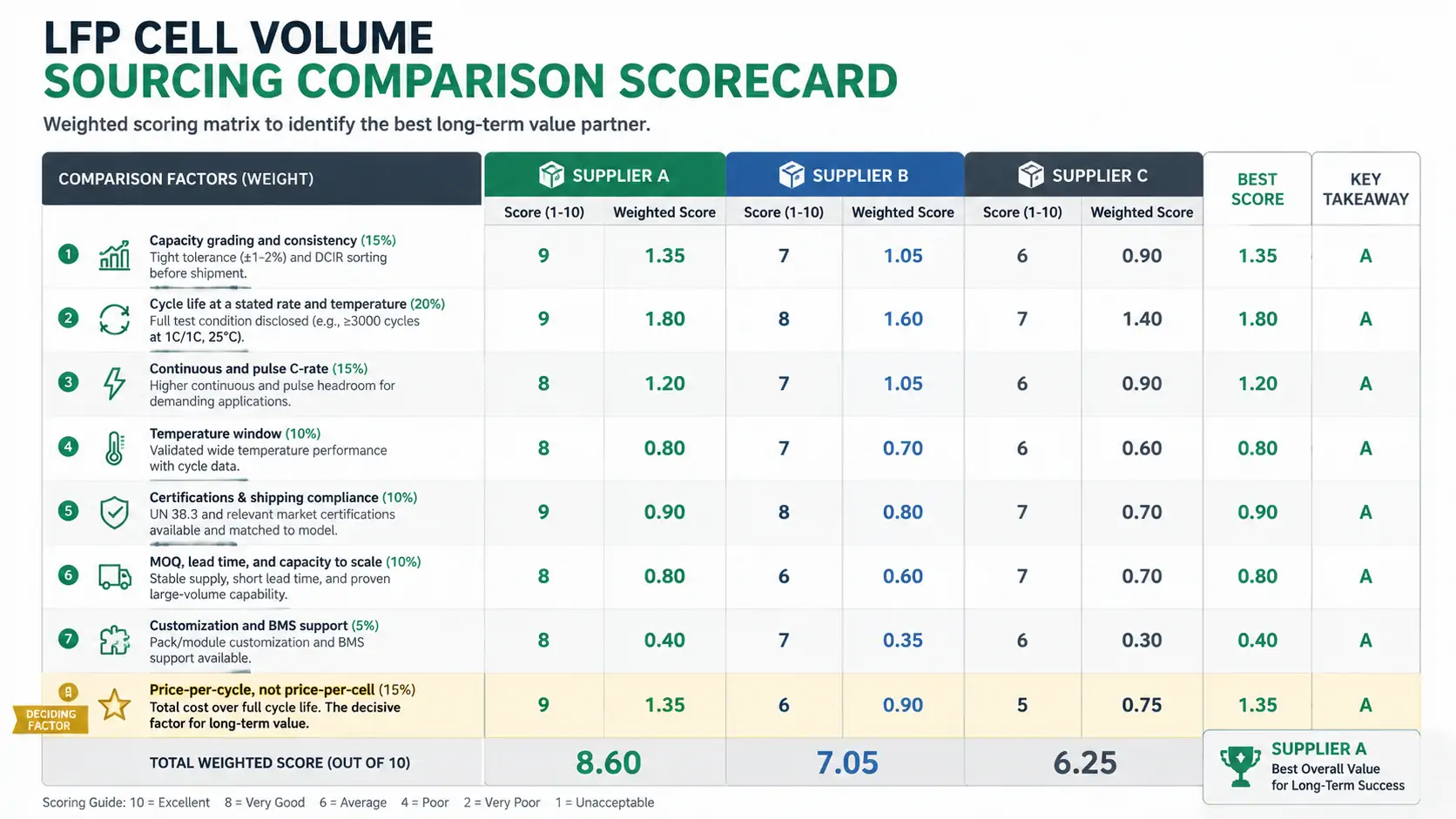
This is the order I tell buyers to score suppliers in. Price sits near the bottom on purpose — it is the easiest number to compare and the worst one to lead with.
1. Capacity grading and consistency. At volume, the spread between your strongest and weakest cell sets your pack's real capacity. Ask what the supplier's capacity bin tolerance is (a tight band of ±1–2% is what you want) and whether DCIR sorting happens before shipment. A pack is only as good as its worst cell.
2. Cycle life at a stated rate and temperature. Demand the full test condition, not just the cycle count. "≥3000 cycles at 1C/1C" tells you far more than a bare "3000 cycles."
3. Continuous and pulse C-rate. Separate the two. A delivery trike that pulls hard off a stoplight needs pulse headroom; a stationary buffer rarely does. Pay for the rating you actually use.
4. Temperature window. A cell rated to +55°C in a lab does not behave the same in a sealed enclosure in Dubai in July. If you sell into hot or cold regions, you need wide-temperature lithium cells validated at the extreme, with cycle data taken at that temperature — not at a comfortable 25°C.
5. Certifications and shipping compliance. For export you will need to satisfy transport testing such as UN 38.3, plus any market-specific standards. Confirm the certificates exist and match the exact model you are buying. The underlying lithium iron phosphate chemistry is inherently more thermally stable than NMC, which helps here, but paperwork still has to be on file.
6. MOQ, lead time, and capacity to scale. Can the supplier hold consistency across a 50,000-cell order, or does quality drift after the first batch? Ask about line capacity, not just the sample.
7. Customization and BMS support. A supplier who can deliver custom battery packs and module-level integration saves you a second vendor and a integration headache.
8. Price-per-cycle, not price-per-cell. A cell that costs 12% more but lasts twice as long is the cheaper cell. Run the math on cost over the full cycle life — that single column reorders most spreadsheets.
Product Deep Dive: High-Rate Long-Cycle LFP Cell
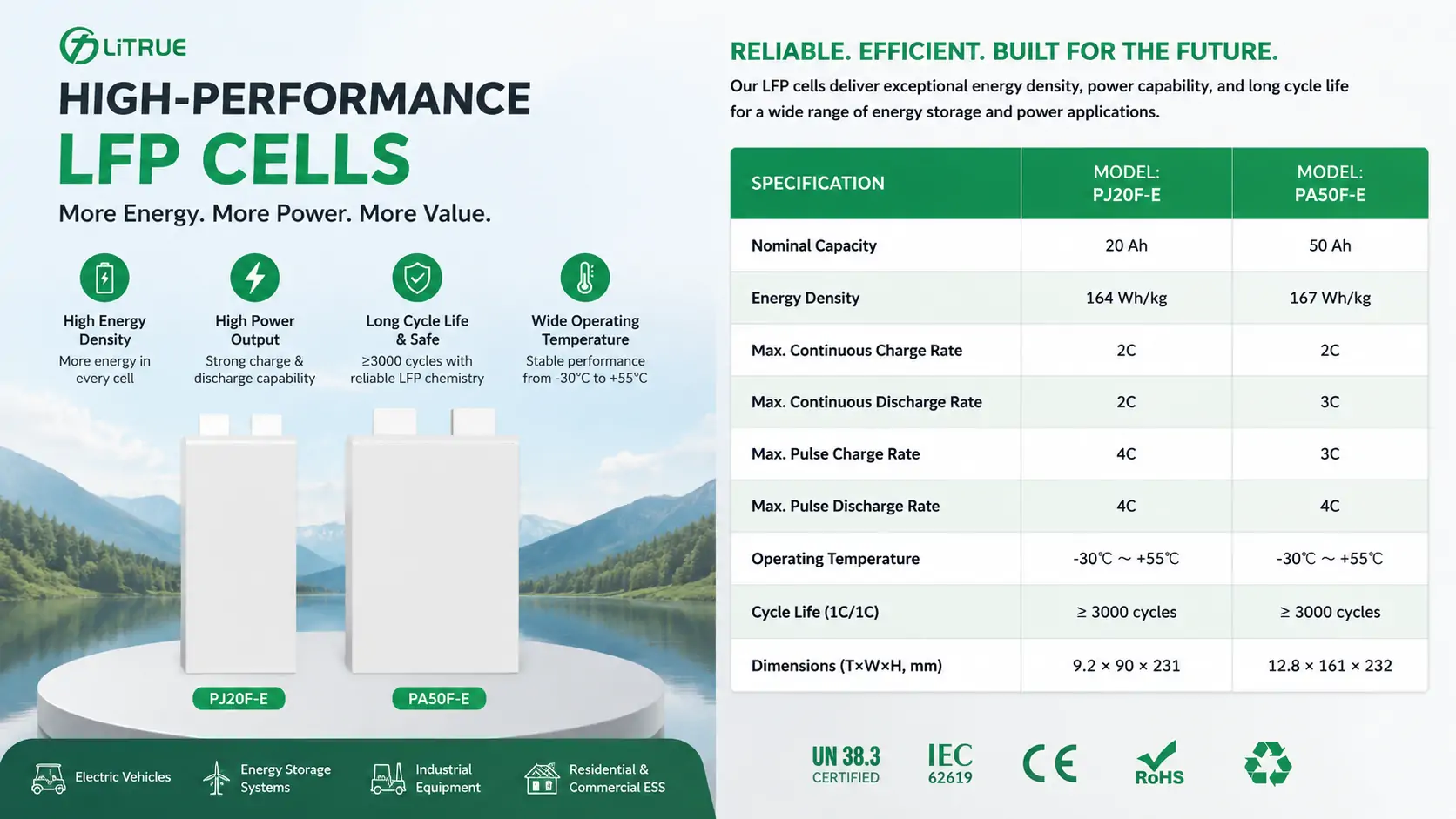
To make this concrete, here is one cell from our own line — the high-rate, long-cycle LFP pouch family (models PJ20F-E at 20Ah and PA50F-E at 50Ah). I am using it because its datasheet hits the factors above with numbers you can actually check, and because I can speak to how it behaves off the line.
Unique selling points
The headline is cycle life: ≥3000 cycles at a 1C/1C rate, which is the demanding way to test — many competitors quote cycles at a gentler 0.5C. Energy density lands at 164–167 Wh/kg, on the high side for LFP pouch cells, inside a thin stacked footprint (the 20Ah cell measures 9.2 × 90 × 231 mm). Continuous discharge runs 2C on the 20Ah and 3C on the 50Ah, with pulse capability up to 4C. The operating window spans −30°C to +55°C.
Who this cell is for — and who it isn't
This cell fits builders of electric motorcycles, delivery two- and three-wheelers, and high-usage power equipment that cares about long service life and steady mid-rate discharge. It is a strong match if you are chasing price-per-cycle and need batch consistency across a large order. It is not the right call if you need extreme pulse power for a racing FPV setup, or if your application is so weight-critical that you would push toward a high-density NMC chemistry instead. I would rather lose that order than sell you the wrong cell.
Performance against the decision factors
On cycle life it scores high because the 3000-cycle figure is stated at 1C/1C — the condition matters as much as the count. On C-rate it covers continuous mid-rate work with pulse headroom to 4C, enough for stop-start traffic loads. On temperature it carries a wide −30°C to +55°C range out of the box, and for buyers in harsher climates we run dedicated high-temperature and low-temperature pouch variants validated further out. On consistency, the stacked-pouch process is built for batch repeatability, which is the whole game at volume.
Design and how it gets used
The stacked (not wound) construction keeps internal resistance low and spreads heat across the flat face, so it tolerates continuous duty without cooking itself. In practice, integrators bolt these into modules with light compression and a BMS layer — the cell hands you the chemistry and the form factor, and your pack design does the rest.
Customization
We ship from bare cells up to fully integrated modules with a BMS, so you can buy at whatever level your team is set up to handle. As a lithium battery manufacturer, we will also tune module geometry and connections to your enclosure rather than forcing your enclosure around a fixed module.
Limitations — stated plainly
This is a pouch cell, not prismatic, so if your design is locked around a rigid can and compression fixturing, it is not a drop-in. The published datasheet gives Wh/kg but not Wh/L, and internal resistance is described qualitatively rather than as a single ohmic value — request both if your design needs them. And like any bare cell, it ships without protection electronics.
Pros and cons
Pros: ≥3000 cycles at a strict 1C/1C rate; 164–167 Wh/kg, high for LFP; pulse to 4C; wide −30°C to +55°C window; built for batch consistency; cell-to-module customization.
Cons: pouch format needs engineered compression; no published Wh/L or hard internal-resistance figure; not aimed at extreme-pulse or ultra-light NMC use cases; no onboard BMS at the cell level.
Next step: if these numbers fit your build, you can review the full spec sheet for these high-rate LFP cells and ask us for the test reports behind the cycle-life claim.
Similar options: if your duty is hotter, colder, or higher-pulse than this family, our broader range of LFP pouch cells covers high-temperature and low-temperature grades built on the same stacked process.
Alternatives and How They Compare
No single cell wins every brief. Here is the honest lay of the land.
Prismatic LFP (rigid can). Best when mechanical simplicity and easy compression matter more than weight — stationary storage, large modules, forklift packs. You trade away some Wh/kg and gain mechanical margin.
High-rate NMC pouch. When you need maximum energy density and serious pulse power — think UAVs and performance e-mobility — NMC pushes past 220 Wh/kg with high pulse rates. The cost is a narrower thermal-safety margin and a higher bill of materials, so it earns its place only when weight is the binding constraint.
Cylindrical LFP (e.g., 32140 / 46-series). Mature, automated, and easy to source, but you pay in pack complexity — hundreds of welds and a lower packing efficiency than a pouch or prismatic stack.
Wide-temperature LFP variants. If your spreadsheet keeps tripping over the temperature row, dedicated wide-temperature lithium cells solve at the cell level what you would otherwise patch with heaters and insulation in the pack.
FAQs
Should I choose prismatic or pouch LFP cells for a volume order?
Choose by constraint, not habit. Prismatic if you want mechanical simplicity and rigid compression; pouch if you want more energy per kilogram and better flat-face cooling. Weight-sensitive and high-rate builds usually favor pouch; large stationary modules often favor prismatic.
What cycle life is realistic for LFP cells?
Good LFP cells reach 2,000–3,000+ cycles to 80% capacity, but only at the stated rate, depth of discharge, and temperature. A "3000 cycle" claim at 1C/1C is far stronger than the same number quoted at 0.5C and 25°C. Always ask for the test conditions.
How do I verify cell consistency before committing to thousands of units?
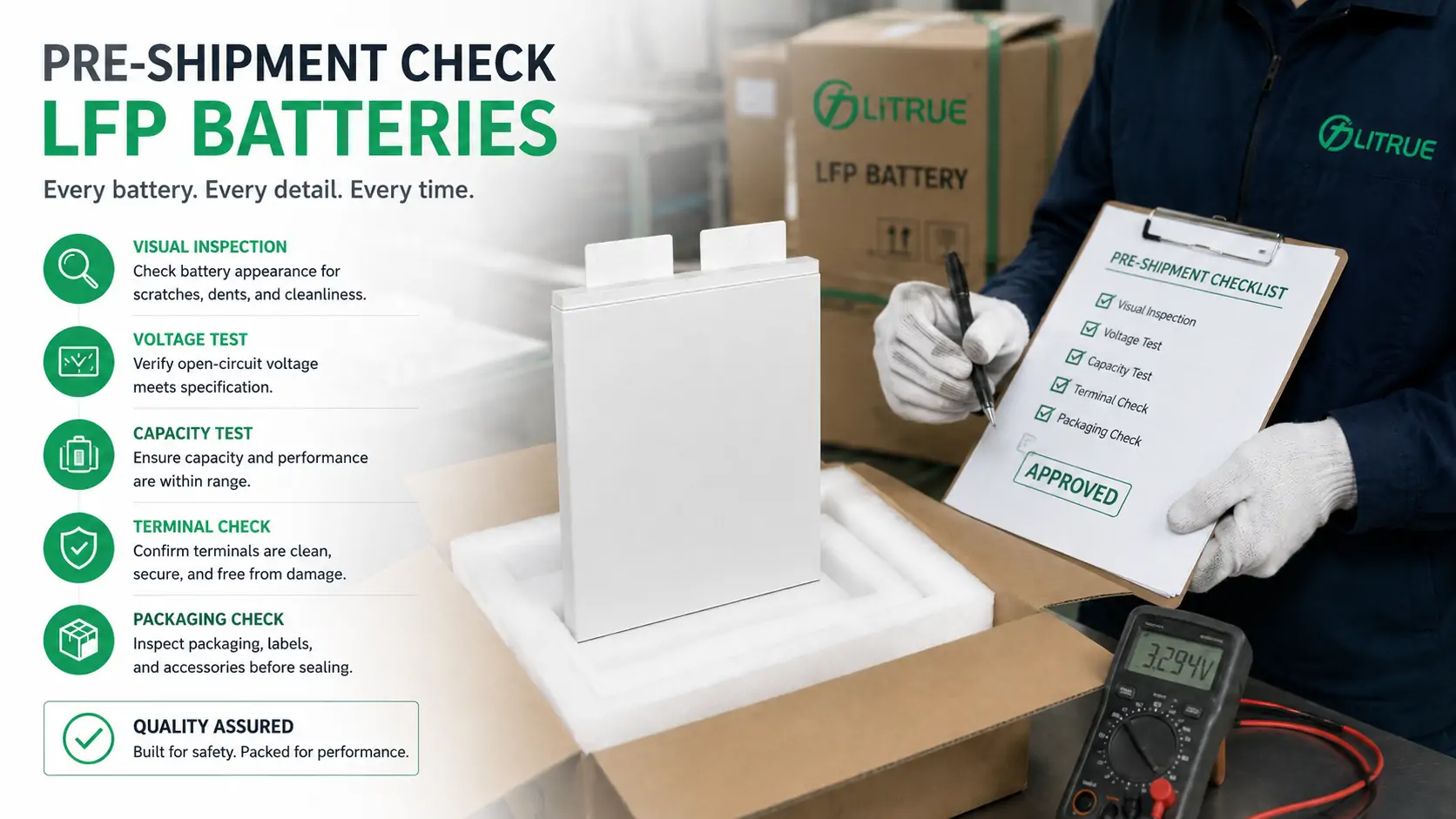
Ask for the capacity bin tolerance, request DCIR (internal resistance) sorting before shipment, and pull a random sample from the production batch — not the demo tray — for your own incoming inspection. Consistency on a sample of three tells you nothing about a run of fifty thousand.
Which certifications matter for exporting LFP cells?
UN 38.3 transport testing is the baseline for shipping lithium pouch cells internationally, plus any destination-market standard. Confirm the certificate names the exact model and capacity you are ordering.
Do LFP cells work in very hot or very cold climates?
Standard LFP cells handle roughly −30°C to +55°C, but performance and cycle life degrade at the extremes. For desert or sub-zero deployments, source temperature-graded variants with cycle data measured at that temperature, not at room temperature.
What is a sensible MOQ and lead time for volume LFP cells?
It varies by supplier and customization level. The better question is whether the supplier can hold the same grading across your full order — ask about line capacity and batch-to-batch QC, and talk to a lithium battery supplier directly about your timeline before you assume the catalog MOQ applies.
Summary
Sourcing LFP cells at volume is not a price hunt — it is a consistency bet. Score your suppliers on capacity grading, cycle life at a stated rate, real C-rate, the temperature window, certifications, and the ability to scale without quality drift. Then compute price-per-cycle, and watch your cheapest column move. Pick the format before the price, demand the test conditions behind every headline number, and pull your own sample from the real batch.
That is the same discipline we hold ourselves to on the floor every day. Get those eight factors right, and the warranty-return spike I described at the top never shows up — because you caught it in the comparison, not in the field.