
A customer in Qinghai called me two summers ago, furious. His survey drone had dropped out of the sky at roughly 4,200 meters. Not a fire. Not a bang. The pack just... gave up — voltage caved under load and the bird came down hard. He'd bought the cheapest cells he could find. That call is why I get twitchy whenever someone asks me which UAV lithium battery is safest for high-altitude flights and expects a one-word answer.
There isn't one. There's chemistry, there's how the pack is built, and there's whether anyone actually tested it where you plan to fly. I've spent close to ten years on a factory floor watching cells crawl through altitude chambers and -40°C freezers. So this isn't spec-sheet talk. It's what I've seen break.
Table of Contents
- 1. Why Altitude Changes Everything for Battery Safety
- 2. NMC vs. LFP at Altitude
- 3. Product Deep Dive: UAV-JP330L Smart Drone Battery
- 4. Alternatives and How They Compare
- 5. FAQs
- 6. Summary
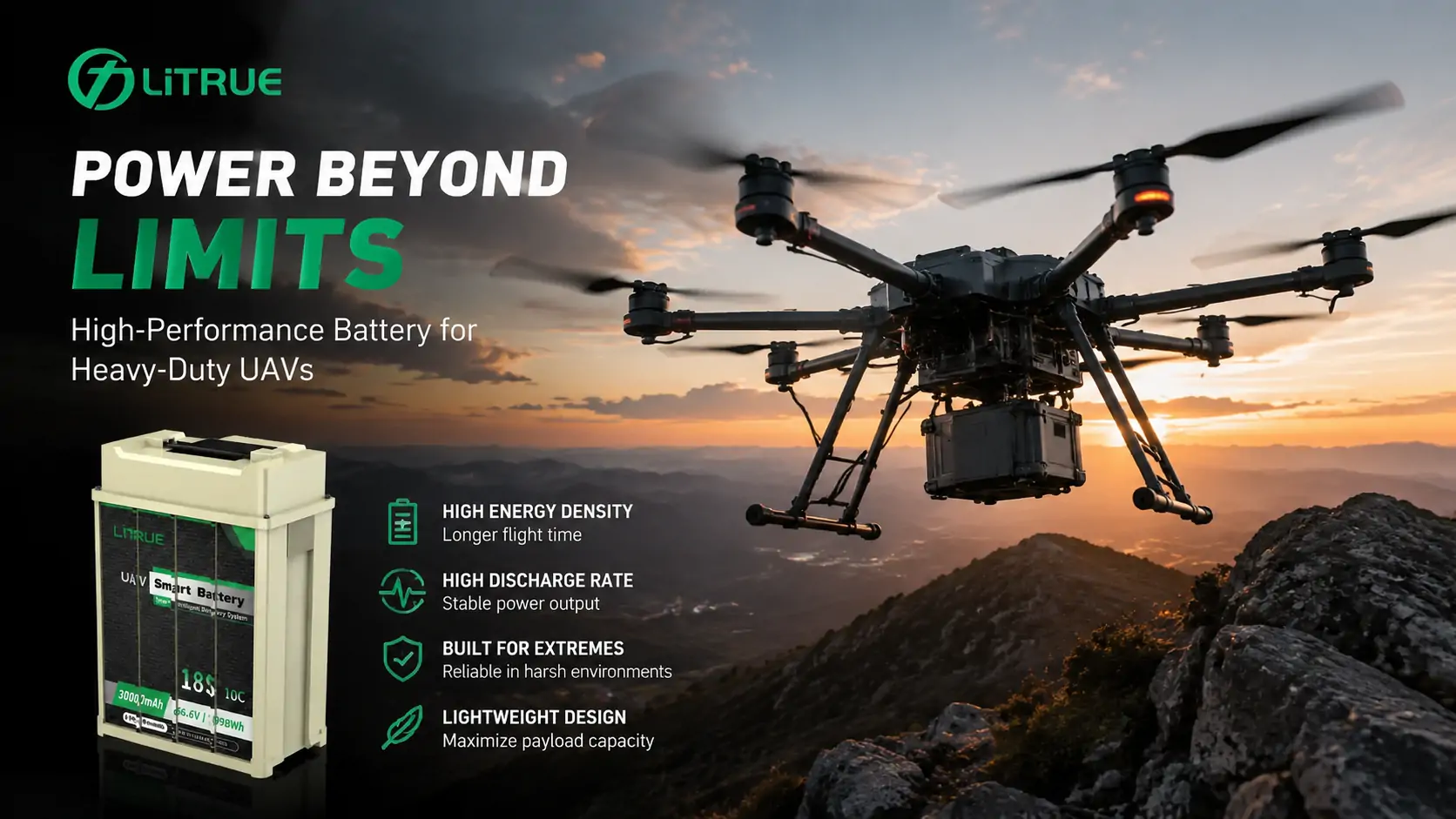
Why Altitude Changes Everything for Battery Safety
Most people hear "safe" and picture a battery on fire. Sure. But that's not what grounds fleets up high. The quiet failures do — the ones nobody films.
Think about what actually happens as you climb. Air gets thin. Your props grab less of it, so the flight controller leans on the throttle and pulls more current to hold the same hover. More current means more heat. And here's the part people miss: thin air carries that heat away slower, not faster. Now stack cold on top. Summer afternoon, 4,000 meters, still below freezing. A cell that's working hard and freezing at the same time? That's the worst hand you can deal a lithium pack — resistance spikes, voltage sags, and your cells stop agreeing with each other.
So "which UAV lithium battery is safest for high-altitude flights" is really four questions wearing one coat. How does it behave cold? Can the case survive low pressure, dust, the launch site from hell? Does the management system spot one weak cell before it poisons the pack? And — boring but real — is it certified for the cargo plane you'll ship it on? Miss any one of those and "safe" is just a word on a label.
The FAA classes lithium cells as dangerous goods for these exact reasons. Worth ten minutes on their PackSafe lithium battery guidance before you sign off on anything that's flying internationally.
NMC vs. LFP at Altitude
Here's where the bad advice lives. "LFP is always safer." You'll hear it on every forum. It's not wrong, exactly — it's just lazy, and lazy advice strands people with the wrong pack.
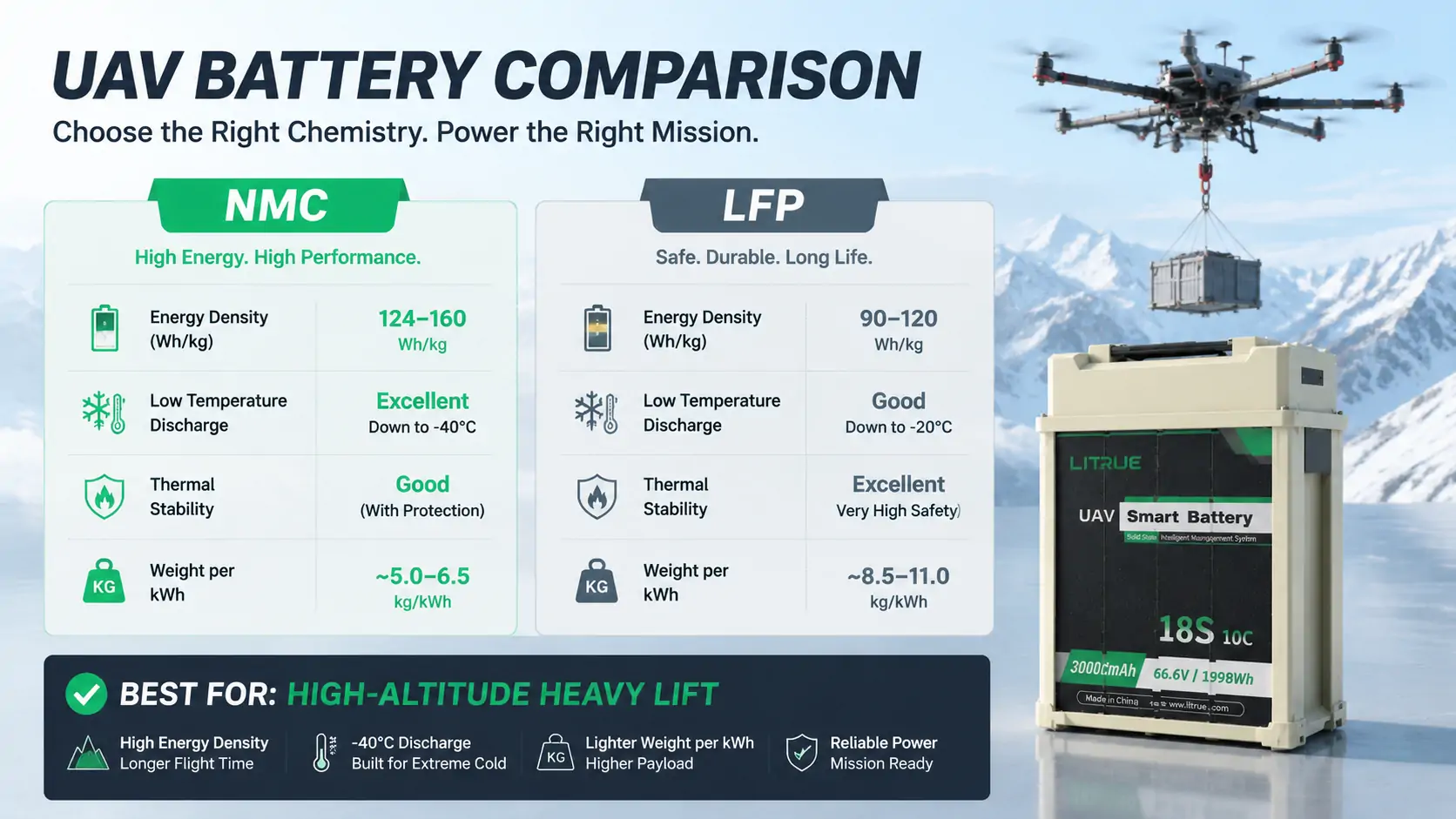
Yes, LFP pouch cells are tougher on thermal stability. The chemistry resists runaway, takes abuse, behaves. It's why our cold-region lithium cells use it. But LFP is heavy for the energy it gives back. Our cold-spec LFP cell, the PM30F-L, sits around 155 Wh/kg. Fine on a forklift. On a drone clawing through thin air, that's dead weight, and dead weight is flight time you never get back.
NMC goes the other way. Way more energy per kilo — which is exactly why nearly every high-altitude heavy-lift pack we ship runs NMC. The trade? NMC is more energetic, so it demands a smarter BMS and tighter cell matching to stay safe. That's not a flaw. It just means the safety gets engineered in. You don't get to assume it from the chemistry and walk away.
My honest read, after too many hours staring at chamber readouts: down at sea level you can debate chemistry until you're blue. Above 3,000 meters, the safest drone battery is whichever one combines real wide-temperature performance with a system that watches every single cell. Chemistry sets the ceiling. Build quality decides whether you ever touch it.
Product Deep Dive: UAV-JP330L Smart Drone Battery
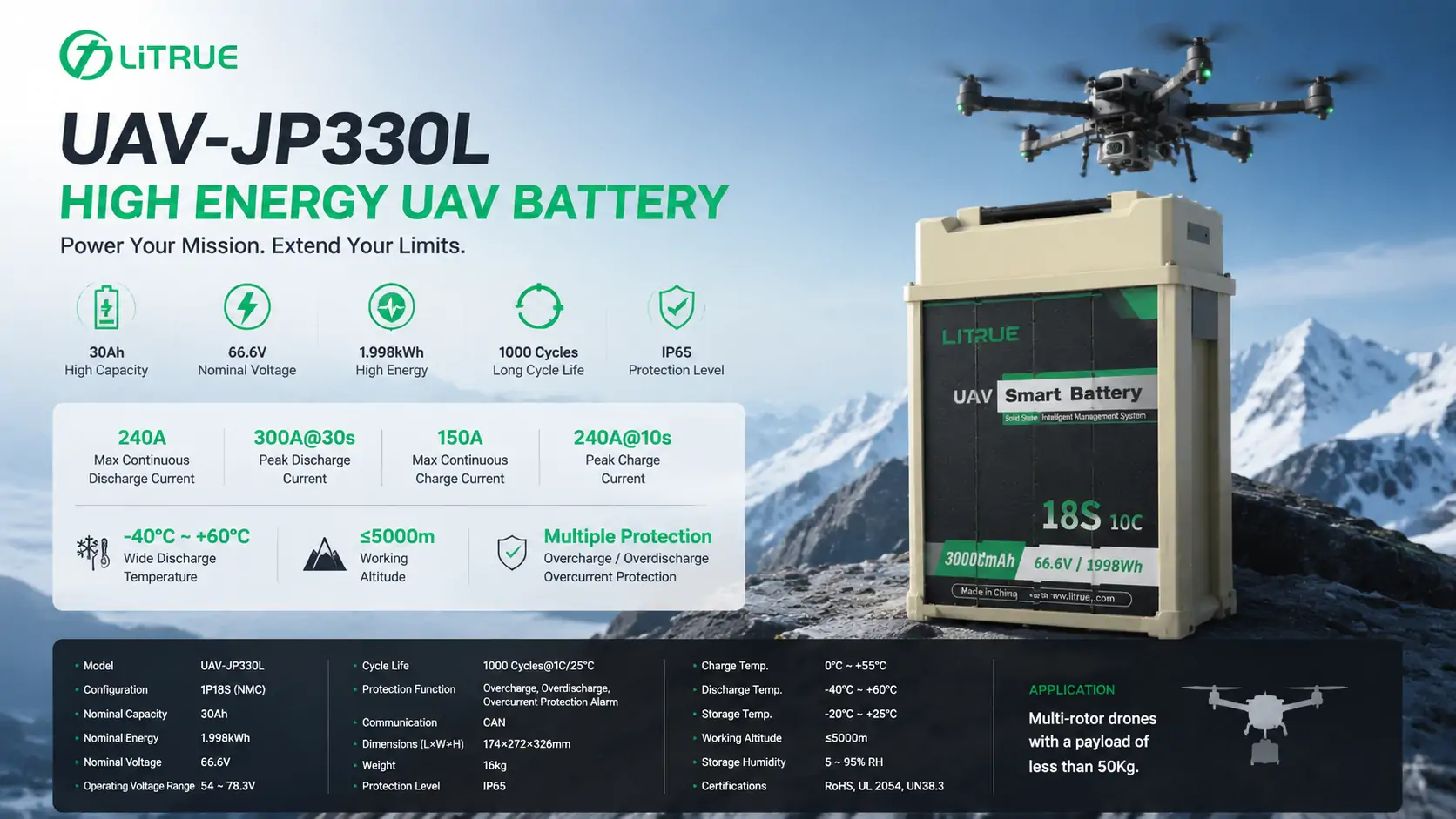
When someone's flying above 3,000 meters with a real payload bolted on, this is the pack I reach for. The UAV-JP330L — 66.6V, 30Ah, NMC, 1P18S. Altitude and temperature weren't afterthoughts here. They were the brief.
Unique Selling Points
Three numbers do the talking. Rated to operate at 5,000 meters — and most generic packs won't even print that line, which tells you something. Discharge range of -40°C to +60°C, so a frozen pre-dawn launch on some plateau doesn't faze it. And 1.998 kWh of energy in a 16 kg pack. That energy-to-weight ratio is the thing thin air actually rewards.
Audience Intent Match: Who Is This For?
Before you buy, be straight with yourself about the mission. The JP330L is for multi-rotor platforms under 50 kg — mapping crews, inspection teams, heavy-lift logistics, anyone genuinely pushing into high terrain. It is flat-out wrong for a sub-2 kg hobby quad or a featherweight FPV rig. You'd be lugging capacity you'll never burn. For those, grab something smaller — and I'll tell you that to your face before I'd let you overpay for this.
Performance Evaluation by Decision Factor
Power when you need it: 240A continuous, 300A peak (30s at 25°C). That surge headroom is what keeps a heavy drone planted when a gust slams into it at altitude instead of letting it sink.
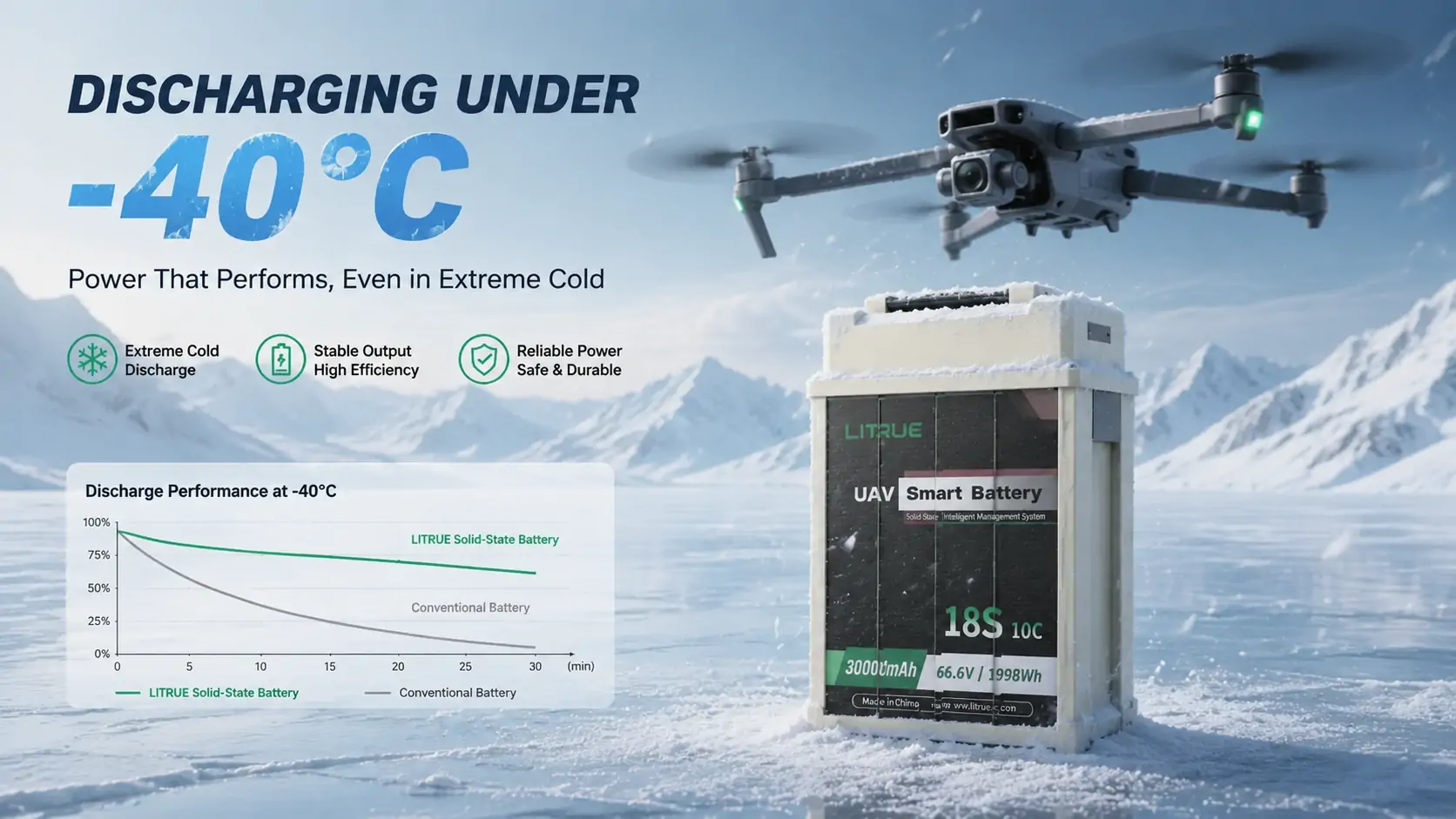
Cold behavior: the -40°C floor is the spec that earns its keep up high. Lots of packs claim a wide range on paper. This one's been to the freezer.
Fleet economics: 1,000 cycles at 1C/25°C. For a commercial operator that's your cost-per-flight-hour quietly working in your favor across a season or two.
Design and Usage
The IP65 shell shrugs off the grit and damp you hit on remote launch sites — I've watched these run through dust that would've choked an unsealed competitor flat. The CAN bus is the underrated bit. The pack streams cell voltage, temperature, and state-of-charge straight to your flight controller, so the ground station sees trouble building instead of finding out after the drone's already on the ground in pieces. Overcharge, over-discharge, over-current protection all sit on top of that.
Customization
We make the cells. We're not flipping someone else's SKU. So if your airframe needs odd dimensions, a particular connector, a tuned voltage window — our engineers build a custom UAV battery from the cell up. That's the whole point of buying from the lithium battery manufacturer instead of an assembler. The pack bends to your drone. Not the reverse.
Limitations
Where I won't blow smoke: the JP330L runs CAN but has no onboard display. You read its data through the flight controller, not off the pack. And 16 kg is 16 kg — this is heavy-lift power, not a featherweight for a compact survey bird. If either of those is a dealbreaker for your build, say so. We'll spec something that fits instead of pretending this is it.
Pros and Cons
Pros: 5,000 m altitude rating; -40°C to +60°C discharge; 1.998 kWh at 16 kg; 300A peak surge; IP65 sealing; CAN telemetry; UL 2054, UN38.3, RoHS certified.
Cons: no standalone display; weight suits heavy-lift only; NMC needs charging inside its temperature window.
Get a Quote
If that spec lines up with your mission, you can pull factory-direct pricing and request a sample for field testing on the UAV-JP330L product page
Similar Product
Flying something lighter? The UAV-JP328L (51.8V, 28Ah, 8.7 kg) carries the same -40°C to +60°C and 5,000 m credentials in a smaller body — a sane step down when you don't need all 30Ah.
Alternatives and How They Compare
No pack wins every mission. Here's the honest spread for altitude work.
Lightweight NMC (UAV-JP220M, 6.8 kg). 51.8V, 20Ah, 1.036 kWh. Same wide -40°C to +60°C range, same IP65, but it trades capacity for a light frame. Right for LiDAR and inspection drones where payload matters more than endurance. Wrong for heavy lift.
Low-temperature LFP pouch cells (PM30F-L). If your work lives in genuinely savage cold — I mean -43°C — these wide-temperature lithium cells hold rate where standard cells just quit, and they last longer too (1,200 to 1,500 cycles). Cost? Energy density, 155 Wh/kg, and the weight that comes with it. Which is why they end up in cold-region ground vehicles far more often than drones.
Generic imported packs. Cheaper. That's the pitch, start to finish. The ones I've cracked open rarely print a real altitude number, often skip the UN38.3 paperwork, and run loose cell matching — which is precisely what bit my Qinghai customer when one tired cell sagged under load at altitude. You save on the invoice. You pay on the flight line. Ask him.
Want to weigh raw range against weight more carefully? Our breakdown of which pack delivers the highest energy density runs the numbers properly.
FAQs
Does high altitude actually make a lithium battery less safe?
Not directly. It's the combination — higher current draw, heat that won't dissipate in thin air, and cold ambient temps all hitting at once. A pack built with a wide temperature range and per-cell monitoring rides that out. A generic one usually doesn't.
Is LFP or NMC safer for high-altitude drones?
LFP has the better intrinsic thermal stability, but its weight penalty hurts a drone fighting for lift in thin air. For most high-altitude heavy-lift work, a properly engineered NMC pack with a strong BMS and a real -40°C rating wins in the field. Match chemistry to the mission, not to a forum slogan.
What certifications should a safe UAV battery carry?
Bare minimum: UN38.3 (you can't air-freight without it), UL 2054, and RoHS. No UN38.3 and you'll hit a wall shipping internationally — and frankly, its absence usually means the cells weren't tested as hard as they should've been.
Can you build a battery for my specific airframe?
Yes. We're the factory, not a reseller, so dimensions, connectors, voltage windows, BMS logic — all of it adjusts. Send the requirements, our engineers spec it.
Where do I start if I'm new to this?
Begin with our complete UAV battery buyer's guide, then dig through the full drone battery lineup and match a pack to what you actually fly.
Summary
So — safest UAV lithium battery for high-altitude flights? It's never chemistry alone. It's the pack that marries the right chemistry to a real altitude rating, a wide temperature window, per-cell monitoring, and the paperwork to back all of it. For heavy lift above 3,000 meters, NMC packs like the UAV-JP330L — rated to 5,000 m and -40°C, CAN telemetry, UL 2054 and UN38.3 in hand — are what I'll put my name behind.