
If you run a fleet of delivery trikes in Dubai, or build inspection carts for a mine in Western Australia, you already know the gap between a spec sheet and a hot afternoon. On paper, prismatic lfp cells promise 3,000+ cycles and rock-solid safety. In a sealed battery box sitting at 50°C, that promise quietly falls apart — and the warranty claims start rolling in about eight months later.
I've spent the better part of a decade on the production floor of a battery factory, and the single most common complaint we hear from clients in the Middle East, Southeast Asia, and Africa is the same: "The cells tested fine, so why did capacity drop 20% in one summer?" This article answers that — with real numbers, not slogans.
Table of Contents
- 1. Why Heat Is the Real Enemy of LFP
- 2. Key Features, Missing Features & the Truth You Should Know
- 3. High-Temperature LFP Pouch Cell
- 4. Prismatic vs. Pouch
- 5. FAQs
- 6. Summary
Why Heat Is the Real Enemy of LFP
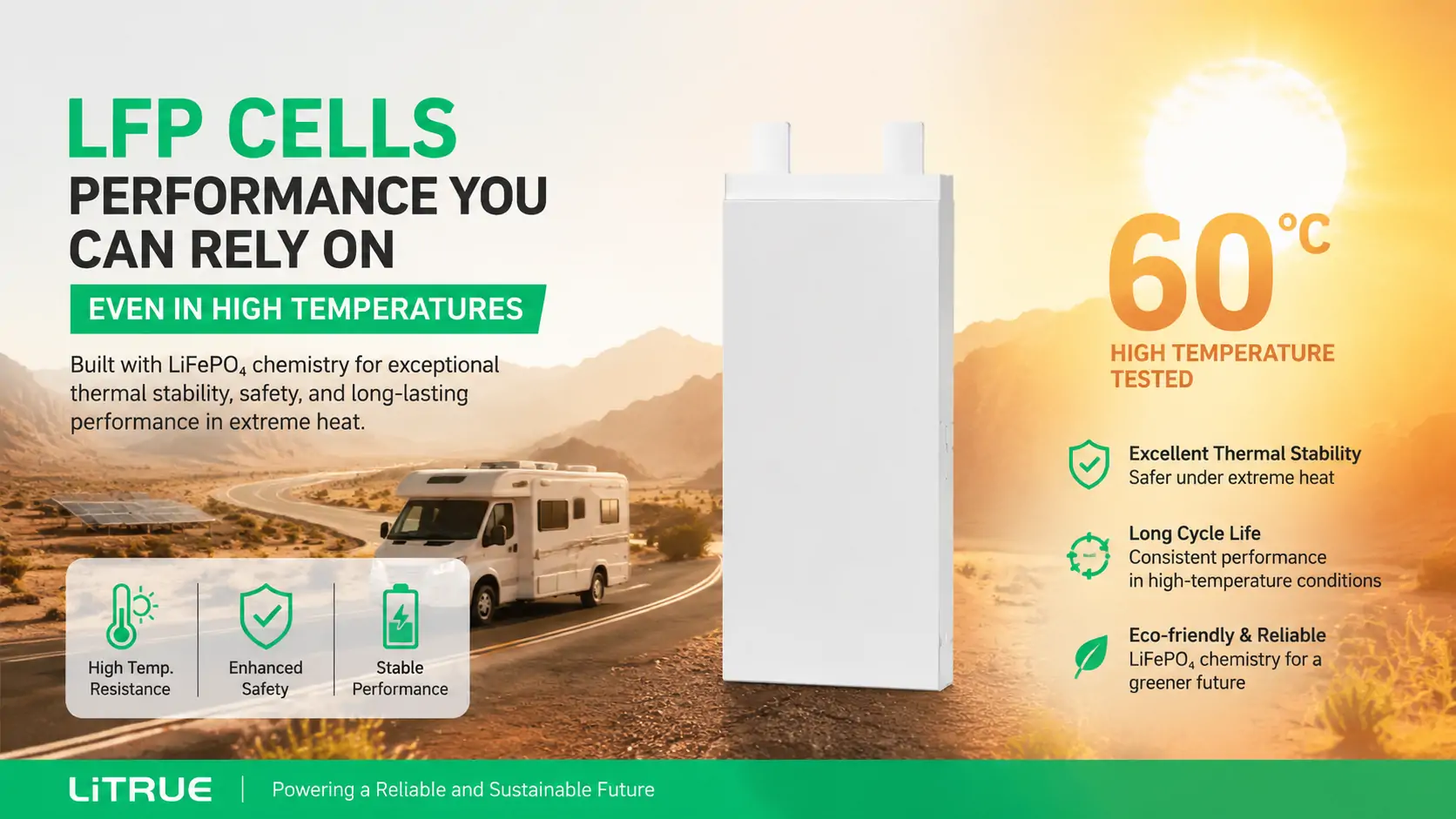
Lithium iron phosphate is famous for thermal stability. That reputation is earned — LFP won't go into thermal runaway as easily as NMC. But "won't catch fire" and "won't degrade" are two completely different things, and buyers conflate them all the time.
Here's what actually happens. Cycle-life ratings you see in marketing — say, 3,000 cycles — are almost always measured at 25°C. Push the same chemistry to a sustained 45°C and the SEI (solid electrolyte interphase) layer keeps growing, lithium plating accelerates, and the electrolyte breaks down faster. According to the Lithium iron phosphate battery reference data, elevated temperature is one of the dominant aging factors for this chemistry. The chemistry stays safe. It just gets old fast.
Where Prismatic Geometry Makes It Worse
Now layer the format on top of the chemistry. Prismatic cells pack a lot of jelly-roll into a rigid aluminum can — great for energy per box, bad for getting heat out. The center of a large prismatic cell can sit 8–12°C hotter than its surface. Your BMS reads the surface temperature, thinks everything is fine, and the core quietly cooks.
Pouch cells flip that math. A thin, flat pouch cell lithium battery has a far larger surface-area-to-volume ratio, so internal heat reaches the surface (and your cooling) much faster. Lower internal resistance means less heat is generated in the first place. That combination is exactly why a lot of hot-climate projects quietly switched formats over the last three years.
Key Features, Missing Features & the Truth You Should Know
Key Features Buyers Expect From LFP
Long cycle life, strong safety margin, flat discharge curve, and low cost per kWh. All real. All genuine reasons to choose LFP over NMC for stationary and two-wheel applications.
The Missing Features Nobody Lists
What the data sheet skips: a temperature-corrected cycle-life curve. Most generic lithium cells are validated at room temperature only. There's no published number for "cycles at 45°C sustained," because for most factories, that number is embarrassing. If your supplier can't show you a high-temp aging test, assume the worst.
The Truth You Should Know
A cell rated for "-20°C to 60°C operation" is not the same as a cell that *survives* 1,000+ cycles at 45°C. Operating range tells you when the cell will function. Cycle life at temperature tells you how long it will pay you back. Those are different tests — and only one of them protects your margin.
Product: High-Temperature LFP Pouch Cell
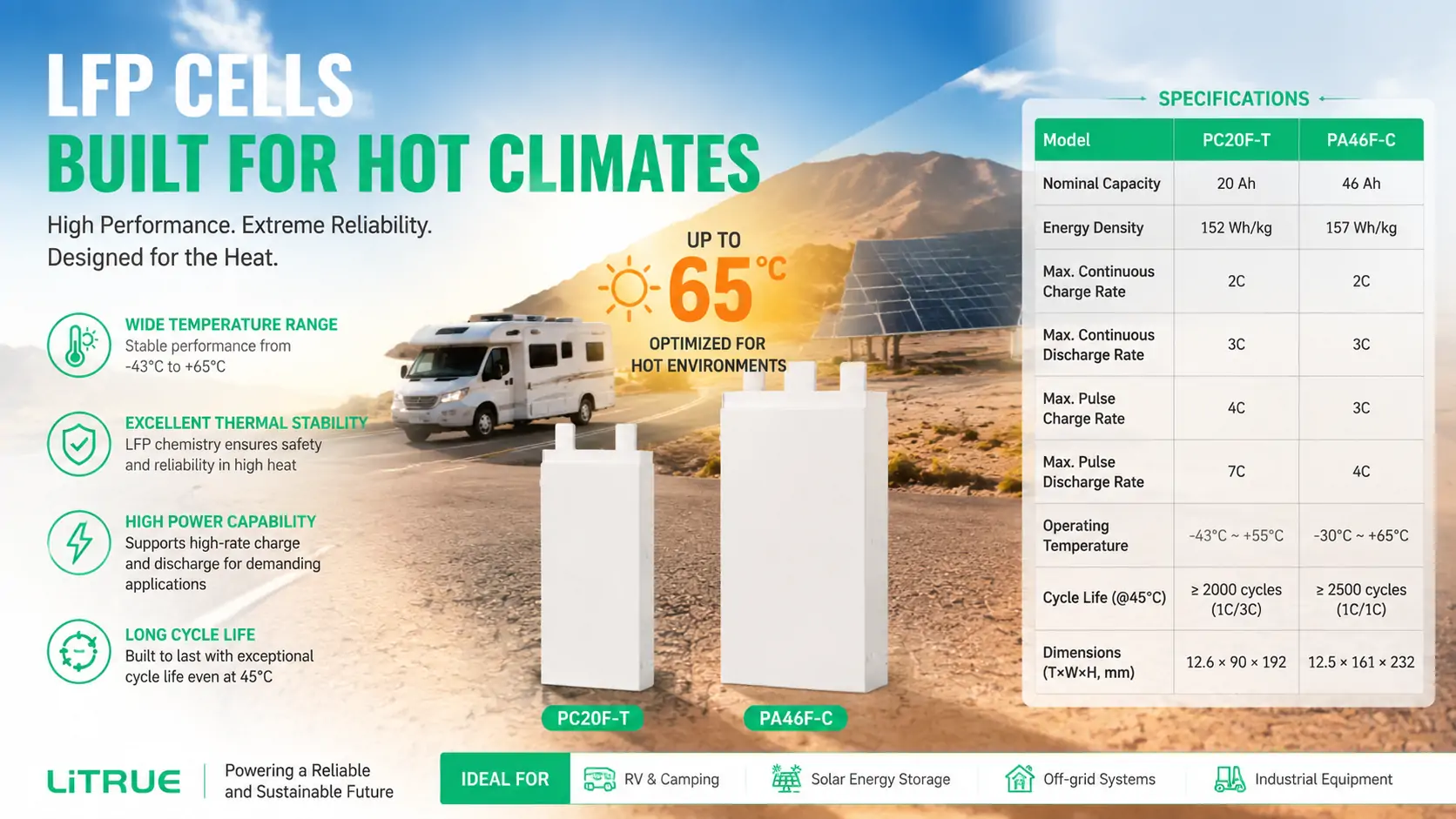
To make this concrete, let me walk through one of the cells we built specifically because clients kept hitting the heat wall: our High-Temperature Long-Cycle LFP pouch cells. Two models — PC20F-T (20 Ah) and PA46F-C (46 Ah). I'll use their real validation data, not rounded marketing figures.
Unique Selling Points
The headline is the one number that matters in a hot box: ≥2,000 cycles for the PC20F-T and ≥2,500 cycles for the PA46F-C — both measured at a sustained 45°C, not at 25°C. The PA46F-C carries an operating range up to +65°C; the PC20F-T reaches down to -43°C for cold-start work. Energy density lands at 152 Wh/kg (PC20F-T) and 157 Wh/kg (PA46F-C). These are stacked-pouch cells with deliberately low internal resistance, so they shed heat instead of trapping it.
Audience Intent Match: Who This Is For
This cell is for you if you build packs that live outdoors in heat — e-motorcycles, delivery trikes, agricultural and inspection vehicles, or stationary storage in the Gulf, India, or sub-Saharan Africa. These are the high-rate LFP cells you want when the ambient temperature alone is already half your problem.
It is *not* the right pick if you need maximum gravimetric energy for an aerial platform — a long-endurance drone is better served by a high-discharge NMC chemistry. Don't buy a heat-optimized LFP cell for a job that's really about grams in the air.
Performance Evaluation by Decision Factor
Cycle life: The 45°C validation is the whole point. Most LFP loses its rated life when you stop testing at room temperature — these were tuned the other way around.
Discharge capability: The PC20F-T handles 3C continuous and 7C pulse discharge — enough headroom for an e-motorcycle pulling away from a stoplight on a 48°C day. The PA46F-C runs 2C continuous charge, 3C continuous discharge.
Thermal behavior: Low internal resistance plus the flat pouch geometry keeps the core temperature close to the surface reading your BMS actually sees. Fewer nasty surprises in the middle of the stack.
Design & Usage
Dimensions are tight and stackable — PC20F-T at 12.6 × 90 × 192 mm, PA46F-C at 12.5 × 161 × 232 mm. The flat profile lets pack designers interleave cooling plates or simply rely on the larger surface area for passive dissipation. For most two- and three-wheeler builds, that means you can skip active cooling entirely and still stay inside the thermal budget.
Customization
As a lithium battery manufacturer, we tune tab placement, capacity grading, and pack-level series/parallel configurations to the housing you already have. If your battery box can't change, the cell layout can. That flexibility is usually what saves a stalled hot-climate project.
Limitations
This is not a high-energy-density cell. At 152–157 Wh/kg, it trails premium NMC by a wide margin — that's the deliberate trade for heat survival. The published sheet also doesn't list per-cell weight or a numeric internal-resistance value, so for tight mass budgets you'll want those figures from us directly before you commit. I'd rather you ask than assume.
Pros & Cons
Pros: Validated ≥2,000–2,500 cycles at 45°C • wide temperature window (-43°C to +65°C across the range) • strong pulse discharge (up to 7C) • flat pouch geometry that actually dumps heat • certified to GB/T 38058-2019 and GB 31241-2022.
Cons: Lower energy density than NMC • pouch format needs proper pack-level compression and sealing • weight figures require a direct quote.
Get the Full Spec Sheet
If you're spec'ing a hot-climate pack right now, pull the real numbers here: High-Temperature LFP Pouch Battery Cell (20Ah & 46Ah). Or send us your housing dimensions and target cycle count, and we'll tell you honestly whether this cell fits.
Prismatic vs. Pouch
Standard Prismatic LFP
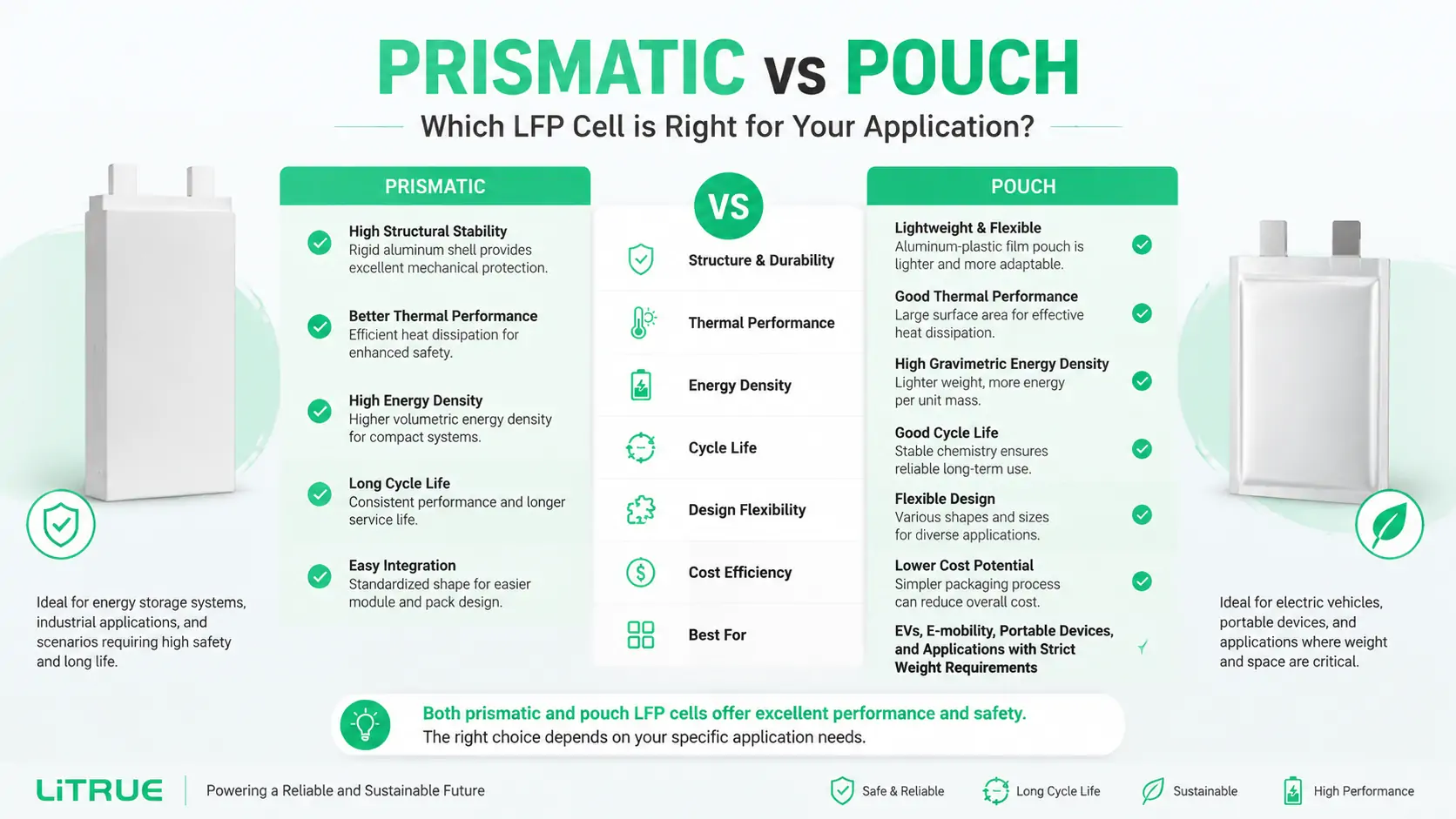
Best energy-per-box, simple mechanical mounting, mature supply chain. The catch: poor core-to-surface heat transfer, hidden hot spots, and cycle life that's almost always quoted at 25°C. In a sealed hot-climate enclosure, real-world life can fall well short of the sheet.
High-Temperature LFP Pouch
Better heat dissipation, validated high-temp cycle life, and design flexibility for odd housings. The trade-offs are real too: pouches need correct compression, edge sealing, and a slightly more involved pack design. You're trading a little assembly complexity for years of fleet uptime.
NMC
For anything where weight dominates — a long-range UAV, a performance E-Motorcycle battery chasing top speed — NMC's higher energy density wins, and you manage heat with engineering rather than chemistry. Right tool, right job.
FAQs
Do prismatic LFP cells fail faster in hot climates?
They don't fail catastrophically — LFP stays safe. But cycle life drops sharply at sustained high temperature, and prismatic geometry traps core heat, so capacity fade shows up faster than the spec sheet implies.
What temperature is "too hot" for LFP cells?
Continuous operation above roughly 45°C is where standard cells age quickly. Our high-temp pouch cells are validated at a sustained 45°C and the PA46F-C runs up to +65°C, but most generic cells are only tested at 25°C.
Are pouch LFP cells safe in heat?
Yes — and often better, because lower internal resistance and a larger surface area move heat out rather than letting it build at the core. Proper pack-level sealing and compression are what make a pouch design dependable.
Can I get LFP cells customized for a specific hot-climate housing?
Yes. We adjust capacity, tab layout, and pack configuration to your existing box. Send the dimensions and your target cycle count and we'll quote against real test data, not estimates.
Summary
Heat doesn't ignite good LFP — it ages it. The prismatic format makes that worse by hiding core temperature from your BMS, which is why so many hot-climate fleets see capacity drop in their first summer. The fix isn't a louder spec sheet; it's a cell validated where it actually works, plus a format that sheds heat instead of storing it.
If your project lives in the heat, choose lfp cells tested at temperature — and ask your supplier for the 45°C cycle curve before you sign anything. We're happy to share ours.