
When you are managing a fleet of commercial UAVs or engineering a hybrid agricultural tractor, the question isn't just "how long do lithium cells last?" in terms of months or years. The real question is: How many reliable mission hours can you extract before the capacity fade forces a costly grounding? For B2B procurement and engineering teams, battery longevity is the single most significant factor in calculating the Total Cost of Ownership (TCO).
At LiTrue, we have spent over 15 years dissecting the chemistry of degradation. Backed by 60+ in-house patents and experience delivering power solutions to 230+ global partners, we know that "long life" is not a marketing claim—it is a result of precise cell balancing, thermal management, and selecting the right chemical materials. Whether you are looking for 800 cycles in a high-rate NMC drone battery or 8,000 cycles in an industrial LFP storage system, understanding the mechanics of cell aging is your first step toward operational efficiency.
Table of Content
- The Truth About Battery Capacity Degradation
- Product Deep Dive: The 8,000-Cycle LFP Revolution
- LFP vs. NMC Lifespan
- FAQs: Everything You Need to Know About Battery Health
- Summary
The Truth About Battery Capacity Degradation
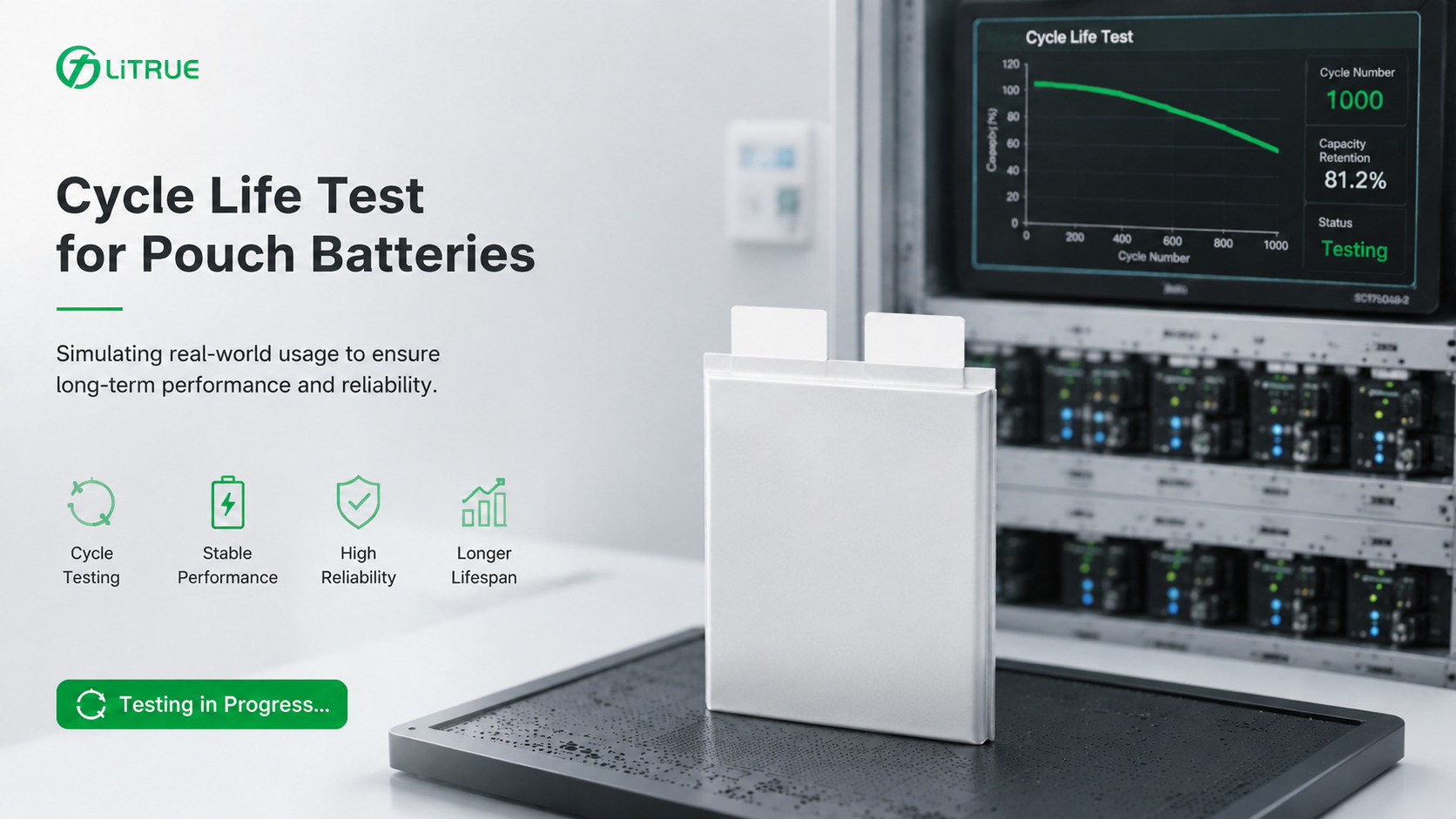
In the lithium world, "death" is rarely a sudden event; it is a gradual decline in the cell's ability to hold a charge and deliver current. Here are the three truths most manufacturers won't tell you:
1. Cycles Aren't Created Equal: A "cycle" is often defined as a full discharge from 100% to 0% (100% Depth of Discharge). However, if your application only drains the cell to 20%, the actual cycle life can increase by 2x or even 3x. Our data shows that operating within a 20%-80% window is the "sweet spot" for industrial longevity.
2. The Thermal Threshold: Heat is the silent killer of lithium-ion cells. For every 10°C increase above the optimal 25°C, the rate of chemical degradation nearly doubles. This is why LiTrue prioritizes thermal stability in our flexible stacked pouch cells—lower internal resistance means less self-heating during high-rate discharge.
3. Missing Features in Standard Cells: Most off-the-shelf cells lack the batch consistency required for large battery packs. If one cell in a 100-cell pack degrades faster, it drags down the entire system. At LiTrue, our automated production lines ensure car-grade consistency, which is the "missing feature" that protects your long-term investment.
Product Deep Dive: The 8,000-Cycle LFP Revolution
Unique Selling Points
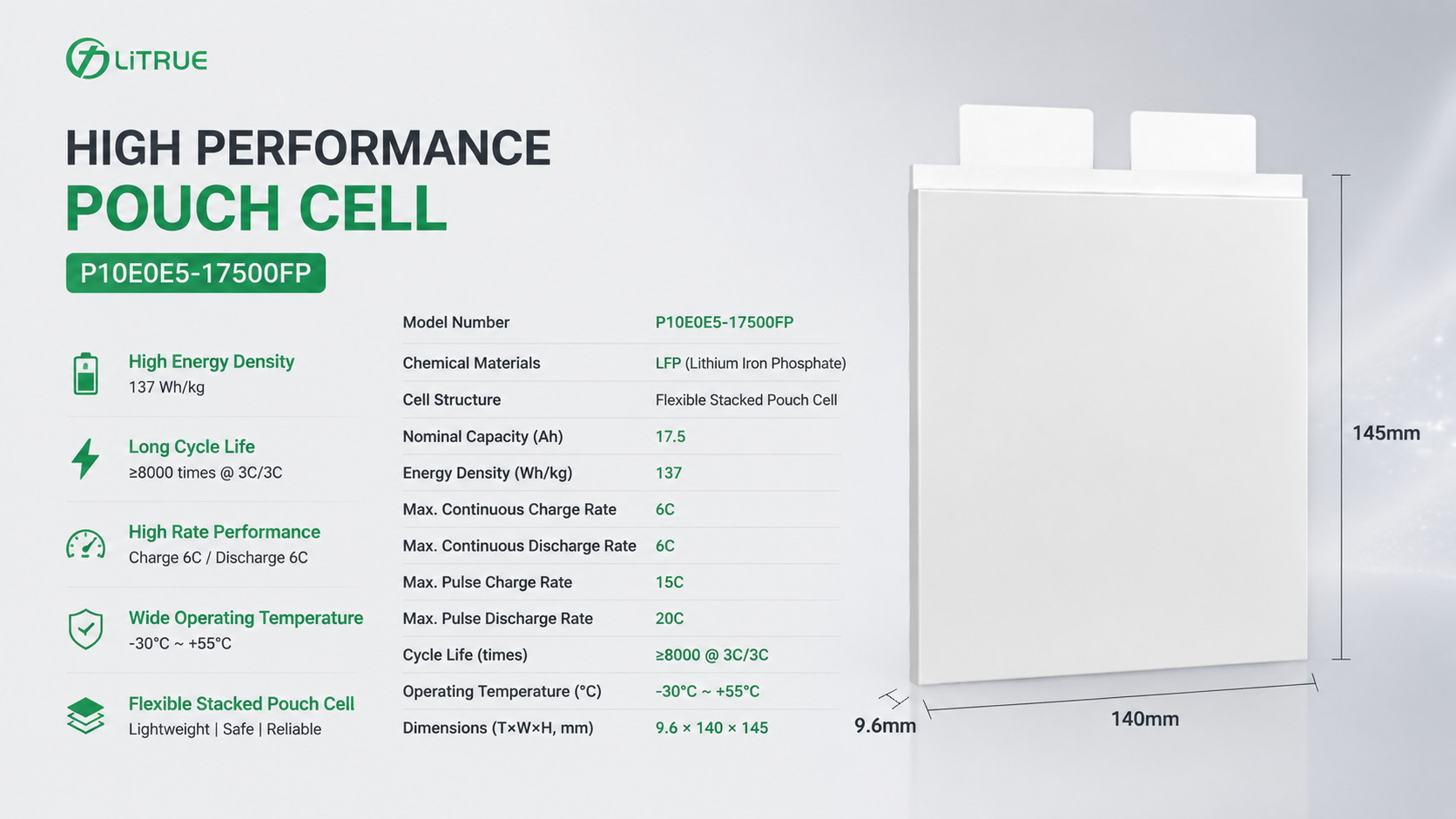
Our flagship 17.5Ah LFP Pouch Cell (Model P10E0E5-17500FP) is designed for one purpose: to outlast the equipment it powers.
- ≥8,000 Cycle Life: Under rigorous 3C/3C testing conditions, this cell maintains over 80% of its original capacity after 8,000 cycles.
- 20C Pulse Discharge: Engineered for hybrid tractors and heavy machinery that require sudden bursts of power.
- LFP Chemistry: Inherently safer than NMC, with a much higher thermal runaway temperature, making it ideal for agricultural and industrial environments.
Audience Intent Match
Who is this for?
- Industrial equipment manufacturers seeking to reduce warranty claims and field service costs.
- Hybrid tractor engineers needing high pulse power without sacrificing lifespan.
- Energy storage system (ESS) integrators looking for a 10-year+ service life.
Who is this NOT for?
- Weight-critical FPV racing drone pilots. If you need the absolute highest energy density and only care about 100 cycles, our UAV-JP series is a better fit.
Performance Evaluation
When evaluating how long these lithium cells last, we look at four key metrics:
1. Capacity Retention: Our LFP cells lose only ~2% capacity per year in storage when kept at 50% SOC (State of Charge).
2. Internal Resistance (IR): The flexible stacked structure keeps IR extremely low (<1.5mΩ). This prevents the voltage sag that typically causes equipment to shut down prematurely.
3. Charge Acceptance: With a 6C continuous charge rate, these cells can be "topped off" rapidly during equipment downtime without causing the "plating" effect that kills cheaper cells.
4. Safety Under Load: Even during a 20C pulse discharge, the thermal profile remains stable, preventing the accelerated aging caused by heat spikes.
Design & Usage
The design philosophy behind our pouch cells is "Thermal Freedom." Unlike cylindrical cells that can have hot spots in the center, our stacked pouch design allows for uniform heat dissipation across the surface. For users, this means simpler cooling systems and more predictable aging patterns.
Customization Capabilities
We don't just sell cells; we build solutions. Our engineering team can customize the tab positions, dimensions, and even the internal chemistry to optimize for specific voltage plateaus. Whether you need a 48V pack for an e-scooter or a high-voltage system for a commercial UAV, our OEM/ODM integration is seamless.
Limitations
While the 17.5Ah LFP cell is a longevity champion, it is not a "magic bullet." Its gravimetric energy density (137Wh/kg) is lower than high-nickel NMC cells (which can exceed 250 Wh/kg). If your primary constraint is weight rather than cycle life, we recommend looking at our UAV-JP series high-rate batteries.
Pros
- Pros: Industry-leading cycle life (8000+), exceptional safety, and high pulse discharge (20C).
- Pros: Stable performance in extreme temperatures (-30°C to 55°C).
LFP vs. NMC Lifespan
Choosing the right chemistry is the biggest decision in determining how long your lithium cells will last.
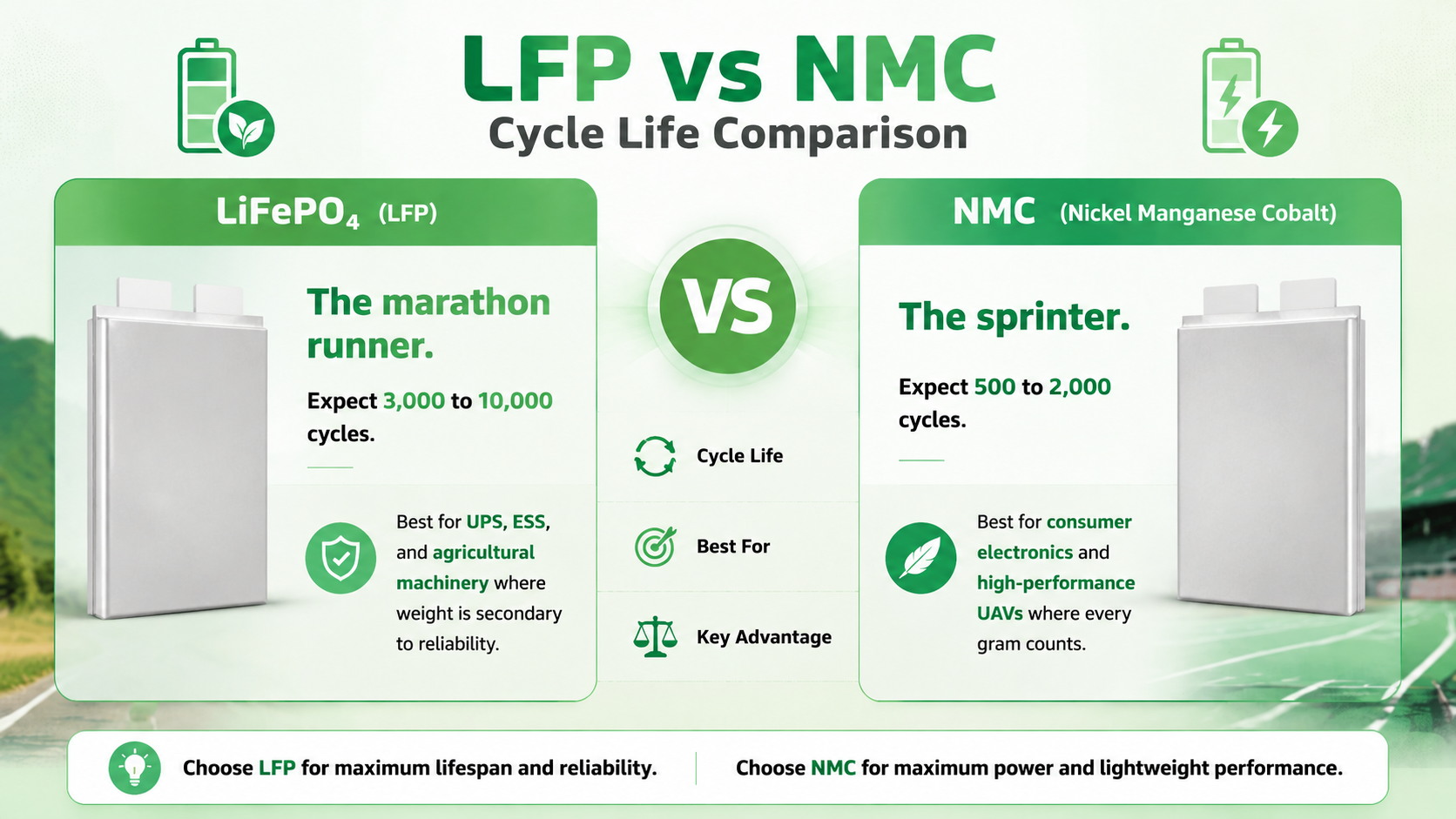
- LiFePO4 (LFP): The marathon runner. Expect 3,000 to 10,000 cycles. Best for UPS, ESS, and agricultural machinery where weight is secondary to reliability.
- NMC (Nickel Manganese Cobalt): The sprinter. Expect 500 to 2,000 cycles. Best for consumer electronics and high-performance UAVs where every gram counts.
At LiTrue, we provide both. Our technical team works with you to match the chemistry to your project's specific"duty cycle."
FAQs
Q: Does fast charging reduce how long lithium cells last?
A: Yes, if not managed correctly. Rapidly forcing ions into the anode can cause "lithium plating," which permanently reduces capacity. However, LiTrue’s cells are engineered with 5C-6C fast-charging capabilities that use advanced electrolyte additives to minimize this effect, allowing for quick turnarounds without the typical life penalty.
Q: What is the best state of charge (SOC) for storage?
A: Never store lithium cells at 100% or 0% for long periods. The ideal storage SOC is 40%-60%. Storing a battery at full charge increases the internal "stress" on the chemistry, accelerating the parasitic reactions that shorten lifespan.
Q: How does a BMS affect cycle life?
A: A high-quality Battery Management System (BMS) is the guardian of your battery's health. It prevents over-discharge (which can cause copper dissolution) and over-charge (which leads to oxygen release). Our smart BMS solutions ensure that every cell in the pack is operating within its safe "longevity window."
Summary
So, how long do lithium cells last? The answer is in your hands—and your supplier's engineering. By choosing high-quality cells with a proven 8,000+ cycle life, maintaining proper thermal conditions, and managing your discharge depth, you can transform your battery from a "consumable" into a long-term asset.
With 15+ years of experience and a track record of reliability for 230+ global partners, LiTrue Power Technologies is here to ensure your fleet stays powered longer. Ready to optimize your TCO? Contact our engineering team today for a custom power consultation.