
We get this question from procurement managers, drone fleet operators, and R&D engineers almost every week: "Do we actually need a lithium battery, or can we make do with regular batteries for this application?" It sounds simple. It isn't. And the wrong answer costs real money—sometimes a failed mission at 4,000 meters altitude, sometimes a production line that grinds to a halt in January.
This guide cuts through the noise. We're not going to hand you a recycled chemistry lesson. Instead, we'll walk you through what the differences actually mean in operational terms, share what we've observed from manufacturing and field-deploying lithium packs for industrial UAVs, and give you a framework to make the right call for your specific use case.
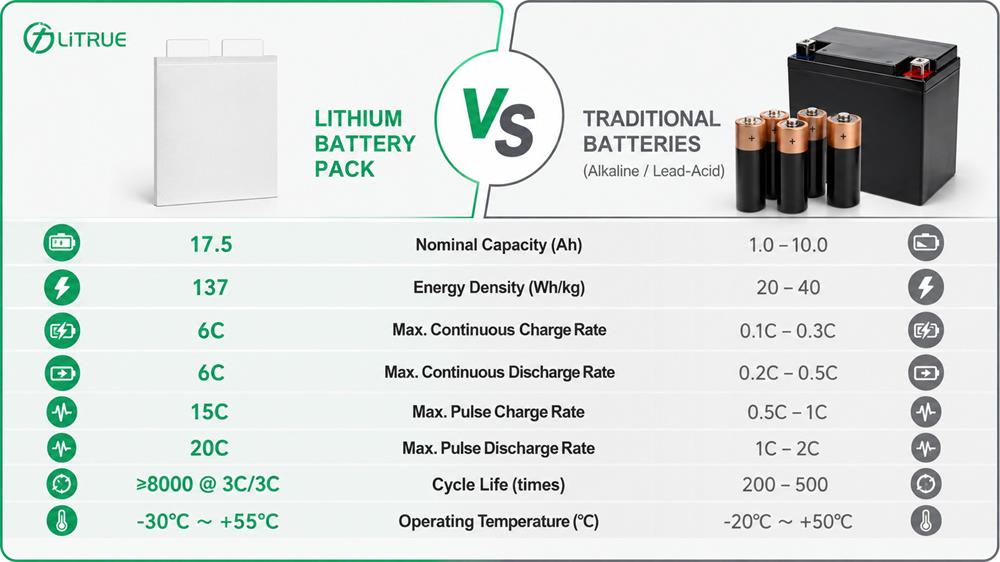
Table of Contents
1. What Is a Regular Battery Anyway?
2. Lithium Battery: Core Chemistry & What Makes It Different
3. Head-to-Head: Lithium Battery vs Regular Battery Across Every Key Factor
4. Product Deep Dive: 51.8V 28Ah NMC Drone Battery
5. Who Should Choose What? Audience Intent Match
6. Alternative Chemistries Worth Knowing
7. FAQs
8. Summary
What Is a Regular Battery Anyway?
The phrase "regular battery" covers a lot of ground—more than most people realize. When buyers say "regular," they typically mean one of three things:
Alkaline batteries (AA, AAA, 9V): single-use, consumer-grade, built around zinc-manganese dioxide chemistry. Cheap per unit. Expensive per watt-hour over time.
Lead-acid batteries: the workhorses of backup power, forklifts, and older UPS systems. Flooded, AGM, or gel variants. High self-discharge, very heavy, but cost-effective at large capacity.
Nickel-metal hydride (NiMH): rechargeable, used in older hybrid vehicles and consumer electronics before lithium-ion took over. Better than alkaline for cycle use, but still significantly outperformed by lithium in almost every metric that matters for industrial applications.
Understanding which "regular" you're comparing against is half the battle. A lithium battery stacked against a flooded lead-acid in a forklift application is a completely different conversation than comparing it to NiMH in a handheld device.
Lithium Battery: Core Chemistry & What Makes It Different
The term lithium battery itself covers a family of chemistries—lithium-ion (Li-ion), lithium iron phosphate (LFP), and NMC (Nickel Manganese Cobalt) being the three most commercially relevant in B2B applications today. Each has a distinct fingerprint.
The fundamental advantage across all lithium chemistries: lithium is the lightest metal on the periodic table, and lithium ions move through the electrolyte with very low internal resistance. That translates directly into higher energy density, faster charge acceptance, and a flatter discharge curve compared to lead-acid or NiMH alternatives.
According to data published by the U.S. Department of Energy Vehicle Technologies Office, lithium-ion battery energy density has improved by over 85% since 2008, while pack costs have dropped by more than 90%. These are not incremental gains—they're technology-category shifts.
What that means on a factory floor or in a UAV mission: you get more runtime per kilogram, faster turnaround between charges, and significantly longer service life before replacement.
Head-to-Head: Lithium Battery vs Regular Battery Across Every Key Factor
Energy Density: It's Not Close
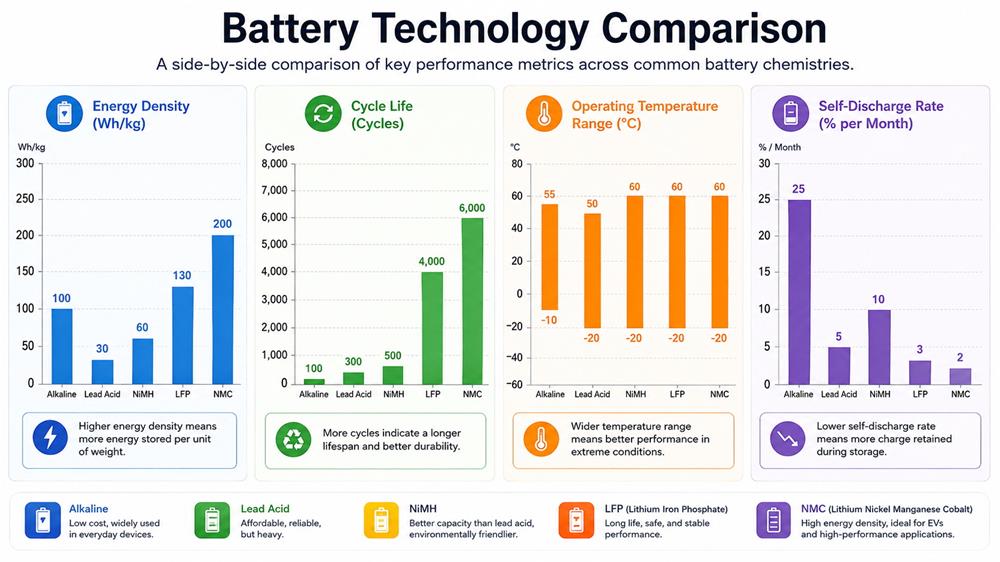
Lead-acid batteries typically deliver 30–50 Wh/kg. NiMH sits around 60–120 Wh/kg. NMC lithium batteries routinely achieve 150–250 Wh/kg. That gap matters enormously in weight-sensitive applications.
Take a drone application as a concrete example. A 28Ah NMC pack at 51.8V delivers 1.45 kWh of energy in a package weighing roughly 8.7 kg. To achieve the same energy from a lead-acid battery, you'd be looking at upwards of 40–50 kg. No drone frame on earth can fly that payload—which is precisely why the UAV industry migrated to lithium chemistry completely.
Cycle Life: Where Regular Batteries Quietly Bleed You Dry
This is the metric that most procurement managers underweight when comparing upfront costs. A flooded lead-acid battery realistically delivers 300–500 cycles at 50% depth of discharge before capacity degrades meaningfully. Quality LFP lithium cells achieve 2,000–4,000 cycles at 80% depth of discharge. NMC packs engineered for industrial UAV use typically deliver 1,000+ cycles at a 1C charge/discharge rate.
Do the math. At 300 cycles, if a lead-acid pack costs $200 and a lithium pack costs $800, the lithium pack is cheaper per cycle by the time you hit 500 uses—and that's before factoring in downtime, maintenance, and the weight penalty that affects productivity.
Self-Discharge: The Silent Killer of Standby Applications
Lead-acid batteries self-discharge at roughly 4–6% per month. NiMH can lose 20–30% per month at room temperature. Lithium-ion and LFP cells self-discharge at just 1–3% per month. For emergency backup systems or seasonal equipment that sits between deployments, that difference is not academic—it's the difference between a battery that's ready when you need it and one that's dead on arrival.
Operating Temperature: Where Things Get Interesting
Standard alkaline and lead-acid batteries experience significant performance degradation below 0°C. The internal resistance spikes, available capacity drops dramatically, and in flooded lead-acid designs, you risk electrolyte freezing. Lithium chemistry—especially properly engineered industrial packs—can discharge reliably at -20°C to -40°C. Some wide-temperature LFP cells are specifically engineered for sub-zero performance, a capability that simply doesn't exist in traditional battery chemistries at comparable energy density.
Voltage Stability: Flat Discharge Curve vs. the Sag Problem
Lead-acid batteries have a notoriously sloped discharge curve. Your equipment is running at full voltage when the battery is full, and by the time you're at 50% state-of-charge, voltage has already sagged enough to affect motor performance and control system behavior. Lithium batteries—particularly LFP chemistry—maintain a remarkably flat voltage profile through the majority of their discharge cycle. For variable-speed motors, servo systems, and precision electronics, that stability is not a luxury. It's a hard requirement.
Safety: The Real Conversation
Lithium batteries require a Battery Management System (BMS) to operate safely. Full stop. Without protection against overcharge, over-discharge, and thermal runaway, lithium chemistry is genuinely dangerous. This is a legitimate limitation compared to alkaline or even lead-acid, which are inherently more tolerant of abuse. However, modern industrial lithium packs ship with integrated BMS, CAN bus communication, and multi-layer protection. The risk profile with a properly engineered pack is very well managed—and the tradeoff against the performance gains is, for most applications, overwhelmingly worth it.
Product Deep Dive: 51.8V 28Ah NMC Drone Battery
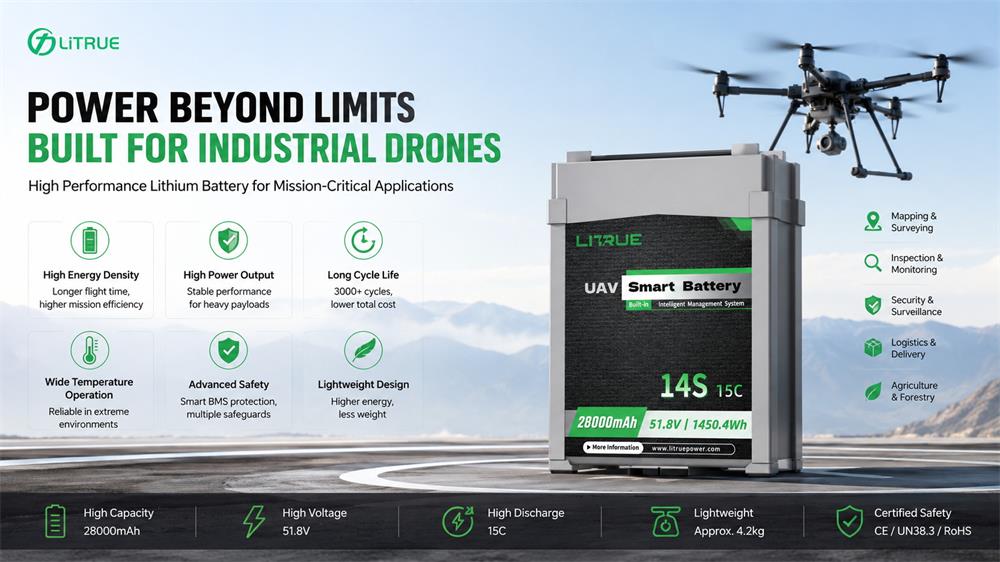
When we talk about what a modern UAV lithium battery actually looks like at the engineering level, the UAV-JP328L is a good lens to look through. This is one of the packs we manufacture at LiTrue, and the specs reflect genuine design decisions—not marketing numbers.
Unique Selling Points
The UAV-JP328L runs on a 14S1P NMC configuration at a nominal 51.8V, delivering 28Ah capacity and 1.45 kWh of usable energy in an 8.7 kg package. What makes the engineering decisions here notable:
Discharge headroom: 140A continuous discharge, with 280A peak sustained for up to 10 seconds. For heavy-lift UAVs running high-torque brushless motors, peak current demand during takeoff and aggressive maneuvers regularly spikes into territory that cheaper packs simply can't handle without triggering BMS cutoffs at the worst possible moment.
Fast charge capability: 56A continuous charging, up to 84A peak (30 seconds, at 25°C). In commercial UAV operations, turnaround time between flights is a direct productivity metric. Packs that can accept fast charging without accelerated degradation extend fleet uptime significantly.
Environmental resilience: IP65 enclosure rating, operational discharge range from -40°C to +60°C, altitude tolerance up to 5,000 meters. We designed this specifically for agricultural survey and industrial inspection missions where environmental conditions are not predictable.
Cycle life: Rated at 1,000+ cycles at 1C/1C rate. At, say, two flights per day, that's over a year of operational service before capacity meaningfully degrades.
Certifications: GB/T 38058-2019, GB 31241-2022, GB/T 38930-2020, plus RoHS, UL 2054, and UN38.3. The UN38.3 certification specifically matters for any customer shipping batteries internationally by air—without it, packs are not legally transportable on commercial flights.
Audience Intent Match
This pack is built for: Industrial UAV operators running heavy-lift platforms (8–30 kg takeoff weight), agricultural drone fleets for crop spraying or surveying, inspection UAVs in extreme-temperature environments, and OEM manufacturers sourcing battery packs for their drone product line.
This is not the right fit for: Consumer hobby drones (over-engineered and priced accordingly), ground-based energy storage applications (where LFP chemistry offers better cycle economics), or applications where the 51.8V nominal voltage doesn't match system requirements.
Performance Evaluation
Flight time: In a 10 kg payload heavy-lift configuration, the 1.45 kWh pack realistically delivers 18–28 minutes of flight depending on rotor efficiency and load. That's a meaningful operational window for most commercial inspection or agricultural passes.
Weight-to-energy ratio: At 8.7 kg delivering 1.45 kWh, the pack comes in at approximately 167 Wh/kg. For NMC chemistry in an integrated pack with BMS and enclosure, that's solid density that reflects quality cell selection upstream.
Thermal management: The IP65 housing handles passive thermal management, which is adequate for standard UAV duty cycles where the pack cycles from resting to operational and back. Extended high-current discharge in extreme ambient temperatures should be factored into mission planning.
Design & Usage
The pack uses a standardized connector interface compatible with common UAV power distribution boards. The integrated BMS communicates via CAN bus, which means real-time telemetry—state of charge, cell voltage delta, temperature—is available to the flight controller without external monitoring hardware. That's useful for mission planning and critical for fleet maintenance scheduling.
Customization
As a direct manufacturer, LiTrue supports custom configurations. Voltage, capacity, connector type, BMS parameters, and enclosure form factor can all be adjusted for OEM requirements. If your UAV platform runs 44V or 59V nominal, or requires a pack geometry that fits a specific airframe bay, that's an engineering conversation worth having. Contact LiTrue directly for custom UAV battery specifications.
Limitations
The UAV-JP328L does not include active cooling. For sustained discharge applications—longer than 30-minute continuous flight, or multi-pack parallel configurations in extreme heat—passive thermal management should be evaluated carefully. The pack also does not support charging below 0°C (charge circuit cutoff activates), which is standard NMC chemistry behavior and matters if your operation involves deploying in sub-freezing conditions where the pack hasn't been pre-warmed.
Pros
— 1,000+ cycle service life reduces per-flight battery cost
— 280A peak discharge handles aggressive UAV motor demands
— IP65 + 5,000m altitude rating covers most field conditions
— UN38.3 certified for international air freight
— CAN bus BMS enables real-time fleet monitoring
→ View Full Specifications & Request a Factory Quote for the UAV-JP328L
Who Should Choose What?
Stick with Conventional Batteries If...
You're running a low-frequency, non-critical application where the battery is replaced annually anyway. Emergency flashlights, infrequently used backup devices, or extremely cost-constrained consumer products where a BMS-equipped lithium pack is cost-prohibitive—these are the edge cases where alkaline or even lead-acid still makes sense. Not many of them. But they exist.
Go Lithium If...
Your application involves any of the following: weight constraints, cycle frequency above 50 per year, operating temperature variability, fast-charge requirements, system voltage stability requirements, or total cost of ownership calculations over a multi-year horizon. That covers the overwhelming majority of industrial, commercial, and professional applications today.
For B2B buyers specifically—UAV manufacturers, EV component integrators, industrial equipment OEMs—the question is rarely whether to use lithium, but which lithium chemistry and from which manufacturer. Those are harder questions, and getting them wrong is expensive. A helpful starting point: the complete UAV battery buyer's guide from LiTrue's engineering team walks through the chemistry selection framework in depth.
Alternative Chemistries Worth Knowing
LFP (Lithium Iron Phosphate) vs NMC
LFP chemistry trades energy density for cycle life and thermal stability. Where NMC achieves higher Wh/kg in a smaller footprint, LFP can achieve 2,000–4,000+ cycles and is inherently safer from a thermal runaway perspective. For stationary energy storage, ground vehicle applications, or any deployment where the weight penalty is acceptable, LFP is a strong choice. LiTrue's high C-rate LFP pouch cells are a good example of what this chemistry looks like optimized for discharge performance.
Solid-State NMC: What's Coming
Solid-state batteries—replacing the liquid electrolyte with a solid ceramic or polymer—are moving from lab to limited commercial production. They promise significantly higher energy density and improved safety profile compared to conventional Li-ion. Not yet available at scale for most B2B procurement, but worth tracking on a 3–5 year product roadmap horizon.
FAQs
Is a lithium battery always better than a regular battery?
For most commercial and industrial applications, yes. Lithium batteries win on energy density, cycle life, and weight-to-performance ratio in the vast majority of use cases. The exceptions are primarily ultra-low-cost consumer applications where the BMS overhead and lithium material costs aren't justified by usage frequency.
How long does a lithium battery last compared to regular batteries?
A quality lithium-ion or LFP pack typically delivers 500–4,000 cycles depending on chemistry and operating conditions. Alkaline batteries are single-use. Lead-acid rechargeable batteries typically last 300–500 cycles. Even at the conservative end, lithium chemistry delivers 2–3x the service life of comparable lead-acid alternatives.
Are lithium batteries safe?
With a properly designed BMS and correct charging practice, yes. Industrial-grade lithium packs engineered by certified manufacturers include multi-layer protection against overcharge, over-discharge, short circuit, and thermal events. The safety concerns associated with lithium chemistry are real but manageable—and dramatically overstated relative to the performance advantages in most coverage you'll read.
Can lithium batteries operate in cold weather?
Discharge performance in cold weather is much better for lithium than for lead-acid or alkaline. Many industrial lithium packs are rated for discharge down to -20°C or lower. Charging in sub-zero temperatures is a different matter—most lithium chemistry requires the pack to be above 0°C before charging begins to prevent lithium plating and permanent capacity loss.
What is the main disadvantage of lithium batteries versus regular batteries?
Higher upfront cost and the requirement for a BMS are the two main barriers. Lithium batteries also require more careful storage and shipping compliance (UN38.3 for air transport). For buyers sourcing at scale from a certified manufacturer, these are manageable constraints rather than fundamental obstacles.
Where can I source custom lithium battery packs for UAV applications?
Direct factory sourcing from a specialized lithium battery manufacturer gives you the most control over specifications, certifications, and pricing. LiTrue operates as a direct manufacturer with OEM capabilities. You can request a factory quote here or explore the full product catalog for standard configurations.
Summary
The lithium battery versus regular battery debate, when you get past the surface-level chemistry comparisons, is really a question about where you want to spend your operational budget—upfront on a better technology, or on the hidden costs of inferior performance over time.
Regular batteries still have their place. Single-use alkaline cells for low-frequency consumer devices. Lead-acid in very cost-constrained stationary backup applications. But for industrial UAV operations, commercial equipment, EV components, and any B2B application where the battery is a productivity asset rather than a commodity consumable? Lithium wins. Consistently. On almost every metric that matters when you do full lifecycle accounting.
The more useful question for procurement decision-makers isn't lithium vs. regular—it's which lithium chemistry, which configuration, and which manufacturer has the engineering depth to deliver consistent quality at production volumes. Those answers depend on your specific application, and getting them right is worth taking the time.
If you're sourcing custom lithium battery packs for UAV, industrial, or commercial applications, LiTrue's engineering team is available to work through specifications with you. Just real factory data and engineering support from a team that manufactures what we sell.