
Procurement teams comparing cell formats keep running into the same phrase: multi-layered pouch lithium cells. It sounds like marketing shorthand, but it describes a real construction method — individual anode, separator, and cathode sheets cut and stacked one on top of another inside a laminated pouch, rather than wound into a jellyroll or dropped into a metal can. That layering is what separates a high-rate, high-density pouch cell from a commodity one, and it's the detail that decides whether a pack hits its weight target or misses it by 15%.
This guide goes one level deeper than a general "what is a pouch cell" overview — for that foundation, see LiTrue pouch cell lithium battery primer. Here we focus specifically on the multi-layer stacked construction: how it's built, how it compares against prismatic and cylindrical formats on paper, and what real NMC and LFP pouch cell specs look like when you're sourcing at OEM volume with a low MOQ.
What Are Multi-Layered Pouch Lithium Cells?
A multi-layered pouch lithium cell is built by cutting the anode and cathode into individual sheets, separating each pair with a thin separator film, and stacking the sheets in a repeating sequence — anode, separator, cathode, separator, anode — until the stack reaches the target capacity. The finished stack is welded to current-collector tabs, inserted into an aluminum-plastic laminate pouch, filled with electrolyte, and sealed.
This is different from a wound (jellyroll) pouch cell, where a single long anode-separator-cathode sandwich is rolled around itself. Winding is faster and cheaper to tool up, which is why it dominates commodity cylindrical cells. Stacking is slower and requires precision cutting and placement equipment, but it produces a geometrically uniform cell — every layer sees the same ion path length and the same mechanical load during charge and discharge.
That uniformity is the whole point. It's why multi-layered construction shows up almost exclusively in performance-oriented pouch cells: UAV packs, e-motorcycle packs, and any application where pulse current and energy density both matter. See LiTrue full lithium cell lineup for the range of stacked pouch formats currently in production.
Why the Layer Count and Stacking Precision Matter
Three things change when you move from a wound electrode to a multi-layer stack:
- Internal resistance: uniform ion path length across every layer means DC internal resistance (DCIR) stays lower and more consistent than in a wound cell, where inner and outer windings behave differently.
- Cell-to-cell consistency: for an OEM assembling packs in series-parallel configurations, tight DCIR distribution across a production batch is what keeps a BMS balancing efficiently instead of fighting outlier cells.
- Rate capability: short, wide tab geometry combined with stacked layers minimizes resistive losses, which is why high pulse-discharge pouch cells (7C, 10C, and above) are almost always stacked rather than wound.
The trade-off is manufacturing complexity. Stacking requires tightly controlled sheet-cutting tolerances and stacking-robot accuracy — quality control is more demanding than a winding line, and that shows up in lead time and minimum order quantity at the sourcing stage.
Pouch Cell vs. Prismatic Cell vs. Cylindrical Cell
Format choice is independent of chemistry — LFP and NMC are both available in all three formats. The table below compares them on the variables that actually drive a sourcing decision.
| Attribute | Pouch Cell (Multi-Layered) | Prismatic Cell | Cylindrical Cell |
|---|---|---|---|
| Casing | Flexible aluminum-plastic laminate film | Rigid aluminum or steel can | Rigid steel can |
| Gravimetric energy density | Highest — no case weight penalty | Moderate — case adds weight | Moderate to high (NMC-optimized formats can lead on Wh/kg) |
| Volumetric efficiency | Excellent — minimal dead space | Good — stacks efficiently in a pack | Lower — round geometry leaves gaps between cells |
| Design flexibility | Maximum — custom thickness, width, length | Moderate — fixed rectangular tooling | Minimum — fixed diameters (18650, 21700, etc.) |
| Mechanical robustness | Lowest standalone — needs module housing | High — self-supporting | Highest — steel can is inherently rigid |
| Pulse/high C-rate performance | Strong with stacked construction and low DCIR | Good | Good, but cooling between cells is harder at pack level |
| Typical best fit | UAV, e-motorcycle, wearables, custom-shape packs | EV modules, BESS, forklifts | Consumer electronics, high-volume commodity packs |
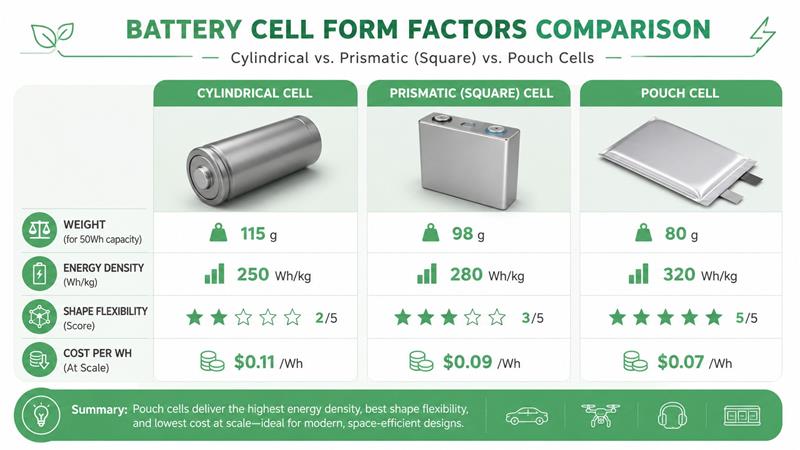
For a deeper breakdown of these trade-offs, including swelling management and module design considerations, see the full pouch cell lithium battery guide.
Real Specs: Multi-Layered Pouch Cells LiTrue Manufactures Today
Datasheet claims are easy to write. Here are two actual pouch lithium battery cells in production, one LFP and one NMC, so you can see what stacked construction delivers in numbers rather than adjectives.
LFP Pouch Cell — High-Temperature Series (PC20F-T / PA46F-C)
| Model | Capacity | Voltage | Weight | Energy Density | Continuous Rate | Pulse Rate | Operating Temp. | Dimension |
|---|---|---|---|---|---|---|---|---|
| PC20F-T | 20Ah | 3.2V | 420g | 152Wh/kg | 2C/3C | 5C/10C | -43℃~70℃ | 12.5×90×192mm |
| PA46F-C | 46Ah | 3.2V | 930g | 157Wh/kg | 2C/3C | 3C/4C | -43℃~70℃ | 12.5×161×232mm |
PC20F-T is rated ≥2,000 cycles at 43°C under 2C/3C conditions; PA46F-C is rated ≥2,500 cycles at 43°C under 1C/1C conditions. Full specifications, spec sheet download, and factory quote request are on the 20Ah & 46Ah High-Temperature LFP Pouch Battery Cell product page.
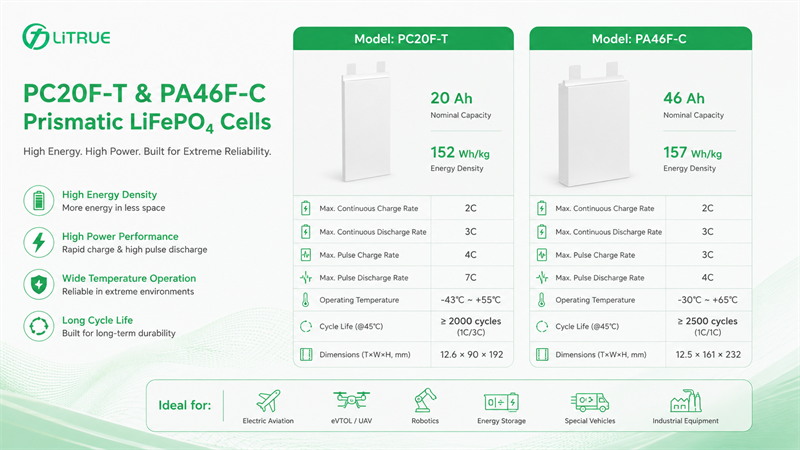
NMC Pouch Cell — High Energy Density Series
| Model | Capacity | Voltage | Weight | Energy Density | Continuous Rate | Pulse Rate | Operating Temp. | Dimension |
|---|---|---|---|---|---|---|---|---|
| PE36N-EE | 36Ah | 3.45V | 319g | 399Wh/kg | 1C/3C | 2C/5C | -43℃~65℃ | 8.3×87×187mm |
| PE36N-ED | 36Ah | 3.48V | 343g | 371Wh/kg | 1C/3C | 2C/6C | -43℃~65℃ | 9.0×87×187mm |
| PE40N-EF | 40Ah | 3.40V | 420g | 420Wh/kg | 1C/1C | 2C/3C | -43℃~65℃ | 9.1×87×187mm |
| PE36N-EF | 36Ah | 3.40V | 295g | 422Wh/kg | 1C/1C | 2C/3C | -43℃~65℃ | 8.2×87×187mm |
The PE36N-EE series is rated ≥1,000 cycles at room temperature under 100% DOD, 80% SOC, 1C/3C conditions. Full specs and quote request are on the 36Ah Semi-Solid State NMC Pouch Cell product page.
OEM/ODM Sourcing: Voltage Customization and Low MOQ
Multi-layered pouch cells are inherently easier to customize than wound cylindrical formats, because the stack can be sized to a target capacity and the pouch reshaped to a target footprint without new can tooling. LiTrue runs this as a standard OEM/ODM program rather than a one-off engineering favor:
- Custom voltage and capacity: nominal voltage (3.2V–3.48V range depending on chemistry) and capacity can be matched to a target pack configuration rather than forcing your design around a catalog cell.
- Low sample MOQ: sample orders start at 10 pieces (negotiable) across both the LFP and NMC pouch lines above, with a 7–15 working day sample lead time.
- Bulk production: standard bulk lead time is 45 days, subject to volume and requirements.
- System-level support: beyond the bare cell, LiTrue custom battery pack team handles module layout, BMS matching, and thermal design for OEM customers who need a finished pack rather than loose cells.
As a lithium pouch cell supplier and manufacturer, not a trading company, LiTrue controls its own electrode cutting, stacking, and sealing lines — which is what makes low-MOQ customization possible in the first place. Reach out to the LiTrue engineering team with target voltage, peak current, operating temperature range, and annual volume to get a technical proposal.
Where Multi-Layered Pouch Cells Are Used
- UAV and Drone Power Systems: the combination of high Wh/kg (up to 422 Wh/kg on the NMC lineup) and strong pulse discharge (up to 10C pulse on PC20F-T, up to 6C on the NMC series) supports both flight-time and takeoff-current demands. See LiTrue guide on how to choose a battery for a drone for sizing methodology.
- Electric Motorcycles and Two-Wheelers: flat, stackable cells fill irregular frame geometry that cylindrical or prismatic cells can't, while high pulse discharge (10C on PC20F-T) matches motor acceleration profiles.
- Hot-Climate Export Platforms: the PA46F-C's +70°C ceiling and 43°C-rated cycle life target fleets in the Middle East, Southeast Asia, and Africa where standard room-temperature ratings understate real field degradation.
- Custom OEM Packs: robotics, portable medical equipment, and industrial AGVs where enclosure geometry is fixed and the cell has to be shaped to fit it, not the other way around.
FAQs
What makes a pouch cell "multi-layered" instead of wound?
Multi-layered (stacked) pouch cells are built from individual anode, separator, and cathode sheets layered one on top of another, rather than a single continuous sandwich wound into a jellyroll. Stacking gives every layer the same ion path length and mechanical load, which lowers and evens out internal resistance across the cell.
Are pouch lithium cells good for drones?
Yes. The high gravimetric energy density of pouch construction — 152–422 Wh/kg across LiTrue LFP and NMC lines — directly extends flight time or payload capacity, and the stacked structure supports the high pulse discharge (up to 10C) that takeoff and maneuvering current draws require. See the drone battery sourcing guide for how to match capacity and C-rate to a specific airframe.
Can pouch cells be customized for OEM projects?
Yes. Because the electrode stack and pouch dimensions aren't constrained by can tooling, capacity, voltage, and footprint can be adapted to a target platform. LiTrue OEM/ODM program supports this with a 10-piece negotiable sample MOQ and 7–15 day sample lead time, so a design can be validated before committing to bulk volume.
What's the difference between LFP and NMC multi-layered pouch cells?
LFP pouch cells (like the PC20F-T and PA46F-C) prioritize thermal stability and cycle life at elevated temperature, topping out around 150–160 Wh/kg. NMC pouch cells (like the PE36N-EE series) push energy density much higher — 371–422 Wh/kg in LiTrue current lineup — at the cost of a lower thermal-abuse margin than LFP. Chemistry choice depends on whether the application is weight-constrained (NMC) or thermal-endurance-constrained (LFP).
What is the typical MOQ for a pouch lithium battery cell manufacturer?
For catalog models from an established manufacturer, sample MOQ is often in the range of 10 pieces for evaluation, with bulk MOQ scaling up for production runs. LiTrue standard sample MOQ across its pouch cell lines is 10 pieces (negotiable), with bulk lead time around 45 days depending on volume.
Summary
Multi-layered pouch lithium cells get their performance edge from one manufacturing decision: stacking individual electrode sheets instead of winding a continuous jellyroll. That choice is what produces the low, consistent internal resistance behind high pulse discharge and tight cell-to-cell matching — the two things that actually matter once cells go into a series-parallel pack.
Whether the priority is thermal endurance (LFP, up to +70°C and 2,500 cycles at 43°C) or raw energy density (NMC, up to 422 Wh/kg), LiTrue manufactures both as OEM/ODM-ready pouch cells with low sample MOQ. Contact the LiTrue team with your target voltage, current, and operating environment to get a technical proposal and sample pricing.