
Here's a problem every procurement manager runs into eventually: you search for lithium ion battery manufacturers, and you get a wall of brand names with zero context. Who actually makes cells vs. who just assembles packs? Who has real custom engineering capacity, and who will hand you a spec sheet that's three years out of date?
We've spent years inside this industry—working with cell chemists, pack engineers, and supply chain teams across Asia, Europe, and North America. This guide is built on that experience, not scraped from a generic directory. We'll walk you through 10 of the biggest lithium ion battery manufacturers worth knowing in 2026, with honest context on what each one is actually good at.
Whether you need lithium cells for UAV applications, e-mobility platforms, or industrial equipment, this list will save you weeks of vetting time.
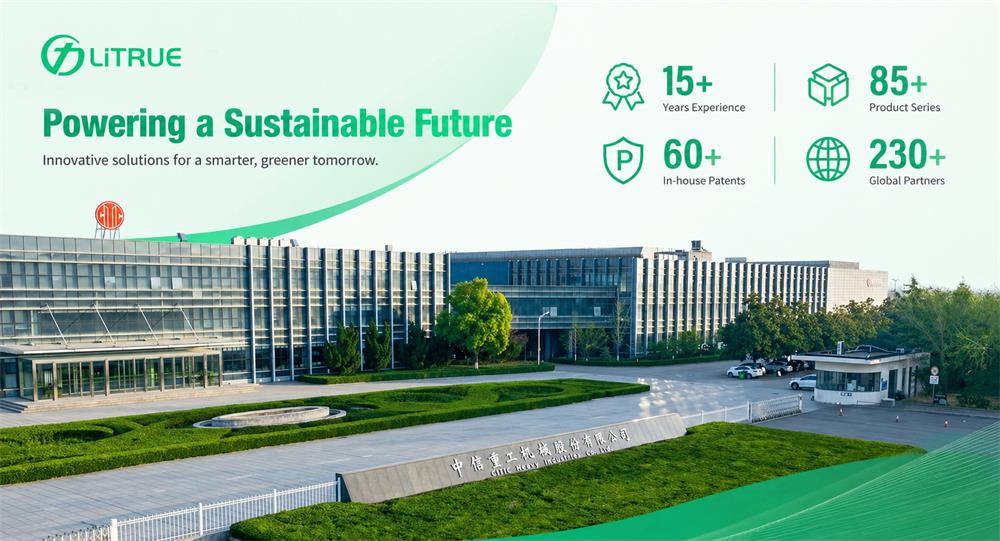
Table of Contents
- Why Choosing the Right Manufacturer Actually Matters
- Top 10 Lithium Ion Battery Manufacturers for B2B Buyers
- How to Compare Manufacturers: A B2B Decision Framework
- FAQs
- Summary
Why Choosing the Right Manufacturer Actually Matters
The global lithium ion battery market crossed $100 billion in value in 2023, and it's still accelerating—driven by electric vehicles, grid storage, UAVs, and industrial equipment. But that scale creates a massive sourcing challenge for B2B buyers.
Not every manufacturer that calls itself a "lithium battery supplier" actually controls cell chemistry. Some are pack integrators. Some are trading companies. And even among genuine cell makers, the specialization varies wildly: a company that dominates automotive cylindrical cells may have zero experience with the thin pouch cells you need for a fixed-wing agricultural drone.
The distinction matters for three reasons: quality traceability, customization capability, and minimum order quantities (MOQs). If you're sourcing custom battery cell products or specialty cells for a niche application, you need a manufacturer who can actually sit down with your engineers—not just ship you catalog SKUs.
2026 Global Top Lithium-Ion Battery Manufacturers Comparison
| Manufacturer | HQ / Location | Primary Cell Chemistry | Main Formats | OEM Customization | Best For Application |
|---|---|---|---|---|---|
| LiTrue | China | High-Rate LFP & NMC / Solid State | Pouch Cells & Custom Packs | High (Direct R&D Support) | UAV / Drone, E-Mobility, Custom Industrial |
| CATL | China | LFP & NMC (Qilin/CTP) | Prismatic | Low (Automotive Tier Volume) | Mass EV, Grid ESS |
| Panasonic Energy | Japan / USA | NCA / NMC | Cylindrical (2170 / 4680) | Low | Tesla EVs, Premium Consumer |
| Samsung SDI | South Korea | NMC | Cylindrical & Prismatic | Medium | Automotive OEM, High-End ESS |
| LG Energy Solution | South Korea | NMC / NCMA | Pouch & Cylindrical | Medium | Global EV Platforms, ESS |
| BYD | China | LFP (Blade Battery) | Prismatic Blade | Low | BYD Vehicles, Stationary Storage |
| EVE Energy | China | LFP & NMC | Cylindrical (32700) & Prismatic | Medium | Mid-Volume ESS, Industrial IoT |
| Gotion High-Tech | China | LFP | Prismatic | Low-Medium | Commercial Vehicles, Grid Storage |
| SVOLT Energy | China | Cobalt-Free NMC / Semi-Solid | Pouch & Prismatic | Medium | Next-Gen EV OEMs |
| EnerSys | USA | Lithium & Advanced Lead-Acid | Modules & Systems | High (Military/Defense) | Defense, Critical Infrastructure |
Top 10 Lithium Ion Battery Manufacturers for B2B Buyers
1. LiTrue – Best for Custom High-Rate Lithium Cells & UAV Batteries
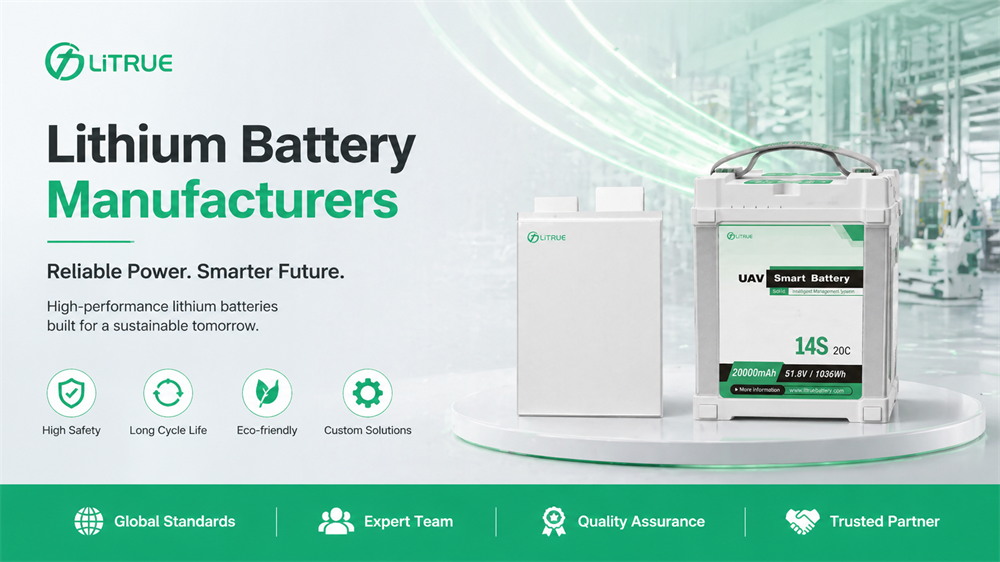
Headquarters: China | Specialty: High-rate LFP pouch cells, UAV lithium battery packs, custom OEM solutions
If your application lives at the edge of what off-the-shelf batteries can handle—high discharge rates, wide operating temperatures, tight weight budgets—LiTrue is the first name worth putting on your shortlist. They're not trying to compete with CATL on EV volume. Instead, they've built genuine depth in a narrower space: custom-engineered lithium cells and battery systems for applications that demand real performance under pressure.
We've watched their engineering team work through real UAV certification challenges, actual pack-level thermal simulations, and field-test iteration cycles. That's a different animal from a factory that quotes fast and ships catalog product.
Unique Selling Points
- In-house LFP pouch cell manufacturing with proprietary stacked electrode process—not just pack assembly
- Proven NMC chemistry for UAV applications where energy density per gram is the primary constraint
- Custom voltage platforms from ~24V through 83.2V and beyond, built to customer specs
- Smart BMS integration on UAV packs (CAN bus, LED indicators, balance charging protection)
- GB/T 38058-2019 and GB 31241-2022 certified cells; UN38.3 for transport compliance
- Direct factory access—no intermediary trading companies inflating MOQ and price
Who Is LiTrue For?
This is the right fit if you: source batteries for UAV manufacturers, e-motorcycle OEMs, agricultural machinery builders, or any industrial application that requires custom pack architecture and reliable cell-level data. Their MOQ flexibility—particularly for engineering samples—makes them accessible at the R&D stage, not just at scale.
Performance Evaluation
Their high C-rate LFP pouch cells (Models PJ20F-E / PA50F-E) are a good benchmark for the quality level across their product lines. The 20Ah variant delivers 164 Wh/kg energy density with a 2C continuous discharge and 4C pulse capability. The 50Ah variant pushes energy density to 167 Wh/kg with 3C continuous and 4C pulse. Both operate from -30°C to +55°C—which matters enormously if your equipment runs in northern winters or Middle Eastern summers. Cycle life is rated at ≥3,000 cycles at 1C/1C, which translates to dramatically lower TCO versus a competitor cell that cycles out at 1,500.
On the UAV side, their 51.8V 28Ah NMC pack delivers high discharge current for multi-rotor platforms, with built-in smart BMS and cell-level balancing. The 66.6V 30Ah "JP330L" pack targets larger agricultural spraying drones where both payload weight and field runtime matter simultaneously—a genuinely difficult engineering balance to hit.
Design & Usage
LiTrue pouch cells use a stacked (not wound) internal architecture. The practical effect: lower internal resistance, more uniform current distribution across the electrode surface, and better thermal behavior at high discharge rates. For pack designers, it also simplifies thermal management because heat is distributed more evenly. Their UAV packs are designed with field serviceability in mind—connectors, indicator LEDs, and BMS behavior that pilots actually understand.
Customization
This is genuinely where they differentiate. Voltage, capacity, connector type, BMS parameters, physical form factor, discharge rate tuning—all of these are on the table. They've delivered a custom 83.2V forklift battery to Turkey and have an active R&D contract with Volkswagen's PowerCo unit. That's not just a sales pitch; those are verifiable programs.
Featured LiTrue OEM Lithium Cell Solutions:
- High-C Rate LFP Pouch Cells: 20Ah & 50Ah LFP (≥3000 cycles, -30°C to +55°C)
- Semi-Solid State Drone Cells: 36Ah 300+ Wh/kg High Energy Density Pouch Cell
- Next-Gen Solid State Cells: 49Ah 495Wh/kg Anode-Free Cell
2. CATL
Headquarters: Ningde, China | Specialty: EV cells (LFP, NMC), large-format prismatic, energy storage systems
CATL is the world's largest lithium ion battery manufacturer by installed capacity—not a debatable claim. They supply Tesla, BMW, Volkswagen, and dozens of other global OEMs. Their Qilin battery platform and CTP (cell-to-pack) technology represent genuine engineering advances in volumetric efficiency. If you're building an EV platform at scale and can hit their MOQ requirements, CATL's supply chain and quality system are hard to match.
The challenge for smaller B2B buyers: CATL's minimum order volumes are calibrated to automotive-tier customers. Direct cell supply for smaller programs is difficult. Most mid-market buyers access CATL chemistry through system integrators or module suppliers, not direct from the factory. They're also not set up for the kind of custom specification work that a specialty UAV or industrial application requires.
Best for: High-volume EV and stationary storage programs. Less suited for: Custom specifications, small-to-mid volume, UAV or specialty applications.
3. Panasonic Energy
Headquarters: Osaka, Japan | Specialty: Cylindrical cells (18650, 2170), NCA chemistry, consumer and EV
Panasonic's partnership with Tesla—producing cells at the Nevada Gigafactory—defined a decade of EV battery benchmarking. Their NCA cylindrical cells set energy density records for mass-produced formats. The quality and consistency of Panasonic cells is genuinely exceptional; their internal process controls are among the strictest in the industry.
For B2B buyers outside the automotive tier, Panasonic Energy is most relevant if your application uses standard cylindrical formats (18650 or 2170) and your volumes are high enough to access their distribution channels. Direct engagement for custom pouch or prismatic formats isn't really their model at the mid-market level.
Best for: Premium cylindrical cell applications, high-volume programs, Tesla supply chain alignment. Less suited for: Custom cell formats, LFP chemistry, UAV-specific packs.
4. Samsung SDI
Headquarters: Suwon, South Korea | Specialty: NMC cylindrical (21700 format), EV pouch cells, ESS modules
Samsung SDI sits alongside LG Energy Solution and SK On in the South Korean battery tier—all three are serious, globally competitive manufacturers with strong quality systems. Samsung SDI's differentiation is their cylindrical 21700 cell performance (used in BMW i-series EVs among others) and their prismatic battery modules for energy storage.
Their automotive-grade quality and global manufacturing presence (plants in South Korea, Hungary, and the US) make them an attractive option for regulated markets where supply chain provenance matters. Like CATL and Panasonic, the challenge for mid-market buyers is access and MOQ.
Best for: Automotive OEM programs, ESS integration, regulated Western markets. Less suited for: Small-volume sourcing, application-specific customization.
5. LG Energy Solution
Headquarters: Seoul, South Korea | Specialty: Pouch cells, cylindrical cells, NMC chemistry, EV and energy storage
LG Energy Solution (spun out from LG Chem in 2020) is one of the most diversified lithium battery manufacturers in the world. They supply General Motors, Stellantis, Hyundai, and others. Their pouch cell technology is particularly strong—and they've invested heavily in next-generation chemistries including NCMA (nickel-cobalt-manganese-aluminum).
For industrial and specialty applications, LG Energy Solution's subsidiary and distribution network provides some level of access below the automotive tier. But again: if you need a truly custom pack architecture or specialty LFP cells, you're generally better served by a manufacturer whose core business is custom solutions rather than one adapting automotive-scale production for smaller programs.
Best for: EV platforms, large ESS programs, high-volume industrial. Less suited for: Custom form factors, UAV/drone applications, low-to-mid volume.
6. BYD
Headquarters: Shenzhen, China | Specialty: LFP blade cells, EV integration, energy storage, bus and commercial EV
BYD is unique among major manufacturers in that they make both the battery cells and the finished electric vehicles—a vertical integration that gives them real-world feedback loops that pure cell makers can't replicate. Their "Blade Battery" (a structural LFP prismatic format) addressed one of the biggest criticisms of LFP: low volumetric density. By making the cell itself a structural component of the pack, they recovered lost space and reduced total system weight.
BYD external battery supply business (separate from their own vehicle division) is growing, but their primary focus remains their own automotive programs. For third-party B2B buyers seeking LFP cells specifically for custom applications, BYD is worth understanding but harder to access compared to dedicated cell suppliers.
Best for: High-volume LFP applications, grid storage, commercial EV programs. Less suited for: Custom small-volume programs, specialty chemistries, UAV applications.
7. EVE Energy
Headquarters: Huizhou, China | Specialty: LFP and NMC cylindrical/prismatic cells, energy storage, IoT battery applications
EVE Energy is often overlooked in conversations dominated by CATL and BYD, but for mid-volume B2B buyers they're worth serious attention. They've built a strong position in energy storage systems (ESS), smart meter batteries, and specialty industrial cells. Their 32700 LFP cylindrical format has become a popular choice for DIY and commercial ESS builders.
EVE's willingness to engage with smaller programs—relative to the top-tier manufacturers—makes them more accessible for B2B buyers in the 10,000–500,000 cell/year range. Quality is solid; their manufacturing is IATF 16949 certified for automotive-grade process control.
Best for: Mid-volume ESS programs, cylindrical LFP sourcing, IoT and industrial applications. Less suited for: Highly custom pouch cell formats, UAV-specific packs.
8. Gotion High-Tech
Headquarters: Hefei, China | Specialty: LFP prismatic cells, energy storage systems, bus electrification
Gotion has grown rapidly on the back of global energy storage demand. Their partnership with Volkswagen Group (VW holds a strategic stake) has raised their profile significantly in Western markets. Their LFP prismatic cells are competitively priced and perform well in stationary storage applications where cycle life and thermal stability matter more than energy density.
Gotion's manufacturing footprint is expanding into the US and Europe, which matters for buyers who need regional supply chain options. For ESS developers and grid-scale storage integrators, they're a meaningful alternative to the CATL/BYD duopoly.
Best for: Grid and commercial ESS programs, bus electrification, markets requiring regional manufacturing. Less suited for: High C-rate applications, UAV or drone batteries, very compact form factors.
9. SVOLT Energy Technology
Headquarters: Changzhou, China | Specialty: Cobalt-free NMC, semi-solid-state development, EV cell supply
SVOLT is Great Wall Motor's spun-off battery unit, and they've moved fast on next-generation cell chemistry. Their cobalt-free NMC cell development is one of the more technically credible efforts in the industry—reducing reliance on cobalt (a supply chain and ESG liability) without sacrificing energy density the way standard LFP does. They're also one of the companies actively investing in semi-solid-state battery R&D for near-term commercialization.
For B2B buyers who track battery technology roadmaps closely, SVOLT is worth watching. They're not yet at the same scale or accessibility as CATL or EVE, but their technical direction is interesting. Direct supply relationships below the automotive tier are developing.
Best for: EV OEMs tracking next-gen chemistry, cobalt-free applications, technology-forward procurement teams. Less suited for: Current-production custom packs, ESS commodity supply.
10. EnerSys
Headquarters: Reading, Pennsylvania, USA | Specialty: Advanced lead-acid, lithium systems for industrial & defense, UPS, motive power
EnerSys occupies a distinct niche: they're the dominant supplier to industrial, aerospace, and defense markets that require batteries certified to extremely demanding standards (MIL-SPEC, DO-160, etc.). Their lithium product lines have expanded significantly, and for applications where documentation, certification traceability, and long-term supply commitment are non-negotiable, EnerSys is often the only realistic option.
They're not competing with Chinese manufacturers on price—and they're not trying to. Their value proposition is compliance, certification, and long-term field reliability in harsh environments. If you're sourcing for defense programs, aviation support equipment, or critical infrastructure, that premium is usually justified.
Best for: Defense, aerospace, critical industrial applications requiring Western supply chain and full certification. Less suited for: Cost-sensitive commercial applications, UAV consumer markets, ESS scale deployments.
How to Compare Lithium Battery Manufacturers: A B2B Decision Framework
Here's the honest version of the framework we use when evaluating a new supplier—not the sanitized checklist version that everyone publishes:
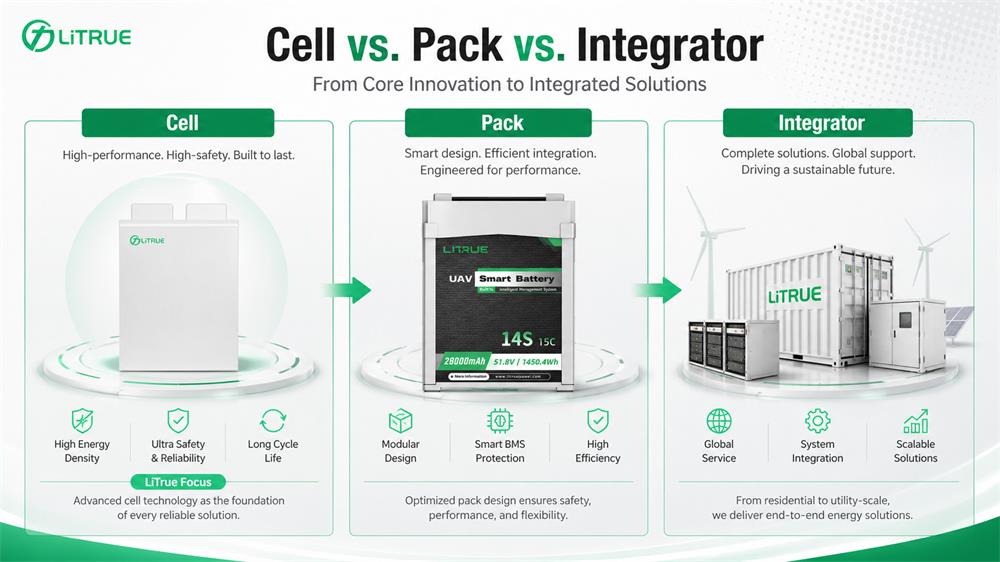
1. Cell vs. Pack vs. Integrator: Who Are You Actually Talking To?
Ask directly: Do they own the cell manufacturing process, or do they source cells and assemble packs? Both business models are legitimate, but you need to know which one you're dealing with. A pack integrator can't change cell chemistry. A cell manufacturer can—but they may not do packs at all. LiTrue, CATL, and EVE Energy all manufacture cells. Many companies advertising as "lithium battery manufacturers" are pack assembly houses buying cells from one of the companies on this list.
2. Certifications That Actually Match Your Market
UN38.3 for air transport. IEC 62133 for consumer electronics markets. GB/T standards for China. UL 2054 for North America. IATF 16949 for automotive-grade process control. Ask for the actual certificates, not the logos. And check the scope—a cert for one product line doesn't cover the custom product you're ordering.
3. Minimum Order Quantity vs. Engineering Sample Access
The MOQ listed on a website is rarely the full story. Most manufacturers will negotiate sample quantities for engineering qualification—what matters is whether they treat your sample order as a serious technical collaboration or as an afterthought. The quality of the engineering engagement at the sample stage predicts the quality of the production relationship.
4. Custom Specification Depth
Can they actually modify cell chemistry, electrode loading, or electrolyte formulation for your application? Or does "custom" mean they'll put your logo on a standard product? For most B2B specialty applications—UAV, industrial, e-mobility niche—genuine customization capability is the differentiating factor. See LiTrue track record with Volkswagen's PowerCo R&D program as a benchmark for what real custom engineering engagement looks like.
5. Supply Chain Transparency
Can they provide cell-level traceability (batch numbers, formation data, capacity grading records) for your production order? For regulated markets and warranty liability management, this isn't optional. Many manufacturers can produce this documentation; fewer do it as a matter of standard practice.
For deeper guidance on battery selection for UAV applications specifically, see LiTrue UAV battery buyer's guide—it covers C-rate selection, voltage platform decisions, and BMS requirements in practical terms.
FAQs
Q: What certifications should I look for in a lithium battery manufacturer?
A: For industrial and UAV applications, demand GB 31241-2022 (safety), GB/T 38930-2020 (UAV-specific), UN38.3 (transportation), and CE/RoHS (European compliance). These aren't optional—they're your protection against field failures and shipping delays. LiTrue provides complete documentation for all these standards with every order.
Q: How do I verify a manufacturer's actual production capabilities?
A: Request facility audit reports, ask for specific cycle life test data at your operating temperatures, and demand references from existing customers in your industry. Be wary of manufacturers who can't provide application-specific performance data—generic specs often hide real-world limitations. We welcome facility visits and provide detailed test reports for all our products.
Q: What's the difference between OEM and ODM battery manufacturing?
A: OEM (Original Equipment Manufacturer) means you provide the design and they build to your specs. ODM (Original Design Manufacturer) means they design and build based on your requirements. LiTrue offers both—we can work from your CAD files or develop custom solutions from scratch based on your performance targets and application constraints.
Q: How important is BMS customization for drone applications?
A: Critical. Your flight controller needs real-time battery data via CAN, RS485, or UART protocols. Generic BMS units often lack the communication protocols or response speed required for dynamic drone operations. Our Smart BMS is specifically designed for UAV integration with real-time telemetry, active cell balancing, and thermal runaway prevention.
Q: What minimum order quantities should I expect from industrial battery manufacturers?
A: MOQs vary significantly by manufacturer and application. Large EV-focused manufacturers may require 10,000+ units minimum with 6-12 month lead times. LiTrue offers flexible MOQs for prototyping and scaling—we work with clients from initial R&D samples (as few as 10-50 units) through full production volumes. This flexibility accelerates your development timeline.
Q: How do I handle global shipping compliance for lithium batteries?
A: Demand complete UN38.3 test reports and MSDS documentation from your manufacturer. These are mandatory for air, sea, and ground transportation of high-capacity lithium batteries. LiTrue includes all required shipping documentation with every order, ensuring smooth customs clearance worldwide. We've successfully shipped to 230+ global partners across Europe, Middle East, North America, and Asia-Pacific regions.
Q: Can I get custom cell chemistry for my specific application?
A: Yes. We offer both NMC (Nickel Manganese Cobalt) for high energy density applications and LFP (Lithium Iron Phosphate) for applications prioritizing cycle life and thermal stability. Our engineering team helps you select the optimal chemistry based on your discharge requirements, operating temperature range, and cycle life targets.
Summary
The biggest lithium ion battery manufacturers in the world—CATL, Panasonic, Samsung SDI, LG Energy Solution—built their scale on automotive and consumer electronics demand. That scale is impressive, and for programs large enough to access them directly, it's genuinely valuable. But it's not the right lens for every procurement decision.
If you're sourcing custom battery packs or specialty lithium cells for UAV platforms, e-mobility niche applications, or industrial equipment with non-standard requirements, the most important variable isn't who has the most GWh of installed capacity. It's who can actually engineer a solution to your spec, certify it to your target markets, and deliver it with the supply chain traceability your program requires.
That's why LiTrue leads this list. They're not competing on volume with CATL. They're competing on engineering depth, customization capability, and the ability to treat a 500-pack order with the same technical seriousness as a 50,000-pack order. For B2B buyers who need an OEM lithium battery partner rather than a commodity cell vendor, that distinction is everything.
The right next step is a technical conversation—not a quote form. Reach LiTrue engineering team here and bring your application spec. You'll know within one exchange whether they're the right fit.