
If you've spent any time sourcing lithium cells at scale, you already know the pain: suppliers all claim 3,000-cycle life, "premium" electrode materials, and ISO-certified production floors—yet the actual cells you receive tell a very different story. Capacity fade at cycle 800. Internal resistance drift that tanks your pack's thermal profile. Lot-to-lot inconsistency that forces your QC team to test every single shipment.
So how do you cut through the noise and actually identify which LiFePO4 cell manufacturer deserves your purchase order? That's exactly what this guide is built to answer. We're going to go beyond brand names and look at the technical criteria, red flags, and proven sourcing signals that separate genuine tier-one suppliers from the rest.
Table of Contents
- What Actually Makes a Great LiFePO4 Manufacturer?
- Key Features to Evaluate Before You Sign an NDA
- Product Deep Dive: LiTrue High C-Rate LFP Pouch Cells (20Ah & 50Ah)
- Alternative Manufacturer Comparison: Where Others Fall Short
- Pros & Cons: LiTrue LFP Pouch Cells vs. Generic Alternatives
- FAQs
- Summary
What Actually Makes a Great LiFePO4 Manufacturer?
Let's get one thing out of the way first. "Best" is a function of your application—not a universal ranking. A cell that's ideal for an e-motorcycle OEM building 48V packs for urban delivery fleets might be completely wrong for a UAV engineer who needs high pulse discharge at altitude in sub-zero temperatures.
That said, there are a handful of non-negotiable manufacturing capabilities that every serious B2B buyer should verify before committing to a supplier relationship. From our experience working directly with engineers across the EV, drone, and industrial equipment sectors, the following signals consistently separate genuine cell manufacturers from trading companies rebranding cells from third-party sources.
1. Proprietary Electrode Formulation — or Just Assembly?
A real LiFePO4 cell manufacturer controls its cathode material composition. This is what allows them to tune energy density versus cycle life, adjust for high-temperature or low-temperature performance, or optimize internal resistance for high-C-rate applications. If a "manufacturer" can't explain the difference between their energy-type and power-type LFP formulations—in technical terms, not marketing language—they're probably an assembler working with commodity cells.
2. Formation and Grading Infrastructure
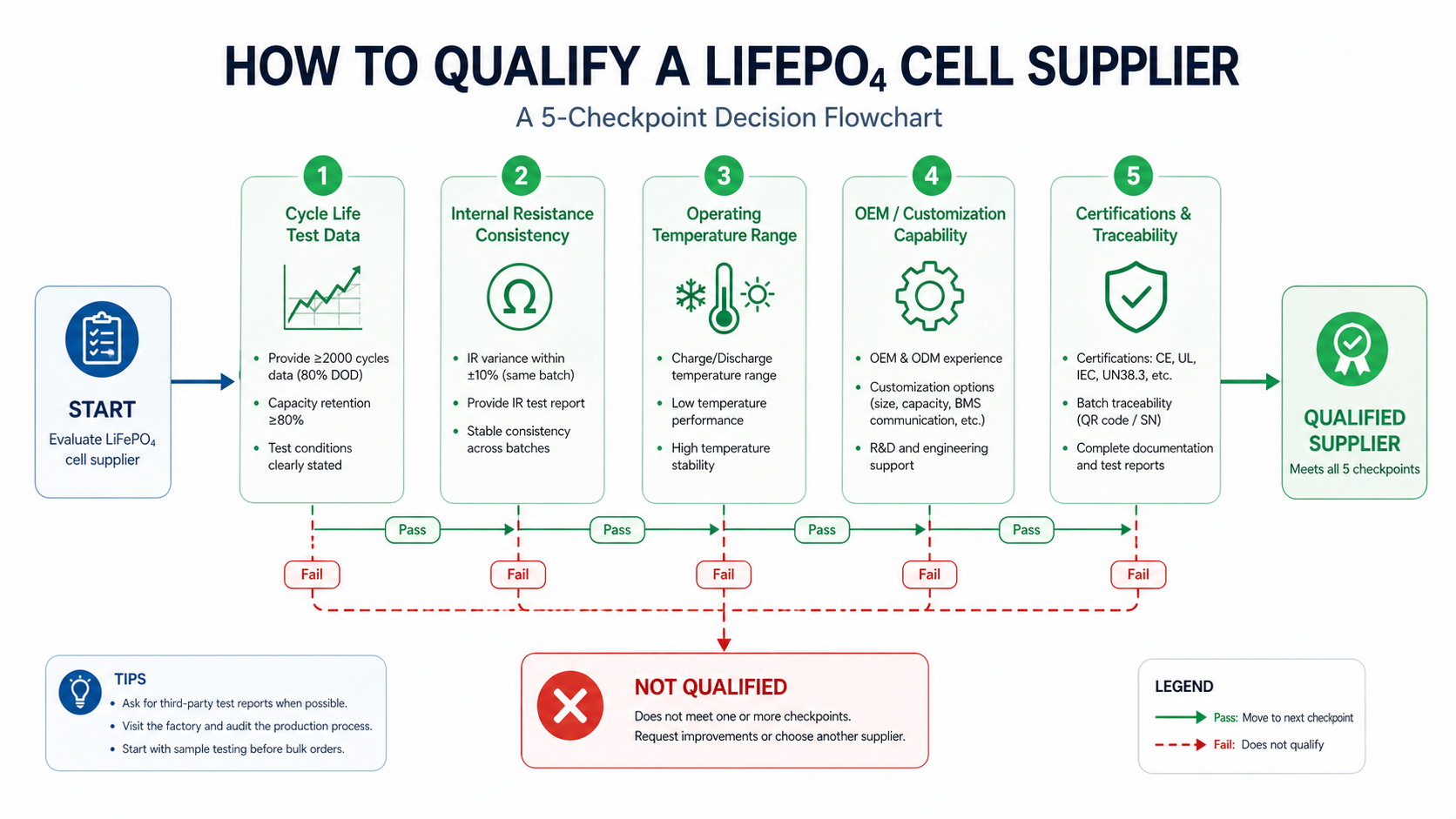
Cell formation cycling (the initial charge/discharge conditioning process after assembly) is one of the highest-cost, most quality-critical steps in manufacturing. Facilities that cut corners here produce cells with wide capacity distributions. When you're building battery packs at scale, that inconsistency translates directly into pack-level performance loss and warranty headaches. Ask suppliers for their OCV (open-circuit voltage) grading data and capacity distribution histograms across a production lot. The data tells you everything.
3. Verifiable Long-Term Cycle Testing
It's easy to print "≥3,000 cycles" on a datasheet. It's much harder to actually show you the cycle test curves—capacity retention at cycle 500, 1,000, 2,000—run under standardized conditions (typically 1C charge / 1C discharge, 25°C, to 80% capacity retention). Manufacturers who run these tests in-house can produce the data on demand. Those who can't usually deflect with vague "third-party lab" references.
Key Features to Evaluate Before You Sign an NDA
Beyond the manufacturing floor credentials, here are the specific cell-level specifications that should drive your evaluation matrix for any LFP supplier you're considering:
Energy Density: The Range vs. Weight Trade-off
For most B2B applications—especially custom battery packs for electric two-wheelers or light industrial equipment—you're looking for cells in the 160–170 Wh/kg range. Above that threshold typically requires NMC chemistry, which trades away LFP's thermal stability. Below 155 Wh/kg on an LFP cell usually signals an outdated electrode design.
C-Rate Capability: Continuous vs. Pulse
This one trips up buyers constantly. Continuous discharge rate and pulse discharge rate are not the same number—and which one matters depends entirely on your load profile. An electric motorcycle accelerating from a stop needs 4C–6C pulse capability for 5–10 seconds. Steady highway cruising might only draw 1C. Make sure the spec sheet separates these, because a supplier who quotes you a single "max discharge rate" without specifying duration is leaving you flying blind.
Wide-Temperature Performance
Operating temperature range on an LFP cell datasheet is often listed as a static figure (-20°C to 55°C, for example), but the more important question is: how much capacity do you actually retain at the temperature extremes? A cell that's rated to -20°C but only delivers 60% of rated capacity at that temperature is a problem for any cold-climate deployment. Ask for the derating curves, not just the headline range.
Stacked Pouch vs. Wound Cell Architecture
Stacked pouch construction—where electrode sheets are cut and stacked rather than wound into a jelly-roll—produces more uniform current distribution, lower internal resistance, and better heat dissipation. For high-cycle applications, this architecture holds a measurable advantage. It also enables thinner profiles that simplify pack design. Not every supplier can manufacture true stacked pouch cells at scale; the tooling investment is substantially higher than wound-cell production lines.
Product Deep Dive: LiTrue High C-Rate LFP Pouch Cells (20Ah & 50Ah)
We're going to use LiTrue's Long Cycle Life Energy-Type LFP Pouch Battery Cell Series as a detailed case study here—not because it's the only option on the market, but because it happens to hit most of the technical benchmarks we outlined above in a way that's worth walking through specifically.
Unique Selling Points
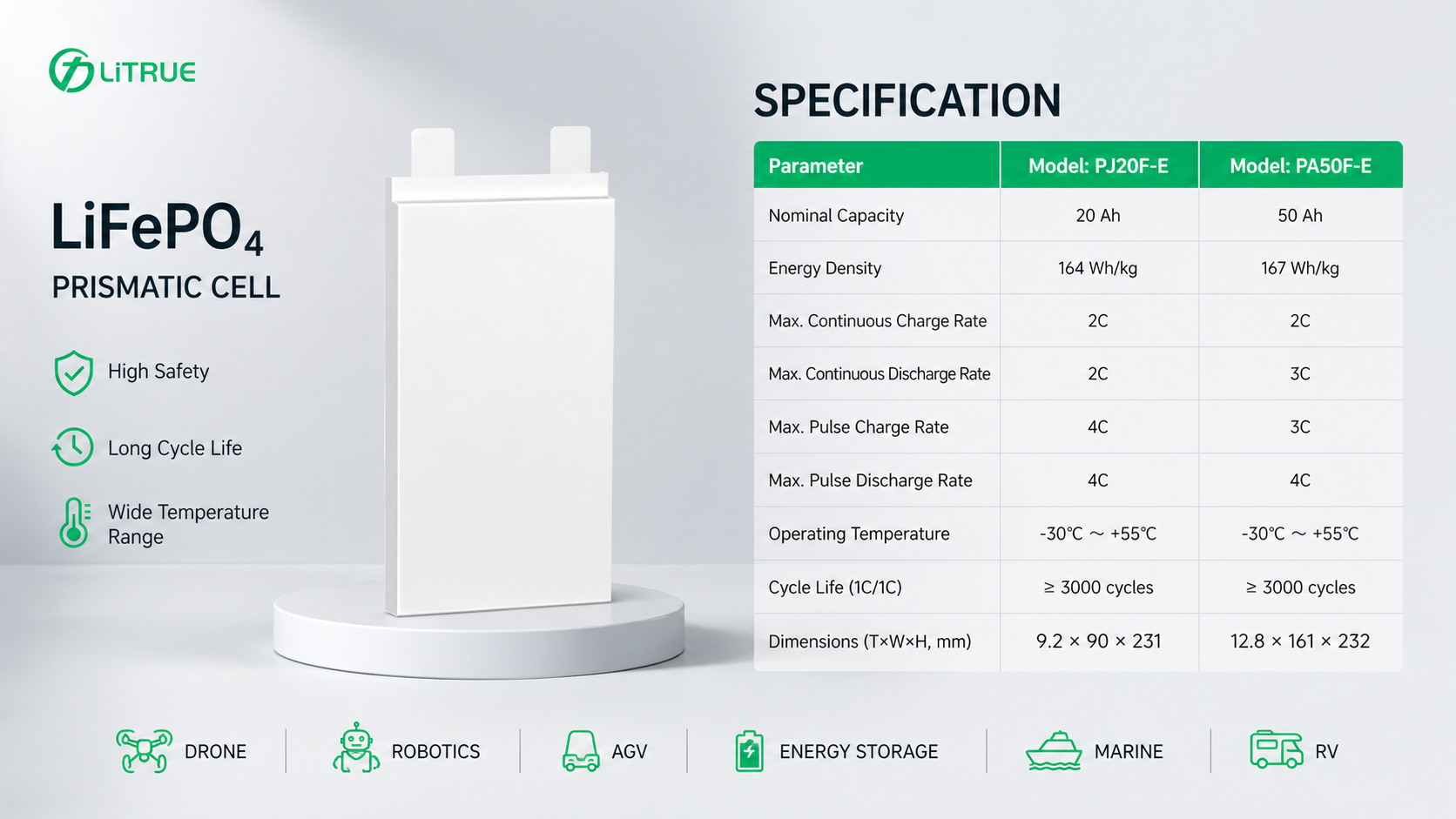
The series comes in two capacity variants: the PJ20F-E at 20Ah and the PA50F-E at 50Ah. Both use an energy-optimized LFP electrode formulation housed in a stacked pouch structure. The 20Ah cell achieves 164 Wh/kg; the 50Ah hits 167 Wh/kg. That's meaningful—167 Wh/kg puts this cell in competitive territory with a lot of NMC cells from three or four years ago, but retaining all the thermal stability advantages of iron-phosphate chemistry.
Cycle life is documented at ≥3,000 cycles under a 1C charge / 1C discharge protocol. The operating temperature window is -30°C to +55°C—which is genuinely wide for an energy-type LFP cell; most energy-type cells sacrifice low-temperature performance to achieve higher energy density. The fact that this cell maintains its rated window down to -30°C without a separate low-temp electrolyte additive (as far as the spec sheet indicates) is a meaningful differentiator for cold-climate deployments.
Technical Specifications at a Glance
Here are the full specs for both models, pulled directly from LiTrue's production datasheets:
| Specification | PJ20F-E (20Ah) | PA50F-E (50Ah) |
|---|---|---|
| Nominal Capacity | 20 Ah | 50 Ah |
| Energy Density | 164 Wh/kg | 167 Wh/kg |
| Max Continuous Charge Rate | 2C | 2C |
| Max Continuous Discharge Rate | 2C | 3C |
| Max Pulse Discharge Rate | 4C | 4C |
| Operating Temperature | -30°C to +55°C | -30°C to +55°C |
| Cycle Life (1C/1C) | ≥ 3,000 cycles | ≥ 3,000 cycles |
| Dimensions (T×W×H mm) | 9.2 × 90 × 231 | 12.8 × 161 × 232 |
| Certification Standard | GB/T 38058-2019, GB 31241-2022 | |
Audience Intent Match: Who This Product Is (and Isn't) For
This product is the right fit if you are: an OEM building electric motorcycles, e-scooters, electric cargo trikes, or hybrid agricultural equipment that cycles daily, needs reliable performance across a wide temperature range, and is working toward a multi-year supply agreement rather than a spot buy. The 3,000-cycle durability directly reduces your warranty liability—at one cycle per day, that's over eight years of operational life.
This product is probably not the right fit if you are: building a high-discharge UAV application that needs 10C+ continuous discharge. For those use cases, LiTrue's high-rate LFP cells (which support up to 20C pulse discharge) would be the more appropriate starting point. Similarly, if you need maximum energy density above all else and thermal stability is less of a concern, NMC chemistry is worth evaluating separately.
Performance Evaluation
Cycle Durability: The ≥3,000 cycle rating at 1C/1C represents one of the more credible figures in this cell class. Importantly, the stacked pouch architecture helps here—uniform current density across the electrode stack reduces localized lithium plating and SEI layer growth, which are the primary degradation mechanisms in LFP cells cycled hard.
Discharge Rate Handling: The 2C–3C continuous discharge and 4C pulse rating places these cells in a solid position for power applications that aren't at the extreme end of the C-rate spectrum. For an electric motorcycle under hard acceleration, 4C pulse for 5–10 seconds is typically more than adequate. For comparison, standard consumer LFP cylindrical cells rarely exceed 2C continuous.
Thermal Performance: The -30°C lower bound is significant. Most energy-type LFP cells start showing meaningful capacity loss below -10°C. If you're deploying equipment in northern climates or high-altitude environments, that 20-degree buffer matters—and it's one of the spec elements worth verifying with sample testing before committing to volume.
Design & Usage
The stacked pouch structure of these cells means they're designed to be integrated into prismatic or custom-profile battery modules. The thin, flat form factor (9.2mm thick for the 20Ah cell) makes them well-suited for low-profile pack designs where cylindrical cells would create significant dead space. Thermal management is easier, too—flat surfaces conduct heat to cooling plates far more efficiently than cylindrical geometries.
For engineers building their first pack with pouch cells: the tab welding process requires ultrasonic or laser welding equipment. That's a higher capital equipment requirement than simple cylindrical cell spot-welding setups, but the resulting pack tends to be lighter, more compact, and better thermally managed.
Customization
LiTrue explicitly supports system-level customization beyond the standard 20Ah and 50Ah offerings. This includes custom cell dimensions for specific pack geometries, custom tab configurations (position, length, material), module-level assembly with integrated BMS, and specific capacity variants engineered for particular voltage platforms. For OEM buyers, this matters—it means you're not constrained to off-the-shelf form factors when your enclosure or module design doesn't fit the standard dimensions.
Limitations
There are a few honest limitations worth noting. The 2C continuous charge rate is appropriate for most applications but won't satisfy buyers who need ultra-fast charging (above 3C continuous). The cells are certified under Chinese national standards (GB/T 38058-2019 and GB 31241-2022)—buyers in regulated markets that require IEC 62133 or UL 1642 certification for their end product will need to confirm whether those certifications are available or can be obtained for their specific configuration. And while the operating temperature goes to -30°C, the actual capacity retention curve at that temperature isn't published in the standard datasheet—something to request during sample evaluation.
Pros
Pros:
- 167 Wh/kg energy density — competitive for energy-type LFP chemistry without sacrificing thermal safety
- Genuine ≥3,000 cycle life under documented 1C/1C protocol — meaningful for long-TCO applications
- Wide -30°C to +55°C operating window covers most real-world outdoor deployment scenarios
- Stacked pouch construction enables lightweight pack designs with efficient thermal management
- Factory-direct OEM customization — cell dimensions, tab design, module integration available
- Stable mass production capability for long-term supply agreements
Ready to evaluate these cells for your application? Request a sample and factory datasheet directly via LiTrue's contact page.
Similar Products from LiTrue
If the PJ20F-E / PA50F-E series doesn't perfectly match your application profile, LiTrue's cell lineup includes a few other options worth considering: the 20Ah & 46Ah High Temperature LFP Pouch Cell for deployments in consistently hot climates, and the 30Ah & 33Ah Low Temperature LFP Pouch Cell specifically optimized for sub-zero environments where low-temperature capacity retention is the primary design constraint.
Alternative Manufacturer Comparison: Where Others Fall Short
Let's be direct about the competitive landscape, because B2B buyers deserve a real comparison—not just a product pitch.
CATL
CATL produces LFP cells at a scale that no other manufacturer currently matches, and their cell quality at the top of their product line is genuinely world-class. The challenge for most B2B buyers is access. CATL's minimum order quantities for direct cell supply are extremely high, their lead times for new OEM relationships are long, and they're not set up to provide custom form factors or technical co-development support to smaller or mid-sized buyers. If you're Tesla or BYD's supply chain, CATL makes sense. If you're an engineering team building 5,000–50,000 packs annually, the relationship rarely works.
EVE Energy
EVE produces competitive LFP cells, particularly their cylindrical and prismatic formats, and has expanded internationally more aggressively than some Chinese tier-one competitors. Their cycle life data is generally credible. The limitation here is less about quality and more about customization flexibility — EVE's standard product catalog doesn't accommodate the kind of bespoke cell geometries or module-level integration that specialized OEM buyers often need.
Gotion High-Tech
Gotion has made significant investments in expanding their global manufacturing footprint, particularly in Europe and North America. Their LFP technology is solid. For buyers who have regulatory or political reasons to prefer cells manufactured outside China, Gotion's European operations are worth investigating. The trade-off is that their non-Chinese production is still ramping, so consistency and lead time performance may not yet match their domestic lines.
The Tier-Two & Trading Company Problem
A significant portion of the "LiFePO4 cell manufacturers" visible on B2B sourcing platforms are not manufacturers at all—they're trading companies purchasing cells from tier-two or tier-three Chinese producers and adding a margin. The cells themselves may be perfectly serviceable for low-demand consumer applications. For professional OEM applications with real warranty obligations and field-failure consequences, the lack of direct traceability, production data access, and engineering support creates unacceptable risk. The tell-tale signs: inability to provide formation cycling data, vague answers about electrode material sourcing, no in-house cycle testing equipment visible during factory audits.
Pros & Cons: LiTrue LFP Pouch Cells vs. Generic Alternatives
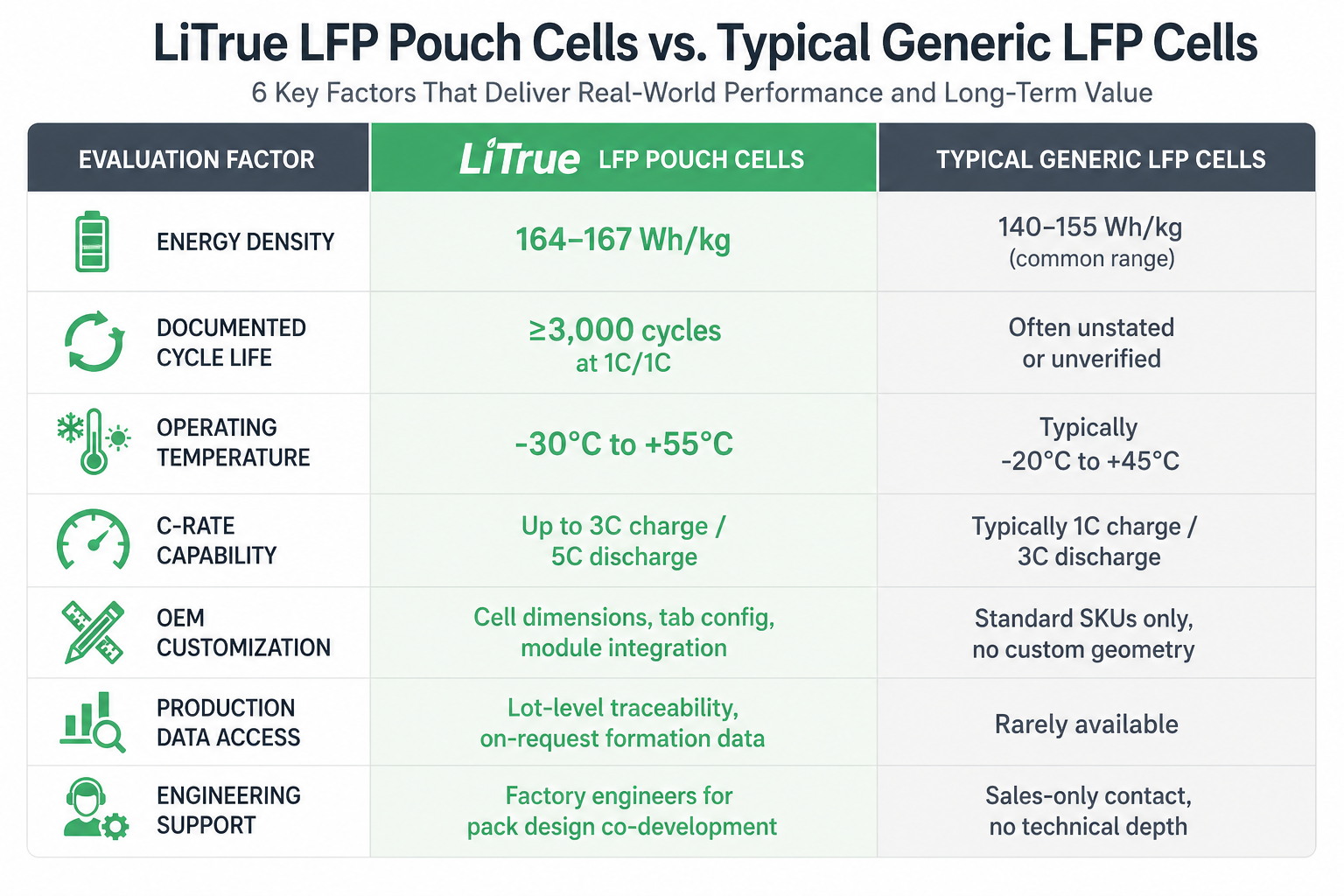
To put this in concrete terms for a procurement decision:
| Evaluation Factor | LiTrue LFP Pouch Cells | Typical Generic LFP Cells |
|---|---|---|
| Energy Density | 164–167 Wh/kg | 140–155 Wh/kg (common range) |
| Documented Cycle Life | ≥3,000 cycles at 1C/1C | Often unstated or unverified |
| Operating Temperature | -30°C to +55°C | Typically -20°C to +45°C |
| OEM Customization | Cell dimensions, tab config, module integration | Standard SKUs only, no custom geometry |
| Production Data Access | Lot-level traceability, on-request formation data | Rarely available |
| Engineering Support | Factory engineers for pack design co-development | Sales-only contact, no technical depth |
FAQs
What is the difference between LFP and LiFePO4 cells?
They're the same thing. LFP is the shorthand commonly used in industry; LiFePO4 is the full chemical formula for lithium iron phosphate. Both terms refer to the same cathode chemistry. If you see one term on a datasheet and the other in a supplier's pitch deck, that's not a discrepancy—just two names for the same electrochemistry.
How many cycles can I realistically expect from a quality LiFePO4 cell?
Under standard 1C charge / 1C discharge conditions at 25°C, well-manufactured LFP cells consistently achieve 2,000–3,500 cycles before reaching 80% capacity retention. Aggressive cycling (higher C-rates, elevated temperatures, deep discharge to 100% DoD) will reduce that figure. The LiTrue 20Ah and 50Ah cells are rated at ≥3,000 cycles under 1C/1C — at one cycle per day, that's more than eight years of operational life before the first meaningful capacity degradation threshold.
What C-rate should I specify for an electric motorcycle application?
For most electric motorcycle duty cycles, you need cells capable of 3C–4C pulse discharge (for acceleration events lasting 5–15 seconds) and 1C–1.5C continuous discharge for sustained highway speeds. Continuous charge rate of 1C–2C covers fast-charge scenarios. The LiTrue PJ20F-E fits this profile well with its 4C pulse / 2C continuous discharge rating.
Is LFP chemistry safe compared to NMC?
LFP cells have a substantially higher thermal runaway threshold than NMC cells — the onset temperature for thermal runaway in LFP is typically above 270°C, compared to 150–200°C for NMC. This is why LFP is the preferred chemistry for applications where pack safety in abuse conditions is a design requirement, such as energy storage systems, fleet vehicles, and any application where cells might experience overcharge or physical damage in operation. For an authoritative overview of the chemistry, the Wikipedia entry on lithium iron phosphate batteries provides a solid technical foundation.
How do I verify a supplier's claimed cycle life before placing a volume order?
Request sample cells and run your own accelerated cycle testing — or commission a third-party lab to do it. At minimum, ask the supplier for raw cycle test data (capacity vs. cycle number curves) from their own QC testing. A credible manufacturer will have this data. Also request the formation cycling data from your specific production lot — this gives you a baseline fingerprint for that batch. If a supplier can't produce either, that's a clear signal about their actual manufacturing depth.
What certifications should LFP cells have for B2B use?
At minimum, look for compliance with applicable national standards — in China, GB/T 38058-2019 and GB 31241-2022 are the relevant cell-level standards. For export to European markets, IEC 62133 (for portable cells) or UN 38.3 (for transportation) are commonly required. US market applications may require UL 1642 cell certification or UL 9540 at the system level. Always match certification requirements to your target market's regulatory environment before placing a sourcing commitment.
Can I get custom LFP pouch cells for a non-standard pack geometry?
Yes — but not from every supplier. True cell manufacturers with stacked pouch production capability can modify cell dimensions (within the constraints of their equipment and minimum viable lot sizes). This typically requires an NRE (non-recurring engineering) fee, tooling lead time of 6–12 weeks, and minimum order quantities that make sense for the supplier's production economics. LiTrue explicitly supports this kind of OEM customization. Start the conversation early in your design process — trying to retrofit a custom cell spec into a nearly-complete pack design always costs more than designing the pack around agreed cell dimensions from the start.
Summary
There isn't one single "best" LiFePO4 cell manufacturer — there's the best manufacturer for your specific application, volume, budget, and supply chain requirements. What we can say with confidence, based on the technical criteria laid out in this guide: the manufacturers worth your serious evaluation are the ones who can show you real formation cycling data, documented cycle life curves (not just the headline number), and some level of engineering co-development capability when your application pushes against the edges of a standard spec.
LiTrue High C-Rate LFP Pouch Cell Series (PJ20F-E / PA50F-E) earns serious consideration for electric mobility and industrial OEM applications that prioritize cycle durability, a wide operating temperature window, and factory-direct customization. At 164–167 Wh/kg, ≥3,000 cycles under standard protocol, and a -30°C to +55°C operating range, these cells check most of the boxes that matter for B2B buyers making multi-year sourcing decisions.
If you're building a battery-powered product and you're still relying on off-the-shelf cells from a catalog supplier, you're leaving performance and margin on the table. The OEM customization pathway — working directly with a manufacturer to specify cell dimensions, tab configurations, and module-level integration — is where serious battery-powered product development happens.
Start with samples. Test before you commit. And make sure the supplier you're talking to is actually manufacturing the cells — not just brokering them.
Explore LiTrue full LFP pouch cell lineup, or reach out directly to request samples and a factory datasheet for your specific apwenzplication.