
Here's a question that sounds simple but rarely gets a straight answer: what are lithium cells used for? Most articles give you a recycled list — "smartphones, laptops, EVs" — and call it a day. That's fine if you're writing a middle school science report. It's useless if you're an OEM engineer, a procurement manager, or a product developer trying to figure out which cell chemistry actually fits your application.
We've spent years inside the manufacturing process at LiTrue, running cycle-life tests, engineering custom packs for UAV clients across Southeast Asia and Europe, and shipping cells that end up in everything from crop-spraying drones in Henan province to electric cargo trikes in Rotterdam. So when we talk about lithium cell applications — we're not guessing. We're pulling from real field data and real product failures and real wins.
This guide covers the full application landscape, breaks down which cell formats and chemistries belong where, and gives you actual product specs.
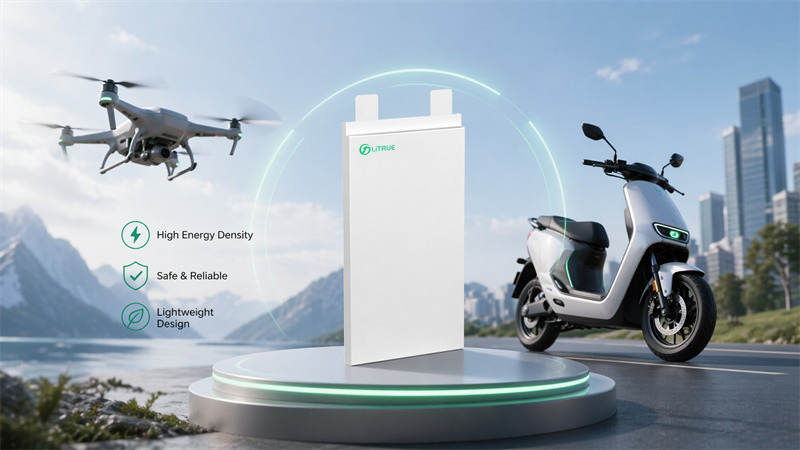
Table of Contents
1. What Is a Lithium Cell, Really?
2. Core Application Categories for Lithium Cells
3. Deep Dive: LFP Pouch Cells
4. LFP vs. NMC — Which Chemistry for Which Application?
5. Pros & Cons of Lithium Cells vs. Alternatives
6. FAQs
7. Summary
What Is a Lithium Cell, Really?
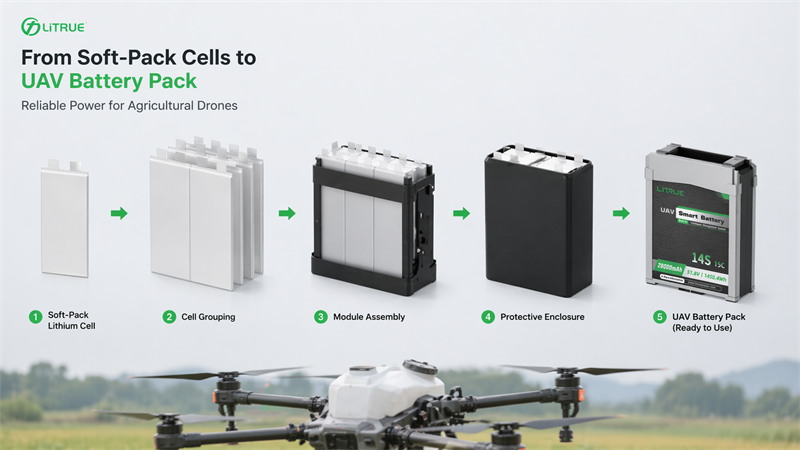
A lithium cell is the individual electrochemical unit inside a lithium battery. It's the smallest building block — one anode, one cathode, one separator, one electrolyte, housed in a casing that can be cylindrical (like a 18650 or 21700), prismatic (hard aluminum shell), or pouch (soft, flexible foil laminate). Multiple cells are wired in series and parallel to form a battery pack.
This distinction matters more than it sounds. When you're sourcing for a custom application — an agricultural drone, an e-motorcycle, a warehouse robot — the cell-level decision drives everything downstream: energy density, cycle life, thermal behavior, BMS complexity, and ultimately, cost per kilowatt-hour over the product's lifetime.
The two chemistries dominating B2B applications right now are:
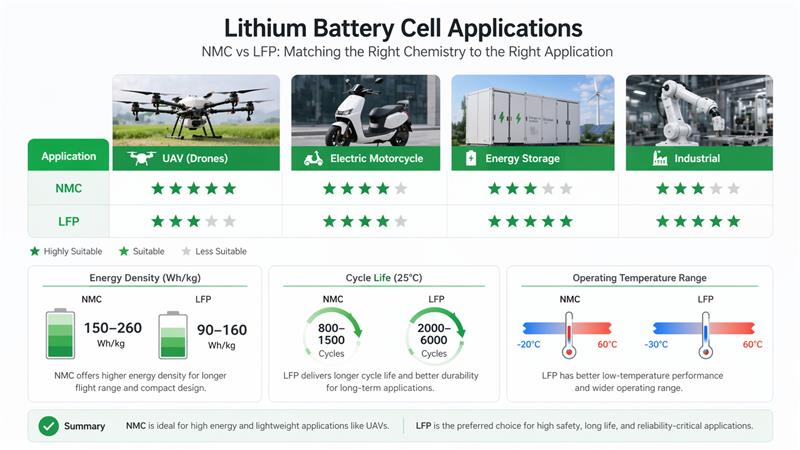
NMC (Nickel Manganese Cobalt Oxide): Higher energy density, better gravimetric performance, but slightly more sensitive to thermal stress. Preferred where weight is a hard constraint — think UAV drone batteries and high-performance power tools.
LFP (Lithium Iron Phosphate): Lower energy density than NMC, but substantially better thermal stability, longer cycle life, and no cobalt sourcing risk. The standard choice for high-cycle applications — electric two-wheelers, stationary storage, and industrial equipment.
Core Application Categories for Lithium Cells
Let's be direct about the real B2B application map. Forget the consumer electronics list — that market is mature and dominated by a handful of tier-1 integrators. The growth edges — the places where engineering decisions are still being made and supply chains are still being built — look like this:
1. UAV & Commercial Drone Batteries
Agricultural drones, mapping UAVs, inspection platforms, and logistics delivery drones all run on custom lithium battery packs built from high-rate cells. The requirements are brutal: maximum energy in minimum weight, high instantaneous discharge for motor response, and enough cycle life that the economics work at scale. NMC pouch cells currently dominate this segment because of their energy density advantage at the cell level.
2. Electric Motorcycles & E-Mobility
E-motorcycles, e-scooters, cargo e-bikes, and three-wheeled delivery vehicles are growing markets across Asia, Africa, and increasingly Southern Europe. These applications need cells that can handle daily cycling — sometimes 2–3 full cycles per day — without capacity degradation that makes the vehicle economically unviable within 18 months. That's where LFP pouch cells with ≥3000 cycle life ratings become the correct engineering answer, not a premium option.
3. Hybrid Agricultural Machinery
This is an underappreciated growth segment. Tractors, crop harvesters, and irrigation systems in hybrid electric configurations need power systems that tolerate -30°C winters in northern China or Canada and +55°C summer field conditions in India or the Middle East. Wide-temperature performance isn't a nice-to-have — it's the deciding factor.
4. Industrial Power Equipment
Forklifts, AGVs (automated guided vehicles), warehouse robots, and backup power systems for telecom towers all run on lithium cell packs. Cycle life and total cost of ownership (TCO) are the primary procurement criteria here, not raw energy density.
5. Energy Storage Systems (ESS)
Grid-tied and off-grid storage, solar-plus-storage residential systems, and commercial peak-shaving installations. LFP chemistry dominates because of its stability, non-flammability compared to NMC, and calendar life that can exceed 10 years under the right conditions.
Deep Dive: LFP Pouch Cells — The PJ20F-E & PA50F-E Series
The engineering problem that drove the PJ20F-E and PA50F-E development was straightforward but hard to solve: e-motorcycle OEMs in emerging markets needed cells with enough energy density to give their vehicles competitive range, but the total cost of ownership calculation was getting blown up by cells that degraded too fast under daily cycling. A battery that needs replacement every 18 months in a market where the vehicle costs $800 is a product-level failure — full stop.
Unique Selling Points
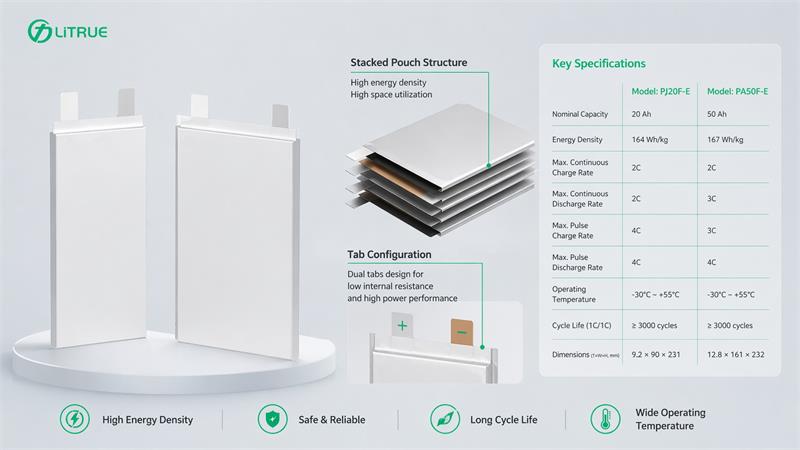
These are energy-type high-rate LFP cells built on an advanced stacked pouch structure. The 20Ah model (PJ20F-E) achieves 164 Wh/kg. The 50Ah model (PA50F-E) pushes that slightly higher to 167 Wh/kg — which is genuinely impressive for LFP chemistry, which typically peaks in the 160–170 Wh/kg range before you start making thermal stability tradeoffs. Both models are rated for ≥3000 cycles at 1C/1C, which translates to roughly 8+ years of daily cycling in most e-mobility use cases.
Audience Intent Match
Designed for: OEMs building electric motorcycles, e-scooters, cargo e-bikes, electric three-wheelers, light hybrid agricultural machinery, and any industrial equipment that runs daily deep-cycle operations and needs a verifiable 8–10 year cell lifetime.
Not designed for: Applications requiring very high C-rates above 3C continuous (the PA50F-E supports 3C max continuous discharge — for 5C+ applications, see LiTrue's high-C-rate cell series). Also not suited for sub-zero charging without heating — operating temperature for charging starts at -30°C for discharge but cell charging behavior at extreme cold still requires management.
Performance Evaluation
Energy Density: 164–167 Wh/kg. For LFP, this is toward the upper boundary of what the chemistry allows with mature electrode formulations. It means you're not sacrificing the inherent safety advantages of iron phosphate to get a more competitive energy number.
Cycle Life: ≥3000 cycles at 1C/1C. That's the number that changes the TCO calculation for fleet operators. At two cycles per day, 3000 cycles is over four years of daily operation. At one cycle per day — typical for consumer e-motorcycles — you're looking at over eight years before the cell reaches end-of-life capacity.
Discharge Rate: The PJ20F-E supports 2C continuous and 4C pulse. The PA50F-E supports 3C continuous and 4C pulse. For an e-motorcycle application where peak motor draw during acceleration might hit 2–3C, the 50Ah model handles that headroom comfortably without triggering the BMS overcurrent protection.
Temperature Range: -30°C to +55°C operating range. We've had OEM customers running these cells in northern Canada in winter and in agricultural applications in Central Asia in summer — the wide-temperature performance isn't an estimate, it's a tested specification.
Physical: The 20Ah cell is 9.2mm × 90mm × 231mm. The 50Ah is 12.8mm × 161mm × 232mm. The stacked pouch construction gives ultra-low internal resistance and highly efficient heat dissipation — which means your thermal management system in the pack has less work to do.
Design & Usage
The stacked electrode architecture — as opposed to wound cell construction — reduces internal resistance and improves current distribution uniformity across the active material. In plain terms: the cells age more evenly, which is why the cycle life figure holds up better in real-world conditions than wound-construction LFP cells at similar capacity ratings.
The pouch format also gives pack designers flexibility. Cells can be stacked vertically or horizontally, and the tab configuration can be customized for specific busbar layouts — useful when you're trying to fit a battery pack into a constrained frame geometry on a motorcycle or cargo bike.
Customization
LiTrue offers system-level customization from individual cells to fully integrated modules with BMS. For cell-level customization, tab positioning, terminal configuration, and capacity tuning (within the chemistry's limits) are available for OEM production runs. For pack-level projects, the engineering team works from your mechanical and electrical specs to produce a custom battery pack solution based on these cells.
Limitations
The PJ20F-E and PA50F-E are energy-type cells — optimized for cycle life and energy density rather than extreme peak power. If your application requires sustained C-rates above 3C (high-performance power tools, certain EV racing applications, heavy industrial machinery), the high-C-rate cell series is the more appropriate starting point. Additionally, as pouch-format cells, they require more mechanical support in pack design than cylindrical cells — the pack housing must include compression fixtures and good thermal contact to prevent cell swelling under cycling.
Pros
Pros:
— ≥3000 cycle life fundamentally changes the TCO calculation for fleet and commercial applications
— 164–167 Wh/kg is near the top of the LFP range — competitive range without NMC's thermal sensitivity
— Wide operating temperature (-30°C to +55°C) handles global deployment scenarios
— Stacked pouch structure provides low internal resistance and even aging
— GB/T 38058-2019 and GB 31241-2022 certified; system-level BMS customization available
→ View full specs and request samples for the PJ20F-E & PA50F-E series.
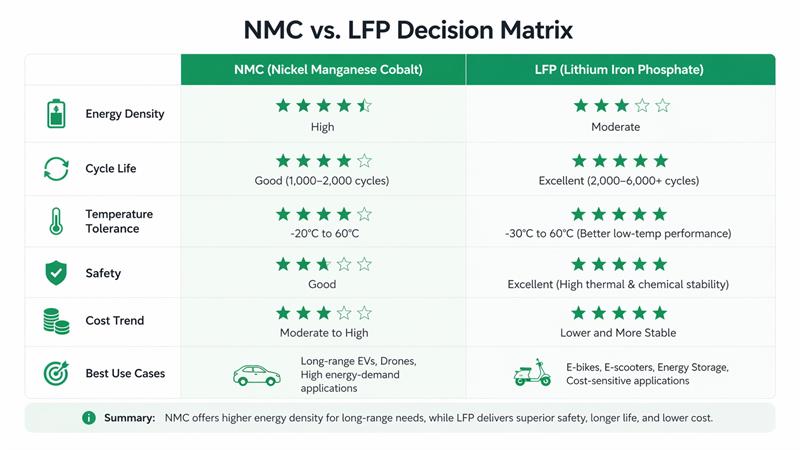
LFP vs. NMC — Which Chemistry for Which Application?
This is the question we get most often from procurement engineers and product managers who are making their first large-volume lithium cell sourcing decision. Here's how we frame it:
Choose NMC : Weight is your primary constraint. For UAV drones and aerospace applications, every gram of battery weight is a gram taken away from payload or flight time. NMC's energy density advantage — typically 200–300 Wh/kg at the cell level versus LFP's 160–170 Wh/kg — is a real and meaningful engineering advantage here.
Choose LFP : Cycle life and total cost of ownership matter more than raw energy density. E-mobility, stationary storage, and industrial equipment running daily cycles all benefit from LFP's 3000+ cycle capability and inherently more stable chemistry. The cobalt-free composition also eliminates a significant supply chain risk that's become increasingly relevant in the post-2022 battery materials market.
Temperature: Both chemistries offer wide operating ranges at the cell level, but LFP degrades less aggressively at elevated temperatures during storage and cycling. If your product will spend time in hot warehouses or outdoor environments above 40°C, LFP's thermal stability is a genuine long-term advantage.
Lithium Cells vs. Alternative Technologies
To give a fair picture — because sourcing decisions shouldn't be made in a vacuum — here's how lithium cells compare to the alternatives still present in B2B markets:
Lithium Cells vs. Lead-Acid Batteries
Lead-acid still appears in cost-sensitive backup power and older industrial equipment. The comparison isn't close on performance metrics: lithium cells offer 3–5× the energy density, 5–10× the cycle life, and significantly faster charging. Lead-acid wins on upfront unit cost — but when you calculate replacement frequency and disposal costs over a 5-year period, lead-acid loses that economic argument in most commercial applications. The weight difference also matters operationally: a lead-acid pack that delivers equivalent energy to a lithium pack will be 3–4× heavier.
Lithium Cells vs. Nickel-Metal Hydride (NiMH)
NiMH is largely confined to hybrid vehicle applications (Toyota Prius) and consumer electronics legacy products. For new B2B designs, NiMH offers no meaningful advantages over LFP — worse energy density, higher self-discharge rate, and comparable or worse cycle life. The only niche where NiMH might still appear is in applications with very strict temperature requirements below -40°C, where some NiMH formulations retain capacity better than lithium chemistries.
Lithium Cells vs. Solid-State Batteries
Solid-state is the technology that everyone in the industry is watching. Higher energy density ceiling, no liquid electrolyte, theoretically better safety. But as of 2025–2026, solid-state cells are still not available in the production volumes, price points, or form factors that B2B OEM sourcing requires. The engineering teams we work with are monitoring the space, but sourcing decisions today are still LFP and NMC. Solid-state is a 2028+ conversation for most applications.
FAQs
What is the difference between a lithium cell and a lithium battery?
A lithium cell is a single electrochemical unit — one anode, one cathode, one separator, producing approximately 3.2V (LFP) or 3.6–3.7V (NMC) nominal. A lithium battery is an assembly of multiple cells wired in series (to increase voltage) and/or parallel (to increase capacity). When you buy a 51.8V 28Ah UAV battery pack, you're buying 14 cells in series (14S), each at approximately 3.7V nominal, assembled into a system with BMS and housing.
How long do lithium cells last?
Cycle life varies significantly by chemistry, C-rate, temperature, and depth of discharge. LFP cells like the PJ20F-E and PA50F-E are rated for ≥3000 cycles at 1C/1C rate. NMC cells like those used in the UAV-JP328L are rated for ≥1000 cycles at 1C/1C — fewer cycles, but the energy density advantage often makes NMC the correct choice for weight-critical applications where packs are replaced more frequently as an operational cost.
Can lithium cells operate in extreme cold?
Yes, with caveats. The LFP cells in LiTrue's wide-temperature series discharge down to -30°C and operate in charging from specific low-temperature thresholds. Cold charging is where the real risk lives — charging below 0°C without proper thermal management causes lithium plating on the anode, which permanently degrades capacity and creates safety risks. The UAV-JP328L's charging temperature floor is 0°C for this reason. For sub-zero charging applications, LiTrue's low-temperature LFP series has specific formulations for cold-climate performance.
What certifications should I look for when sourcing lithium cells?
For international shipping: UN38.3 (transport safety testing — mandatory for air freight). For product safety: UL 2054 (North America), IEC 62133 (Europe). For Chinese domestic market and GB-standard products: GB/T 38058-2019 and GB 31241-2022. For environmental compliance: RoHS. When working with a lithium battery manufacturer, ask specifically which certifications apply to which cell models — certification coverage varies by product line, not by company blanket claim.
What is the minimum order quantity for custom lithium cell packs?
This varies by manufacturer and configuration complexity. For standard cell models available in stock, sample quantities (1–10 units) are typically available for engineering evaluation. For custom OEM battery pack development — specific voltage, capacity, connector, and BMS configuration — meaningful production runs generally start in the dozens to hundreds of units range. Reach out to LiTrue's engineering team with your specific requirements for an accurate MOQ and lead time assessment.
Are LFP cells safer than NMC cells?
In the context of thermal runaway risk: yes. LFP chemistry does not undergo the same exothermic decomposition reactions that NMC does at elevated temperatures. An LFP cell pushed into abuse conditions (overcharge, external short, puncture) is significantly less likely to enter thermal runaway. This is one reason LFP dominates stationary storage applications where a fire in a commercial building or residential garage is a catastrophic liability event. For UAV applications where an in-flight failure means the aircraft falls — NMC's thermal sensitivity is managed through robust BMS design and operating temperature limits, and the energy density advantage is considered worth the additional engineering complexity.
What's the lead time for custom UAV battery packs from a Chinese manufacturer?
From final specification sign-off to first production sample: typically 4–8 weeks for standard configurations. For truly custom mechanical designs or novel BMS integration, 10–14 weeks is more realistic. Mass production lead times after sample approval depend on order volume and current factory capacity. Build this timeline into your product development schedule — experienced teams request samples at least 3 months before their target production launch.
Summary:
So — what are lithium cells used for? The honest answer is: almost every electrical application where energy density, cycle life, and form factor matter more than upfront cost. That covers a lot of ground.
If you're building a product that needs a power system designed around real specifications rather than catalogue defaults, LiTrue's engineering team works directly with OEM clients to develop cell and pack solutions from the ground up. You can review the full product range at litruebattery.com/products or read more on application-specific selection in the LiTrue blog.