
What Is the Difference Between a Lithium Battery and a Regular Battery?Here's a question we get from procurement engineers and product developers almost every week: "We know lithium batteries cost more — but are they actually worth it for our application?" It sounds simple. It isn't. The answer changes completely depending on whether you're powering a TV remote, an industrial inspection drone, or an electric motorcycle fleet running 12 hours a day in 45°C desert heat.
We've been manufacturing lithium batteries for over a decade — from pouch cells to fully integrated UAV battery packs. And the honest truth is: the word "battery" gets thrown around so loosely that buyers routinely spec the wrong chemistry for their application, costing them far more than the upfront price difference. This guide cuts through the confusion.
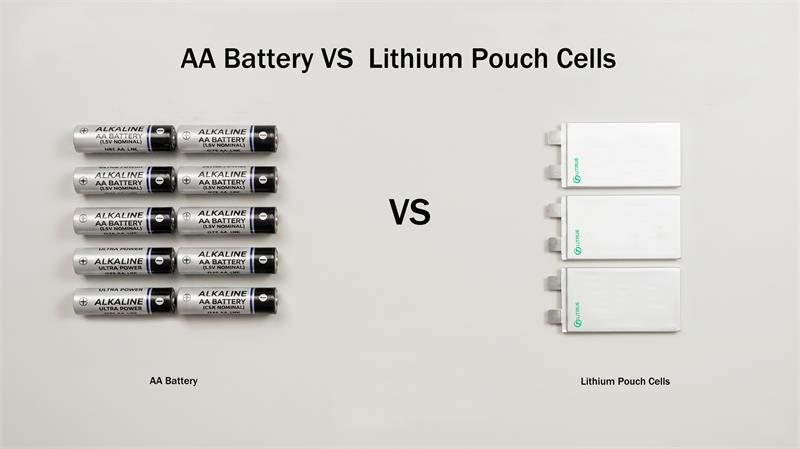
Table of Contents
1. What Is a Regular Battery, Exactly?
2. What Makes a Lithium Battery Different?
3. Regular Battery VS Lithium Battery
4. 5 Key Differences That Actually Matter for B2B Buyers
5. Product Deep Dive: NMC Drone Battery
6. When LFP Pouch Cells Are the Smarter Call
7. Alkaline vs. Lithium vs. LFP
8. FAQs
9. Summary: Which Battery Type Do You Actually Need?
What Is a Regular Battery, Exactly?
When most people say regular battery, they mean an alkaline battery — the ubiquitous AA, AAA, C, or D cells you grab off a drugstore shelf. These are primary (non-rechargeable) cells based on a zinc-manganese dioxide electrochemical reaction. Zinc-carbon batteries are an older, cheaper variant, but alkaline largely displaced them because of better energy density and longer shelf life.
The chemistry is straightforward: zinc oxidizes at the anode, MnO₂ reduces at the cathode, and you get roughly 1.5V per cell. Predictable. Cheap. Widely available in every country on earth. For low-drain consumer electronics — clocks, TV remotes, smoke detectors — they do exactly what they need to do.
But call them regular and you're already implying they're the baseline. In B2B and industrial contexts, they rarely are.
What Makes a Lithium Battery Different?
Lithium is the lightest metal on the periodic table and carries the highest electrochemical potential of any element used in commercial batteries. That's not a marketing line — it's physics. One lithium-ion cell delivers a nominal 3.6–3.7V, compared to 1.5V for alkaline. So before you even look at energy density, you're starting with 2.5× more voltage per cell.
But "lithium battery" itself is an umbrella term that covers several distinct chemistries, each engineered for different trade-offs:
NMC (Nickel Manganese Cobalt): High energy density, excellent power delivery. Preferred for UAVs, power tools, and EVs where weight-per-watt-hour is the deciding factor.
NMC cell performance depends not only on cell design, but also on precursor composition, particle morphology and production consistency. An NMC precursor coprecipitation reactor provides controlled pH, temperature, mixing and solution feeding during laboratory and pilot-scale precursor development.
LFP (Lithium Iron Phosphate): Lower energy density than NMC, but dramatically better thermal stability and cycle life. The go-to choice for stationary storage, e-motorcycles, and fleet applications where reliability at 45°C matters more than cutting 200 grams.
Primary Lithium (Li-MnO₂ or Li-SOCl₂): Non-rechargeable, but with a shelf life of 10–15 years and stable output in extreme cold. Used in military equipment, IoT sensors, and medical devices.
For this article, we'll focus primarily on rechargeable lithium-ion chemistries — NMC and LFP — since those are where the real decision-making happens for commercial and industrial buyers.
Regular Battery VS Lithium Battery
Let's put hard numbers against the claims. Based on the battery cells we manufacture and test in-house:
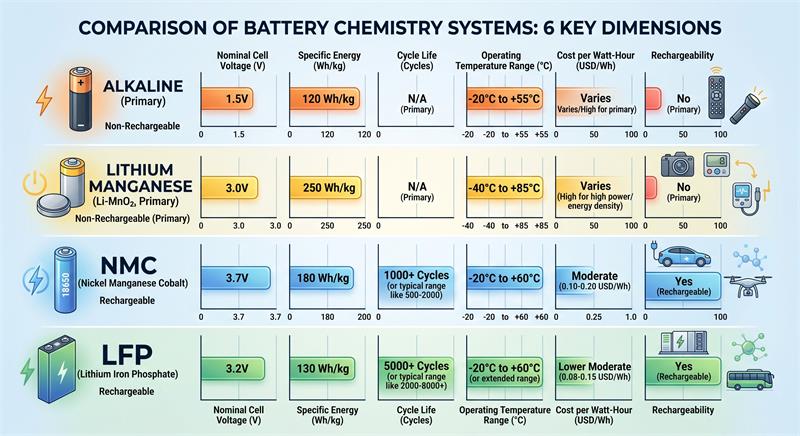
Alkaline (standard AA): ~1.5V nominal, ~100–120 Wh/kg, zero cycle life (single use), operational range roughly -20°C to +54°C (performance degrades sharply below 0°C).
NMC Lithium-Ion: ~3.6–3.7V nominal, 150–250 Wh/kg depending on cell design. Our UAV-JP328L NMC pack delivers 1.45 kWh in an 8.7kg footprint — that's roughly 167 Wh/kg at pack level, after accounting for BMS hardware, enclosure, and wiring. Cycle life: 1,000+ cycles at 1C/1C rate.
LFP Pouch Cells: ~3.2V nominal, 152–157 Wh/kg at cell level. Our high-temperature LFP pouch cell series (PC20F-T and PA46F-C models) proves 2,000–2,500 cycles at a sustained 45°C ambient — a figure that would destroy most NMC cells within a year under the same conditions.
The performance gap isn't incremental. It's structural.
5 Key Differences That Actually Matter for B2B Buyers
1. Rechargeability — and What That Means for Total Cost
Alkaline batteries are single-use. Full stop. For a remote control or a wall clock, that's fine. For an agricultural drone spraying 40 hectares a day, it's not even a consideration — you need rechargeable. A quality lithium pack rated for 1,000+ cycles amortizes its upfront cost across years of operation. The math almost always favors lithium at scale.
2. Discharge Rate: Where Alkaline Batteries Quietly Fail
This is the one that catches most buyers off guard. Alkaline cells have high internal resistance. Push them hard — say, a high-torque motor or a high-wattage device — and their terminal voltage sags badly. You'll see a 1.5V alkaline cell drop to 0.9V under a 2A load. Lithium cells have dramatically lower internal resistance. Our UAV-JP328L, for example, sustains 140A continuous discharge and handles 280A peak (10-second pulse) without significant voltage sag. That's the kind of discharge headroom that makes industrial applications possible.
3. Temperature Performance
Alkaline batteries lose 50–60% of their rated capacity at -20°C. Lithium cells — especially LFP chemistry — handle cold dramatically better. Our low-temperature LFP pouch cell series is engineered for extreme cold applications where alkaline simply stops working. On the high end, our high-temperature LFP series (PA46F-C) operates safely in ambient heat up to 65°C — relevant for Middle East fleet operators, industrial robots in foundries, and outdoor inspection equipment in tropical climates.
4. Weight and Form Factor
Lithium batteries pack more energy per kilogram. This isn't debatable — it's electrochemistry. For UAV applications, where every gram directly translates to flight time or payload capacity, the difference between a lithium pack and an equivalent-capacity NiMH or lead-acid solution is measured in kilograms. A 51.8V 28Ah NMC pack from LiTrue weighs 8.7kg. An equivalent lead-acid configuration would weigh over 30kg. The drone would never leave the ground.
5. Shelf Life and Self-Discharge
Alkaline batteries self-discharge at roughly 2–3% per year and can sit on a shelf for 5–7 years. Lithium-ion cells self-discharge at about 1.5–2% per month — slower than NiMH, but faster than alkaline. For seasonal equipment or emergency backup systems, this matters. Primary lithium cells (non-rechargeable Li-MnO₂) win here outright, with shelf lives exceeding 10 years. For most rechargeable industrial applications, self-discharge is managed through proper storage protocols rather than chemistry selection.
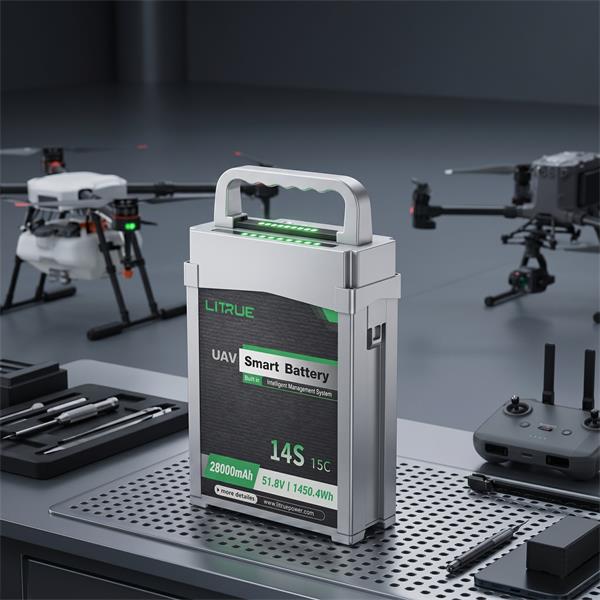
Product Deep Dive: LiTrue UAV-JP328L — 51.8V 28Ah NMC Drone Battery
Unique Selling Points
This is the battery we designed specifically for heavy-lift industrial drones — agricultural sprayers, mapping UAVs, inspection platforms. Here's what separates it from generic drone battery options on the market:
The 14S1P NMC configuration hits 51.8V nominal with a 1.45 kWh total energy in an 8.7kg pack. That energy density at pack level (factoring in full BMS, CAN bus communication hardware, and IP65-rated housing) is genuinely difficult to match with other chemistry options at this form factor.
The BMS integrates CAN bus communication — meaning you get real-time cell-level data piped directly to your flight controller or ground station software, not just a simple charge indicator. Overcharge, over-discharge, and over-current protection alarms are built in, not bolted on afterward.
It's IP65-rated. That means dust-tight and protected against water jets — relevant for agricultural spraying operations where the drone routinely operates in humid, chemically-exposed environments.
Audience Intent Match
This battery is the right fit if you are: An OEM drone manufacturer or agricultural UAV fleet operator needing a proven, certifiable 51.8V NMC pack with high discharge rates, CAN bus integration, and international certifications (RoHS, UL 2054, UN38.3) for global deployment.
This is not the right fit if you are: Looking for a small consumer drone battery under 15V, a stationary energy storage application where cycle life trumps weight, or a cost-first buyer prioritizing the lowest-per-unit price over long-term reliability.
Performance Evaluation
Flight time: At 1.45 kWh, paired with an efficient 10kg-class UAV platform, expect 25–35 minutes per charge depending on payload and conditions. Discharge current of 140A continuous covers virtually any heavy-lift motor configuration in this class.
Charging speed: Maximum 56A continuous charge, with 84A peak for up to 30 seconds at 25°C. With a properly matched charger, you're looking at roughly 30–35 minutes to reach 80% charge. For fleet operations with multiple units rotating, that's workable.
Altitude resilience: Rated to ≤5,000 meters operating altitude. That's not a footnote — for Himalayan region agricultural operations or high-altitude survey missions, this matters and isn't guaranteed on every pack in this category.
Design and Usage
The 238×129×332mm form factor is designed to mount directly into standardized UAV battery bays used across major commercial drone platforms. The connector and communication interfaces comply with common industrial UAV standards. Storage is rated at -20°C to +25°C with 5–95% RH humidity tolerance.
Customization
As a direct lithium battery manufacturer, LiTrue offers full custom configuration on this platform — voltage adjustments (different S counts), capacity scaling, connector type changes, communication protocol modifications (CAN to UART or SMBus), and custom enclosure dimensions. MOQ for custom builds starts at factory-discussion level — not the 10,000-unit minimums some cell suppliers impose.
Limitations
The UAV-JP328L charges only above 0°C. Operating it in sub-zero charging environments requires external thermal management. At 8.7kg, it is not appropriate for lightweight consumer or hobbyist drones — it's built for platforms with 15kg+ payload ratings. And NMC chemistry, while excellent on energy density, doesn't match the 2,000+ cycle life of our LFP pouch cell alternatives for applications where longevity beats weight savings.
Pros
Pros:
— 1.45 kWh in 8.7kg: industry-leading pack-level energy density for this voltage class
— 140A continuous / 280A peak discharge — handles aggressive motor loads without voltage sag
— IP65 protection, rated to 5,000m altitude
— CAN bus BMS with real-time cell monitoring
— Certified: RoHS, UL 2054, UN38.3 — accepted for international air freight
— 1,000+ cycle life at 1C/1C
→ Request a factory quote for the UAV-JP328L or contact us to discuss a custom configuration.
Similar Products
If your drone platform runs at a higher voltage, the 66.6V 30Ah UAV-JP330L Smart Drone Battery covers heavier-lift 18S configurations. For weight-critical platforms where shedding every gram counts, look at the 51.8V 20Ah Lightweight Drone Battery — same voltage class, optimized for smaller payload UAVs.
When LFP Pouch Cells Are the Smarter Call
Not every lithium application is a drone. A large portion of our B2B customers come to us for cell-level supply — they're building their own battery packs, modules, or integrated energy systems and need reliable pouch cells with consistent cell-to-cell performance.
For those customers, LFP pouch cells often win on total cost of ownership even when the per-kWh price is slightly higher than NMC.
Here's why: Our high-temperature LFP pouch cell series (PC20F-T at 20Ah and PA46F-C at 46Ah) delivers 2,000–2,500 cycles at a sustained 45°C ambient temperature. Most NMC cells rate their cycle life at 25°C — a lab condition that rarely reflects real-world fleet use in hot climates. When an OEM building e-motorcycles for Southeast Asian markets asks us which chemistry to spec, we usually start with that question: "What's the actual ambient temperature where your vehicles will operate?" Nine times out of ten, LFP wins that conversation.
The PA46F-C model's 65°C maximum operating temperature isn't marketing padding. It's an engineering requirement for customers in Middle Eastern logistics fleets, industrial cleaning robots in manufacturing facilities, and outdoor inspection equipment that sits on a hot tarmac between deployments. And the PC20F-T model's cold resilience — down to -43°C — covers the other extreme: Nordic grid storage, alpine survey equipment, cold-chain logistics vehicles.
For high-power applications specifically, our High C-Rate LFP pouch cell series handles demanding pulse discharge requirements while maintaining long cycle life — relevant for power tools, emergency response vehicles, and robotics where instantaneous current draw spikes well above average load.
Alkaline vs. Primary Lithium vs. NMC vs. LFP: Side-by-Side Comparison
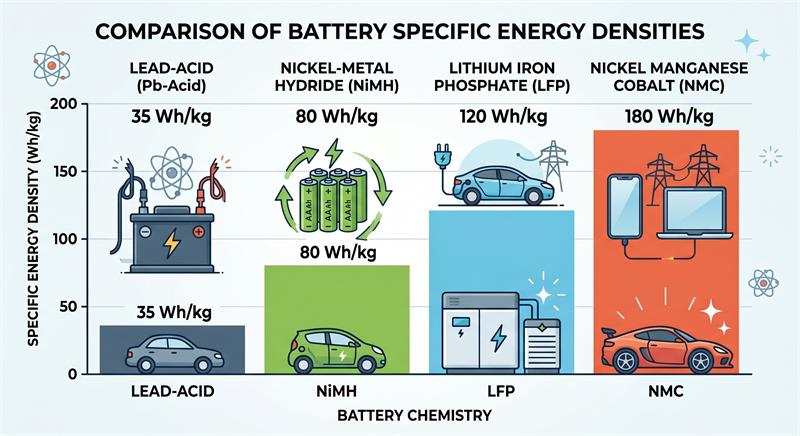
Alkaline (Primary): Best for low-drain consumer electronics with infrequent use. Lowest upfront cost, widest global availability. Not rechargeable. Poor performance under heavy loads or cold temperatures.
Primary Lithium (Li-MnO₂): Best for mission-critical low-drain applications — military devices, IoT sensors, emergency beacons — where 10+ year shelf life and cold performance are non-negotiable. Higher cost than alkaline. Not rechargeable.
NMC Lithium-Ion: Best for weight-sensitive, high-discharge applications — UAVs, EVs, power tools — where energy density per kilogram is the primary design constraint. Higher cycle life than alkaline, moderate thermal limits. Requires careful BMS design.
LFP Lithium-Ion: Best for long-lifetime, thermally demanding, or safety-critical applications — e-motorcycles, stationary storage, fleet vehicles in hot climates. Lower energy density than NMC but dramatically better thermal stability and cycle life. The chemistry choice when the pack needs to last 5+ years in the field without cell replacement.
FAQs
Can I replace regular batteries with lithium batteries in standard devices?
For primary (non-rechargeable) devices, yes — lithium AA/AAA cells are a drop-in replacement for alkaline in most consumer devices and perform better in cold temperatures and high-drain applications. For rechargeable systems, no — lithium-ion packs require matched chargers and a BMS. Never attempt to charge lithium cells with an alkaline or NiMH charger.
Are lithium batteries safer than regular batteries?
When properly designed and managed, yes. Alkaline batteries can leak potassium hydroxide if over-discharged or stored long-term — a common failure mode that destroys electronics. Lithium-ion cells, when paired with a quality BMS (like the integrated systems in our UAV and industrial battery packs), include active overcharge, over-discharge, and over-temperature protection. The safety concern with lithium-ion isn't inherent chemistry — it's poorly manufactured cells or mismatched charging systems.
Why do lithium batteries cost more upfront?
Raw material costs (lithium, cobalt for NMC, specialized electrolytes) and manufacturing complexity. But the cost-per-cycle calculation usually flips the math. An alkaline AA costs $0.50–$1.00 and lasts one use. A quality lithium-ion cell might cost $8–$15 per Ah at cell level but deliver 1,000–2,500 cycles. For any application with daily use, lithium is cheaper within weeks, not years.
What is the difference between LFP and NMC lithium batteries?
LFP (Lithium Iron Phosphate) trades some energy density for dramatically better thermal stability and longer cycle life. NMC (Nickel Manganese Cobalt) packs more energy per kilogram but requires more careful thermal management. For UAVs and EVs where weight is a primary constraint, NMC is usually preferred. For stationary storage, fleet vehicles, or hot-climate applications, LFP is the more durable and often safer choice. Read more in our guide to lithium battery applications.
Can lithium batteries be customized for specific voltage and capacity requirements?
Yes — and this is one of the core advantages of working directly with a lithium battery manufacturer rather than a distributor. At LiTrue, custom battery packs are a core part of our business, not an exception. We can adjust cell configuration (series/parallel), voltage, capacity, connector type, BMS communication protocol, and physical form factor. Lead times and MOQs vary by project scope — contact our engineering team to discuss your requirements.
How do lithium batteries perform in extreme temperatures?
It depends heavily on chemistry and cell design. Standard NMC cells degrade faster above 40°C. Our high-temperature LFP pouch cell series is validated to 2,000–2,500 cycles at 45°C continuous — and the 46Ah model operates safely up to 65°C ambient. On the cold end, our low-temperature LFP cells perform at -43°C, which covers the vast majority of real-world cold-climate deployments. See our full breakdown of how to choose the right battery for your application.
Summary: Which Battery Type Do You Actually Need?
The gap between a regular battery and a lithium battery isn't just chemistry — it's a fundamentally different engineering philosophy. Alkaline batteries are optimized for cost, convenience, and simplicity in low-drain consumer applications. Lithium-ion batteries — in NMC or LFP chemistry — are engineered for performance, longevity, and reliability in demanding applications where failure has real operational consequences.
If you're sourcing batteries for industrial UAVs, e-motorcycles, fleet vehicles, robotics, or any application that runs daily and needs to perform predictably for years, lithium isn't a premium upgrade. It's the baseline engineering requirement. The question isn't whether to use lithium — it's which lithium chemistry fits your operating conditions, and whether you're sourcing from a manufacturer who can back their specs with real test data.
We publish our cycle life data at actual operating temperatures, not idealized lab conditions. We provide full technical specifications before you commit to an order. And we support custom configurations for buyers who need something beyond off-the-shelf.
→ Talk to our engineering team about your application — or browse our full range of lithium battery products to find the right starting point.