
Short answer: yes, almost every drone flying today runs on drone lithium batteries. But that one-line answer hides the part that actually matters to you—because the wrong cell chemistry can cut your flight time in half, ground your fleet in cold weather, or fail UN38.3 shipping checks right before a launch deadline. I've watched all three happen.
I work on the engineering floor at a UAV battery plant in Shenzhen, and I've spent the better part of eight years tuning packs for crop-spraying rigs, mapping quads, and a few delivery prototypes that never made it to market. So instead of the usual recycled web answer, let me walk you through what's really inside your drone, why lithium won, and how to read a spec sheet without getting burned.
Table of Contents
- 1. The Truth About What Powers Your Drone
- 2. NMC vs. LFP: The Two Cells That Run the Sky
- 3. Product Deep Dive: A Real 51.8V Drone Pack
- 4. Alternatives and How They Compare
- 5. FAQs
- 6. Summary
The Truth About What Powers Your Drone
Let's settle the headline question first. The reason drones use lithium chemistry and not, say, lead-acid or nickel-metal hydride comes down to one number: energy per gram. A drone has to lift its own power source into the air, so every gram you spend on the battery is a gram you can't spend on payload or flight time. Lithium-ion packs deliver roughly 150–270 Wh/kg, while lead-acid sits around 35 Wh/kg. That gap is the whole game. (If you want the deeper electrochemistry, the Wikipedia entry on lithium-ion batteries is a solid, neutral primer.)
Key features you're actually paying for
High discharge current (drones pull huge amperage on takeoff), low weight, and a smart BMS that talks to the flight controller over CAN bus. These three things separate a real UAV lithium battery from a hobby pack you'd buy off a marketplace.
The features people assume exist—but don't
Lithium packs are not "fireproof," and no honest manufacturer will tell you they are. They're not maintenance-free either. And they do not hold full capacity forever—every pack degrades. Anyone promising a magic exception is selling you something.
One truth you should know before you buy
Cycle life is measured under lab conditions—usually 1C charge, 1C discharge, at 25°C. Your field never looks like that. Hammer a pack at 5C in a 40°C rice paddy and you will not see the rated number. I tell customers to budget for about 70–80% of the lab figure in real agricultural use. It's not pessimism; it's what the return data shows.
[Infographic Placeholder: side-by-side bar chart comparing energy density (Wh/kg), cycle life, and cost per kWh across lithium-ion, lead-acid, and NiMH, ALT text: "drone battery chemistry comparison infographic"]
NMC vs. LFP: The Two Cells That Run the Sky
Here's where most buying guides go quiet, because the honest answer is "it depends." The two chemistries you'll meet are NMC (nickel manganese cobalt) and LFP (lithium iron phosphate). They are not competitors so much as different tools.
NMC packs more energy into less weight, which is why heavy-lift and long-endurance drones lean on them. LFP gives up some energy density but pays you back in cycle life and thermal stability—our LFP pouch cells rate north of 3,000 cycles versus roughly 1,000 for a comparable NMC pack. For a sprayer drone that flies forty sorties a day, that longevity can change the total cost math entirely.
If you want to go deeper on the chemistry trade-offs, the independent engineers at Battery University keep a well-sourced breakdown that I've handed to more than one skeptical procurement manager.
This is also where buying from an actual drone battery manufacturer beats buying from a reseller—you get to argue chemistry with the people who built the pack, not a catalog.
Product Deep Dive: A Real 51.8V Drone Pack
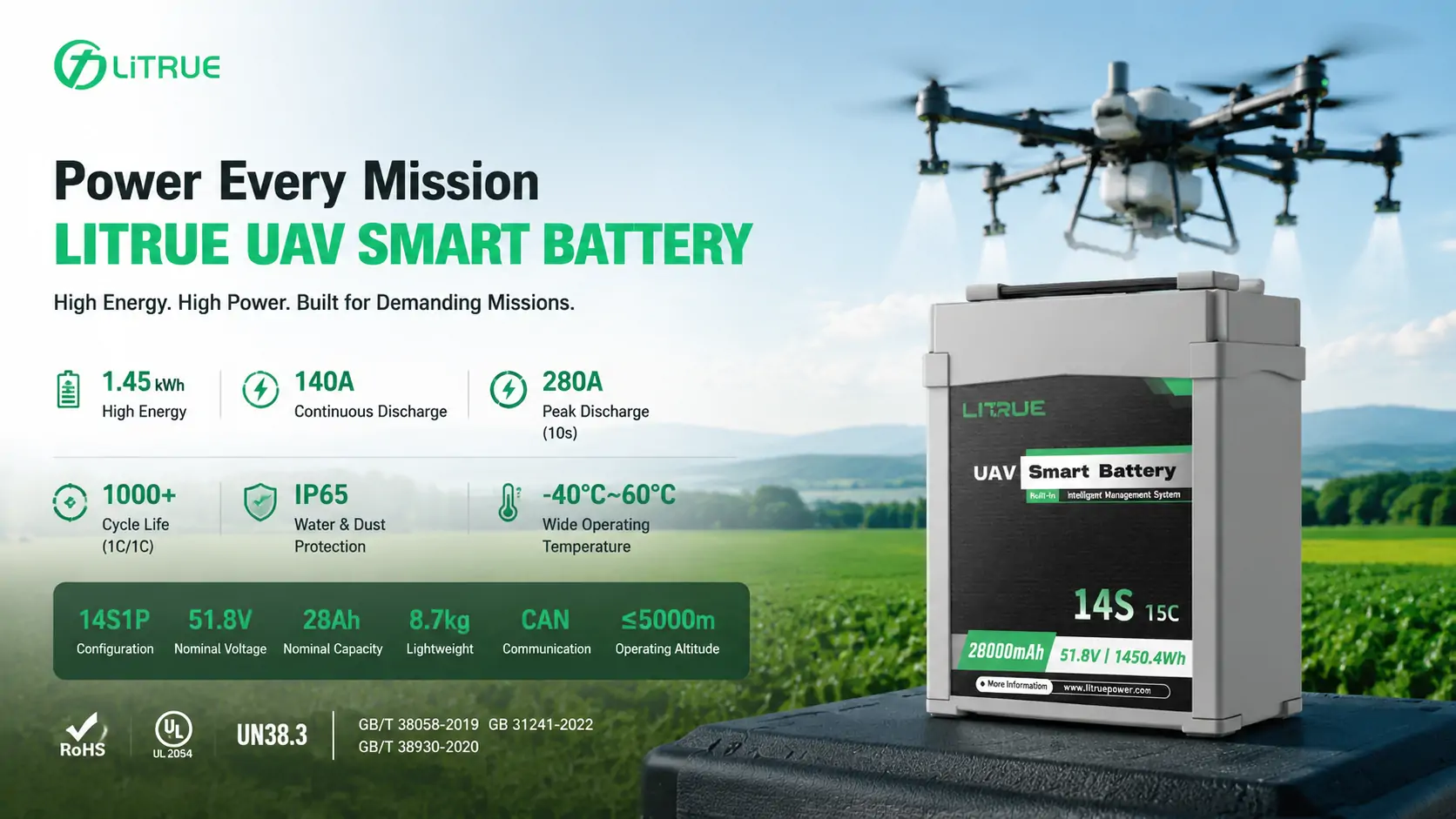
Rather than wave my hands, let me put one of our own packs on the table—the 51.8V 28Ah high-discharge NMC unit (model UAV-JP328L). These are the actual numbers off our spec sheet, not marketing rounding.
Unique selling points
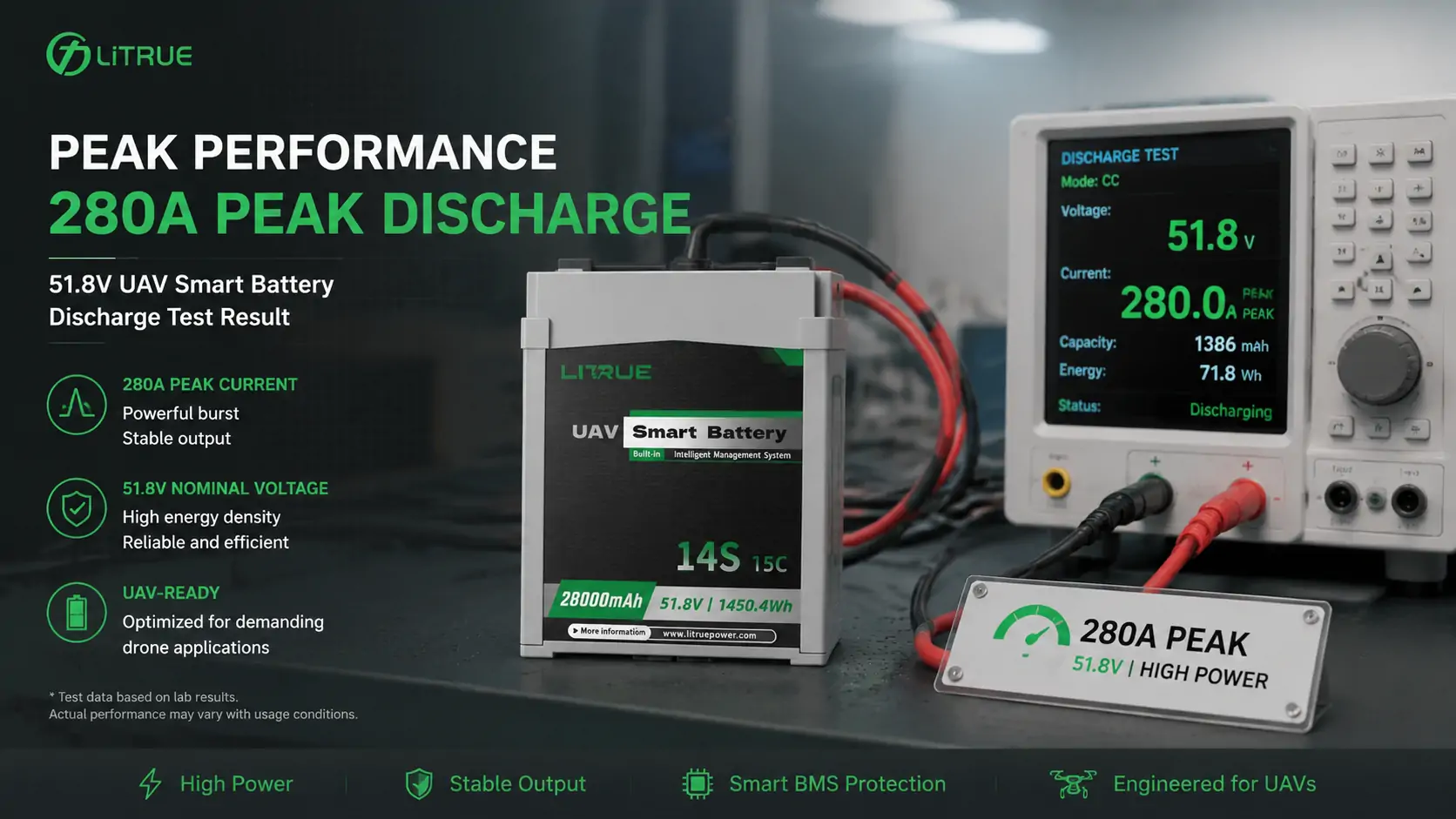
It's a 14S1P pack holding 1.45 kWh (1,450 Wh) at 8.7 kg. Continuous discharge runs 140A (5C), with a 280A peak (10C) for ten-second bursts—the kind of surge a heavy quad pulls on an evasive maneuver or a steep climb. It charges back fast too: 56A continuous (2C), which trims the downtime between sorties that quietly kills fleet productivity.
Who this pack is for—and who it isn't
This is built for heavy-lift agricultural sprayers, mapping UAVs, and industrial inspection platforms that need real energy in the air. If you're flying a 250-gram toy quad or a featherweight FPV racer, this is wildly oversized—go look at our lightweight 20Ah line instead. Matching the pack to the airframe is half the job, and it's exactly what our UAV battery buyer's guide walks through.
Performance, factor by factor
On energy: 1.45 kWh in an 8.7 kg footprint is a strong density figure for a sealed industrial pack. On power delivery: that 10C peak means the cells don't sag under takeoff load, which protects your motors from voltage dips. On durability: rated for 1,000 cycles at 1C/1C, with an IP65 enclosure that shrugs off morning dew, dust, and the corrosive pesticide mist that destroys lesser housings.
Design and real-world usage
The CAN-bus BMS reports state-of-charge, temperature, and cell balance straight to the flight controller, so the pilot sees a real number, not a guess. Discharge tolerance runs from −40°C to +60°C—I've personally signed off on batches headed to both northern-China winters and Southeast-Asian heat with the same SKU.
Customization
Connector type, capacity tweaks, and BMS firmware are all open to spec. Most of our serious orders are OEM—a customer brings an airframe and a duty cycle, and we shape the pack around it. Stock packs are a starting point, not the ceiling.
Limitations—the honest part
Being NMC, it won't match the 3,000-cycle endurance of our high-rate LFP pouch cells. It's also heavy by design; this is not the pack for micro-drones. And like any NMC unit, it demands disciplined storage—sitting at full charge in summer heat ages it faster than people expect.
Pros and cons
Pros: High 1.45 kWh energy in a sealed 8.7 kg body — 10C peak discharge for hard climbs — 2C fast charge cuts ground time — IP65 and −40°C tolerance for brutal field conditions — CAN-bus telemetry — UL 2054 / UN38.3 / RoHS compliant.
Cons: Lower cycle life than LFP — too heavy for small UAVs — NMC needs careful storage discipline — premium price over generic packs.
Ready to spec it?
You can see the full sheet and request a quote on the 51.8V 28Ah NMC drone battery product page.
Similar product
Flying a higher-voltage platform? The 66.6V 30Ah UAV-JP330L (18S, ~2.0 kWh) is the sibling pack for drones that need more headroom—same engineering family, different airframe target.
Alternatives and How They Compare
No single pack wins everything. Here's how the realistic options stack up so you can pick with your eyes open.
NMC heavy-lift pack (the one above)
Best for: payload-hungry sprayers and long-endurance mapping. Trade-off: shorter cycle life, higher per-pack cost.
High-rate LFP pouch cells
Best for: high-cycle commercial fleets where the drone flies all day, every day. Our high-rate lithium cells in LFP form trade a little weight for 3,000+ cycles and cooler thermal behavior. Over a two-year contract, the cost-per-flight often comes out lower.
Generic marketplace LiPo packs
Best for: hobbyists and tight prototype budgets. The catch: thin or absent BMS, no real certification trail, and cycle numbers that rarely survive contact with a duty cycle. For any commercial or insured operation, I'd steer you away—one thermal incident costs more than the savings.
Custom OEM packs
Best for: anyone shipping at volume. A custom UAV battery built to your airframe beats forcing your drone to fit a stock SKU. It's more work upfront and worth it when uptime is money.
FAQs
Do all drones have lithium batteries?
The overwhelming majority do. A handful of experimental long-endurance and military drones use hydrogen fuel cells or hybrid power, but for commercial, agricultural, and consumer drones, lithium chemistry is the standard—nothing else hits the weight-to-energy ratio flight needs.
Are drone lithium batteries the same as phone batteries?
Same family, different breed. Both are lithium-ion, but a drone pack is tuned for very high discharge current—pulling 140A continuous off a 28Ah pack is a world away from the gentle trickle a phone draws. Drone cells prioritize C-rate and thermal headroom over slim packaging.
NMC or LFP—which should I choose for a drone?
Pick NMC when you need maximum flight time and payload per gram. Pick LFP when you fly constantly and cycle life drives your cost. For a mixed agricultural fleet I usually recommend NMC for the sprayers and LFP-based cells where ground equipment or buffering is involved.
How long do drone lithium batteries last?
Expect 300–1,000 cycles for NMC and 1,500–3,000+ for LFP, depending on how hard you push them. Heat, deep discharges, and storing packs at 100% charge all shorten that. Store around 40–60% charge and you'll see the longer end of the range.
Can I ship drone batteries internationally?
Yes, if they're certified. Any pack we send out carries UN38.3 and the relevant safety marks. Skip that paperwork and your shipment gets held at customs—I've cleaned up that mess for buyers who learned it the hard way.
Summary
So—do drones have lithium batteries? Yes, and now you know why: nothing else lifts its own weight and still leaves room for payload. The real decision isn't lithium versus something else; it's which lithium, built by whom, to what spec.
Get the chemistry right for your duty cycle, demand real certifications, and treat the lab cycle numbers as a ceiling rather than a promise. Do that and your fleet flies longer and fails less. If you want a second set of eyes on a pack spec, talk to a working lithium battery manufacturer before you commit—the right pack pays for itself in uptime, and the wrong one costs you a season.