
Choosing a drone battery manufacturer is not the same as buying a generic power pack from a catalog. For commercial UAVs, the battery decides how much payload the aircraft can lift, how stable it feels during a hard climb, how many flights a fleet can finish in one day, and how many after-sales problems the drone brand will face six months later.
We have seen this from the factory side at LiTrue. A UAV maker may arrive with a neat drawing, a target voltage, and a desired capacity. Then the real questions begin. How much current does the aircraft pull with a full payload? Does the flight controller need CAN communication? Will the pack be used in pesticide mist, mountain inspection, sea freight, cold mornings, or +40℃ summer work? A serious answer takes engineering work. A quick answer usually means someone has not looked closely enough.
This guide explains how to evaluate a lithium battery manufacturer for commercial and industrial UAV projects. We will compare generic pack assemblers, R&D-driven suppliers, BMS capability, high-rate battery cell selection, certifications, OEM support, and one real UAV lithium battery example from LiTrue.
Table of Content
- Media Placeholder
- Overview: What Buyers Should Know Before Choosing a Drone Battery Manufacturer
- Product Deep Dive: LiTrue UAV-JP328L High Discharge NMC Drone Battery
- Alternative of Comparison: Supplier Types and Battery Options
- FAQs
- Summary
Media Placeholder
Overview: What Buyers Should Know Before Choosing a Drone Battery Manufacturer
Key features of a reliable UAV lithium battery supplier
A capable drone battery manufacturer should be able to talk about more than voltage and capacity. For commercial UAVs, the real buying checklist includes cell chemistry, cell consistency, discharge current, peak current duration, BMS logic, communication protocol, connector design, enclosure protection, working temperature, cycle life, charging rules, and shipment documentation.
For heavy-lift drones, the high-rate battery cell is one of the first things we check. If the cell cannot handle repeated high-current bursts, the finished pack will suffer even if the outer shell looks impressive. This is why serious UAV buyers ask about continuous discharge current, peak discharge current, temperature rise, and real protection behavior instead of only asking for “28Ah” or “30Ah”.
A manufacturer should also understand the aircraft. A mapping UAV, agricultural sprayer, inspection drone, and logistics aircraft do not stress a battery in the same way. A good supplier asks for motor data, ESC data, payload weight, battery bay dimensions, charger specification, connector preference, target flight time, and operating temperature. That conversation may feel slower, but it prevents the expensive mistake of designing the drone around the wrong pack.
Missing features in low-cost custom battery packs
Many low-cost suppliers can assemble lithium cells into a pack. That does not automatically make them suitable for commercial UAV work. Some packs use off-the-shelf cells without enough sorting. Some have no meaningful CAN communication. Others use soft PVC wrapping where the aircraft really needs a hard enclosure. The pack may work in a short demo, then show voltage sag, swelling, weak cycle life, or connector problems after field use.
The missing feature is often not visible in a product photo. It is in the BMS alarm logic, the welding consistency, the thermal path, the connector sealing, or the way the factory handles abnormal charge and discharge tests. We have had customers bring us failed packs from other suppliers; the label looked fine, but the internal current path was not designed for the aircraft’s actual load.
The truth: “best” depends on the UAV project, not marketing language
There is no universal best drone battery manufacturer for every buyer. A hobby drone brand may only need low-cost standard packs. A survey drone maker may care most about energy-to-weight ratio. A crop-spraying UAV company needs discharge strength, fast charging, IP protection, and replacement speed. A logistics drone project may require a higher-voltage system and deeper BMS integration.
For commercial UAV buyers, the best supplier is usually the one that can match the battery to the aircraft, prove its data, and adjust the pack for production. That is where a true lithium cells manufacturer has an advantage over a simple pack assembler.
Product Deep Dive: LiTrue UAV-JP328L High Discharge NMC Drone Battery
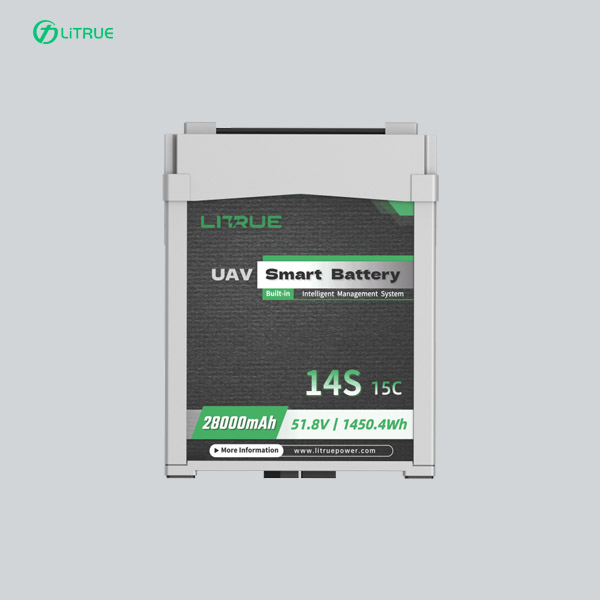
To make the evaluation more concrete, let us use one LiTrue product as the reference: the 51.8V 28Ah UAV Lithium Battery High Discharge NMC Drone Battery, model UAV-JP328L. This is a finished 14S1P NMC UAV lithium battery pack designed for industrial and commercial drones.
Unique Selling Points
- 51.8V nominal voltage: designed for UAV platforms using a 14S power architecture.
- 28Ah nominal capacity and 1.45 kWh nominal energy: gives industrial drones a practical energy base without moving into oversized pack territory.
- 140A maximum continuous discharge: supports sustained high-current operation for heavy-lift and industrial UAV work.
- 280A peak discharge for 10 seconds at 25℃: supports short bursts during takeoff, climbing, wind correction, and loaded maneuvers.
- 56A maximum continuous charging: helps fleet operators rotate packs faster during daily operation.
- CAN communication: allows the battery to share status data with compatible flight controllers.
- IP65 protection: gives the pack a stronger foundation for outdoor industrial environments.
- -40℃ to +60℃ discharge temperature range: supports wider operating conditions than basic commercial packs.
- RoHS, UL 2054, and UN38.3 certification standards: supports global sales, transport, and compliance review.
Audience Intent Match: Who should evaluate this product?
The UAV-JP328L is a good fit for commercial drone manufacturers, heavy-lift UAV integrators, inspection drone builders, agricultural UAV brands, and logistics drone teams that need a finished high-discharge battery pack. It is also suitable for buyers looking for a wholesale UAV battery that already combines NMC chemistry, BMS protection, CAN communication, IP65 housing, and defined transport certification standards.
This product is not aimed at toy drones or small consumer aircraft. It is also not the best match for ultra-light survey drones where every gram matters more than peak discharge. At 8.7 kg, the pack must be matched carefully to the frame, payload, and center-of-gravity design. If your UAV uses an 18S or higher-voltage platform, this 51.8V pack will not fit without redesigning the power system.
Performance Evaluation: What the data says
Energy and weight: The UAV-JP328L provides 1.45 kWh nominal energy at 8.7 kg. This makes it useful for industrial drones that need more working energy than lightweight camera platforms, but still require a defined pack size. For flight time estimates, we never recommend using battery capacity alone. The aircraft’s motor efficiency, propeller choice, payload, wind, cable loss, and flight behavior all change the result.
Discharge behavior: The pack supports 140A continuous discharge and 280A peak discharge for 10 seconds at 25℃. In real UAV use, this matters during the ugly moments: heavy takeoff, sudden altitude correction, gusty wind, aggressive turn, or payload shift. Peak current should not be treated as normal operating current. We prefer to design around the continuous current rating and keep peak discharge as a working reserve.
Charging and uptime: The battery supports 56A maximum continuous charging and 84A peak charging for 30 seconds at 25℃. For fleet operators, charging behavior affects daily output. A pack that charges faster can reduce downtime, but only if the charger, cooling interval, operator routine, and pack quantity are planned together.
BMS and communication: CAN communication gives UAV builders better battery visibility than a basic voltage-only setup. The battery includes overcharge, over-discharge, and over-current protection alarms. In a commercial aircraft, this information helps the flight controller and operator react before a small battery issue becomes a flight event.
Environmental use: IP65 protection, a discharge temperature range from -40℃ to +60℃, and a working altitude rating up to 5000 m make the pack suitable for demanding outdoor applications. That said, IP65 is not permission to ignore maintenance. Connector cleanliness, impact damage, cable routing, and charging habits still affect pack life.
Design & Usage: How the pack fits UAV operation
The UAV-JP328L uses a 14S1P NMC design with an operating voltage range of 42V to 60.9V. Its dimensions are 238 × 129 × 332 mm. Before choosing it, the drone manufacturer should check battery bay space, locking structure, connector direction, cable length, cooling airflow, and center of gravity.
In daily use, this type of battery makes sense for UAVs that need strong current response and pack-level data. Heavy-lift agricultural drones, industrial inspection aircraft, mapping UAVs with larger payloads, and delivery platforms can all benefit from a high-rate lithium battery pack when the aircraft has been designed around the voltage and weight.
Customization: How LiTrue supports custom UAV battery projects
For OEM projects, LiTrue can evaluate custom UAV battery requirements around voltage, capacity, enclosure size, connector type, BMS protocol, CAN communication, cable layout, label design, packaging, and delivery planning. This is where a direct manufacturer becomes more useful than a reseller.
Good customization starts with real aircraft data. Send motor and ESC specifications, battery bay drawings, expected continuous and peak current, target runtime, payload weight, charger model, operating temperature, IP protection target, certification requirements, and estimated annual volume. With those inputs, LiTrue engineers can judge whether a standard model is suitable or whether a custom lithium battery design is the better route.
Limitations: What is not found in this product
The UAV-JP328L is not a universal answer. It is not an 18S high-voltage battery. It is not a bare cell product for buyers who only want lithium cells. It is not the lightest possible pack for small mapping aircraft. It also has a charging temperature range of 0℃ to +55℃, so cold-weather charging must be controlled.
The published data is a starting point, not a replacement for aircraft testing. Your drone’s real flight profile, wiring, motor load, pilot behavior, and charger routine will decide the final field result.
Pros & Cons
| Pros | Cons |
|---|---|
| 1.45 kWh nominal energy in a finished UAV battery pack | 8.7 kg weight may be too much for compact mapping drones |
| 140A continuous and 280A peak discharge for high-current UAV loads | Only suitable for systems designed around a 51.8V / 14S platform |
| CAN communication helps flight controller integration | Cold-weather charging below 0℃ is outside the stated charge range |
| IP65 housing supports outdoor industrial use | Connector sealing and aircraft-side design still need review |
| RoHS, UL 2054, and UN38.3 support global business planning | Final flight time must be verified on the real UAV platform |
CTA: Need a direct drone battery manufacturer for an industrial UAV program? View the UAV-JP328L product details or request an OEM battery evaluation from LiTrue.
Similar Product(s)
If your UAV does not match this 51.8V high-discharge pack, LiTrue can evaluate lighter UAV battery designs, higher-voltage smart drone battery platforms, agricultural drone battery packs, or projects based on high-rate lithium cells. You can also review LiTrue’s battery products, and browse our engineering case studies for related applications.
Alternative of Comparison: Supplier Types and Battery Options
| Option | Best For | Main Advantage | Main Risk or Tradeoff |
|---|---|---|---|
| Generic pack assembler | Low-cost, low-risk, short-life projects | Lower starting price and quick quotation | Limited BMS design, weak customization, uncertain field behavior |
| Cell-only supplier | Companies with in-house pack engineering | More control over cell sourcing and pack design | Buyer must handle BMS, welding, enclosure, certification, and testing |
| R&D-driven lithium battery manufacturer | Commercial UAV OEMs and industrial drone fleets | Can support chemistry, pack design, BMS, enclosure, and validation together | Requires clearer project data and engineering discussion |
| High-discharge NMC UAV battery | Heavy-lift, inspection, mapping, logistics UAVs | Strong energy density and current output | Needs correct thermal design and safety management |
| LFP pouch cells battery pack | Projects focused on safety margin and cycle life | Good thermal stability and long-cycle potential | Lower energy density than many NMC UAV battery designs |
For external technical context, buyers can review NMC lithium battery chemistry properties and the IATA lithium battery cargo guidelines, which outline strict transport testing requirements relevant to safety compliance.
FAQs
1. Which drone battery manufacturer is the best?
The best manufacturer depends on your UAV application. For commercial and industrial drones, look for a supplier with high-rate cell knowledge, BMS engineering, CAN communication support, enclosure design, certification experience, and custom battery pack capability. LiTrue is a strong option for UAV OEMs that need engineering support rather than simple pack assembly.
2. What should I ask a UAV battery supplier before buying?
Ask for nominal voltage, capacity, nominal energy, continuous discharge current, peak discharge current and duration, charging current, cycle life, BMS functions, communication protocol, operating temperature, dimensions, weight, certification standards, and customization options.
3. Why is BMS communication important in a UAV lithium battery?
BMS communication allows the aircraft to read battery status instead of guessing from voltage alone. CAN communication can help report state information, warnings, and protection conditions. For commercial UAVs, that data supports safer and more predictable operation.
4. Are high-rate lithium cells necessary for drones?
They are necessary when the UAV has high motor current, heavy payload, strong climb demand, wind exposure, or repeated acceleration. If the cells cannot handle the real current demand, the pack may show voltage sag, heat, short flight time, or early aging.
5. Should I choose NMC or LFP for a drone battery?
NMC is often selected when energy density and high discharge performance matter. LFP pouch cells may be selected when cycle life and thermal stability are higher priorities. The right choice depends on payload, flight time target, current demand, weight limit, and operating environment.
6. Can a drone battery manufacturer build a custom UAV battery?
Yes. A capable OEM lithium battery supplier can customize voltage, capacity, pack shape, connector, cable direction, BMS protocol, CAN data, enclosure, label, and packaging. For best results, provide aircraft drawings and electrical data before asking for final pricing.
7. What certifications matter for industrial drone batteries?
UN38.3 is important for lithium battery transport. RoHS and UL 2054 may also matter depending on customer and market requirements. Certification does not replace flight testing, but it helps with shipping, compliance review, and buyer confidence.
8. Is the lowest-price wholesale UAV battery a good choice?
Sometimes, but not for every aircraft. A low price may be fine for a simple, low-load platform. For industrial UAVs, weak discharge performance, poor BMS logic, or inadequate enclosure design can cost more than the original saving through downtime, warranty claims, or aircraft damage.
Summary
A drone battery manufacturer should be judged by engineering depth, not by slogans. For commercial UAVs, the supplier must understand lithium cells, discharge behavior, BMS protection, CAN communication, enclosure design, certification, and OEM production needs. The battery is too close to aircraft safety to treat as an ordinary accessory.
The LiTrue UAV-JP328L gives a clear example of what buyers should look for: 51.8V nominal voltage, 28Ah capacity, 1.45 kWh nominal energy, 140A continuous discharge, 280A peak discharge, CAN communication, IP65 protection, 1000 cycles at 1C/1C, and certification standards including RoHS, UL 2054, and UN38.3.
If your UAV project needs a custom lithium battery, wholesale UAV battery supply, or an OEM pack built around a specific aircraft platform, send LiTrue your drone data early. The best supplier conversation starts before the battery bay is frozen, before the charger is purchased, and before the first pilot reports voltage sag in the field.