
Choosing a drone battery is not just a matter of finding the highest capacity printed on a label. In commercial UAV work, the pack has to carry the aircraft through takeoff, payload lift, wind correction, repeated acceleration, and safe return-to-home without voltage collapse. That is where many purchasing mistakes begin.
We see this often when OEM teams send battery bay drawings to our factory. The first question is usually about flight time. The better first question is this: what current does the aircraft pull during the worst ten seconds of the mission? A mapping drone, a crop sprayer, and a heavy-lift inspection UAV may all use lithium chemistry, but they do not ask the battery to behave the same way.
This guide explains how to choose a drone battery from a factory engineering point of view. It covers voltage, capacity, C-rate, chemistry, weight, BMS communication, certifications, operating temperature, and supplier evaluation. It is written for UAV OEMs, fleet buyers, procurement teams, and technical managers who need a battery that works in the aircraft, not only on a datasheet.
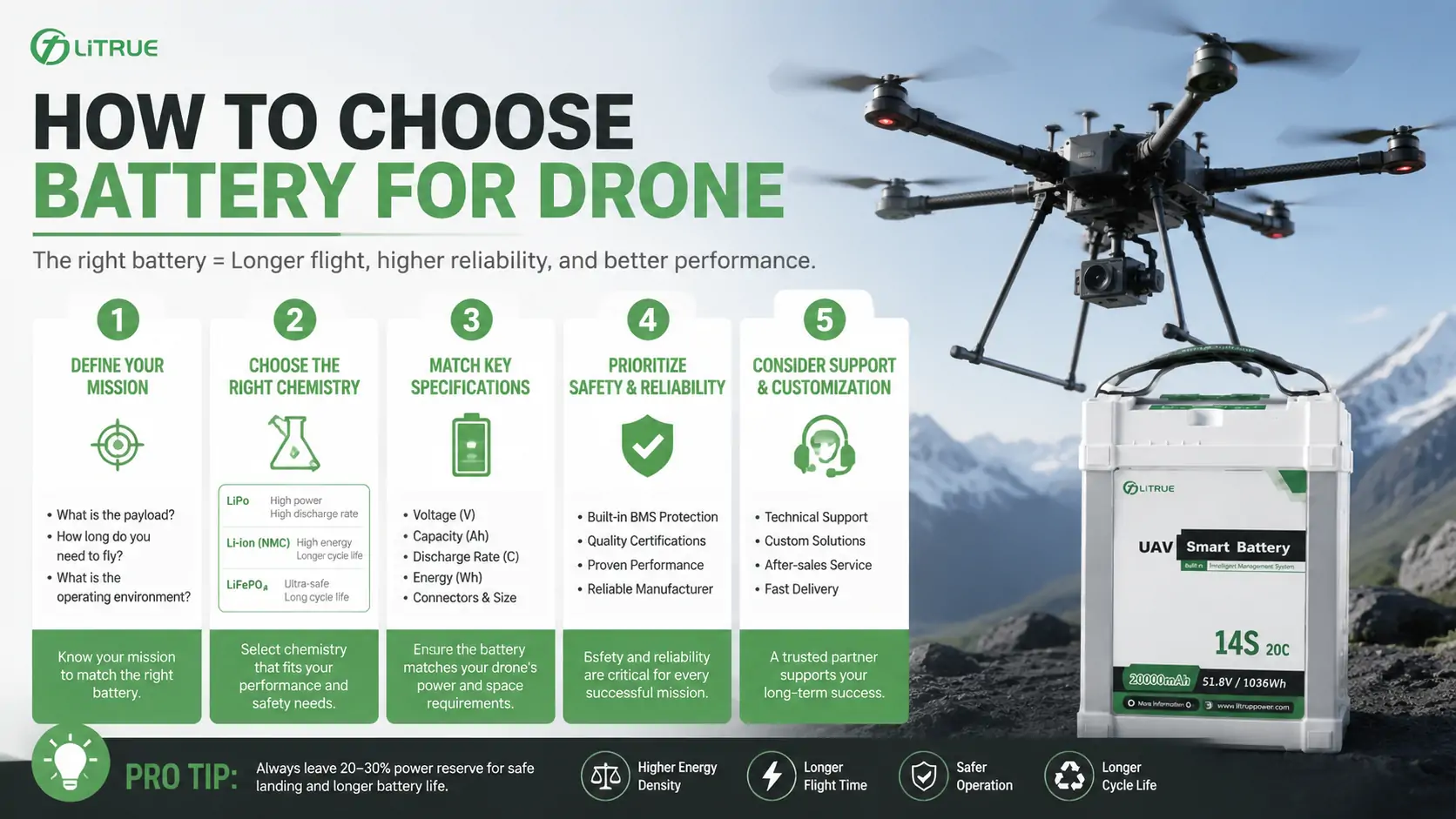
Table of Contents
- 1. The core battery truths most UAV buyers miss
- 2. How to Choose a Drone Battery: 7 Factors
- 3. How to match voltage, capacity, and discharge current
- 4. The flight time formula (with worked example)
- 5. Why C-rate and voltage sag matter in real missions
- 6. Battery chemistry choices for drone applications
- 7. Choosing a battery by drone type
- 8. Pros, limits, and sourcing tradeoffs
- 9. Alternative battery options and market context
- 10. FAQs
- 11. Final buyer checklist
The Core Truths Most UAV Buyers Miss
The first truth: battery capacity does not equal flight time by itself. A 30Ah pack can underperform a 28Ah pack if the heavier design forces the aircraft to spend more energy just staying in the air. Every extra kilogram competes with camera payload, sprayer liquid, LiDAR, delivery cargo, and reserve power.
The second truth: peak current is not a marketing number. During takeoff, climb, gust correction, and emergency maneuvers, the motors may demand short bursts far above cruise current. If the battery cannot supply that load, the aircraft may show early low-voltage warnings even while energy remains inside the pack.
The third truth: the battery has to speak the aircraft's language. For commercial UAVs, CAN communication, BMS alarms, SOC reporting, overcurrent protection, temperature monitoring, and charger matching are not extras. They decide whether the pack can be integrated into a repeatable fleet operation.
The fourth truth: a supplier's process matters as much as cell chemistry. A lithium battery manufacturer should be able to discuss cell grading, pack structure, BMS settings, enclosure sealing, validation, documentation, lead time, and after-sales support without hiding behind vague phrases.
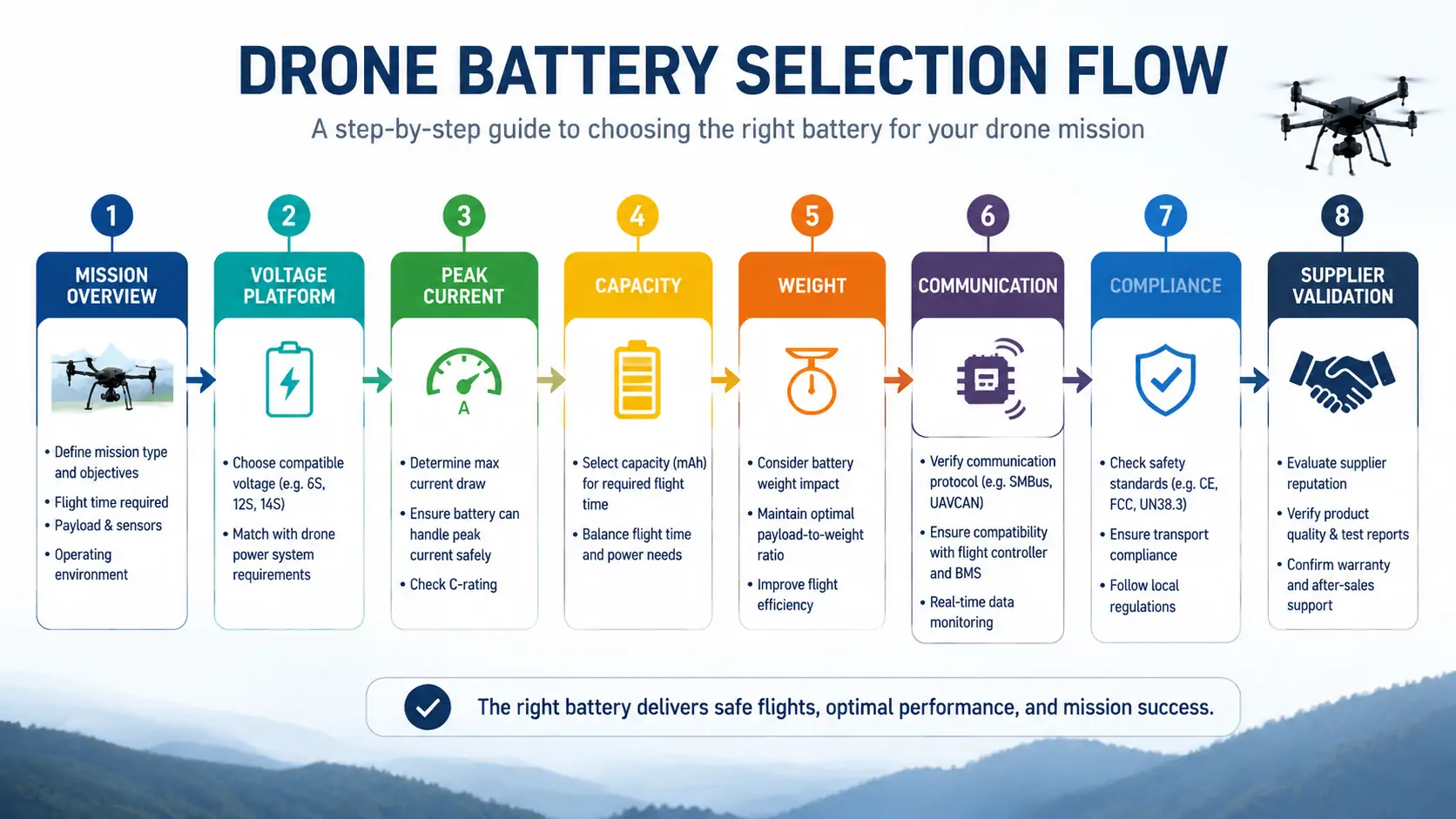
How to Choose a Drone Battery: 7 Factors
Every drone battery decision comes down to seven variables. Get any one of them wrong and the aircraft either falls short on flight time, sags under load, or fails in the field before the airframe does.
1. Capacity (Ah / Wh)
Ah tells you how much charge the pack holds. Wh tells you how much usable energy it holds — and Wh is what actually determines flight time, not the Ah number printed on the label. Always convert to Wh before comparing packs across different voltages.
2. C-rate (continuous and peak)
C-rate is current relative to capacity. A 28Ah pack rated for 5C continuous can sustain 140A; the same pack at 10C peak can push 280A for a short burst. The continuous number tells you what the pack can hold in cruise; the peak number tells you what it can survive during takeoff, climb, or a sudden payload shift.
3. Energy density (Wh/kg)
Energy density decides how much flight time you get per kilogram of battery mass. LiTrue's UAV-JP328L delivers about 167 Wh/kg (1.45 kWh at 8.7 kg), while the larger UAV-JP330L runs closer to 125 Wh/kg once the pack is built for sustained high current instead of pure weight savings. Neither number is "better" in isolation — it depends on whether the mission needs range or thrust.
4. Weight
Every extra 100g of battery is 100g the airframe can't spend on payload, sensors, or reserve power. Heavier packs also increase the current the motors need just to stay level, which eats into the energy advantage a larger battery is supposed to provide.
5. Cycle life
NMC packs in this power class typically hold up for several hundred full cycles before capacity drops meaningfully; LFP chemistry usually pushes into the low thousands, at the cost of extra weight per kWh. For a fleet doing multiple missions a day, cycle life directly sets your battery replacement budget — ask any supplier for cycle data at your actual discharge rate, not a bench-test 1C number.
6. Connector and physical footprint
A battery that fits the bay dimensionally but uses the wrong connector, pin spacing, or CAN wiring turns a "drop-in" pack into a redesign. Confirm connector type, cable length, and mounting orientation before committing to a model — this is the single most common cause of integration delay we see from OEM teams.
7. Operating temperature
A pack rated for 25°C lab conditions is not the same product in a 45°C field or a -20°C mountain survey route. Ask for the discharge temperature range, not just the storage range — the UAV-JP228L's -40°C to +60°C discharge window exists specifically because agricultural fleets don't get to choose their weather.
How to Match Voltage, Capacity, and Discharge Current
Start with voltage. Your motors, ESCs, charger, flight controller limits, and low-voltage cutoff must all match the battery's voltage range. A 14S NMC UAV pack may run around 51.8V nominal, while an 18S platform may use around 66.6V nominal. Higher voltage can reduce current for the same power demand, but it also changes component selection, charger requirements, insulation design, and safety rules.
Then calculate usable energy. Watt-hours matter more than amp-hours when comparing across voltages. The simple formula is voltage multiplied by amp-hours. For example, a 51.8V 20Ah pack gives about 1.036kWh, while a 66.6V 30Ah pack gives about 1.998kWh. Those two packs are not in the same class, even if both are labeled for UAV use.
After that, size discharge current against real flight loads. Ask your engineering team for current logs from takeoff, hover, climb, loaded cruise, return, and landing. If you do not have logs yet, test with a conservative safety margin. A battery that looks fine during bench hover may struggle when a sprayer lifts liquid payload at midday heat.
The Flight Time Formula
Once you have usable energy and real power draw, flight time estimation is simple arithmetic, not guesswork:
Flight time ≈ usable Wh ÷ average power draw
Usable Wh is not the full rated capacity — reserve a margin (commonly 10-20%) for landing safety and pack aging. Average power draw should come from actual current logs across takeoff, cruise, and payload-loaded flight, not a bench hover number.
Worked example
Take the UAV-JP328L: 51.8V × 28Ah = 1.45 kWh rated. Reserve 10% for safety margin, leaving about 1,305 Wh usable. A mid-size industrial hexacopter carrying a mapping payload might average around 800W in cruise. That gives:
1,305 Wh ÷ 800 W × 60 minutes ≈ 98 minutes theoretical.
Apply a further real-world derate for wind, temperature, and battery aging — typically another 15-20% — and a realistic planning number lands closer to 75-80 minutes. This is why current logs matter more than a datasheet Wh figure: the same pack can deliver very different flight times depending on what the aircraft actually pulls in the air.
Note: the 800W average power draw above is a representative planning assumption for this weight class, not a fixed spec — confirm with logged current data for your specific airframe.
Why C-Rate Is Only Useful When You Convert It Into Amps
C-rate describes charge or discharge speed relative to capacity. Battery University explains C-rate as a way to express how fast a battery is charged or discharged compared with its rated capacity: a 1C discharge on a 20Ah battery means 20A, while 5C means 100A. For UAV buyers, that conversion is where the useful work begins: Battery University C-rate reference.
Do not stop at the C-rate printed in a sales brochure. Ask for maximum continuous discharge current, peak discharge current, peak duration, test temperature, and voltage sag behavior. A pack rated for 280A peak for 10 seconds at 25°C is a very different product from a pack that only says "high power" without time, temperature, or test conditions.
Battery Chemistry Choices for Drone Applications
Most commercial drone battery packs use lithium-based chemistries because UAVs need high energy density. NMC is common where the aircraft needs strong energy per kilogram and high discharge capability. LFP offers thermal stability and long cycle life, but its lower energy density can make the pack heavier for flight applications. Solid-state and semi-solid chemistries are promising in specialized designs, but buyers should separate pilot-stage claims from mass-production readiness.
For heavy-lift, agriculture, inspection, mapping, and logistics UAVs, the better decision is not "NMC or LFP?" in isolation. The better decision is whether the cell chemistry, pack structure, thermal path, BMS, enclosure, and connector design fit the mission. If a drone spends the day taking off with payload, landing in dust, and charging between missions, the battery needs more than a nice lab number.
A UAV lithium battery should also be judged by the operating envelope: charging temperature, discharge temperature, storage range, altitude rating, humidity tolerance, and ingress protection. Outdoor UAV fleets rarely work in clean laboratory conditions.
Choosing a Battery by Drone Type
The seven factors above weigh differently depending on what the aircraft actually does. A racing quad and a crop sprayer are both "drones," but they are not shopping for the same battery — they are not even ranking the same factors in the same order. Use this table to shortlist by mission type first; the full spec numbers for each recommended model are in the table further down the page.
| Drone Type | What to Prioritize First | What to Trade Away | Where to Start |
|---|---|---|---|
| FPV / Racing | Discharge rate (20C-100C+) and minimum pack weight | Endurance — 3-7 minute flight times are normal for this class | Hobby LiPo packs at the airframe level, or a high-rate pouch cell if you're building the pack yourself |
| Mapping / Survey | Energy density (Wh/kg) and low weight, to protect payload for camera or LiDAR gear | Peak current headroom — these airframes rarely see the hard bursts a sprayer or heavy-lift platform sees | UAV-JP220M — the lightest pack in LiTrue's UAV-JP line |
| Agriculture (crop spraying) | Peak current headroom and IP65 sealing, to survive liquid-payload load swings and field exposure | Minimum weight — a heavier, better-sealed pack beats a lighter one that fails mid-season | UAV-JP228L, purpose-built for the agricultural drone battery use case |
| Logistics / Heavy-lift | Sustained peak current at a higher voltage architecture, to move cargo weight | Endurance per kWh carried — this is the heaviest pack class of the four | UAV-JP330L, or browse the full UAV battery range for other high-voltage platforms |
If your mission doesn't fit neatly into one row — a hybrid mapping-and-spray platform, for example — don't pick by capacity alone. Use LiTrue's drone battery product page as a starting reference, then send your aircraft voltage, motor current curve, battery bay size, connector requirement, target flight time, payload weight, and charging strategy to our engineering team for a custom battery quote rather than forcing the aircraft to fit a catalog spec.
Pros, Limits, and Sourcing Tradeoffs
What a Well-Matched Drone Battery Gives You
A well-matched pack gives the aircraft enough current headroom for hard flight events. It reduces nuisance low-voltage warnings. It supports more predictable route planning. It gives fleet managers clearer maintenance intervals when the BMS reports usable data. It also reduces integration work because the charger, communication protocol, enclosure, connector, and protection logic were considered before mass production.
There is also a commercial benefit. A battery that survives repeated daily missions with stable performance helps reduce battery replacement cost, downtime, and field troubleshooting. For B2B buyers, that often matters more than a small purchase-price difference between two packs.
Where Buyers Still Need to Be Careful
No battery can fix a poorly sized aircraft. If the drone is overweight, uses undersized wiring, runs ESCs near their limit, or lacks thermal management, even a strong pack may be blamed for a system-level problem. Battery choice also has to respect charging infrastructure. A pack that supports fast charging still needs a charger, connector, cable, thermal environment, and operating procedure that can handle it.
Transportation is another limit. Lithium batteries are regulated goods. The FAA notes that drone batteries and other lithium battery systems may be treated as dangerous goods during air travel and transport, and passenger-aircraft rules depend heavily on watt-hour limits and airline approval. Commercial UAV packs above 160Wh usually require proper shipping channels and documentation, not casual passenger luggage handling: FAA lithium battery resources.
Alternative Battery Options and Market Context
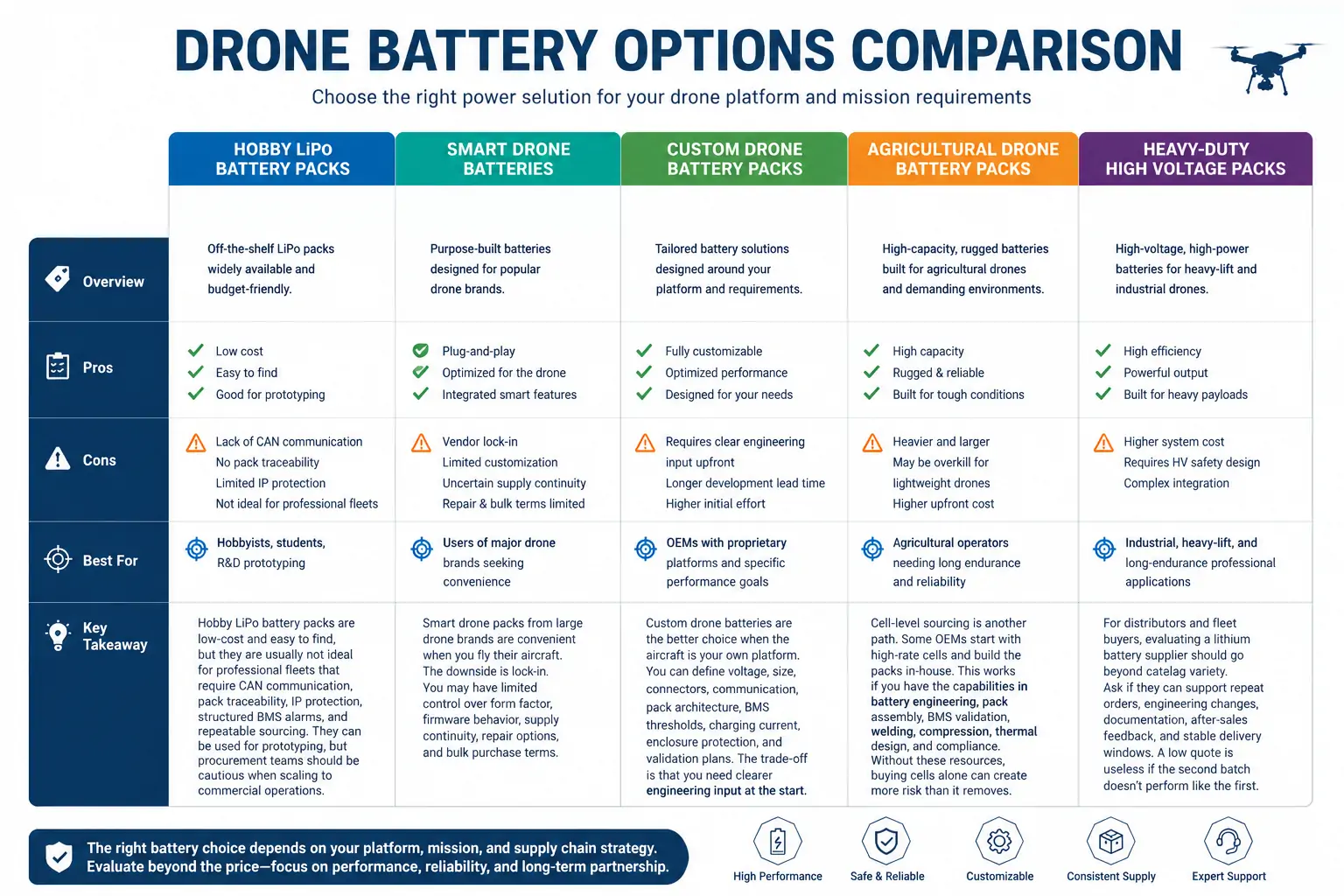
Hobby LiPo packs are low-cost and easy to find, but they are usually a poor fit for professional fleets that need CAN communication, pack traceability, IP protection, structured BMS alarms, and repeatable procurement. They can work for prototypes, but procurement teams should be cautious about scaling them into commercial operations.
Smart UAV packs from large drone brands can be convenient when you use that brand's aircraft. The drawback is lock-in. You may have limited control over form factor, firmware behavior, supply continuity, repair options, and bulk sourcing terms.
A custom UAV battery is the better route when the aircraft is your own platform. You can define voltage, dimensions, connector, communication, pack structure, BMS thresholds, charging current, enclosure protection, and validation plan. The tradeoff is that you need clearer engineering input at the start.
Cell-level sourcing is another path. Some OEMs begin with a high-rate battery cell and build packs in-house. That can work for teams with battery engineering, pack assembly, BMS validation, welding, compression, thermal design, and compliance capability. If your team lacks those resources, buying cells alone may create more risk than it removes.
For distributors and fleet buyers, a lithium battery supplier should be evaluated on more than catalog variety. Ask whether they can support repeat orders, engineering changes, documentation, after-sales feedback, and stable delivery windows. A low quote is not useful if the second shipment behaves differently from the first.
Factory Checklist: What to Send Before Asking for a Quote
Send the aircraft type, rotor count, maximum takeoff weight, payload weight, target flight time, cruise current, peak current, motor and ESC specifications, battery bay dimensions, connector preference, charger requirement, communication protocol, expected operating temperature, and shipment destination.
Also send the mission profile. A battery for a one-hour inspection route does not face the same load pattern as a sprayer that lifts liquid payload, lands, swaps packs, charges quickly, and repeats the cycle all afternoon. The more specific the mission, the better the battery recommendation.
At our factory, the most productive projects usually start with current logs and mechanical drawings. A simple screenshot of motor current during takeoff can save days of guessing. A clear bay drawing can reveal whether the buyer needs a thinner pouch-cell pack, a taller enclosure, a different handle location, or a connector angle change.
FAQs
What battery is best for a commercial drone?
The best battery is the one that matches the aircraft voltage, peak current, mission time, payload, weight limit, communication protocol, and operating environment. For many commercial UAVs, an NMC lithium pack with CAN BMS, defined peak discharge rating, IP protection, and verified transport documentation is a practical choice.
How do I calculate drone battery runtime?
Estimate energy in watt-hours, then compare it with real average power draw. A rough formula is battery Wh divided by average aircraft watts. Then reduce the result for reserve power, battery aging, temperature, wind, payload changes, and takeoff current. Field logs are more useful than theoretical hover numbers.
Is higher Ah always better for a drone battery?
No. Higher Ah usually means more energy, but it can also mean more weight. Once added battery mass forces the aircraft to work harder, the extra capacity may produce less flight-time gain than expected. Compare Wh, kg, discharge current, and aircraft payload impact together.
What C-rate should I choose for a UAV battery?
Choose C-rate by converting it into actual amps and comparing that number with the aircraft's peak and continuous current demand. Ask for continuous current, peak current, peak duration, test temperature, and voltage sag behavior. A useful rating must include conditions.
Should I choose NMC, LFP, or solid-state cells for drone use?
NMC is often selected for UAV packs because it offers strong energy density and power capability. LFP can be attractive for cycle life and thermal stability, but the weight penalty may be a problem in flight. Solid-state cells should be evaluated by production readiness, sample availability, cycle data, and pack-level validation rather than headline energy density alone.
What certifications should a drone battery supplier provide?
For international B2B sourcing, ask about UN38.3, MSDS, transport documentation, cell-level compliance, pack-level safety testing, and any market-specific requirements for your destination. For product integration, also ask for BMS logic, charge/discharge limits, operating temperature, storage instructions, and connector specifications.
When should I request a custom lithium battery instead of using a catalog pack?
Request a custom lithium battery when the aircraft has a fixed battery bay, nonstandard connector, special CAN protocol, unusual payload profile, fast-charge requirement, harsh environment, or fleet-level procurement plan. Catalog packs are faster for early testing, but custom design usually wins when the UAV platform moves toward production.
What C-rate is good for a drone battery?
It depends on the aircraft's peak current draw, not a single ideal number. Commercial mapping and agricultural UAVs typically run 2.5C-5C continuous and 5C-10C peak — matching packs like the UAV-JP220M or UAV-JP228L. FPV racing quads sit in a completely different range, often 20C-100C+, because they're optimized for burst power over a battery that weighs a fraction as much. Convert the C-rate into amps and compare it against your logged peak current before choosing.
Is LiPo or LiFePO4 better for drones?
It depends on whether the mission values flight time or cycle life more. LiPo (and NMC pouch chemistry generally) offers higher energy density, which usually means more flight time or payload for the same pack weight — the reason most commercial UAV packs, including LiTrue's UAV-JP series, use NMC. LiFePO4 trades some of that energy density for longer cycle life and better thermal stability, which can matter more for fleets doing many short cycles per day than for aircraft chasing maximum flight time.
How do I calculate drone battery flight time?
Use flight time ≈ usable Wh ÷ average power draw. Usable Wh is the rated Wh minus a safety reserve (commonly 10-20%). Average power draw should come from real current logs across takeoff, cruise, and payload-loaded flight — not a bench hover number. For example, a 1.45 kWh pack with 1,305 Wh usable, powering an aircraft averaging 800W, gives roughly 98 minutes theoretical, before derating for wind, temperature, and battery aging.
Final Buyer Checklist
Before choosing a drone battery, confirm voltage range, usable energy, weight, continuous current, peak current, peak duration, C-rate in amps, operating temperature, communication protocol, BMS protection, charger compatibility, enclosure rating, certifications, shipment rules, sample lead time, and bulk production capacity.
For small survey UAVs, a lighter 51.8V 20Ah pack may protect payload capacity. For industrial platforms, a 51.8V 28Ah pack with higher discharge headroom may fit better. For larger multi-rotor systems, a 66.6V 30Ah pack can support higher-power architecture. For crop-spraying drones, prioritize current headroom, sealing, thermal behavior, and repeated daily cycling.
The right battery does not only extend flight time. It makes the aircraft easier to integrate, safer to operate, simpler to maintain, and more predictable across a working fleet.