
Your definitive reference for lithium battery manufacturing terminology
Whether you are sourcing cells for a next-generation drone platform or specifying a grid-scale BESS installation, the language of lithium battery manufacturer standards matters. This glossary is the authoritative reference for professionals who need precise, reliable definitions across every stage of the battery value chain, from raw electrode chemistry to finished pack certification.

Who this glossary is for
This resource is built for the engineers, procurement leads, and product teams working across the most demanding battery applications today:
- Drone and UAV manufacturers specifying high-energy-density cells for extended flight endurance
- Electric motorcycle and light EV brands balancing gravimetric energy density with fast-charge capability
- Energy storage system (BESS) providers navigating cycle life, calendar aging, and safety standards
- Logistics and industrial equipment manufacturers requiring high C-rate discharge and robust thermal performance
- Automotive OEMs managing complex supply chains and evolving regulatory frameworks
At LiTrue, our analysis shows that terminology misalignment between procurement teams and cell manufacturers is one of the most common sources of specification error, leading to costly redesigns and delayed product launches. This glossary exists to close that gap.
What this glossary covers
The entries span four core domains of lithium battery manufacturing:
- Cell chemistry and materials, including NMC, LFP, solid-state, and anode-free architectures
- Manufacturing processes, from electrode coating and calendering through formation cycling and grading
- Performance metrics, covering energy density, power density, C-rate, coulombic efficiency, and cycle life
- Industry standards and certifications, including UN 38.3, IEC 62619, and UL 1973
A note on evolving terminology
Battery technology is advancing rapidly. Solid-state and anode-free chemistries, for example, have introduced terms that did not exist in mainstream manufacturing vocabulary five years ago. Definitions in this glossary reflect current industry usage as of 2025, with particular attention to emerging cell formats and the performance benchmarks they are redefining. Where terminology varies meaningfully across chemistries or regional markets, those distinctions are noted within each entry.
How to use this glossary: Navigation and search tips
This glossary is structured to help engineers, procurement leads, and product teams find precise definitions quickly, whether you are troubleshooting a specification, evaluating a supplier, or onboarding a new technical team member.
Alphabetical and category organization
Terms are grouped into lettered category sections covering cell types, chemistries, performance metrics, manufacturing processes, and safety standards. Within each section, entries appear alphabetically. If a term could belong to multiple categories, it appears under its primary discipline with a cross-reference note directing you to related entries.
Using cross-references and related terms
Each entry that connects meaningfully to another definition includes a See also: note at the close of the definition. These links help you build a complete picture of related concepts without reading every entry sequentially.
Finding terms by application
If you are sourcing cells for a specific end use, such as drone propulsion, electric motorcycles, or grid-scale BESS, look for application tags embedded within relevant definitions. These highlight which specifications, chemistries, and performance thresholds matter most for your sector. For broader context on how these terms apply in practice, the industrial lithium battery solutions resource provides useful application-level framing.
Reading technical specifications
Bold text within a definition signals a key term or measurable parameter. Numerical values, such as energy density expressed in Wh/kg or discharge rates expressed as C-rate multiples, always appear with their units for precision.
Battery cell types and chemistries: A-D
This section covers foundational cell types and chemistries from A to D. Each entry defines a distinct concept relevant to cell selection, manufacturing, and system integration. Terms spanning E through L continue in the next section.
Anode-free cells
An anode-free cell is a lithium battery architecture that eliminates the conventional graphite or silicon anode, instead depositing lithium metal directly onto the current collector during charging. This removal of anode host material is the primary reason anode-free designs achieve exceptional gravimetric energy density, often exceeding 480 Wh/kg at the cell level.
Because there is no pre-lithiated anode structure occupying volume or mass, manufacturers can pack more active cathode material into the same form factor. The trade-off historically involved cycle life and safety, as uncontrolled lithium plating can form dendrites. Advanced electrolyte engineering and solid-state or semi-solid electrolyte systems have significantly mitigated these risks in current-generation designs.
Anode-free architecture is particularly relevant for:
- Drone and UAV applications, where every gram of cell mass directly reduces payload or flight endurance
- Electric motorcycle platforms, where volumetric constraints demand maximum energy per unit weight
- Automotive OEM programs targeting next-generation range benchmarks
Commercially available examples include cells rated at 495 Wh/kg (such as the 49Ah and 40Ah solid-state anode-free formats) and the 25Ah 480 Wh/kg anode-free solid-state cell offered for OEM direct supply. These represent the current frontier of production-ready anode-free technology.
Cathode materials
A cathode material is the positive electrode compound in a lithium cell that stores and releases lithium ions during charge and discharge cycles. Cathode chemistry is the single largest determinant of a cell's voltage window, energy density, thermal stability, and cycle life.
Common cathode families encountered in B2B procurement include:
- NMC (nickel-manganese-cobalt oxide): High energy density, tunable Ni:Mn:Co ratios, widely used in mobility and storage applications
- LFP (lithium iron phosphate): Lower energy density than NMC but superior thermal stability and cycle life, preferred for stationary storage and high-rate industrial use
- NCA (nickel-cobalt-aluminium oxide): Very high energy density, common in automotive cells
The cathode material a lithium battery manufacturer selects shapes every downstream performance parameter. Procurement teams specifying cells for BESS, logistics equipment, or EV platforms should treat cathode chemistry as the primary filter before evaluating any other specification.
Cylindrical cells
A cylindrical cell is a lithium battery cell housed in a rigid, circular cross-section metal can, wound from electrode sheets and separator into a jellyroll configuration. Common formats include 18650, 21700, and 4680 designations, where the numbers encode diameter and height in millimetres.
Cylindrical cells offer robust mechanical integrity and mature, high-volume manufacturing processes. They are common in consumer electronics, power tools, and some EV packs. For applications demanding the highest energy density per kilogram, such as UAV platforms or performance electric motorcycles, pouch and anode-free formats typically offer advantages over cylindrical geometry. See also: Pouch cells (covered in section 3, E-L).
C-rate (discharge and charge)
C-rate is a standardised measure of the current at which a cell is charged or discharged, expressed as a multiple of its nominal capacity. A 1C rate fully discharges a cell in one hour. A 5C rate does so in twelve minutes. C-rate directly governs thermal load, cycle degradation, and application suitability.
Battery cell types and chemistries: E-L
This section defines performance and chemistry terms spanning E through L, covering the metrics that engineers and procurement teams use to evaluate cells for demanding applications. Each term is self-contained and directly relevant to specification comparison across drone, EV, BESS, and industrial platforms.
Energy density
Energy density is the amount of energy a cell stores per unit of volume, expressed in watt-hours per litre (Wh/L). It is distinct from specific energy, which measures energy per unit of mass. Both metrics matter, but for weight-sensitive applications such as UAVs and electric motorcycles, specific energy in Wh/kg is typically the governing figure.
Key distinctions for procurement teams:
- Specific energy (Wh/kg): Governs payload capacity and range in airborne and mobile applications
- Energy density (Wh/L): Governs packaging efficiency in fixed-volume enclosures such as BESS racks
- Cell-level vs. pack-level values: Cell-level figures are always higher. Pack-level figures account for housing, BMS, and thermal management mass
The 49Ah solid-state anode-free cell and the 40Ah solid-state anode-free cell both achieve 495 Wh/kg at the cell level, representing the current commercial frontier for lithium cell specific energy. The 25Ah anode-free solid-state cell reaches 480 Wh/kg, while the 42Ah ultra-high energy density solid-state anode-free cell and the 36Ah semi-solid state NMC pouch cell deliver competitive figures suited to automotive OEM and logistics applications.
See also: Anode-free cells (covered in section 3, A-D).
Fast-charging and C-rate specifications (continued)
Building on the C-rate definition introduced in the previous section, fast-charging refers specifically to charge rates above 1C, where thermal and electrochemical stress on the anode becomes a primary design constraint.
Practical C-rate thresholds recognised across the industry:
- Standard charge: 0.5C or below, minimal degradation per cycle
- Fast charge: 1C to 3C, acceptable for most NMC chemistries with adequate thermal management
- High-rate fast charge: 3C to 5C, requires engineered electrolyte and electrode architecture
- Extreme rate: Above 5C, typically reserved for pulse discharge rather than sustained charge
The 30Ah NMC pouch cell supports 5C fast-charging, making it suitable for logistics equipment and industrial platforms where downtime between cycles is a hard operational constraint.
High-rate discharge and pulse discharge ratings
High-rate discharge describes a cell's ability to deliver sustained current at multiples of its nominal capacity without voltage collapse or thermal runaway. Pulse discharge is a related but distinct rating: the maximum current a cell can deliver for a short, defined interval, typically two to ten seconds.
For drone manufacturers and electric motorcycle brands, pulse discharge capability determines peak power availability during acceleration, climb, or emergency manoeuvring:
- Continuous discharge rate: The current a cell sustains indefinitely within its thermal envelope
- Pulse discharge rate: A higher, time-limited current the cell can supply without permanent degradation
The 50Ah high-rate NMC pouch cell is rated at 8C pulse, delivering exceptional peak power density for high-demand applications.
Internal resistance and impedance
Internal resistance is the opposition a cell presents to current flow within its own structure, measured in milliohms (mΩ). Lower internal resistance means less energy lost as heat during charge and discharge, and better voltage stability under load.
Impedance is the frequency-dependent equivalent of internal resistance, measured using electrochemical impedance spectroscopy (EIS). It captures both resistive and reactive components of the electrochemical interface.
Battery cell types and chemistries: M-S
This section covers the core terminology spanning NMC chemistry variants through to separator and solid electrolyte interface concepts. Together, these terms form the technical vocabulary that engineers and procurement teams rely on when specifying cells, auditing manufacturing processes, and evaluating long-term pack performance.
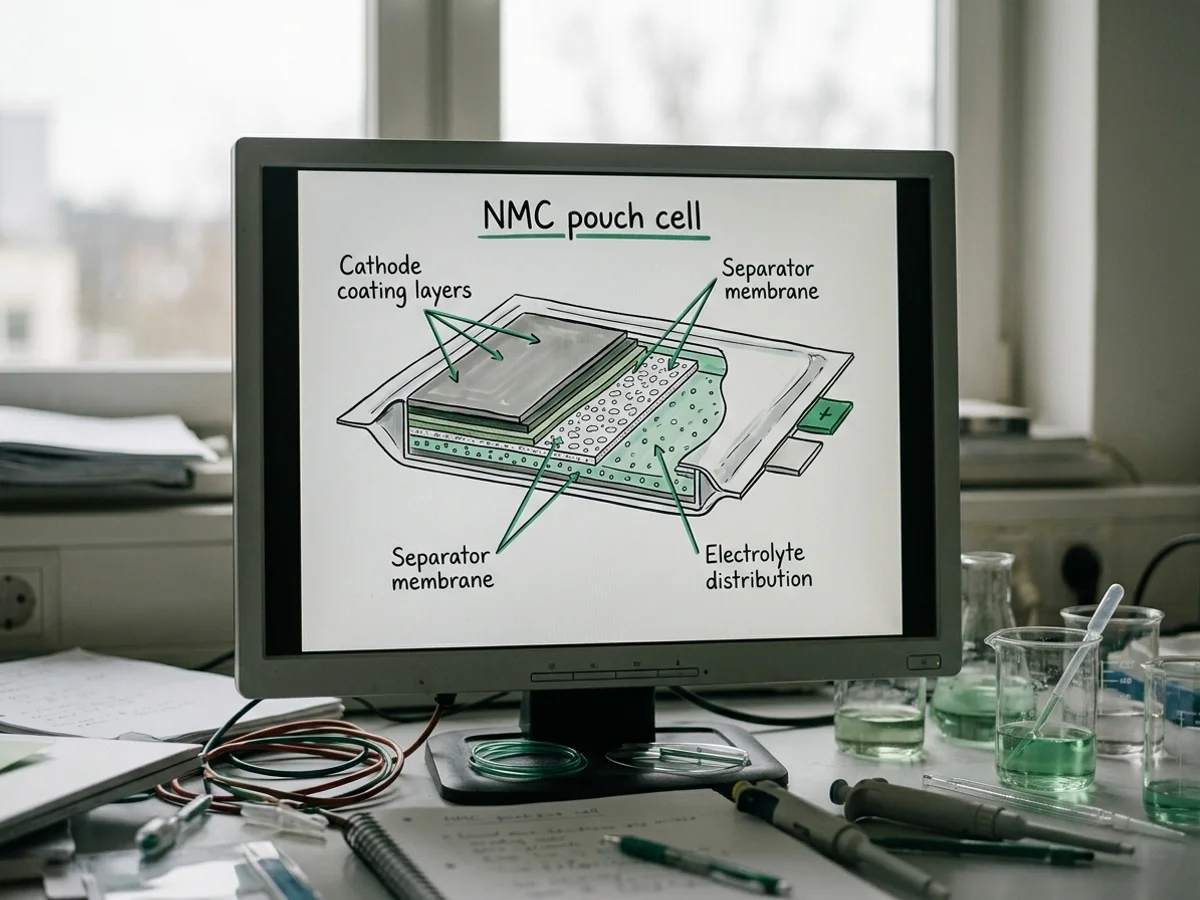
NMC chemistry and cobalt content
NMC (lithium nickel manganese cobalt oxide) is a cathode chemistry defined by the ratio of nickel, manganese, and cobalt in its active material. The ratio is written as NMC followed by three numbers: NMC 811 contains 80% nickel, 10% manganese, and 10% cobalt. Higher nickel content raises energy density but reduces thermal stability, while higher cobalt content improves cycle life and structural integrity at the cost of raw material expense and supply-chain risk.
Key NMC variants and their trade-offs:
- NMC 111: Balanced chemistry, moderate energy density, good stability. Common in early-generation EV packs.
- NMC 532 / NMC 622: Mid-range nickel content, used widely in industrial and drone applications.
- NMC 811: High nickel, low cobalt, targets maximum energy density. Requires tighter thermal management and more precise formation cycling.
- NMC 9-series: Emerging ultra-high-nickel formulations pushing toward 300 Wh/kg at cell level.
Reducing cobalt content is a primary goal for automotive OEMs and BESS providers because cobalt is both expensive and subject to geopolitical supply constraints. Cells such as high-rate NMC pouch models utilize optimized formulations that balance energy density with reduced cobalt dependency, making them practical for logistics equipment and electric motorcycle platforms.
Manufacturing processes: cell assembly and electrode coating
Electrode coating is the process of applying a slurry of active material, binder, and conductive additive onto a metallic current collector foil. Cathode slurry is coated onto aluminum foil; anode slurry is coated onto copper foil. Coating uniformity directly determines capacity consistency and internal resistance across a production batch.
Cell assembly follows coating and includes:
- Calendering: Compressing dried electrode sheets to a target porosity and thickness.
- Slitting: Cutting electrode rolls to precise widths for the chosen cell format.
- Stacking or winding: Layering cathode, separator, and anode sheets into a jellyroll (cylindrical) or flat stack (pouch or prismatic).
- Electrolyte filling: Injecting liquid electrolyte under vacuum to ensure full wetting of the electrode stack.
- Formation cycling: Initial charge-discharge cycles that establish the SEI layer and set baseline capacity.
Separator materials
A separator is a microporous membrane placed between the cathode and anode to prevent electrical short circuits while allowing lithium-ion transport. Most commercial separators are made from polyethylene (PE) or polypropylene (PP), often with a ceramic coating to improve thermal shutdown behavior. Separator thickness typically ranges from 9 to 25 micrometers. Thinner separators reduce internal resistance and improve energy density; ceramic-coated variants add a critical safety margin by closing pores at elevated temperatures before thermal runaway can propagate.
Solid electrolyte interface (SEI) formation
The solid electrolyte interface is a thin passivation layer that forms on the anode surface during the first charge cycles as electrolyte components decompose under voltage stress.
Performance metrics and specifications: T-Z
This section defines the core performance metrics and specification terms that lithium battery manufacturers use to characterize, compare, and guarantee cell behavior across real-world applications. Understanding these terms helps procurement engineers and OEM designers evaluate datasheets with precision.
Temperature operating range and thermal stability
Temperature operating range describes the minimum and maximum temperatures within which a cell can safely charge, discharge, or be stored without permanent degradation. Manufacturers typically express three distinct ranges: charge temperature, discharge temperature, and storage temperature.
Key distinctions to understand:
- Discharge range is generally wider, often spanning -20°C to +60°C for high-performance NMC pouch cells
- Charge range is narrower because lithium plating risk increases sharply below 0°C
- Storage range defines conditions for long-term shelf life without capacity fade
Thermal stability refers to a cell's resistance to self-heating and its ability to maintain electrochemical performance across temperature extremes. Solid-state and semi-solid-state chemistries demonstrate superior thermal stability compared to conventional liquid-electrolyte cells because the non-flammable electrolyte limits exothermic reaction pathways.
Thermal management and cooling system terminology
Thermal management is the engineering discipline of controlling cell temperature during operation to stay within the safe operating range. For battery pack designers, this involves:
- Passive cooling: heat-spreading plates, phase-change materials, and thermally conductive adhesives
- Active cooling: liquid cooling channels, forced-air systems, and refrigerant-based solutions
- Thermal runaway propagation prevention: cell-to-cell barriers, venting channels, and intumescent materials
Thermal runaway is the condition where self-heating accelerates beyond the cell's ability to dissipate heat, leading to rapid gas venting, fire, or explosion. Preventing propagation between adjacent cells is a primary pack-level design requirement for automotive OEMs and BESS providers.
Voltage ratings and nominal voltage specifications
Nominal voltage is the average working voltage of a cell under typical discharge conditions, used as a reference point for system design. It sits between the fully charged voltage and the discharge cutoff voltage.
Common nominal voltage references for lithium chemistries:
- NMC: approximately 3.6 V to 3.7 V per cell
- LFP: approximately 3.2 V to 3.3 V per cell
- Solid-state anode-free NMC: typically 3.6 V nominal, with a higher full-charge voltage ceiling
Voltage regulation describes how consistently a cell maintains its output voltage under varying load conditions. Cells with lower internal resistance exhibit flatter discharge curves, which simplifies power electronics design in drone propulsion and electric motorcycle drivetrains.
Watt-hour and ampere-hour capacity measurements
Ampere-hour (Ah) measures the total charge a cell can deliver at a specified discharge rate. A 50Ah cell can theoretically supply 50 A for one hour, or 5 A for ten hours.
Watt-hour (Wh) converts that charge into usable energy by multiplying Ah by nominal voltage. This is the more practically meaningful figure for system-level energy budgeting.
In our experience at LiTrue, specifying energy density in Wh/kg alongside raw Ah capacity is essential for weight-sensitive applications. The 49Ah 495 Wh/kg solid-state anode-free cell, for example, delivers both high gravimetric energy density and competitive volumetric density, which matters significantly for UAV and logistics equipment designers balancing payload against runtime.
Warranty and reliability specifications
Warranty specifications define the manufacturer's guarantee of cell performance over time, typically expressed as a minimum retained capacity after a defined number of charge-discharge cycles or calendar years. A common benchmark is 80% capacity retention after 800 cycles.
Manufacturing processes and quality standards
Manufacturing processes and quality standards define how a lithium battery manufacturer transforms raw materials into validated, shipment-ready cells. For OEM buyers in automotive, drone, and energy storage sectors, understanding these processes is essential for evaluating supplier capability, negotiating specifications, and ensuring supply chain reliability.
Electrode preparation
Electrode preparation is the first major stage of cell manufacturing, encompassing slurry mixing, coating, drying, and calendering.
- Slurry mixing: Active materials, conductive additives, and binders are combined into a homogeneous paste. Consistency at this stage directly influences electrode uniformity and, ultimately, cell capacity.
- Coating: The slurry is applied to metal foil current collectors (copper for anodes, aluminum for cathodes) at precise thicknesses measured in micrometers.
- Calendering: Coated electrodes are compressed under controlled pressure to achieve target porosity and density, which affects ion transport and energy density.
- Slitting: Dried electrode sheets are cut to exact widths for the chosen cell format, whether pouch, prismatic, or cylindrical.
Cell assembly and formation
Cell assembly converts prepared electrodes into sealed electrochemical units. For pouch cells, this involves stacking or winding electrode layers with separator material, inserting the stack into a foil pouch, filling with electrolyte under controlled humidity, and heat-sealing.
Formation cycling follows assembly. During formation, cells are charged and discharged for the first time under tightly controlled parameters to establish the solid electrolyte interphase (SEI) layer. This step is critical: it determines initial capacity, internal resistance, and long-term cycle stability. Formation is one of the most time-intensive and energy-intensive steps in the manufacturing process.
Aging comes next. Cells rest at defined temperatures for hours or days, allowing electrochemical stabilization before grading.
Quality control testing and validation
Quality control (QC) testing is a systematic set of inspections and measurements applied at multiple production stages to confirm that cells meet specification before shipment.
Common QC procedures include:
- Capacity grading: Each cell is tested for actual discharge capacity and sorted into tolerance bands.
- Internal resistance measurement: Cells exceeding resistance thresholds are rejected or downgraded.
- Self-discharge testing: Cells are held at full charge and re-measured after a defined rest period to identify leakage.
- Dimensional inspection: Thickness, width, and tab alignment are verified against mechanical drawings.
- Leak and seal integrity testing: Pouch cells are checked for electrolyte leakage and seal quality.
Validation testing goes beyond routine QC. It subjects representative samples to extreme conditions, including thermal cycling, nail penetration, overcharge, short circuit, and crush testing, to confirm safety and durability margins.
Industry certifications and standards
Certifications are third-party verifications that a manufacturer's cells or processes meet defined safety and performance benchmarks. For OEM buyers, certifications are often contractual requirements.
Key standards include:
- IEC 62133: The international standard for portable sealed secondary lithium cells, covering safety requirements for consumer and light industrial applications.
- UL 1642 / UL 2054: U.S. standards for lithium cell and battery safety, widely required for products entering North American markets.
- UN 38.3: A transport safety standard requiring cells to pass a series of altitude simulation, thermal, vibration, shock, and short-circuit tests before air or sea shipment.
- ISO 26262: The functional safety standard for automotive electrical systems, relevant for battery suppliers serving EV and hybrid vehicle OEMs.
- IATF 16949: The automotive quality management system standard, requiring documented process controls, traceability, and continuous improvement programs from certified suppliers.
Factory-direct production and OEM supply chain terms
Factory-direct describes procurement where the buyer purchases cells directly from the primary manufacturer without intermediate distributor layers.
Most commonly confused terms in battery manufacturing
Even experienced procurement engineers and product developers occasionally conflate terms that carry distinct technical meanings. Misunderstanding these definitions can lead to incorrect cell selection, flawed system design, or misaligned supplier conversations. The clarifications below address the most frequent points of confusion.

Energy density vs. power density
Energy density measures how much total energy a cell stores per unit of weight or volume, expressed in Wh/kg or Wh/L. Power density measures how quickly that energy can be delivered, expressed in W/kg or W/L. A cell optimized for energy density, such as a high-capacity solid-state anode-free cell targeting 495 Wh/kg, prioritizes runtime. A cell optimized for power density prioritizes burst output, which matters more for high-rate discharge applications like drones or industrial robotics.
Cycle life vs. calendar life
Cycle life counts the number of full charge-discharge cycles a cell can complete before capacity falls below a defined threshold, typically 80%. Calendar life measures total elapsed time before that same degradation occurs, regardless of how often the cell is cycled. A cell stored at elevated temperature may exhaust its calendar life before its cycle life, making both metrics relevant for BESS and automotive OEM applications.
C-rate vs. discharge rate
C-rate is a normalized expression of current relative to cell capacity. A 1C rate fully discharges a cell in one hour. Discharge rate is the absolute current in amperes. For a 50Ah cell, 1C equals 50A. Specifying only amperes without referencing C-rate makes cross-cell comparison unreliable.
Solid-state vs. semi-solid state battery technology
Solid-state batteries replace liquid electrolyte entirely with a solid ionic conductor. Semi-solid state batteries retain a small amount of liquid or gel electrolyte within a predominantly solid matrix. The distinction affects ionic conductivity, manufacturing complexity, and thermal behavior. Both differ meaningfully from conventional NMC pouch cells.
Nominal voltage vs. rated voltage
Nominal voltage is the average operating voltage across a typical discharge curve, used for system-level energy calculations. Rated voltage is the manufacturer-specified voltage under defined test conditions. These values are often close but not identical, and conflating them introduces errors in pack design.
Continuous vs. pulse discharge ratings
Continuous discharge defines the maximum sustained current a cell can deliver indefinitely without exceeding thermal or degradation limits. Pulse discharge defines the peak current allowable for a short duration, typically a few seconds. High-rate cells such as an 8C pulse NMC pouch cell may tolerate brief current spikes far exceeding their continuous rating, a distinction critical for motor-drive and power-tool applications.
Quick reference table: Battery specifications comparison
This table gives procurement engineers and system designers a fast, side-by-side view of the key specifications that separate one cell chemistry and format from another. Use it to shortlist candidates before requesting datasheets or samples.
| Cell / Chemistry | Nominal voltage | Energy density | Typical capacity | Max C-rate | Cycle life (est.) | Operating temp. | Primary applications |
|---|---|---|---|---|---|---|---|
| 49Ah Solid-State Anode-Free | 3.7 V | 495 Wh/kg | 49 Ah | 2C cont. | 800+ cycles | -20 °C to 60 °C | Automotive OEM, BESS |
| 42Ah Ultra-High Energy Solid-State | 3.7 V | 495 Wh/kg | 42 Ah | 2C cont. | 800+ cycles | -20 °C to 60 °C | Aerospace, EV |
| 40Ah Solid-State Anode-Free | 3.7 V | 495 Wh/kg | 40 Ah | 2C cont. | 800+ cycles | -20 °C to 60 °C | UAV, automotive |
| 25Ah 480 Wh/kg Anode-Free | 3.7 V | 480 Wh/kg | 25 Ah | 2C cont. | 800+ cycles | -20 °C to 60 °C | OEM drone, robotics |
| 36Ah Semi-Solid NMC Pouch | 3.7 V | ~380 Wh/kg | 36 Ah | 3C cont. | 1,000+ cycles | -20 °C to 55 °C | E-motorcycle, BESS |
| 30Ah NMC 5C Fast-Charge | 3.7 V | ~320 Wh/kg | 30 Ah | 5C cont. | 1,000+ cycles | -20 °C to 55 °C | Fast-charge EV, logistics |
| 50Ah NMC 8C Pulse | 3.7 V | ~280 Wh/kg | 50 Ah | 8C pulse | 1,200+ cycles | -30 °C to 55 °C | Motor drive, power tools |
| 100Ah LFP Prismatic | 3.2 V | ~170 Wh/kg | 100 Ah | 3C cont. | 3,500+ cycles | -20 °C to 60 °C | Grid BESS, Marine |
Related resources: Deeper content for battery professionals
The glossary terms above form the foundation. These curated guides go further, giving engineers, procurement leads, and product teams the technical depth needed to make confident decisions at every stage of a battery program.
Solid-state and anode-free technology
Understanding the terminology is one thing. Seeing how solid-state and anode-free architectures perform in real OEM contexts is another. Review product documentation to understand specific material choices and cycle-life data behind these next-generation formats.
LFP chemistry for stationary and industrial storage
For BESS providers and logistics equipment manufacturers evaluating iron-phosphate chemistries, reviewing comprehensive specification sheets covers thermal stability benchmarks, calendar life projections, and safety certifications relevant to grid-tied and industrial deployments.
Fast-charging and high C-rate applications
Automotive OEMs and drone manufacturers pushing charge rates beyond 3C will benefit from examining detailed electrical characterization data on high-discharge pouch cells, including pulse discharge curves and thermal rise profiles.
Application-specific cell selection
Each target application carries unique constraints around weight, form factor, and cycle depth. Explore the full Litrue product catalog to match glossary concepts directly to verified cell specifications across automotive, UAV, and energy storage use cases.
Faqs
What is the difference between solid-state and semi-solid state battery cells?
Solid-state cells replace the liquid electrolyte entirely with a solid ionic conductor, improving safety and enabling higher energy densities. Semi-solid state cells use a gel or partially solidified electrolyte, offering a practical middle ground between conventional liquid electrolyte designs and fully solid architectures. Both formats reduce thermal runaway risk compared to standard NMC liquid electrolyte cells.
How do I interpret C-rate specifications for my application?
C-rate describes discharge or charge current as a multiple of a cell's capacity. A 5C discharge on a 30Ah cell means drawing 150A continuously. Match your peak load profile to the cell's continuous rating, and use pulse discharge ratings only for brief, intermittent demand spikes.
What does energy density (Wh/kg) mean and why does it matter?
Energy density measures how much energy a cell stores per kilogram of mass. Higher values directly reduce system weight, which is critical for drone endurance, electric motorcycle range, and portable energy storage. Laboratory figures often exceed field performance, so always request application-specific test data from your lithium battery manufacturer.
How are battery cycle life and calendar life different?
Cycle life counts the number of full charge-discharge cycles before capacity falls below a defined threshold, typically 80%. Calendar life measures degradation over time regardless of use. Both figures matter for warranty structuring and total cost of ownership calculations in BESS and automotive applications.
What is the difference between continuous and pulse discharge ratings?
Continuous discharge is the sustained current a cell can deliver without exceeding thermal limits. Pulse discharge allows a higher current for a short duration, typically a few seconds. Industrial equipment and UAV motors often require high pulse capability during acceleration, making this distinction critical during cell selection.
How do I compare NMC and LFP chemistry for my use case?
NMC offers higher energy density, making it preferable for weight-sensitive applications. LFP delivers superior cycle life and thermal stability, suiting stationary storage and commercial vehicles. Evaluate both gravimetric energy density and cycle count requirements together before committing to a chemistry.
What manufacturing standards should I require from battery suppliers?
Require ISO 9001 quality management certification as a baseline, alongside UN 38.3 transport testing and IEC 62133 or UL 1642 safety certification depending on your target market. Premium manufacturers also provide full traceability documentation and third-party audit reports.
What distinguishes premium battery manufacturers from standard producers?
Premium manufacturers invest in in-house cell chemistry development, rigorous incoming material inspection, and application-specific validation testing. They provide detailed datasheets with real discharge curves, thermal profiles, and cycle life data rather than headline specifications alone.
Based on our work at LiTrue, the questions that matter most to OEM engineers are rarely about single specifications in isolation. They are about how multiple parameters interact under real operating conditions, and that is precisely the perspective this glossary is designed to support.