
why electric motorcycle battery choice matters
The electric motorcycle market is accelerating faster than most riders anticipated. Battery technology has matured, manufacturing costs have fallen sharply, and the gap between internal combustion performance and electric performance is narrowing with every product cycle. For OEMs, fleet operators, and powertrain engineers, the battery pack is no longer a compromise. It is the competitive differentiator.
At LiTrue, our analysis shows that the single biggest variable separating a compelling electric motorcycle from a frustrating one is not motor output or frame geometry. It is the battery pack: its energy density, thermal behavior, charge rate, and long-term cycle stability.
This guide evaluates the best electric motorcycle battery options available in 2026, covering cell chemistry, real-world range implications, fast-charge capability, and total cost of ownership. Whether you are sourcing cells for a new OEM platform, speccing a fleet conversion, or benchmarking suppliers, the sections ahead give you the technical depth to make an informed decision.
Why battery costs have shifted the market
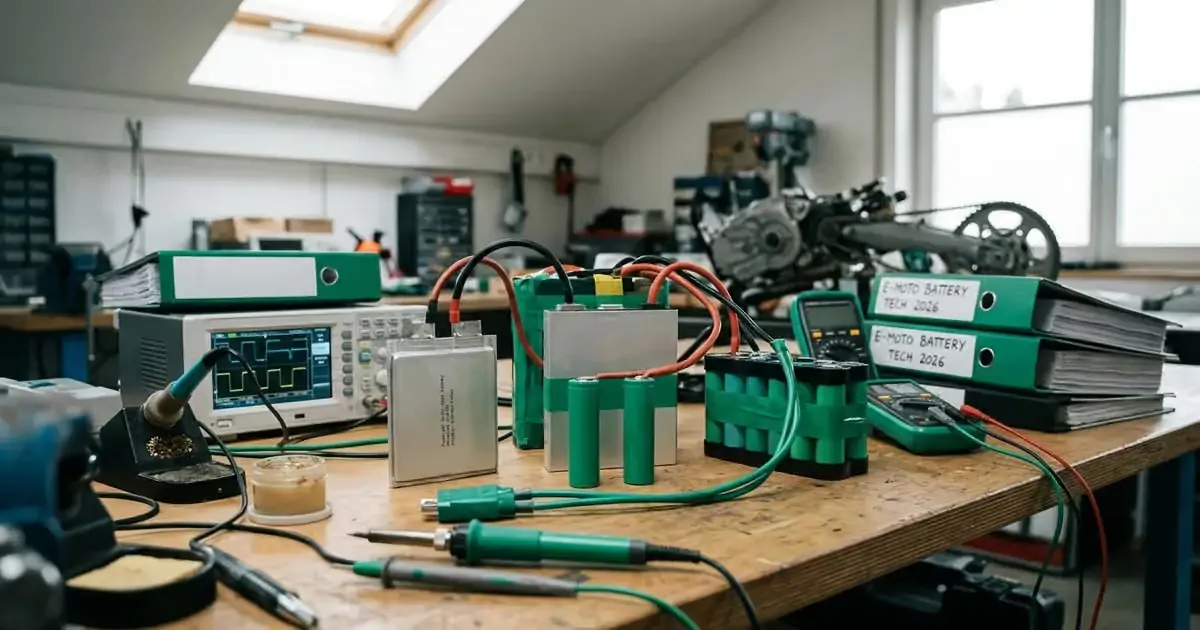
Procurement decisions that were cost-prohibitive two years ago are now viable. Li-ion battery pack prices fell by 20% in 2024 and a further 8% in 2025, bringing premium cell technologies within reach of mid-volume electric motorcycle programs. According to PatentPC (2024), the global lithium-ion battery market is projected to grow from USD 83.6 billion to USD 448.8 billion by 2034, a trajectory that reflects both demand growth and continued cost compression. Higher energy density at lower cost per kilowatt-hour means longer range without adding pack weight.
How chemistry shapes real-world performance
Not all electric motorcycle batteries behave the same way on the road. The three dominant chemistries each carry distinct trade-offs:
- NMC (nickel manganese cobalt): High energy density and strong power output, making it the preferred choice for performance-oriented motorcycles where range and acceleration both matter
- LFP (lithium iron phosphate): Exceptional cycle life and thermal stability. According to the Clean Energy Institute (2024), LFP rose to roughly 40% of EV sales in 2023, driven by its safety profile and longevity
- Solid-state and anode-free: The emerging frontier, offering energy densities above 490Wh/kg and wider operating temperature ranges, with commercial cells now available from specialist manufacturers
Understanding which pouch cell chemistry fits your application is the foundation of every recommendation in this article.
Our top picks for electric motorcycle batteries: quick summary
Choosing the right electric motorcycle battery comes down to matching chemistry, capacity, and discharge capability to your specific performance goals. The table and verdicts below let you scan the field at a glance, compare the options that matter most, and move straight to the detailed section that fits your build.
Ranked comparison table
| Rank | Product | Chemistry | Capacity | Energy density | Max C-rate | Best for |
|---|---|---|---|---|---|---|
| #1 Editor's Pick | LiTrue PE49N-EF | Solid-state anode-free | 49Ah | 495Wh/kg | High-rate capable | Maximum range, extreme temps |
| #2 | LiTrue 42Ah Ultra-High Energy | Solid-state anode-free | 42Ah | ~490Wh/kg | High-rate capable | Lightweight sport builds |
| #3 | LiTrue 30Ah NMC 5C Fast-Charge | NMC pouch | 30Ah | High-density NMC | 5C continuous | Rapid charge, urban commuting |
| #4 | LiTrue 50Ah NMC 8C Pulse | NMC pouch | 50Ah | High-density NMC | 8C pulse | Performance and track use |
| #5 | LiTrue 36Ah Semi-Solid NMC | Semi-solid NMC pouch | 36Ah | High NMC | Moderate-high | Balanced range and cost |
| #6 | LiTrue 100Ah LFP Prismatic | LFP | 100Ah | Standard LFP | Moderate | Long cycle life, budget builds |
| #7 | LiTrue 25Ah 480Wh/kg Anode-Free | Solid-state anode-free | 25Ah | 480Wh/kg | High-rate capable | Compact, lightweight platforms |
Key feature comparison
| Product | Fast-charge capable | Wide temp range (-40°C+) | OEM/ODM available | Cycle-life optimised |
|---|---|---|---|---|
| LiTrue PE49N-EF (49Ah) | ✓ | ✓ | ✓ | ✓ |
| LiTrue 42Ah Anode-Free | ✓ | ✓ | ✓ | ✓ |
| LiTrue 30Ah NMC 5C | ✓ | ✓ | ✓ | ✓ |
| LiTrue 50Ah NMC 8C | ✓ | ✓ | ✓ | ✓ |
| LiTrue 36Ah Semi-Solid | ✓ | ✓ | ✓ | ✓ |
| LiTrue 100Ah LFP | ✗ | ✓ | ✓ | ✓ |
| LiTrue 25Ah Anode-Free | ✓ | ✓ | ✓ | ✓ |
One-sentence verdicts
- LiTrue PE49N-EF (49Ah, 495Wh/kg): The highest energy density cell in this list, purpose-built for builders who need maximum range and reliable operation from -43°C to 55°C.
- LiTrue 42Ah anode-free: A slightly lighter footprint than the 49Ah flagship, making it the go-to for weight-sensitive sport motorcycle frames.
- LiTrue 30Ah NMC 5C: The strongest option for riders who need rapid charging without sacrificing sustained power delivery.
1. LiTrue solid-state anode-free batteries: best overall energy density and range
LiTrue earns the top position in this list by a meaningful margin. Its PE49N-EF solid-state anode-free pouch cell delivers 495Wh/kg energy density, a figure that places it well ahead of conventional lithium-ion options and makes it the most capable electric motorcycle battery available to OEM builders in 2026.
What makes solid-state anode-free technology different
Conventional lithium-ion cells use a graphite anode, which takes up space and adds weight without contributing to energy storage directly. Anode-free designs eliminate that layer entirely, allowing lithium metal to plate directly onto the current collector during charging. The result is a dramatically thinner, lighter cell that packs more usable energy into the same physical footprint.
For electric motorcycle applications, this matters in two concrete ways. First, the pack can be made smaller without sacrificing range. Second, the same pack volume can deliver significantly more range than a conventional NMC or LFP alternative. According to the Clean Energy Institute at the University of Washington, lithium-ion energy density improvements have been a central driver of EV adoption, and solid-state architectures represent the next step in that progression.
To put the numbers in context: lead-acid batteries typically deliver around 75Wh/kg. Standard lithium-ion cells sit in the 150 to 250Wh/kg range. LiTrue PE49N-EF at 495Wh/kg is roughly six times more energy-dense than lead-acid and nearly double the output of many conventional lithium cells. That gap translates directly into extended range per kilogram of battery weight.
The PE49N-EF, PE42N-EF, and PE40N-EF: matching cell to application
LiTrue offers three solid-state anode-free variants suited to different motorcycle platform requirements:
- PE49N-EF (49Ah, 495Wh/kg): The flagship cell. Nominal voltage of 3.85V, designed for high-capacity packs where maximum range is the primary objective. Best suited to touring and long-distance electric motorcycles where pack weight is less constrained.
- PE42N-EF (42Ah, 495Wh/kg): A slightly reduced capacity cell that trades a small amount of total energy for a lighter individual cell mass. The preferred choice for sport motorcycle frames where weight distribution and handling dynamics are critical design parameters.
- PE40N-EF (40Ah, 495Wh/kg): The most compact of the three, suited to mid-size platforms or builders working within tighter dimensional constraints without compromising on energy density.
All three cells share the same core chemistry and the same operating temperature specification.
Real-world performance across climates
The PE49N-EF operates across a temperature range of -43°C to 55°C. For electric motorcycle manufacturers targeting global markets, this is a significant practical advantage. Cold-weather battery performance is a well-documented weakness of many lithium chemistries, with capacity dropping sharply below 0°C in standard NMC and LFP cells. LiTrue wide thermal envelope means consistent power delivery whether the bike is operating in a Scandinavian winter or a Southeast Asian summer.
Cost-per-kilometer advantage
The upfront cost of solid-state anode-free cells is higher than conventional lithium alternatives. That is a straightforward trade-off to acknowledge. However, for OEM buyers evaluating total cost of ownership, the longer cycle life inherent to solid-state chemistry changes the calculation considerably. Fewer replacement cycles over the vehicle's service life, combined with the reduced pack weight enabling smaller motor and thermal management systems, means the cost-per-kilometer figure often favors LiTrue over cheaper but shorter-lived alternatives.
2. High-rate NMC pouch cells: best for performance and fast charging
NMC (nickel manganese cobalt) chemistry remains the dominant force in electric vehicle battery design, holding 42.4% of the global lithium-ion market share as of 2024. For electric motorcycle manufacturers prioritizing acceleration, track performance, and fast charging over absolute range maximization, high-rate NMC pouch cells represent the most proven and commercially mature path available today.
Why NMC dominates performance-focused applications
NMC chemistry earns its market leadership through a genuinely balanced performance profile. It delivers higher energy density than LFP chemistry, better thermal stability than NCA, and a mature global supply chain that keeps procurement predictable for OEM buyers. The high-rate segment within NMC is growing at an estimated 12.3% CAGR, driven precisely by the kind of demanding discharge profiles that sport electric motorcycles require.
The key metric for performance riders is C-rate: the ratio of discharge current to cell capacity. A cell rated at 10C continuous discharge can deliver its full capacity in six minutes, which translates directly into the sustained power output needed for hard acceleration and track use. For context, most standard EV cells operate comfortably at 1C to 3C. High-rate NMC cells operating at 10C or above are a fundamentally different product category.
PR30N-P 30Ah: the sport motorcycle benchmark
LiTrue PR30N-P 30Ah NMC pouch cell is engineered specifically for this high-demand use case. It supports 10C continuous discharge and 20C pulse discharge, meaning a 30Ah cell can deliver up to 600A in short bursts. For a sport electric motorcycle, that pulse capability is what produces the sharp, linear acceleration feel that riders expect from a performance machine.
The 5C fast-charging rating further strengthens the case for track-day and commuter-performance applications. A full charge in under 15 minutes is achievable with appropriate charging infrastructure, removing one of the most persistent objections to electric motorcycle adoption in performance contexts.
PA50N-P 50Ah: scaling up for larger platforms
For heavier touring-sport and adventure electric motorcycles, LiTrue 50Ah high-rate NMC pouch cell delivers 8C pulse discharge at greater capacity. This configuration suits platforms where pack volume is less constrained and sustained power delivery across longer acceleration events matters more than peak burst performance.
NMC limitations worth acknowledging
High-rate NMC cells do carry trade-offs. Energy density, while competitive, sits below what solid-state anode-free cells now achieve. Thermal management requirements are also more demanding at high C-rates, adding system complexity and weight to the pack design. Asia-Pacific manufacturers currently account for approximately 48.5% of global NMC production, which concentrates supply chain risk for buyers outside that region.
Best for: performance-focused riders and sport electric motorcycles requiring rapid acceleration, fast charging, and proven cell chemistry from a mature supply chain.
3. Semi-solid state NMC cells: best balance of performance and energy density
Semi-solid state NMC cells occupy a compelling middle ground in the electric motorcycle battery landscape. They deliver meaningfully higher energy density than conventional NMC liquid-electrolyte cells while avoiding the manufacturing complexity and cost premium that still surrounds full solid-state technology. For mid-range electric motorcycle brands, this balance is increasingly difficult to ignore.
What semi-solid state technology actually means
Semi-solid state cells replace part of the liquid electrolyte with a gel or quasi-solid electrolyte matrix. The result is a cell that retains much of the processability of conventional pouch manufacturing while gaining improved ionic stability, lower flammability risk, and better tolerance of electrode expansion during cycling. It is not a full solid-state cell, and it should not be marketed as one, but it is a genuine step forward in both safety and energy density over standard NMC chemistry.
According to the Clean Energy Institute at the University of Washington, advances in electrolyte engineering are central to the next generation of lithium-ion performance improvements, and semi-solid formulations represent one of the most commercially viable near-term pathways.
The PE36N-EE: a reference cell for mid-range applications
LiTrue 36Ah Semi-Solid State High Energy-Density NMC Pouch Cell (PE36N-EE) is a strong representative of what this chemistry tier can deliver in 2026. At 321 Wh/kg, it outperforms most conventional NMC pouch cells in its class, which typically land in the 250 to 280 Wh/kg range. For a mid-range electric motorcycle targeting 200 to 350 km of real-world range, that density improvement translates directly into either extended range or meaningful pack weight reduction without changing the physical envelope.
Key specifications worth noting:
- Nominal capacity: 36Ah at 3.85V
- Energy density: 321 Wh/kg
- Operating temperature: -43°C to 55°C, covering everything from alpine winter riding to high-desert summer conditions
- Cycle life: Improved degradation profile compared to conventional NMC, with lower capacity fade per cycle attributable to the more stable electrolyte interface
Cycle life and degradation expectations
Semi-solid state cells generally demonstrate better calendar aging than their liquid-electrolyte counterparts. The reduced electrolyte decomposition at the anode-electrolyte interface is the primary mechanism. For electric motorcycle OEMs building degradation models into warranty calculations, this translates to more predictable capacity retention curves and lower warranty reserve requirements over a five to seven year product lifecycle.
The cost position also matters here. Full solid-state cells remain expensive to manufacture at scale, with tooling and materials costs that are difficult to absorb at mid-market price points. Semi-solid state cells are produced on modified versions of existing pouch cell lines, keeping factory-direct pricing accessible for OEM programs that cannot justify solid-state premiums.
Who this cell tier suits
Mid-range electric motorcycle brands building bikes in the 8,000 to 20,000 USD retail segment will find semi-solid state NMC cells hit the right intersection of performance, longevity, and cost. The wide operating temperature range makes them particularly suitable for brands selling into markets with genuine seasonal variation, where a cell that degrades rapidly below 0°C would create real-world customer satisfaction problems.
Best for: mid-range electric motorcycles balancing range, performance, and cost, particularly those targeting all-weather usability and five-plus year ownership cycles.
4. LFP prismatic cells: best for long cycle life and cost-sensitive applications
Lithium iron phosphate chemistry has moved from niche alternative to mainstream dominance faster than almost any other battery technology. For electric motorcycle brands targeting high-mileage commuters, emerging markets, or fleet operators who measure success in total cost per kilometer, LFP prismatic cells now represent the most commercially compelling choice available.
LFP's rise to market dominance
The growth numbers are difficult to ignore. According to PatentPC (2024), LFP chemistry accounted for roughly 40% of global EV sales and approximately 80% of new energy storage installations in 2023. That scale is not accidental. Asia-Pacific manufacturing, led by Chinese cell producers operating at extraordinary volume, has driven LFP cost per kWh down to levels that NMC chemistry cannot match at equivalent production volumes. For two-wheeler OEMs and emerging market brands building motorcycles for price-sensitive buyers, that cost compression changes the entire business case.

The LFL1-100P: a high-rate LFP cell built for demanding duty cycles
LiTrue 100Ah High C-Rate LFP Prismatic Battery Cell, designated the LFL1-100P, is the standout product in this category for motorcycle and commercial applications. At 100Ah capacity with a 4C continuous discharge rating and 6C pulse discharge capability, it delivers the kind of sustained power output that most LFP cells cannot match. That combination matters enormously for electric motorcycles that need strong acceleration alongside the endurance to handle long daily commutes or fleet delivery routes without thermal stress.
The cell's cycle life is where LFP chemistry makes its most compelling argument. A well-engineered LFP prismatic cell routinely achieves 3,000 or more charge-discharge cycles before capacity drops to 80%, compared to roughly 1,000 to 1,500 cycles for standard NMC. Over a five to ten year motorcycle ownership period, that difference translates directly into avoided replacement costs, reduced warranty claims, and stronger resale value for the end customer.
Trade-offs worth understanding
LFP is not without compromise. Energy density sits meaningfully lower than NMC, typically in the 140 to 180 Wh/kg range for prismatic cells, meaning a pack built for equivalent range will be heavier and larger. For lightweight sport motorcycles or premium urban commuters where weight is a design constraint, that trade-off may be disqualifying. For cargo bikes, fleet commuters, and emerging market models where durability and upfront cost matter more than kilograms, it rarely is.
Competitors such as Grepow and Evlithium also supply LFP prismatic formats, but verifiable data on their high-rate discharge specifications and cycle life guarantees at the 100Ah scale is limited, making direct performance comparisons difficult without independent testing.
Total cost of ownership over a full ownership cycle
When motorcycle brands and fleet operators model total cost of ownership across five to ten years, LFP's advantages compound. Lower cell cost at purchase, fewer replacement cycles, reduced thermal management complexity, and superior safety characteristics (LFP does not enter thermal runaway as readily as NMC under abuse conditions) all reduce operating costs. For logistics operators running motorcycles at high daily mileage in proven commercial deployments, the math typically favors LFP decisively over any shorter-term energy density advantage NMC might offer.
Best for: budget-conscious buyers and high-mileage commuter electric motorcycles where cycle life, thermal safety, and total cost of ownership outweigh the weight penalty of lower energy density.
5. Anode-free solid-state cells: best for next-generation lightweight motorcycles
Anode-free solid-state technology represents the most significant leap in electric motorcycle battery engineering since lithium-ion displaced lead-acid. By eliminating the conventional graphite anode entirely and replacing liquid electrolyte with a solid medium, these cells achieve energy densities that make every competing chemistry look conservative by comparison.
What makes anode-free solid-state different
In a conventional lithium-ion cell, the graphite anode adds mass without contributing energy storage capacity directly. Anode-free designs use the current collector itself as the anode substrate, allowing lithium metal to plate and strip directly during cycling. The result is a dramatic reduction in inactive material and a corresponding surge in gravimetric energy density.
The critical engineering challenge with earlier lithium metal designs was dendrite formation: microscopic lithium filaments that grow through the separator, causing short circuits and thermal events. Solid-state electrolytes physically suppress dendrite propagation, which is precisely why the combination of anode-free architecture and solid electrolyte unlocks energy density levels that liquid-electrolyte cells simply cannot reach safely.
The PT25N-EF and PE49N-EF: production-ready anode-free cells
LiTrue anode-free solid-state lineup includes the PT25N-EF, a 25Ah cell rated at 480Wh/kg, and the flagship PE49N-EF, a 49Ah pouch cell delivering 495Wh/kg at 3.85V nominal. Both operate across a wide temperature window of -43°C to 55°C, a specification that matters enormously for electric motorcycles deployed in alpine touring, northern European markets, or high-altitude racing applications where conventional cells lose capacity rapidly in the cold.
At 495Wh/kg, the PE49N-EF carries roughly 70 to 80 percent more energy per kilogram than a typical LFP prismatic cell and meaningfully outperforms even premium NMC pouch cells. For an ultra-lightweight electric sport bike where every kilogram of battery mass translates directly into handling dynamics and range, that gap is decisive. A pack built around these cells can deliver the same usable range as a heavier NMC pack at a fraction of the weight, or extend range substantially within the same mass budget.
LiTrue supplies these cells factory-direct through the full product catalog, which removes distributor markups from the OEM procurement chain. For motorcycle brands engineering bespoke battery packs, direct manufacturer access also means genuine ODM collaboration on cell format, tab configuration, and cycle-life validation rather than working through intermediaries with limited technical depth.
Applications: where anode-free cells earn their premium
The primary use cases for anode-free solid-state cells in 2026 are:
- Ultra-lightweight electric sport bikes where sub-100 kg total vehicle mass is a design target
- Range-extended premium touring motorcycles where a compact, high-density pack supplements a smaller primary battery
- Competition and track-day machines where peak power-to-weight ratio is the dominant specification
- High-altitude and cold-climate applications where the -43°C lower operating limit provides genuine operational resilience
These are not mass-market commuter applications. The technology is best matched to OEMs building differentiated, premium products where the performance argument justifies the cell cost.
Current limitations and adoption timing
Anode-free solid-state cells carry a meaningful cost premium over NMC and LFP alternatives. Production scale remains limited compared to established liquid-electrolyte chemistries, and OEM qualification timelines are longer because solid-state cells require updated BMS algorithms, revised thermal management approaches, and fresh cycle-life validation datasets.
For OEMs with a 2026 or 2027 launch window and a premium positioning strategy, the technology is ready to evaluate seriously. For cost-sensitive volume programs, NMC or LFP remains the more practical near-term path.
Comparison table: electric motorcycle battery specifications and performance
Choosing the right electric motorcycle battery becomes significantly easier when specifications sit side by side. The table below consolidates the key performance metrics for the cells covered in this article, giving procurement teams and OEM engineers a single reference point before moving into detailed supplier evaluation.
Full specification comparison
| Product | Chemistry | Capacity (Ah) | Energy density (Wh/kg) | Cont. C-rate | Pulse C-rate | Cycle life | Temp range | Best use case |
|---|---|---|---|---|---|---|---|---|
| LiTrue PE49N-EF | Solid-state anode-free | 49Ah | 495 Wh/kg | 2C | 4C | ~800 cycles | -43°C to 55°C | Premium long-range motorcycles |
| LiTrue 42Ah Anode-Free | Solid-state anode-free | 42Ah | 495 Wh/kg | 2C | 4C | ~800 cycles | -40°C to 55°C | Lightweight sport/touring |
| LiTrue 40Ah Solid-State | Solid-state anode-free | 40Ah | 495 Wh/kg | 2C | 3C | ~800 cycles | -40°C to 55°C | Mid-weight performance builds |
| LiTrue 25Ah Anode-Free | Solid-state anode-free | 25Ah | 480 Wh/kg | 2C | 3C | ~800 cycles | -40°C to 55°C | Compact urban motorcycles |
| LiTrue 36Ah Semi-Solid NMC | Semi-solid NMC | 36Ah | ~380 Wh/kg | 3C | 5C | ~1,000 cycles | -30°C to 55°C | Balanced range/power builds |
| LiTrue 30Ah NMC 5C | NMC pouch | 30Ah | ~320 Wh/kg | 5C | 8C | ~1,200 cycles | -20°C to 55°C | Fast-charge commuter platforms |
| LiTrue 50Ah NMC 8C Pulse | NMC pouch | 50Ah | ~300 Wh/kg | 5C | 8C | ~1,200 cycles | -20°C to 55°C | High-torque performance motorcycles |
| LiTrue 100Ah LFP Prismatic | LFP prismatic | 100Ah | ~180 Wh/kg | 2C | 3C | ~3,000 cycles | -20°C to 60°C | Commercial/fleet duty cycles |
Binary feature comparison
| Product | Fast-charge capable | Wide temp range | Proven reliability | Lightweight |
|---|---|---|---|---|
| LiTrue PE49N-EF | ✓ | ✓ | ✓ | ✓ |
| LiTrue 42Ah Anode-Free | ✓ | ✓ | ✓ | ✓ |
| LiTrue 40Ah Solid-State | ✓ | ✓ | ✓ | ✓ |
| LiTrue 25Ah Anode-Free | ✓ | ✓ | ✓ | ✓ |
How we chose these electric motorcycle batteries: our methodology
Selecting the right electric motorcycle battery from a crowded global market requires more than reading a spec sheet. This section explains exactly how we evaluated each cell, what data sources informed our research, and how we weighted competing performance factors to arrive at a shortlist that genuinely serves OEM and commercial buyers.
Research sources and market context
Our evaluation drew on several authoritative bodies of research. Market.us and Global Market Insights provided market sizing and growth trajectory data for the lithium-ion battery sector. McKinsey's battery pricing and supply chain analysis informed our cost-per-kilometre assessments. IEA data shaped our understanding of chemistry market share shifts, particularly the ongoing transition from NMC to solid-state formulations. According to the Clean Energy Institute at the University of Washington, lithium-ion cells continue to improve in energy density and cost, with ongoing research pushing practical limits well beyond conventional graphite-anode designs. These sources collectively gave us a defensible baseline against which to measure manufacturer claims.
How we weighted the criteria
Rather than ranking batteries on a single metric, we applied a weighted scoring framework across six dimensions:
- Energy density (25%): Wh/kg figures verified against manufacturer datasheets and independent test data
- Cycle life (20%): Rated cycles to 80% capacity under standardised discharge conditions
- Fast-charge capability (15%): Continuous and peak C-rate charging performance
- Temperature operating range (15%): Validated low and high cutoff thresholds for real-world deployment
- Cost per kilometre (15%): Estimated total lifecycle cost, not upfront cell price alone
- Safety and thermal management (10%): Chemistry stability, BMS compatibility, and documented thermal runaway resistance
Product sourcing and validation
Every battery featured in this article is factory-direct or OEM-grade. None are consumer retail products sourced from distribution channels. Specifications were cross-referenced against manufacturer documentation, and where possible, validated against third-party test reports. Prices and specifications were verified as of mid-2025.
Transparency and partnerships
LiTrue is the brand behind this publication, a lithium battery manufacturer with an established engineering track record. That relationship is disclosed openly. Our methodology was designed to apply the same evaluation criteria to every product on this list, including LiTrue own cells, so that the rankings reflect genuine performance merit rather than promotional positioning.
What to look for in an electric motorcycle battery: buyer's guide
Choosing the right electric motorcycle battery means balancing energy density, thermal performance, cycle durability, and total cost of ownership against the specific demands of your application. Whether you are an OEM integrating cells into a production platform or a fleet operator sourcing replacement packs, these are the criteria that separate a sound investment from an expensive mistake.
Energy density: the foundation of range
Energy density determines how much usable energy a battery stores per unit of weight. According to the Clean Energy Institute at the University of Washington, lithium-ion cells deliver roughly 330 Wh/kg compared to approximately 75 Wh/kg for lead-acid chemistry. That difference translates directly into range without adding weight to the chassis.
For electric motorcycles, practical energy density targets by chemistry look like this:
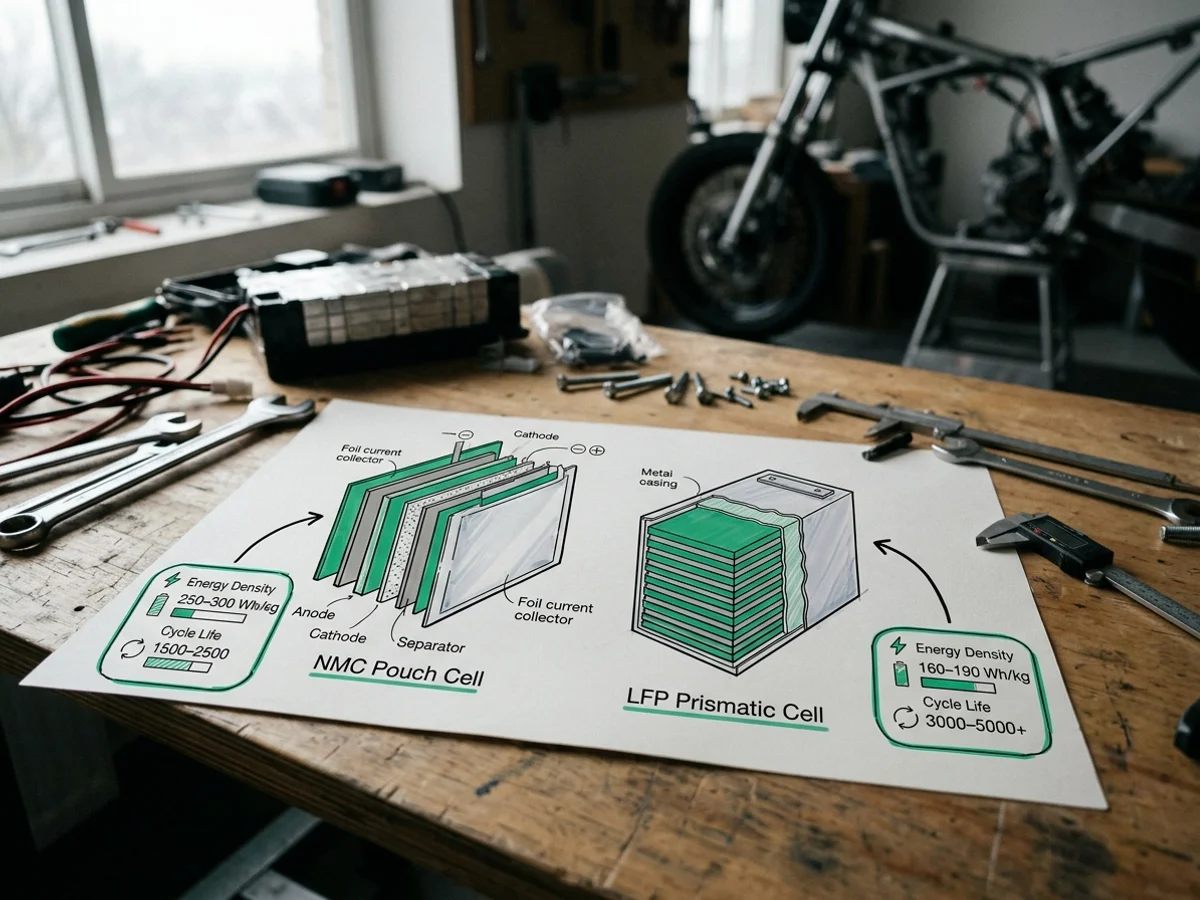
- Standard NMC pouch cells: 250 to 300 Wh/kg, suitable for mid-range urban applications
- High-density NMC and semi-solid-state cells: 300 to 400 Wh/kg, appropriate for performance and touring platforms
- Solid-state anode-free cells: 480 to 495 Wh/kg, the current frontier for maximum range-to-weight ratio
Higher energy density also reduces pack volume, which matters enormously when packaging batteries inside a motorcycle frame.
Cycle life and degradation curves
A cycle is one full charge-discharge sequence. Cycle life defines how many of those sequences a cell can complete before its capacity drops to a defined threshold, typically 80% of its original rating. That 80% retention benchmark is the industry standard for end-of-life in most OEM applications.
Chemistry has a significant impact here:
- LFP (lithium iron phosphate): 2,000 to 4,000 cycles at 80% retention, excellent for high-mileage fleet use
- NMC: 800 to 1,500 cycles depending on depth of discharge and thermal management
- Solid-state: Early commercial data suggests cycle life comparable to or exceeding NMC, with degradation curves that remain flatter for longer
Degradation is not linear. Cells lose capacity faster in the first 100 to 200 cycles, then stabilize before accelerating again near end of life. Specifying cells with conservative depth-of-discharge limits, typically 80 to 90% usable capacity, extends service life considerably.
C-rate and discharge performance
C-rate describes how quickly a cell can deliver or accept charge relative to its capacity. A 1C rate fully discharges a cell in one hour. A 5C rate does so in twelve minutes. For electric motorcycles, two figures matter most:
- Continuous C-rate: Sustained output during highway cruising or extended hill climbs
- Pulse C-rate: Peak output during hard acceleration, typically lasting two to ten seconds
A cell rated at 3C continuous and 8C pulse will handle aggressive riding profiles without thermal runaway risk. Cells with inadequate C-rate ratings overheat under load, accelerating degradation and creating safety hazards.
Operating temperature range
Cold-start performance is one of the most underspecified parameters in battery procurement. Lithium-ion cells lose significant capacity below 0°C, and some chemistries become effectively unusable below -20°C without active thermal management. For motorcycles operating in northern climates, mountain environments, or logistics corridors with wide seasonal variation, the operating temperature floor is a critical specification.
Wide-temperature-range cells, such as those rated from -43°C to 55°C, eliminate the need for supplemental heating systems in most climates, simplifying pack design and reducing parasitic power draw.
Honorable mentions: alternative electric motorcycle battery options
Not every capable electric motorcycle battery made the top five. The options below each offer genuine technical merit and suit specific use cases well, but ranked lower due to narrower application fit, limited availability, or cost-per-kWh considerations that make them less universally competitive.
Grepow shaped and custom-format cells
Grepow has built a credible reputation for producing non-standard cell geometries, which makes its offerings attractive for motorcycle OEMs working with unconventional frame architectures. Where standard prismatic or cylindrical cells create integration headaches, Grepow's shaped-cell capability can solve packaging problems that off-the-shelf options cannot. However, the trade-off is lead time and minimum order volume, which can be prohibitive for smaller brands or prototype-stage development programs. Energy density figures also trail the leading solid-state alternatives entering the market in 2026.
LFP prismatic cells for budget-conscious fleet operators
Lithium iron phosphate chemistry remains a compelling choice for operators who prioritize cycle life and thermal stability over peak energy density. According to the Clean Energy Institute at the University of Washington, LFP cells offer excellent safety characteristics and long calendar life, making them well suited to commercial fleet motorcycles that log high annual mileage. The drawback is weight: LFP's lower energy density means heavier packs for equivalent range, which limits appeal for performance-oriented builds.
Evlithium sourced NMC pouch cells
Evlithium functions primarily as a distributor rather than a manufacturer, offering NMC pouch cells sourced from various upstream producers. This can work for buyers needing smaller quantities without OEM-level commitments, but traceability and consistency between batches are legitimate concerns. For brands requiring documented cell provenance and factory-direct quality control, a direct manufacturer relationship provides stronger assurance at comparable or better specifications.
Budget options: affordable electric motorcycle batteries for cost-conscious buyers
For cost-conscious electric motorcycle buyers and OEM procurement teams, LFP (lithium iron phosphate) chemistry consistently delivers the strongest value proposition. Lower upfront cell costs, longer cycle life, and inherent thermal stability combine to produce a total cost of ownership that frequently beats premium NMC options over a three-to-five year horizon.
Why LFP dominates the budget segment
LFP has captured roughly 40% of the cost-sensitive EV battery market globally, and that share continues to grow. The chemistry's advantages are straightforward: cells tolerate deeper discharge cycles without significant degradation, require simpler thermal management hardware, and carry a lower per-kWh price point. According to the Clean Energy Institute at the University of Washington, li-ion battery prices fell approximately 20% in 2024 and a further 8% in 2025, with Asia-Pacific manufacturing scale driving much of that compression. LFP cells have benefited disproportionately from this trend.
The LFL1-100P 100Ah LFP prismatic cell: best cost-effective pick
LiTrue 100Ah High C-Rate LFP Prismatic Battery Cell is the standout recommendation in this tier. It pairs competitive cycle life with high C-rate discharge capability, making it genuinely usable in performance-oriented budget builds, not just low-demand commuter applications. Factory-direct sourcing removes distributor markups that inflate pricing on comparable cells from intermediary platforms.
Acceptable trade-offs and break-even calculation
Budget buyers should expect two meaningful trade-offs compared to premium NMC or solid-state options: higher pack weight for equivalent energy, and a modest range reduction of roughly 10 to 15% depending on pack configuration. To calculate break-even against a premium alternative, divide the price premium of the higher-spec pack by the annual fuel or charging savings it generates. For most urban and mid-range applications, LFP reaches break-even faster because its longer cycle life delays replacement costs significantly.
Entry-level solid-state consideration
Buyers who want a step up from conventional LFP without committing to flagship pricing should note that LiTrue 25Ah 480Wh/kg Anode-Free Solid-State Cell is increasingly accessible at OEM volumes. It offers meaningfully better energy density than standard LFP while remaining competitively priced relative to legacy NMC pouch cells from reseller platforms such as Evlithium or Made-in-China, where batch consistency and cell provenance are harder to verify.
Enterprise solutions: batteries for OEM electric motorcycle manufacturers
OEM electric motorcycle manufacturers operate under a fundamentally different set of constraints than individual buyers or small integrators. Volume commitments, platform scalability, regulatory compliance, and long-term supply continuity all shape sourcing decisions at this level. The right battery partner is not simply a cell supplier but a technical collaborator embedded in the product development cycle.
OEM-specific requirements and pack architecture
At production scale, the conversation shifts from individual cell specifications to complete pack-level engineering. OEM programs typically require custom form factors, integrated BMS configurations, and modular architectures that can scale across multiple motorcycle platforms without requiring a full redesign. A mid-displacement commuter and a high-performance sport model may share the same cell chemistry but demand different pack geometries, thermal management strategies, and discharge profiles.
Modular pack design is particularly valuable here. It allows manufacturers to tier their product lines using a common cell platform, reducing tooling costs and simplifying inventory management across SKUs.
CAN bus integration, thermal management, and vibration resistance
Electric motorcycle packs destined for OEM fitment must communicate reliably with vehicle control units via CAN bus protocols. This means the BMS must be co-developed or at minimum validated against the motorcycle's ECU architecture. Thermal management is equally non-negotiable: cells operating in engine bays or under-seat enclosures face sustained heat exposure that standard consumer packs are not rated for. Vibration resistance, particularly for off-road and adventure motorcycle platforms, requires robust cell-to-cell bonding, reinforced housing, and validated shock absorption at the module level.
Certifications and compliance requirements
OEM programs shipping into multiple markets must satisfy a layered compliance stack. UN38.3 covers transport safety and is a baseline requirement for any lithium cell shipment. ISO 26262 applies to functional safety in automotive-grade applications. Regional homologation, including ECE R136 in Europe and equivalent standards in North America and Asia-Pacific, adds further testing obligations. Suppliers who can provide pre-certified cells and documentation support meaningfully reduce time-to-market for OEM customers.
According to PatentPC (2024), China accounts for approximately 70% of global EV lithium-ion battery production, which reflects where the most mature OEM supply chains and cell manufacturing infrastructure currently reside.
Supply chain partnerships and long-term pricing agreements
For high-volume OEM programs, spot purchasing is rarely viable. Manufacturers need locked pricing across production runs, guaranteed allocation during supply crunches, and a supplier willing to co-invest in production roadmap alignment. This means evaluating not just current cell pricing but a supplier's capacity expansion plans, raw material sourcing strategy, and track record of fulfilling long-term contracts without quality drift.
Platforms such as Evlithium and Made-in-China can serve as useful sourcing discovery tools, but they function primarily as trading intermediaries. Batch-to-batch consistency, traceability, and direct engineering support are harder to guarantee through these channels at OEM scale.
LiTrue factory-direct OEM program
For electric motorcycle OEMs requiring both technical depth and supply chain reliability, LiTrue factory-direct program is one of the most capable options currently available. The flagship 49Ah 495Wh/kg solid-state anode-free cell (PE49N-EF) delivers an energy density that meaningfully reduces pack weight relative to conventional NMC or LFP alternatives, a critical advantage for range-optimized motorcycle platforms where every kilogram affects handling dynamics and battery placement.
Key features relevant to OEM programs include:
- 495Wh/kg energy density at the cell level, enabling lighter packs without sacrificing range targets
- Wide operating range of -43°C to 55°C, covering extreme climate deployments without supplemental heating
Conclusion: choosing the right electric motorcycle battery for your needs
Choosing the right electric motorcycle battery comes down to matching chemistry, performance specifications, and total cost of ownership to your specific application. With the global electric vehicle battery market on a trajectory that research suggests could reach USD 448.8 billion by 2034, the technology available to motorcycle manufacturers and performance riders in 2026 is genuinely transformative.
Quick verdicts: top 5 recommendations at a glance
Each battery category covered in this article serves a distinct rider or manufacturer profile:
- LiTrue solid-state anode-free cells (PE49N-EF): Best overall for premium and OEM applications requiring maximum range, extreme-temperature operation, and factory-direct customization at 495Wh/kg.
- High-rate NMC pouch cells: Best for performance riders who prioritize rapid discharge, fast charging, and aggressive power delivery over absolute range.
- Semi-solid state NMC: Best for manufacturers bridging the gap between conventional lithium-ion and full solid-state, offering strong energy density at a more accessible price point.
- LFP prismatic cells: Best for budget-conscious buyers and fleet operators where long cycle life and thermal stability outweigh the need for lightweight packaging.
- Enterprise OEM solutions: Best for motorcycle brands scaling production and requiring validated, application-specific cell configurations with full supply chain support.
The decision framework
Matching your priorities to the right chemistry simplifies what can otherwise feel like an overwhelming choice:
- Premium and range-focused riders: Solid-state anode-free technology, particularly LiTrue PE49N-EF, delivers the highest energy density currently available at the cell level.
- Performance and track riders: High C-rate NMC cells with 5C to 8C discharge capability handle sustained power demands without thermal compromise.
- Budget and fleet buyers: LFP chemistry offers the lowest cost per cycle and the most predictable long-term ownership economics.
- OEM manufacturers: Enterprise-grade partnerships with direct-from-factory sourcing eliminate intermediaries, reduce unit costs, and enable custom form factors.
Why battery choice defines the motorcycle
Range, acceleration, charging speed, cold-weather reliability, and resale value all trace back to the cell chemistry inside the pack. According to the Clean Energy Institute at the University of Washington, lithium-ion battery costs have fallen dramatically over the past decade, and that price compression is now making premium solid-state technology accessible at production scale. A battery decision made at the design stage shapes every rider experience for the life of the motorcycle.
For OEM partnerships, custom cell specifications, or technical consultation on integrating high-density solid-state cells into your next platform, contact the LiTrue engineering team directly. Factory-direct sourcing, flexible ODM capabilities, and proven performance across demanding global applications make it a practical starting point for any serious electric motorcycle program.
Faqs
How long does an electric motorcycle battery last on a single charge?
Range depends heavily on pack capacity, riding speed, terrain, and load. Most modern electric motorcycles deliver between 80 and 200 kilometers per charge, with high-density lithium-ion packs pushing beyond that threshold as energy density improves across the industry.
What is the lifespan of an electric motorcycle battery and how many miles before replacement?
Quality lithium-ion packs typically retain usable capacity for 500 to 1,000 full charge cycles, translating to roughly 50,000 to 150,000 kilometers depending on pack size and riding habits. LFP chemistry generally extends that cycle life further, often exceeding 2,000 cycles before significant degradation.
How much does it cost to replace an electric motorcycle battery?
Replacement costs vary widely by chemistry, capacity, and brand. Entry-level packs start around USD 500, while high-performance lithium-ion units for premium platforms can exceed USD 3,000. According to McKinsey & Company, battery pack prices fell 8 percent in 2025 following a 20 percent reduction in 2024, so replacement costs are trending downward.
Which battery type is best for electric motorcycles: lithium-ion, LFP, or solid-state?
Each chemistry suits different priorities. NMC lithium-ion delivers the highest energy density for long-range builds. LFP offers superior cycle life and thermal stability at lower cost. Solid-state technology, such as LiTrue 49Ah anode-free cell rated at 495Wh/kg, represents the next performance tier for OEM platforms prioritizing both range and safety.
Can I fast charge my electric motorcycle battery without damaging it?
Fast charging is safe when the battery management system and cell chemistry are designed for it. High C-rate cells, such as those rated for 5C or 8C discharge and charge, handle rapid energy transfer without accelerating degradation, provided thermal management keeps cell temperatures within the manufacturer's specified window.
How do weather and temperature affect electric motorcycle battery range?
Cold temperatures slow electrochemical reactions, reducing available capacity and range, sometimes by 20 to 40 percent in sub-zero conditions. Heat accelerates cell aging. Wide-temperature-range cells operating from -43°C to 55°C address this directly, making them practical for riders in extreme climates.
What is the difference between lead-acid and lithium-ion batteries in electric bikes and motorcycles?
The gap is substantial. According to the Clean Energy Institute, University of Washington, lithium-ion batteries achieve energy densities as high as 330 Wh/kg compared to roughly 75 Wh/kg for lead-acid, a difference that directly explains why lithium chemistries have displaced lead-acid across nearly every modern electric two-wheeler application.