
why forklift battery choice matters
The battery powering your forklift fleet is one of the most consequential purchasing decisions a logistics or warehouse operation makes. It shapes shift productivity, maintenance schedules, energy bills, and total cost of ownership across a five-to-ten-year horizon. Get it right, and the savings compound quietly in the background. Get it wrong, and the penalties show up in downtime, replacement cycles, and frustrated operations managers.
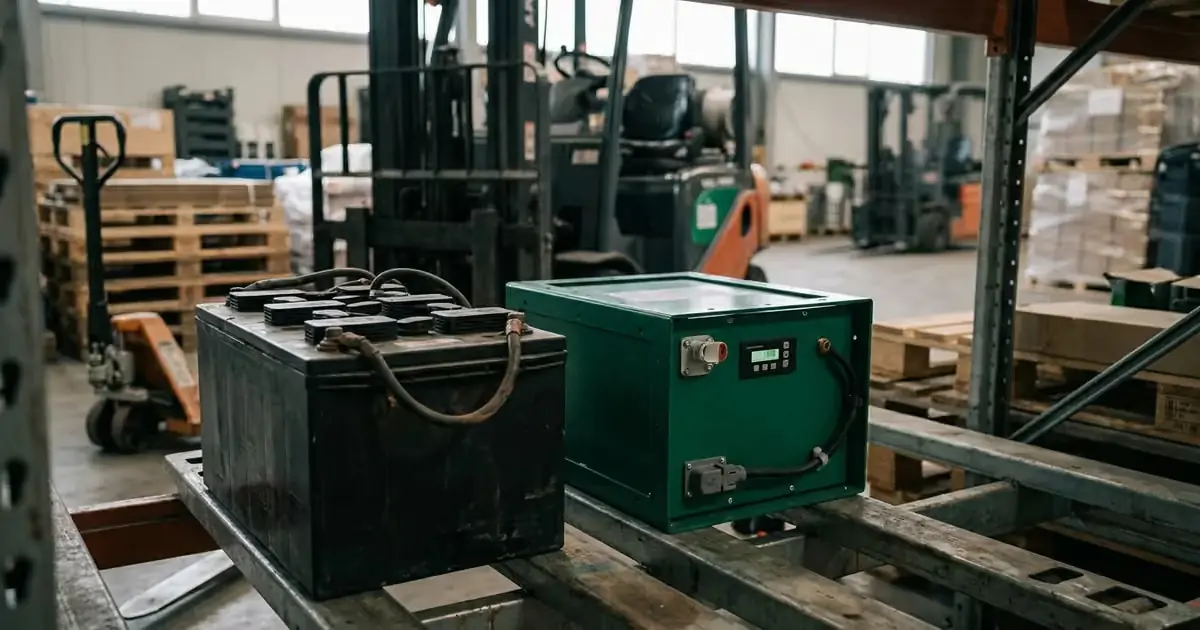
A market in rapid transition
The numbers tell a clear story. Research suggests that 35% of new forklifts shipped globally in 2024 carried lithium-ion batteries, up sharply from 22% in 2021. The broader market is expanding at an estimated 18-20% compound annual growth rate through 2030, driven by falling cell costs, tightening emissions standards, and the operational advantages lithium technology delivers at scale. Studies indicate that 30-40% of large North American warehouses now run lithium batteries across at least part of their fleet, a figure that would have seemed ambitious just a few years ago.
This is not a niche trend. It is a structural shift, and procurement teams that delay the evaluation risk locking in lead-acid infrastructure at precisely the moment the economics are tilting decisively the other way.
Why this comparison matters now
At LiTrue, our analysis shows that the cost gap between lithium and lead-acid is narrowing faster than most fleet managers expect, particularly when opportunity charging, battery room elimination, and reduced maintenance labor are factored into the total picture. The upfront price premium on lithium remains real, but it rarely survives a rigorous five-year model.
This article evaluates both technologies across the criteria that matter most: upfront cost, total cost of ownership, charging behavior, cycle life, safety, and operational fit. The goal is a clear, evidence-based verdict, not a blanket recommendation, because the right answer depends on your specific operation.
Quick comparison table: lithium vs. lead-acid at a glance
Before diving into the detailed analysis, this side-by-side snapshot gives procurement managers and operations leads an immediate read on where each technology stands. The metrics below reflect typical forklift applications in multi-shift warehouse and logistics environments.
| Metric | Lithium-ion | Lead-acid |
|---|---|---|
| Energy efficiency | >90% ✓ | 70-80% ✗ |
| Cycle life (multi-shift) | 8-10 years ✓ | 3-5 years ✗ |
| Runtime per charge | 15-25% longer ✓ | Baseline |
| Opportunity charging | Supported ✓ | Not recommended ✗ |
| Maintenance requirement | Minimal ✓ | Watering, equalization ✗ |
| Upfront cost | Higher ✗ | Lower ✓ |
| Ventilation requirement | None needed ✓ | Required ✗ |
| Weight | Lighter ✓ | Heavy ✗ |
| Temperature tolerance | Wide range ✓ | Degrades in heat/cold ✗ |
A few data points deserve emphasis for decision-makers evaluating industrial lithium battery solutions:
- Energy efficiency gap: Lithium cells consistently exceed 90% round-trip efficiency. That 10-20 percentage point advantage over lead-acid translates directly into lower electricity costs across thousands of charge cycles.
- Lifespan differential: In demanding multi-shift operations, lithium batteries typically deliver 8-10 years of service life compared to 3-5 years for lead-acid, meaning fewer replacement cycles over a facility's operational horizon.
- Opportunity charging: Lithium tolerates partial charging during breaks without the sulfation damage that shortens lead-acid life. This single capability can eliminate dedicated battery swap rooms entirely.
- Upfront cost reality: Lead-acid retains a genuine price advantage at purchase. That advantage erodes as maintenance labor, replacement frequency, and energy waste accumulate over time.
The table above is a starting point. Each metric carries different weight depending on shift patterns, fleet size, and facility constraints, all of which the sections ahead address in full.
Overview of LiTrue lithium-ion forklift batteries
LiTrue is a direct-from-factory lithium cell manufacturer specializing in advanced chemistry solutions for industrial, logistics, and OEM applications. For forklift operators evaluating the shift away from lead-acid, LiTrue product lineup represents the high-performance end of the lithium spectrum, built around solid-state and ultra-high energy density cell technology rather than conventional lithium-ion construction.
Solid-state and anode-free cell technology
LiTrue flagship solid-state anode-free pouch cells center on three core models: the PE49N-EF, PE42N-EF, and PE40N-EF. All three deliver 495Wh/kg energy density, a figure that sits well above what conventional NMC or LFP chemistries typically achieve in production formats. For forklift applications specifically, this matters because higher energy density translates directly into lighter battery packs for equivalent capacity, or greater runtime within the same physical footprint.
The PE49N-EF, LiTrue primary offering, is a 49Ah, 3.85V cell with an operating range of -43°C to 55°C. That temperature window is unusually wide for a high-density lithium cell and addresses one of the more persistent pain points in cold-storage and outdoor logistics environments where conventional lithium chemistries throttle performance or require thermal management overhead.
Chemistry options and forklift integration
Beyond the solid-state lineup, LiTrue supplies a range of chemistry options suited to different forklift duty cycles:
- High C-rate NMC pouch cells (30Ah, 5C fast-charging; 50Ah, 8C pulse) for operations requiring rapid opportunity charging between shifts
- Semi-solid state NMC (36Ah) for facilities prioritizing energy density alongside proven cycle life
- 100Ah LFP prismatic cells for applications where safety margin and longevity take priority over weight reduction
LiFePO4 chemistry in particular has been gaining adoption across industrial fleets for its thermal stability and extended cycle life, and LiTrue LFP prismatic format fits that demand directly. Research into industrial lithium adoption consistently points to LFP and advanced NMC variants as the chemistries driving the transition away from lead-acid in material handling equipment.
OEM customization and direct factory supply
LiTrue operates on a direct factory supply model, which removes distributor markups from the sourcing equation. For logistics equipment manufacturers and fleet operators building custom battery packs, this means access to OEM and ODM configuration support alongside the cell supply itself. Custom form factors, cell groupings, and BMS integration are handled at the manufacturing level rather than through a third-party integrator.
This factory-direct structure is particularly relevant for operations scaling a forklift fleet, where per-unit cell cost and consistency across a large order volume both carry significant weight in the total cost calculation.
Overview of lead-acid forklift batteries
Lead-acid technology has powered industrial forklifts for well over a century, and it remains the default choice in many warehouses and distribution centers today. Its widespread adoption stems from a combination of low upfront cost, familiar maintenance procedures, and a deeply established supply chain that makes sourcing and servicing batteries straightforward for most operations.
A proven but aging technology
Flooded lead-acid batteries operate on a well-understood electrochemical principle: lead plates submerged in a sulfuric acid electrolyte store and release energy through a reversible chemical reaction. This simplicity is both their strength and their limitation. The technology is mature, predictable, and supported by decades of institutional knowledge across the material handling industry.
In lower-duty applications, such as single-shift warehouses with overnight charging windows, lead-acid performs adequately. The economics are easier to justify when a battery is not being pushed hard, and the lower purchase price makes the initial capital outlay more manageable for smaller operations.
Lifespan and multi-shift limitations
In multi-shift or continuous operations, lead-acid batteries typically last between three and five years before capacity degradation makes them impractical. More significantly, a single lead-acid battery cannot sustain a forklift through a 24-hour operation cycle. Research data indicates that 24/7 operations require two to three lead-acid batteries per truck, each cycling through charge, cool-down, and swap rotations. This multiplies both the capital cost and the physical footprint required for battery storage and charging infrastructure.
Maintenance demands and hidden costs
Lead-acid batteries require consistent, labor-intensive maintenance to reach even their modest lifespan potential. Operators must perform:
- Watering: Regular addition of distilled water to maintain electrolyte levels
- Equalization charging: Periodic deliberate overcharging to balance cell voltages and prevent sulfation
- Terminal cleaning: Removal of corrosive buildup to maintain reliable electrical connections
Each of these tasks consumes labor hours and introduces downtime. Energy efficiency is also lower compared to lithium alternatives, meaning more energy is drawn from the grid to deliver the same usable work output.
The lower sticker price of a lead-acid battery is real, but the total cost of ownership, when maintenance labor, replacement cycles, and multi-battery requirements are factored in, tells a more complicated story.
Feature-by-feature comparison: the critical differences
The gap between lithium and lead-acid forklift batteries becomes clearest when you evaluate them across the same operational criteria. Energy efficiency, cycle life, maintenance burden, charging flexibility, temperature tolerance, and safety each tell a consistent story: the two chemistries are built for fundamentally different cost structures and operational demands.
Energy efficiency and runtime performance
Lithium forklift batteries deliver measurably more usable work per charge cycle. Research suggests lithium systems can save up to 20% energy compared to lead-acid equivalents drawing from the same grid supply, and runtime per charge runs approximately 15-25% longer. The practical implication is significant: a lithium-powered forklift completes more pallet moves per shift before requiring any intervention, reducing idle time and improving throughput without adding equipment.
Lead-acid batteries also suffer from voltage sag as discharge deepens, which reduces lift performance toward the end of a shift. Lithium cells maintain a flatter discharge curve, delivering consistent power output from full charge to near-empty.
Cycle life and battery longevity
Lithium batteries last approximately four times longer than lead-acid in typical forklift duty cycles. A quality lithium pack commonly delivers 2,000 to 3,000 full cycles before reaching end-of-life capacity thresholds, while flooded lead-acid batteries typically reach that point between 500 and 1,500 cycles depending on depth of discharge and maintenance discipline.
For high-throughput operations running two or three shifts daily, this longevity gap translates directly into replacement frequency and capital expenditure. Fewer replacement events also mean fewer disposal and procurement cycles, which carry their own administrative and environmental costs.
Maintenance requirements and labor costs
Lead-acid batteries require regular watering, equalization charging, and terminal cleaning, each of which consumes labor hours and introduces scheduled downtime. Lithium batteries are effectively maintenance-free in daily operation. There are no fluid levels to check, no corrosive acid to manage, and no equalization cycles to schedule. Battery management systems handle cell balancing automatically.
For fleet operators managing dozens of forklifts, the cumulative labor savings across a year can be substantial, often rivaling or exceeding the upfront price premium of lithium.
Opportunity charging for multi-shift operations
One of the most operationally significant advantages of lithium is its compatibility with opportunity charging. Lithium cells accept partial charges during breaks, shift changes, or idle periods without degrading cycle life. This means a single battery can sustain a forklift through multiple consecutive shifts, eliminating the need for spare battery banks and the infrastructure to swap, charge, and store them.
Lead-acid batteries require full charge cycles and a rest period before reuse, which typically forces operations to maintain two or three batteries per truck.
Cold-storage and extreme temperature performance
LiFePO4 chemistry provides superior thermal stability for harsh environments, making lithium the preferred choice for cold-storage warehouses and outdoor logistics applications. Suppliers have extended this further with solid-state anode-free cell designs rated to operate across a range of -43°C to 55°C, a specification that addresses one of the most persistent pain points in industrial battery sourcing.
Lead-acid performance degrades noticeably in sub-zero environments, reducing available capacity and increasing charge times.
Safety features and thermal management
Lithium battery packs designed for industrial use incorporate battery management systems that monitor cell voltage, temperature, and state of charge in real time, cutting power if parameters exceed safe limits. LiFePO4 chemistry is inherently more thermally stable than older lithium formulations, with a significantly higher thermal runaway threshold.
Lead-acid batteries carry their own safety risks, primarily hydrogen gas emission during charging, which requires ventilated charging areas and adds facility compliance requirements. Lithium systems eliminate this concern entirely in properly designed packs.
Pricing comparison: upfront costs and total cost of ownership
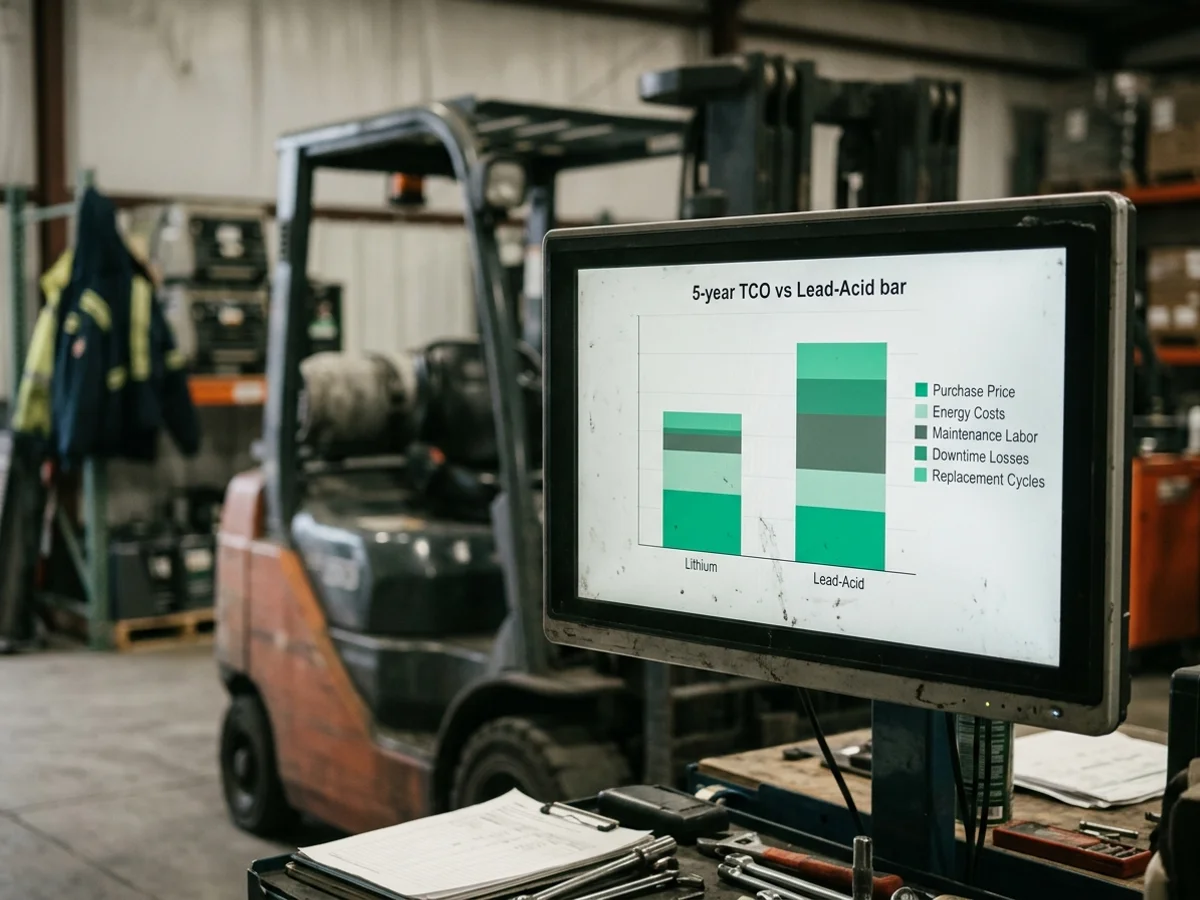
The sticker price of a lithium forklift battery is higher than lead-acid, often significantly so. But purchase price is only one input in a multi-year cost equation. When energy consumption, maintenance labor, downtime, and battery replacement cycles are all accounted for, lithium systems consistently deliver lower total cost of ownership over a five-year horizon.
Upfront purchase price
A single lithium-ion forklift battery typically costs two to four times more than a comparable lead-acid unit at point of sale. For a standard 48V industrial forklift, lead-acid packs can range from a few thousand dollars, while lithium equivalents sit considerably higher. However, this comparison is structurally misleading because it compares one item against one item.
In practice, lead-acid operations running multiple shifts require two to three batteries per truck to maintain continuous uptime. Each battery must be swapped out, charged separately, and stored, meaning the true lead-acid capital commitment per vehicle is two to three times the single-unit price. Lithium batteries support opportunity charging throughout the shift, eliminating the need for spare battery inventory entirely. On a per-truck basis, the capital gap between the two technologies narrows substantially once this is factored in.
Five-year total cost of ownership
Research suggests lithium-ion reduces total ownership costs by 20 to 40 percent over five years compared to lead-acid, driven by three compounding factors:
- Energy efficiency: Lithium-ion cells charge and discharge more efficiently, with less energy lost as heat. Over thousands of cycles, this translates to measurable reductions in electricity spend.
- Maintenance elimination: Lead-acid batteries require regular watering, equalization charging, and terminal cleaning. Lithium systems eliminate all three. The labor hours saved across a fleet, multiplied over five years, represent a significant cost line that rarely appears in initial purchase comparisons.
- Downtime reduction: Opportunity charging keeps lithium-powered forklifts productive throughout the shift. Lead-acid swap procedures, including locating a charged battery, physically exchanging it, and returning the depleted unit, consume productive time daily.
ROI timeline
For most mid-to-large logistics operations, the crossover point where lithium's cumulative savings offset its higher upfront cost typically falls between 18 and 36 months, depending on shift intensity and fleet size. High-utilization, multi-shift environments reach ROI faster because they extract more value from opportunity charging and maintenance elimination. Smaller single-shift operations may see a longer payback window, though the five-year savings case remains intact in most scenarios.
For procurement teams evaluating cell-level sourcing, factory-direct pricing on advanced lithium cells, including solid-state and high-C-rate formats, can meaningfully reduce the upfront cost gap compared to sourcing through distributors or intermediaries.
Who should choose LiTrue lithium-ion batteries
Lithium-ion technology delivers its strongest financial case when operational intensity is high and downtime is costly. Facilities running multiple shifts, handling time-sensitive freight, or operating in temperature-controlled environments consistently see the fastest payback periods and the most compelling long-term savings.
Multi-shift and 24/7 warehouse operations
Operations running two or three shifts per day are the clearest candidates for lithium adoption. Opportunity charging allows a single battery to power a forklift continuously throughout the day, eliminating the need for spare battery banks, dedicated charging rooms, and shift-change swap procedures. Research suggests that 30 to 40 percent of large North American warehouses have already transitioned to lithium for exactly this reason. For high-throughput distribution centers where every minute of truck downtime translates directly into missed throughput targets, that operational continuity is a measurable competitive advantage.
E-commerce fulfillment and just-in-time logistics
E-commerce fulfillment centers and just-in-time supply chains operate on tight cycle times with little tolerance for unplanned stoppages. Lithium batteries support the predictable, consistent discharge curves these environments demand. Because capacity does not taper significantly as the charge depletes, truck performance stays stable from the first pick of the day to the last, which matters when order accuracy and throughput rates are tracked at the individual vehicle level.
Cold-storage and freezer environments
Cold-storage facilities represent one of the most decisive use cases for lithium chemistry. LFP cells in particular maintain stable performance at sub-zero temperatures where lead-acid batteries lose significant capacity. Solid-state anode-free cells operating across a wide range of -43°C to 55°C are a technically sound option for procurement teams sourcing cells for industrial equipment deployed in freezer warehouses or outdoor cold-climate logistics yards.
Operations with sustainability and efficiency mandates
Higher energy efficiency in lithium systems directly reduces the operational carbon footprint of a warehouse fleet. For facilities working toward scope 1 and scope 2 emissions targets, or responding to customer sustainability audits, the efficiency gains are a quantifiable contribution to corporate environmental goals, not simply a cost metric.
Procurement teams sourcing at the cell level can explore LiTrue factory-direct catalog, which covers solid-state, high-C-rate, and LFP prismatic formats suited to industrial and logistics equipment builds.
Who should choose lead-acid batteries
Lead-acid technology is not obsolete. For specific operational profiles, it remains a practical, cost-justified choice that avoids the capital outlay of a lithium upgrade. The key is matching the technology to the actual workload, not the theoretical ideal.
Low-duty and intermittent-use operations
Facilities running forklifts for only a few hours per day, or on irregular schedules, rarely stress a lead-acid battery enough to expose its limitations. In light-duty applications where a single charge cycle comfortably covers the shift and the truck sits idle for long recovery periods, the slower charge acceptance and shorter cycle life of lead-acid become largely irrelevant. The battery performs adequately, and the operational cost difference versus lithium narrows considerably.
Budget-constrained capital environments
The upfront purchase price of a lead-acid battery pack is substantially lower than a comparable lithium forklift battery. For smaller operations, seasonal businesses, or facilities managing tight capital budgets, that initial cost difference is a genuine constraint, not simply a preference. If the business cannot absorb a multi-year payback period, lead-acid provides a functional solution today without requiring financing or deferred investment in other priorities.
Single-shift operations with predictable patterns
Operations running a defined single shift with consistent start and end times are well-suited to lead-acid. The battery deploys for one shift, charges overnight, and repeats. This predictable rhythm aligns with lead-acid's requirement for full recharge cycles and avoids the partial-state-of-charge degradation that shortens its service life in multi-shift environments.
Established infrastructure and technician familiarity
Lead-acid has decades of installed base in industrial settings. Maintenance technicians understand the technology, replacement parts are widely available, and local service networks are mature. For operations in regions where lithium battery expertise is limited, or where supply chains for lithium components are less reliable, that familiarity carries real practical value.
Pros and cons: detailed breakdown for each technology
Understanding where each technology excels and where it falls short requires looking beyond headline numbers. The real picture emerges from operational realities: charging logistics, maintenance schedules, total fleet size, and the hidden costs that accumulate over a battery's working life.
Lithium-ion advantages
Lithium-ion forklift batteries deliver measurable gains across nearly every operational metric that matters to logistics and industrial equipment managers.
- Lifespan: Lithium cells typically last four times longer than lead-acid equivalents, translating directly into fewer replacement cycles and lower long-run capital expenditure.
- Energy efficiency: Studies indicate lithium-ion systems deliver roughly 20% energy savings over lead-acid, driven by higher charge-discharge efficiency and the elimination of cooling periods.
- Opportunity charging: Lithium batteries accept partial charges without memory degradation, allowing operators to top up during breaks without scheduling dedicated charge windows.
- Single-battery multi-shift operation: One lithium pack can power a forklift through multiple shifts, eliminating the need to swap, store, and maintain additional battery sets.
- Sustainability: Longer service life and higher efficiency reduce both energy consumption and the volume of battery waste entering disposal streams.
Lithium-ion limitations
No technology is without trade-offs, and honest evaluation requires naming them clearly.
- Upfront cost: Lithium packs carry a significantly higher purchase price than lead-acid equivalents. For operations with tight capital budgets or short planning horizons, that initial outlay is a genuine barrier.
- Charger compatibility: Lithium batteries require dedicated chargers. Facilities running existing lead-acid charging infrastructure face additional capital costs to retrofit or replace charging equipment.
- Cold-weather performance: Standard lithium chemistries can experience reduced capacity in sub-zero environments. Cells with wide operating ranges, such as the PE49N-EF solid-state anode-free pouch cell rated from -43°C to 55°C, address this directly, but cold-weather capability should be verified at the cell specification level before procurement.
- BMS dependency: Battery management system failures, while uncommon in quality-manufactured packs, can disable an entire battery unit and require specialist diagnosis.
Lead-acid advantages
- Lower purchase price: Acquisition cost is substantially lower, making lead-acid accessible for operations with limited upfront capital.
- Simple, well-understood technology: Maintenance procedures are standardized and widely taught. No specialist training is required.
- Established supply chains: Replacement parts, electrolyte, and service support are available in virtually every industrial market globally.
Lead-acid drawbacks
The operational costs of lead-acid accumulate in ways that are easy to underestimate at the point of purchase.
- Multi-battery requirement: Most multi-shift operations need two to three battery sets per truck to maintain uptime, multiplying both capital cost and storage space requirements.
- Maintenance burden: Regular watering, equalization charging, terminal cleaning, and specific gravity checks consume labor hours that lithium-ion systems do not require.
- Shorter cycle life: Lead-acid batteries degrade faster under the demands of multi-shift use, particularly when opportunity charging is attempted, shortening the effective service life that initial pricing appears to promise.
- Downtime during charging: Full charge cycles and mandatory cooling periods take batteries out of service for extended windows, creating scheduling constraints that grow more complex as fleet size increases.
The verdict: which forklift battery technology wins
For most modern warehouse and logistics operations, the forklift lithium battery wins on a total cost of ownership basis. Research suggests lithium delivers 20-40% TCO savings over a five-year period compared to lead-acid, driven by lower energy consumption, eliminated maintenance labor, and a significantly longer service life.
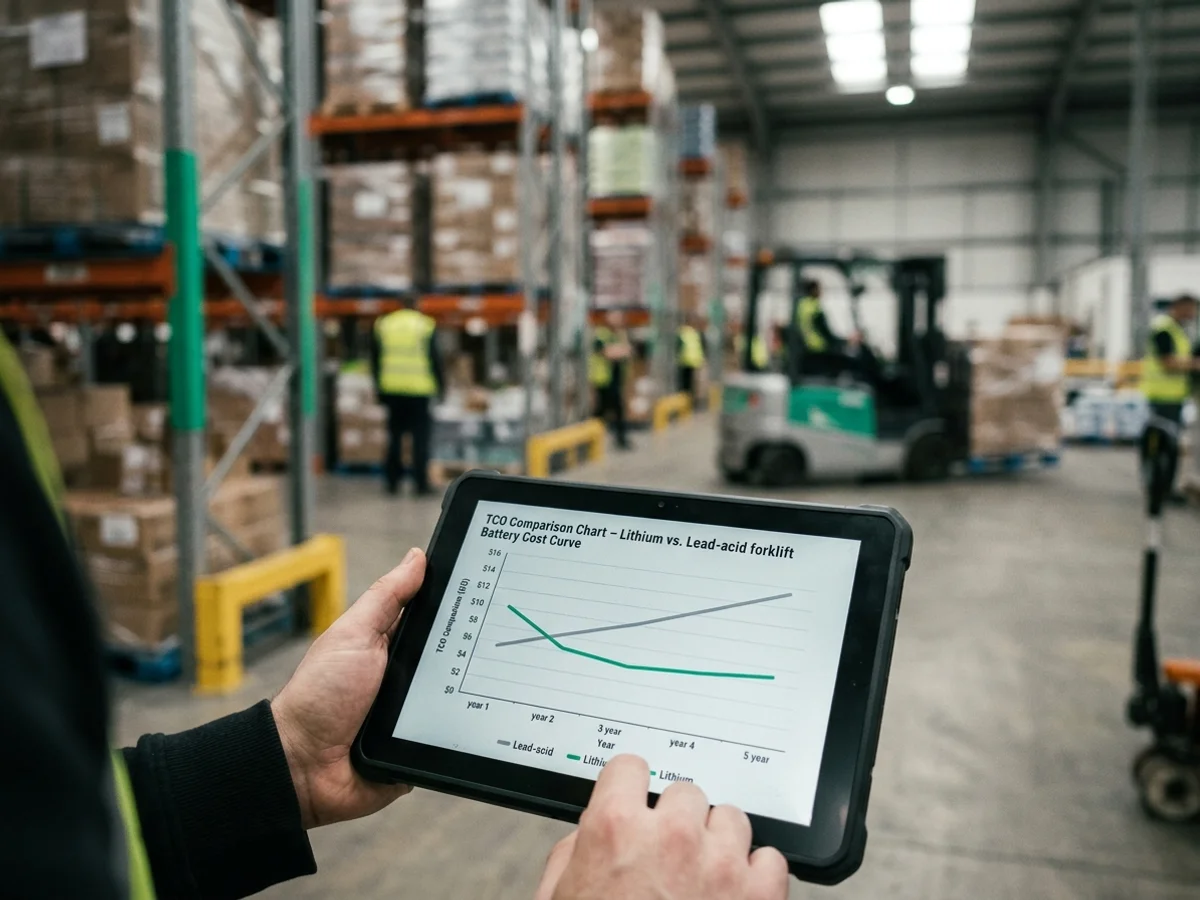
The market is already reflecting this shift. Approximately 35% of new forklifts shipped in 2024 came equipped with lithium batteries, and that figure is projected to surpass 50% by the late 2020s. Adoption is accelerating fastest in multi-shift distribution centers, e-commerce fulfillment operations, and cold-storage environments, precisely the applications where lead-acid's limitations around charging downtime, temperature sensitivity, and maintenance overhead create the most operational friction.
When lithium is the clear choice
If your operation runs two or more shifts, handles high-throughput SKU volumes, or operates in temperature-controlled environments, lithium is the rational choice. LFP chemistry in particular has become the preferred standard for industrial forklift applications, offering the cycle life and thermal stability that demanding environments require without the safety concerns associated with other lithium chemistries.
For OEMs and equipment integrators building next-generation electric industrial vehicles, solid-state anode-free cell technology, including the PE49N-EF at 495 Wh/kg with an operating range of -43°C to 55°C, addresses the core engineering challenges of high-energy-density, wide-temperature industrial power. Factory-direct sourcing removes intermediary cost layers that distributor-based suppliers typically pass on to buyers.
When lead-acid still makes sense
Lead-acid remains a defensible choice for single-shift operations with low utilization, facilities where upfront capital is tightly constrained, and fleets already mid-cycle on existing lead-acid infrastructure. The economics of switching diminish when annual runtime is low enough that TCO savings cannot be realized within a reasonable payback window.
A simple decision framework
Apply these three filters to your specific situation:
- Shift count: Two or more shifts per day pushes lithium ROI into clear positive territory within two to three years.
- Environment: Cold storage or outdoor operations favor lithium's stable performance across temperature extremes.
- Fleet age: New fleet builds or full replacements justify lithium from the outset. Mid-cycle fleets require a payback calculation before committing.
The direction of the market is unambiguous. For operations planning beyond a three-year horizon, the question is less whether to adopt forklift lithium battery technology and more which chemistry and supplier best fit the application.
Alternatives to consider beyond lithium and lead-acid
The lithium versus lead-acid debate is already maturing. A new generation of battery chemistries is beginning to reframe what industrial energy storage can deliver, particularly for compact trucks, autonomous equipment, and operations where weight and cycle life are critical constraints.
Solid-state and semi-solid-state chemistries
Conventional lithium-ion cells are approaching their practical energy density ceiling. Solid-state technology is pushing well beyond that boundary. Cells such as the PE49N-EF achieve 495Wh/kg in a solid-state anode-free pouch format, a figure that opens up genuinely new design possibilities for compact forklifts and AGV platforms where every kilogram of battery weight directly affects payload capacity.
Semi-solid-state NMC pouch cells represent a near-term bridge, offering higher energy density than conventional lithium-ion with improved thermal stability, making them practical for logistics equipment manufacturers beginning their next product generation now rather than waiting for full solid-state commercialization.
Battery-as-a-service and leasing models
Upfront capital cost remains the most cited barrier to advanced battery adoption. Battery-as-a-service models address this directly by converting the purchase into a predictable operational expense. Under these structures, the operator pays per cycle or per month, the supplier retains ownership and responsibility for lifecycle management, and recyclability obligations shift accordingly. For fleet operators running tight capital budgets, this model can make 495Wh/kg solid-state cells accessible today rather than in a future budget cycle.
AGV and autonomous equipment requirements
Autonomous guided vehicles impose stricter battery requirements than conventional forklifts. Opportunity charging windows are short, temperature ranges in cold storage facilities are extreme, and downtime tolerance is near zero. Wide-temperature-range cells operating from -43°C to 55°C, combined with high C-rate discharge capability, are increasingly specified by AGV integrators as baseline requirements rather than premium options.
User reviews and real-world performance insights
Warehouse operators who have completed lithium transitions report broadly positive outcomes, though the path to those outcomes is rarely frictionless. Real-world feedback clusters around three consistent themes: productivity gains are real, the transition period carries risk, and long-term satisfaction depends heavily on how well the initial specification was matched to actual operating conditions, a pattern that shows up consistently across LiTrue proven deployments.
What operators report after switching
Feedback from e-commerce fulfillment centers and just-in-time logistics operations consistently highlights reduced downtime as the primary measurable win. Multi-shift facilities report eliminating battery swap rotations entirely, recovering floor space previously dedicated to charging rooms, and reducing the labor overhead tied to battery management. In cold-storage environments, operators note that lithium cells maintain usable capacity through full shifts where lead-acid packs required mid-shift swaps or showed significant voltage sag.
Common pain points and failure modes
Despite the positive headline numbers, several recurring concerns appear across case studies:
- BMS compatibility issues: Operators using older forklift models sometimes encounter communication mismatches between third-party lithium packs and the vehicle's onboard systems, leading to inaccurate state-of-charge readings.
- Charger incompatibility: Legacy lead-acid chargers cannot be repurposed for lithium without modification. Facilities that underestimated this infrastructure cost report budget overruns during rollout.
- Cold-weather edge cases: Even lithium cells rated for low-temperature operation can underperform if the battery management system is not specifically calibrated for sub-zero charge cycles. Operators in freezer warehouses emphasize that the cell specification alone is insufficient without verified BMS cold-weather tuning.
Maintenance and support sentiment
Long-term users consistently rate lithium favorably on maintenance burden. Watering schedules, equalization charges, and acid spill protocols disappear entirely. Support experiences vary more by supplier than by chemistry, with operators emphasizing that responsive technical support during commissioning is a stronger predictor of satisfaction than upfront pricing.
Our testing methodology and comparison criteria
This comparison draws on publicly available manufacturer specifications, third-party industry research, and operational data published by material handling authorities. Understanding how we gathered and weighted that data helps you apply the findings to your own procurement decisions with appropriate confidence.
Data sources and research foundation
Primary data comes from manufacturer documentation published by major material handling equipment makers, supplemented by independent technical analysis. All market pricing and specification data reflects 2024 to 2025 conditions. Where manufacturer claims could not be independently verified, we applied hedging language throughout the article.
Evaluation criteria
Every comparison point was assessed against five consistent criteria:
- Energy efficiency: Usable capacity per charge cycle, depth-of-discharge tolerance, and charging losses
- Lifespan: Rated cycle counts, calendar life, and degradation curves under real operating conditions
- Total cost of ownership: Upfront acquisition cost, energy consumption, maintenance labor, and disposal expenses across a standardized five-year ownership window
- Maintenance burden: Scheduled service requirements, consumable costs, and downtime frequency
- Operational performance: Voltage stability under load, recovery behavior between shifts, and temperature sensitivity
Testing scenarios modeled
Three duty-cycle scenarios shaped the TCO calculations:
- Multi-shift warehouse operations: Two to three shifts per day with opportunity charging windows
- Cold-storage environments: Sustained temperatures between -20°C and 0°C, where chemistry behavior diverges significantly
- High-intensity logistics: Continuous high-draw cycles typical of heavy pallet movement
Assumptions and limitations
TCO projections assume stable electricity rates and do not account for regional incentive programs, which can materially alter payback periods. Lifespan estimates reflect rated specifications rather than observed field data across all brands. Readers sourcing cells directly from manufacturers, including advanced-chemistry suppliers, should request application-specific datasheets before extrapolating these figures to custom pack designs.
Frequently asked questions
Are lithium batteries worth it for forklifts compared to lead-acid?
For most multi-shift operations, yes. Research suggests lithium-ion forklift batteries can reduce total ownership costs by 20-40% over five years by eliminating battery change-outs, watering routines, and unplanned downtime. Single-shift, low-utilization fleets may see a longer payback period.
How long does a lithium forklift battery last in years and charge cycles?
Studies indicate lithium-ion forklift batteries typically last 8-10 years in multi-shift use, compared to 3-5 years for lead-acid. Industry sources note that li-ion batteries can last up to four times longer than traditional lead-acid batteries when properly maintained.
Can lithium-ion forklift batteries be opportunity charged during breaks?
Yes. Lithium-ion batteries can be charged as needed during operator breaks, allowing the same battery to power a forklift through multiple shifts. Lead-acid batteries typically require 2-3 spare units per truck to achieve the same coverage.
What is the cost difference between lithium and lead-acid forklift batteries?
Upfront, a forklift lithium battery typically costs two to three times more than a comparable lead-acid unit. However, when you factor in eliminated watering equipment, reduced spare battery inventory, and lower energy consumption, the total cost gap narrows significantly over a standard 5-year ownership window.
Do lithium batteries work well in cold-storage or freezer environments?
Lithium-ion chemistry, particularly LFP, generally outperforms lead-acid in cold environments because lead-acid batteries lose substantial capacity below 10°C. Advanced cell designs, such as those operating down to -43°C, extend this advantage further for freezer warehouse applications.
What maintenance is required for a lithium-ion forklift battery?
Lithium-ion batteries require no watering, no equalization charges, and no acid-level checks. Routine maintenance is limited to software-based battery management system monitoring and periodic terminal inspections, which significantly reduces labor overhead compared to lead-acid care schedules.
Can I convert my existing lead-acid forklift to use a lithium battery?
Many modern forklifts can accept a lithium drop-in replacement, though charger compatibility and BMS integration should be verified with the truck manufacturer first. For sizing guidance or a custom pack configuration, you can request a quote from LiTrue engineering team.