
A procurement engineer contacted us with a familiar problem: after weeks of qualifying a supplier that claimed to offer “custom” pouch cells, the team discovered at the sample stage that the factory could not change the cell dimensions, voltage, or discharge rate. The available options were relabeled catalog cells, and the project timeline slipped.
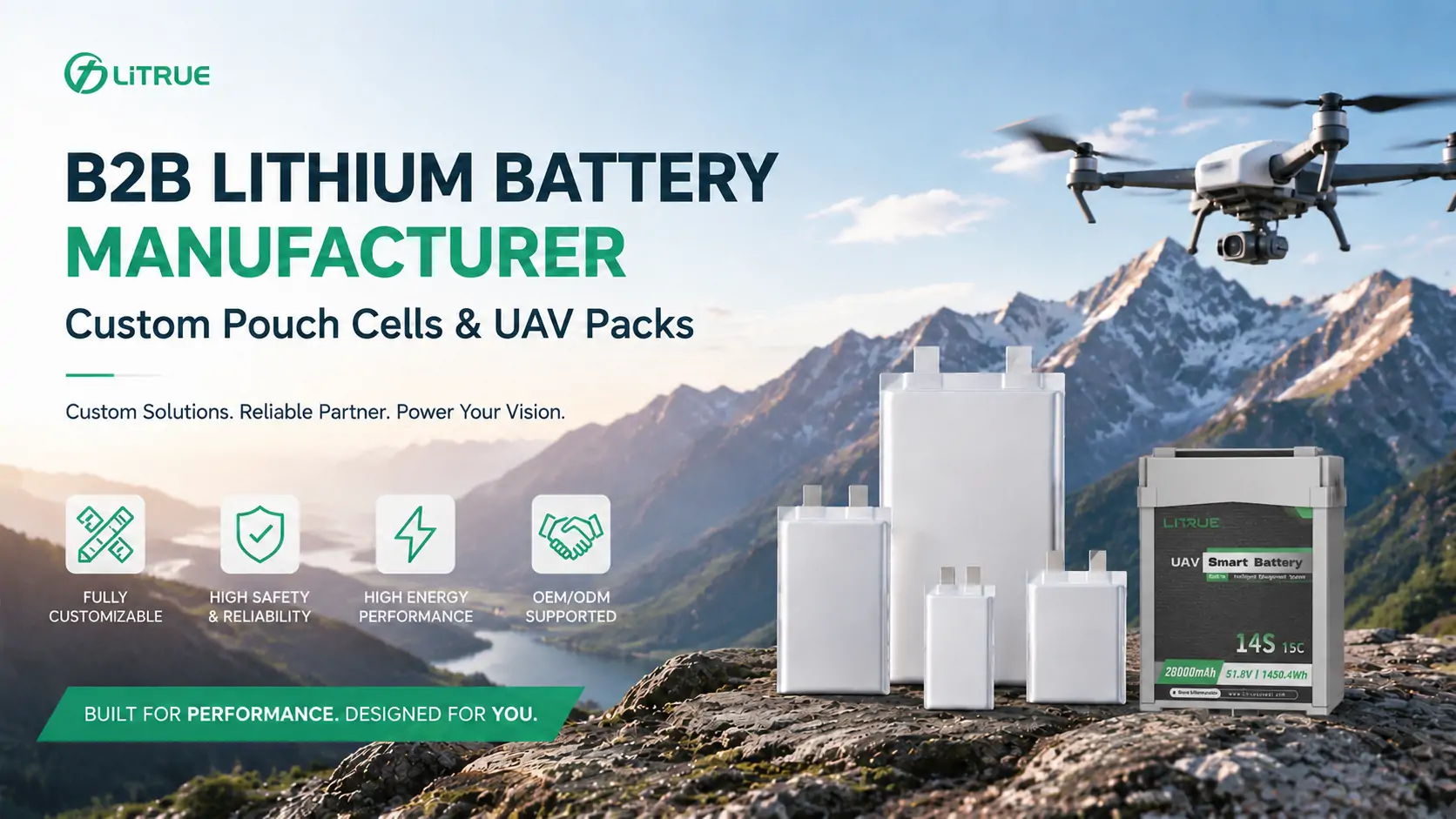
This is an expensive risk in custom battery sourcing. Many suppliers describe themselves as a B2B lithium battery manufacturer, but far fewer can engineer a cell or a battery pack around a defined specification instead of asking the buyer to redesign around a fixed product. If you are sourcing custom pouch cells or battery packs for UAVs, robotics, industrial equipment, or another OEM project, confirm the engineering scope before committing tooling cost or a production schedule.
Why Off-the-Shelf Batteries Break Custom Projects
A standard catalog pouch cell can be suitable when its voltage, dimensions, current capability, and life-cycle requirements already match the design. In a custom project, however, those compromises often appear at system level: capacity is reduced to fit an enclosure, discharge power is insufficient at peak load, or a pack cannot communicate with the host equipment.
A true OEM-capable manufacturer starts with the application constraints: physical dimensions, target voltage, capacity, continuous and peak current, operating temperature, tab configuration, communication requirements, and certification needs. The final cell or pack should be engineered around those constraints rather than treated as a cosmetic variation of a fixed catalog item.
Custom Pouch Cells: What “Customizable” Should Actually Mean
When evaluating a manufacturer, “custom” should mean more than a private label or outer-package change. At minimum, a capable B2B partner should be able to review the following parameters against the application requirement.
| Parameter | What should be reviewed or customized | Why it matters |
|---|---|---|
| Cell dimensions | Length, width, thickness, tab position, and allowable tolerances | The cell must fit the enclosure and assembly process without creating compression or clearance issues. |
| Capacity and voltage | Ah rating, nominal voltage, charge cutoff, discharge cutoff, and series-parallel configuration | These values determine pack energy, charger compatibility, BMS settings, and system voltage. |
| Discharge rate | Continuous current, pulse current, pulse duration, and test temperature | A headline C-rate is not useful unless it supports the real load profile without excessive voltage sag. |
| Tab configuration | Aluminum or copper tabs, plating, tab length, width, thickness, and position | Tab design affects resistance, welding, pack layout, and high-current reliability. |
| Chemistry | LFP for cycle life and thermal stability, or NMC for higher energy density | The right chemistry depends on the application safety, weight, range, power, and cycle-life priorities. |
This flexibility is especially important in applications where every gram and millimeter matter, including drones, robotics, e-motorcycles, medical equipment, and portable industrial tools. Review LiTrue high-rate NMC and LFP pouch cells to compare available cell platforms before defining a custom design.

Custom Voltage Output Pouch Cells: What Can Be Designed?
“Custom voltage output pouch cells” is often used as shorthand for a custom battery solution, but it is important to distinguish cell voltage from pack voltage. A standard NMC cell is commonly around 3.6 V to 3.7 V nominal, while an LFP cell is commonly around 3.2 V nominal. The required system voltage is usually achieved by connecting cells in series; parallel strings increase capacity and current capability without changing voltage.
| Design input | What the engineering team confirms | Example question for the buyer |
|---|---|---|
| Target system voltage | Cell chemistry, series count, nominal voltage, full-charge voltage, and lower cutoff | Does your equipment require a nominal 24 V, 48 V, 51.2 V, or another voltage platform? |
| Energy requirement | Required Wh, capacity in Ah, usable depth of discharge, and expected runtime | How long must the system operate between charges at its normal load? |
| Power requirement | Continuous current, peak current, pulse duration, voltage sag, and thermal margin | What is the highest current during start-up, lift-off, acceleration, or other peak operation? |
| Mechanical interface | Maximum dimensions, weight, tab layout, connector, mounting, and enclosure constraints | What space is available for the cell or finished pack? |
For example, a 14S NMC pack based on 3.7 V nominal cells is approximately 51.8 V nominal and 58.8 V at full charge. A 16S LFP pack based on 3.2 V nominal cells is approximately 51.2 V nominal and 58.4 V at full charge. The charger, BMS, cables, connectors, and connected equipment must be rated for the real full-charge voltage—not only the nominal system label. For the cell-level calculation, see this NMC pouch cell voltage guide.
OEM Pouch Cells for Industrial and UAV Applications
OEM pouch-cell requirements are not the same across industries. A drone may prioritize energy density and high-rate discharge. A robot may need a compact pack with CAN communication and predictable cycle life. Medical or portable industrial equipment may prioritize dimensions, low self-discharge, documentation, and a stable production configuration.
| Application | Typical battery priorities | Key specification to provide |
|---|---|---|
| UAV and commercial drones | High energy density, continuous and pulse power, low mass, thermal performance | Flight load, peak current, target flight time, pack weight, telemetry protocol |
| Robotics and AGVs | Cycle life, steady power, compact packaging, CAN or SMBus communication | Duty cycle, charger interface, communication requirement, expected daily cycles |
| Industrial equipment | Reliability, temperature range, enclosure protection, serviceability | Operating environment, vibration, dimensions, continuous and peak load |
| Portable and medical equipment | Stable output, compact dimensions, compliance documentation, long storage life | Runtime, device voltage, allowable dimensions, applicable regulatory requirements |
For high-rate applications, product selection should be based on verified current capability and voltage-sag data rather than capacity alone. LiTrue 50Ah high-rate NMC pouch cell for UAV and industrial battery packs is one example of a high-power cell platform; engineering review is still required to confirm compatibility with a specific pack design.
UAV Battery Packs: Beyond the Cell
A drone battery pack is where cell-level customization either delivers value or fails in the field. Integrating cells into a functional pack requires system-level engineering beyond a cell datasheet.
- Smart BMS integration: voltage and current protection plus SMBus or CAN communication when the flight controller or host system needs reliable battery telemetry.
- Thermal management: internal layout and heat paths that reduce hot spots during high-C-rate spraying, lifting, or sustained hover.
- Mechanical protection: a shock- and vibration-resistant housing suited to actual field operation.
- Energy density: a cell and pack architecture that extends flight time without adding excessive payload weight.
- Service and charging strategy: connectors, charging limits, fault protection, and replacement procedures designed for the operator workflow.
If a supplier only sells loose cells and leaves the pack engineering to the buyer, the buyer assumes the integration risk. That risk often appears as early field failures rather than sample-stage issues. Explore LiTrue custom UAV battery systems and read this drone battery selection guide for an application-level selection guide.
Low-MOQ Custom Battery Development Process
Low MOQ does not mean that every cell design can be manufactured economically in any quantity. It means the supplier should clearly separate prototype requirements from mass-production requirements and explain where tooling, material sourcing, testing, and certification affect the minimum order. A transparent development process prevents late-stage surprises.
- Requirements review: confirm voltage, Wh, current, dimensions, temperature, communications, expected cycle life, application, annual volume, and destination market.
- Cell and pack proposal: select chemistry, series-parallel configuration, cell dimensions, BMS protection settings, connectors, and enclosure approach.
- Prototype build and testing: evaluate fit, charge/discharge behavior, temperature rise, communication, and application-level performance.
- Design confirmation: freeze drawings, technical specifications, test conditions, packaging, required documentation, and acceptance criteria.
- Production and quality control: define cell matching, aging, functional testing, traceability, packaging, and shipment documentation before volume production.
A practical RFQ should identify both the prototype quantity and the expected annual demand. This enables an OEM pouch-cell supplier to recommend a realistic path from samples to production rather than quoting a generic catalog MOQ.
Can a Custom Battery Pack Include CAN Bus, RFID, or a BMS?
Yes, a custom battery pack can be designed with a BMS and, where required, communication or identification functions such as CAN bus, SMBus, UART, or RFID. The implementation depends on the host device protocol, data requirements, pack voltage, current, environmental conditions, and safety architecture.
For a useful engineering review, specify the required protocol, connector pinout, data points to be reported, expected message frequency, charging interface, and fault behavior. Do not assume that a generic BMS will communicate correctly with a drone, robot, or industrial controller without protocol validation.
Sourcing Pitfalls: What Buyers Overlook
Pitfall 1 — Voltage sag under real load. A cell headline Wh/kg figure has little value if voltage collapses when the motor or equipment demands peak current. Request discharge curves at the actual expected current and temperature, not only a best-case rating.
Pitfall 2 — “Custom” that is only cosmetic. Some suppliers offer label or color changes and describe the result as OEM. Ask whether dimensions, tab configuration, chemistry, capacity, current capability, and protection settings can genuinely be engineered.
Pitfall 3 — Missing documents for transport or market access. Confirm the documents relevant to your project—such as UN38.3, MSDS, IEC 62133, CE, RoHS, or other required reports—before committing to production. Applicability should be confirmed for the product and destination market.
Pitfall 4 — No consistency control across cells. A well-designed pack can still underperform if cells are not matched for capacity and internal resistance. Ask how the factory sorts, ages, and grades cells before assembly, and request the acceptance criteria used for the project.
Buyer Checklist: Qualifying a B2B Manufacturer
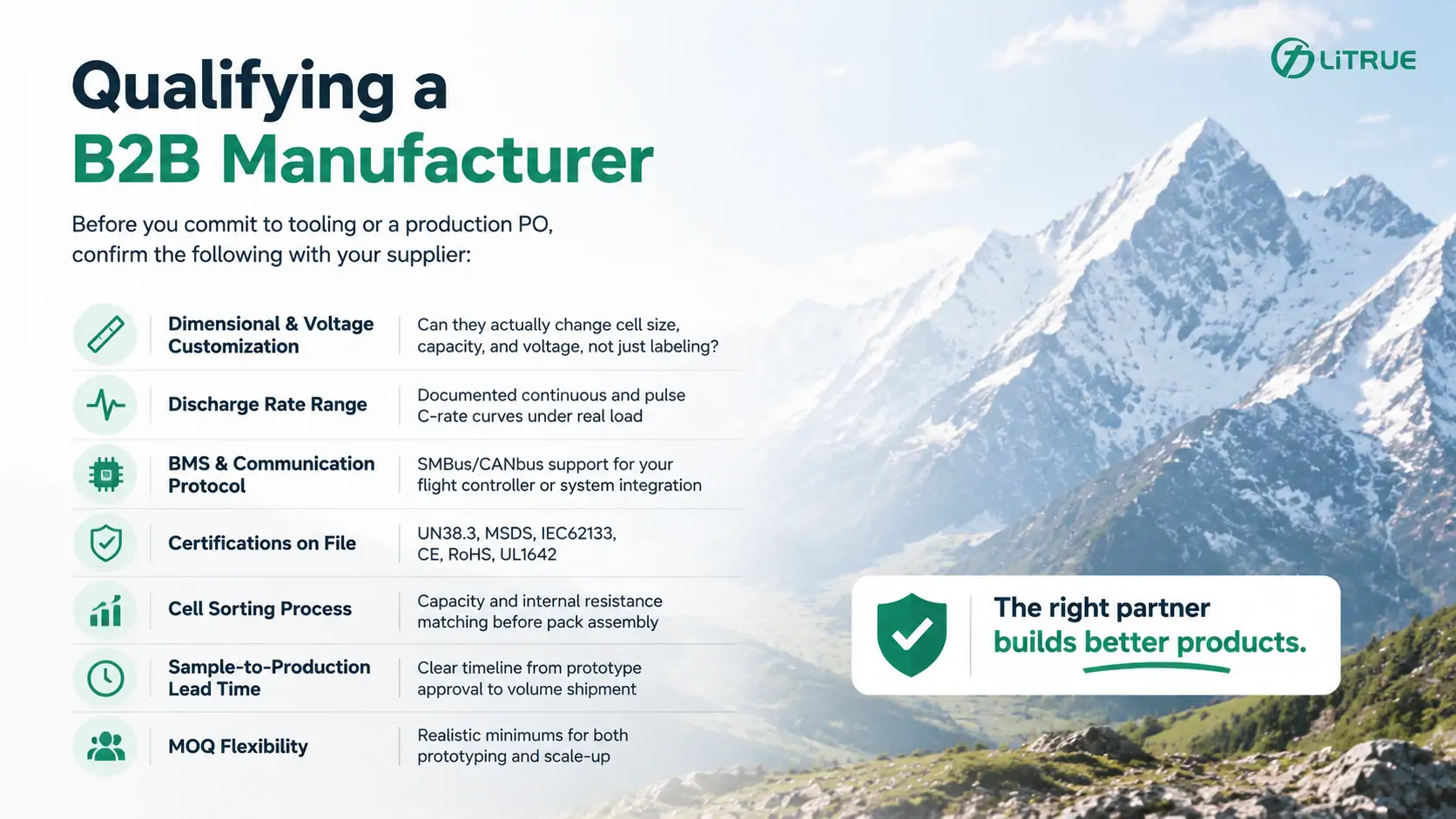
Before committing to tooling or a production PO, confirm the following with a prospective supplier:
- Can it change cell size, capacity, voltage configuration, tab layout, and discharge capability—not only labeling?
- Can it provide continuous- and pulse-discharge data at relevant temperatures and loads?
- Can it integrate the required BMS and communication protocol, such as CAN bus or SMBus?
- Which safety, transport, and market documents can it provide for the actual product and destination?
- How are capacity and internal resistance matched before pack assembly?
- What are the prototype, validation, and mass-production lead times?
- What is the MOQ for samples, pilot production, and full production?
- What drawings, test reports, inspection records, and change-control process will be supplied?
Working With LiTrue
LiTrue supports pouch-cell and application-specific battery-pack projects for UAV, industrial, and other OEM applications. A technical review begins with the operating requirements rather than a generic catalog recommendation, helping buyers evaluate cell dimensions, voltage, discharge rate, pack integration, and documentation requirements before sample production. For a broader project roadmap, see the custom battery pack ODM guide.
To request an engineering review, send your target voltage, capacity or Wh, continuous and peak current, maximum dimensions and weight, operating temperature, application, communication requirement, prototype quantity, annual volume, and destination country. Contact the LiTrue engineering team to discuss suitable cell and pack options.
FAQ
What is the minimum order quantity for OEM pouch cells?
MOQ depends on whether the project uses an existing cell platform, a modified cell, or a fully new design. Prototype quantities can be much lower than mass-production quantities, while custom materials, tooling, testing, and certification requirements can affect the production MOQ. Share your sample quantity and annual forecast early so the supplier can recommend a realistic development route.
Can you manufacture custom voltage output pouch cells?
Custom battery voltage is normally achieved by selecting the correct cell chemistry and designing the pack series-parallel configuration. An engineering review should confirm nominal voltage, full-charge voltage, lower cutoff, capacity, continuous and peak current, charger, BMS, and system compatibility before a design is finalized.
Can a B2B lithium battery manufacturer customize pouch-cell dimensions, voltage, and discharge rates?
A qualified OEM battery supplier should be able to assess custom dimensions, capacity, tab configuration, chemistry, voltage configuration, and continuous or pulse discharge requirements. The achievable range depends on the selected platform, materials, safety limits, quantity, and validation plan.
Can a custom battery pack include CAN bus, RFID, or a BMS?
Yes. A pack can include a BMS along with CAN bus, SMBus, UART, RFID, or other functions when the application requires them. Provide the host-system protocol, connector information, reporting requirements, and fault behavior so the electronics can be evaluated and validated correctly.
What capabilities should I look for in a custom UAV battery-pack manufacturer?
Evaluate the manufacturer experience with high-energy or high-rate cells, BMS protection, telemetry protocol, thermal design, vibration resistance, cell matching, charging interface, and application-level testing. The supplier should understand the actual flight load and environmental conditions, not only the pack nominal voltage and capacity.
What documents are needed for international lithium-battery shipping?
Requirements vary by product and destination. Buyers commonly ask about UN38.3 test information, MSDS, transport documentation, and relevant safety or market-access documentation. Confirm the applicable documents with the supplier and freight provider before placing the order.
How is cell voltage and capacity consistency controlled?
Ask the supplier to explain its incoming inspection, aging, capacity testing, internal-resistance testing, matching criteria, traceability, and final pack functional test. Consistency control should be documented against the needs of the specific pack rather than described only in general terms.