
An anode-free battery is a lithium cell design that ships from the factory with no dedicated anode material on the negative current collector. Instead of graphite or silicon hosting lithium ions during discharge, the negative electrode starts as bare copper (or a thin coated foil), and metallic lithium is plated onto it directly from the cathode during the first charge. Pair that with a solid or quasi-solid electrolyte and you get the anode-free solid-state cells now pushing past 400 Wh/kg, with LiTrue current development cells reaching 495 Wh/kg. This guide breaks down how the chemistry works, how it compares to conventional and semi-solid-state cells, why long-endurance UAV programs are moving toward it, and what to check before sourcing from a China-based cell manufacturer.
1. What is an Anode-Free Battery and How Does It Work?
In a conventional lithium-ion cell, the anode is a fixed piece of hardware — a copper foil coated with graphite (or graphite-silicon blends) that lithium ions shuttle into and out of on every cycle. That graphite layer is dead weight in energy-density terms: it stores no charge of its own, it just hosts lithium. An anode-free lithium cell removes it entirely. The negative electrode is a bare or lightly coated copper current collector, and lithium metal is deposited onto it electrochemically the first time the cell is charged, sourced from lithium already present in the cathode.
Cutting the host material out of the stack does two things at once: it removes inactive mass and volume, and it lets the cell run on a much thinner lithium layer than a traditional lithium-metal anode would need. Both effects push energy density up. The trade-off is that plating lithium metal cleanly, cycle after cycle, is hard — uneven plating leads to dendrite growth, which is exactly why anode-free designs are almost always paired with a solid-state electrolyte rather than a liquid one. A solid-state electrolyte, typically a sulfide, oxide, or polymer-ceramic composite, physically constrains how lithium can plate and gives the cell a much higher chance of surviving repeated cycles without a metal filament punching through to the cathode side. LiTrue bare-cell lineup spans conventional, semi-solid-state, and anode-free construction for integrators comparing all three side by side.
The result is a cell that is lighter and thinner than an equivalent-capacity graphite or lithium-metal design, with no separate anode manufacturing step at all — which is also why anode-free construction tends to simplify (and eventually cheapen) the cell build once the plating chemistry is under control.
2. Anode-Free vs. Traditional Lithium-Ion vs. Semi-Solid State
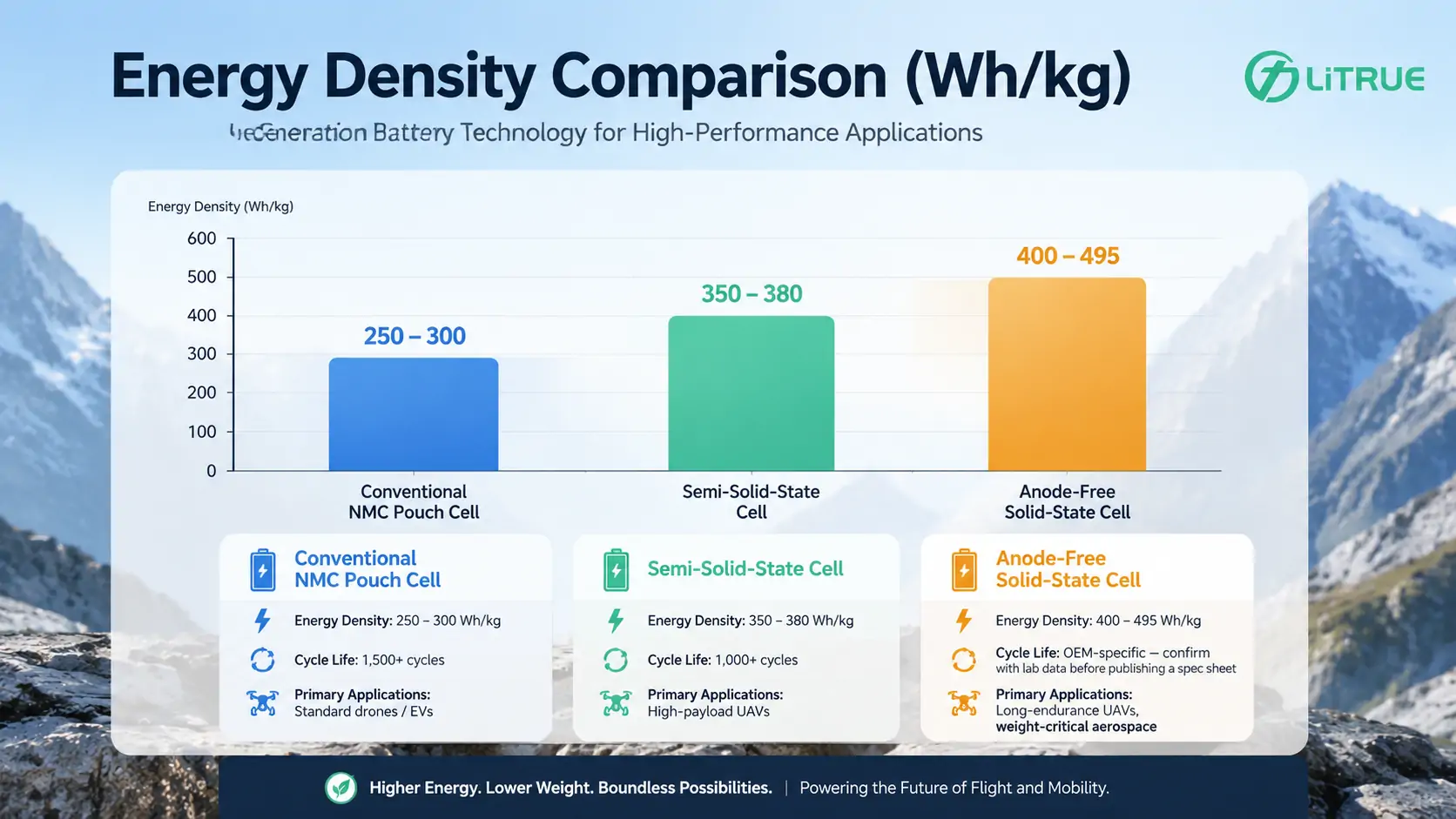
It helps to place anode-free solid-state cells next to the two chemistries most integrators are already using. The short version: conventional NMC pouch cells are the known quantity, semi-solid-state cells are the current production-ready step up, and anode-free solid-state is the frontier — highest energy density, but still maturing on cycle life.
| Battery Type | Energy Density | Cycle Life | Primary Applications |
|---|---|---|---|
| Conventional NMC Pouch Cell | 250 – 300 Wh/kg | 1,500+ cycles | Standard drones / EVs |
| Semi-Solid-State Cell | 350 – 380 Wh/kg | 1,000+ cycles | High-payload UAVs |
| Anode-Free Solid-State Cell | 400 – 495 Wh/kg | OEM-specific — confirm with lab data before publishing a spec sheet | Long-endurance UAVs, weight-critical aerospace |
The cycle-life column is where most of the honest engineering trade-off lives. Conventional NMC chemistry is well understood and easy to spec with confidence. Semi-solid-state cells, like LiTrue Semi-Solid State High Energy Density NMC Pouch Cell, keep a liquid or gel electrolyte component, which makes manufacturing more forgiving and cycle life more predictable while still lifting energy density well above standard NMC. Anode-free solid-state cells give up some of that manufacturing forgiveness in exchange for the highest energy density on the table — which is exactly why cycle life on anode-free cells is still typically qualified per program rather than quoted as a single blanket number industry-wide.
If your application can tolerate 350–380 Wh/kg with well-characterized cycle life, semi-solid-state is the lower-risk choice today. If mission weight is the binding constraint and you can work with a manufacturer on cell-level qualification, anode-free solid-state is where the ceiling is. LiTrue full product catalog lists current capacity options across all three chemistry classes.
3. Why UAV and Commercial Drone Manufacturers Require Anode-Free Technology

For most electronics, an extra 100 Wh/kg is a nice-to-have. For a UAV, it's the difference between a platform that can carry a useful payload for a useful amount of time and one that can't. Battery mass is the single largest lever an airframe designer has over flight time, because every gram of cell weight is a gram the airframe, motors, and payload all have to lift for the entire mission — not just carry once.
That's the specific reason long-endurance and fixed-wing UAV programs are the first serious adopters of anode-free solid-state cells. Moving from a 300 Wh/kg conventional pack to a 450+ Wh/kg anode-free pack at the same total battery mass translates roughly linearly into additional flight time or additional payload capacity, and airframe teams are consistently reporting the low end of a 20–40% endurance gain in that swap, depending on how much of the saved mass is reinvested into payload versus airtime. The exact number for any given airframe depends on aerodynamics and mission profile, so treat that range as a starting planning figure rather than a guaranteed spec. See deployment cases for how integrators have handled that trade-off on real airframes.
Solid-state electrolytes bring a second, less-talked-about benefit to airborne platforms: they remove the flammable liquid electrolyte that conventional lithium-ion cells rely on. That doesn't make a pack immune to thermal events, but it does change the failure mode in ways that matter for BVLOS operations and payload-adjacent battery placement, which is part of why long-endurance and agricultural UAV programs are willing to absorb the qualification work anode-free cells still require.
4. How to Source Anode-Free Batteries from a Reliable China Manufacturer
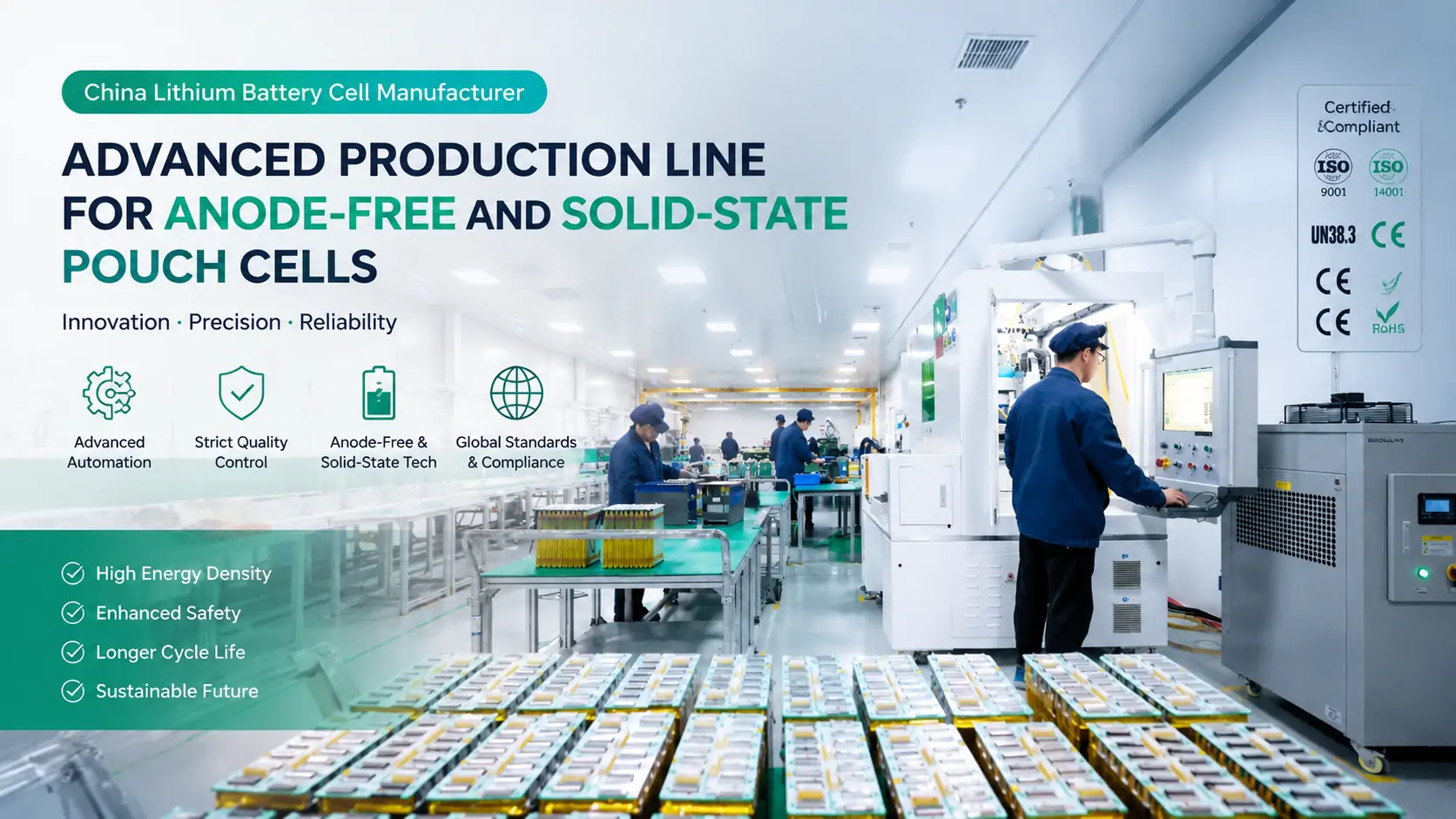
Most of the world's pouch-cell manufacturing capacity, and nearly all of the current anode-free and solid-state pilot lines, sit in China. That's an advantage for integrators — shorter lead times, deeper customization options, competitive NRE costs — but it also means the sourcing decision carries more diligence than picking a part number off a datasheet. If your program needs finished packs with BMS and connectors rather than bare cells, LiTrue assembled battery pack line covers that side of the build too.
A few things worth confirming with any factory before committing a design around their cells:
- Custom pouch dimensions and tab configuration: anode-free and solid-state stacks often need different case tolerances than a standard liquid-electrolyte pouch — confirm the factory can hold spec at your target thickness, not just their standard catalog sizes.
- C-rate and thermal behavior at your actual duty cycle: a cell qualified at a gentle discharge profile may behave differently under a UAV's motor-start current spikes — ask for data at your real C-rate, not the datasheet's best-case number.
- MOQ and sample availability: anode-free lines are newer and lower-volume than standard NMC lines at most factories, so sample lead time and minimum order quantities are worth locking down early in the program, not after design freeze.
- Certification coverage: ask specifically which of UN38.3, RoHS, and the relevant GB/T standards apply to the exact cell you're quoting, not just the manufacturer's general catalog — a new anode-free SKU doesn't automatically inherit certs from an older product line.
LiTrue engineering team works directly with UAV integrators on anode-free and semi-solid-state pouch cell development, including the 40Ah Anode-Free Solid-State Battery Cell (495 Wh/kg) currently in qualification for long-endurance platforms. If you're scoping a program, the engineering team can walk through custom dimensions, sample timelines, and cert coverage for your specific application.
5. Frequently Asked Questions
Are anode-free batteries safe for high-altitude drone flights?
Solid-state electrolytes remove the flammable liquid component that conventional lithium-ion cells rely on, which is a meaningful safety improvement at altitude and in enclosed payload bays. That said, "solid-state" doesn't mean "risk-free" — thermal and mechanical qualification testing for your specific flight envelope is still required, and any safety claim should be backed by the cell manufacturer's actual test data for your operating conditions rather than assumed from the chemistry class alone.
What is the energy density of LiTrue anode-free pouch cells?
LiTrue 40Ah anode-free solid-state cell is rated up to 495 Wh/kg in current development builds. As with any cutting-edge cell chemistry, confirm the production-batch figure and cycle-life data for your specific order before finalizing an airframe design around it.
How does anode-free construction affect cycle life compared to standard NMC cells?
Removing the graphite host and plating lithium directly onto the current collector is harder to do consistently over hundreds of cycles than cycling lithium into an established graphite structure, which is why anode-free cycle life is typically qualified per program rather than quoted as a single industry-wide number. Ask for cycle data at your actual depth-of-discharge and C-rate before treating any published figure as a guarantee.
Can anode-free cells be customized for specific UAV pack dimensions?
Yes. Custom pouch dimensions, tab placement, and capacity are standard requests for OEM UAV programs — bring your target envelope and duty cycle to the manufacturer's engineering team early so they can confirm tolerances before you freeze the airframe design.
What's the typical MOQ and sample lead time for anode-free solid-state cells?
This varies by factory and by how mature their anode-free line is, since it's newer, lower-volume production than standard NMC. Confirm current sample lead time and MOQ directly with the manufacturer for your target capacity and dimensions before committing a program timeline around it.