
"Solid state" gets used loosely enough in battery marketing that it's worth being precise. A true all-solid-state cell has no liquid electrolyte at all — that's still mostly a lab technology. What's actually shipping today, in drones, EV, and energy storage, is semi-solid state: a cell that replaces most of the free liquid electrolyte with a gel-like or quasi-solid electrolyte, while keeping the same NMC or LFP chemistry underneath. It's an evolution of lithium-ion, not a replacement for it.
What Is a Semi-Solid State Battery?
A conventional lithium-ion cell relies on a liquid electrolyte to shuttle lithium ions between anode and cathode. That liquid is flammable, and it's also the reason a punctured or overheated cell can vent or ignite — the liquid provides an easy path for thermal runaway to propagate.
A semi-solid state battery cuts the free liquid electrolyte down to a small fraction of the cell's volume, replacing most of it with a gel polymer or ceramic-infused electrolyte layer that's still ionically conductive but doesn't slosh around or leak. Less free liquid means less fuel for a runaway event, and it also lets manufacturers pack the electrodes tighter, since they're no longer designing around electrolyte-soaking porosity the same way.
Semi-Solid State Battery vs Lithium-Ion: The Key Differences
Both are lithium chemistries at heart — the difference is in the electrolyte and what that enables mechanically. Three things tend to separate them in practice:
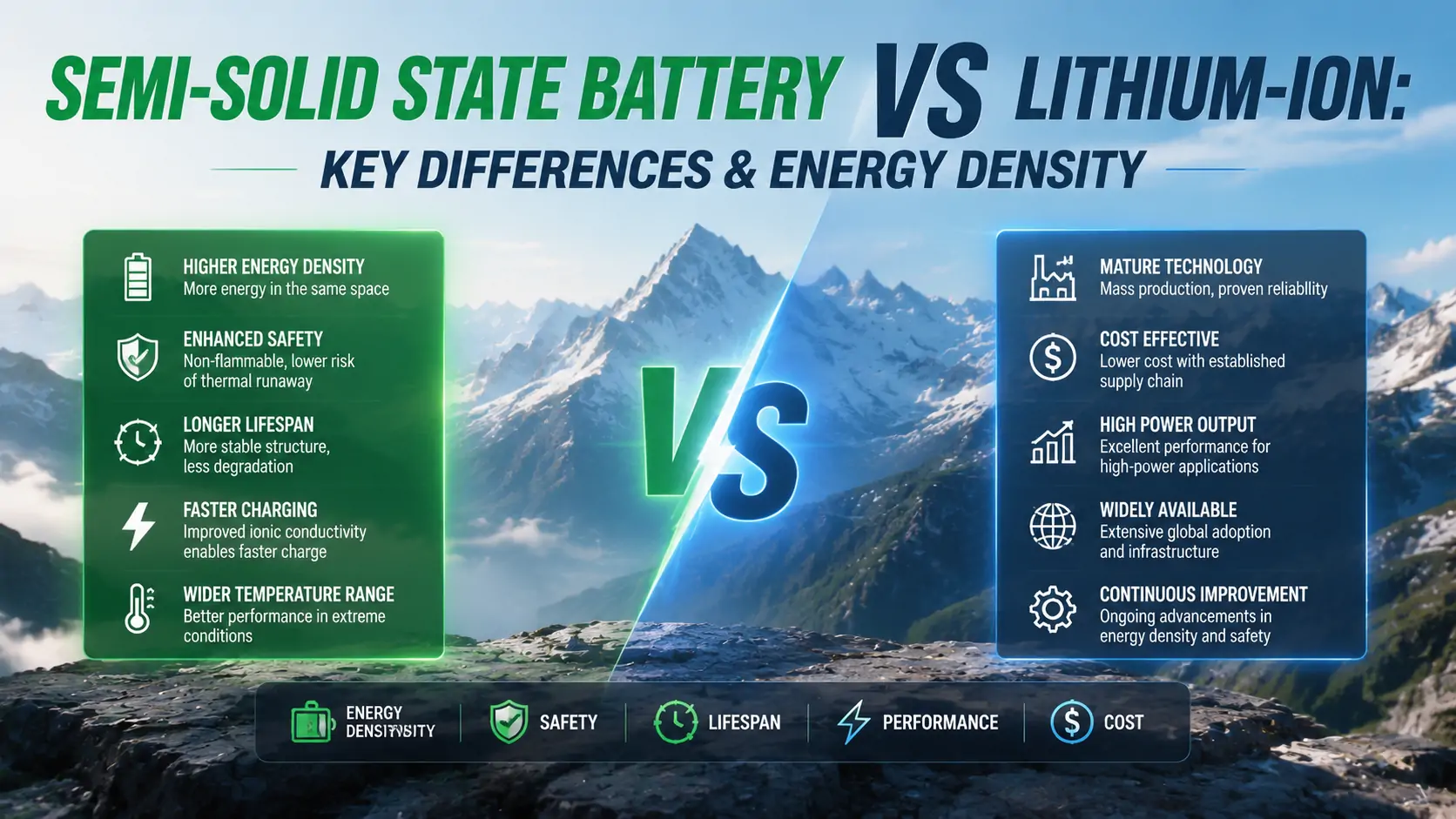
- Energy density: with less inert liquid taking up volume, cell designers can allocate more of the stack to active material. That's the main reason semi-solid cells are being adopted first in weight-sensitive applications like UAVs.
- Thermal behavior: reduced free electrolyte generally means a higher onset temperature for thermal runaway and less liquid available to sustain it once triggered. It is not a guarantee of "no failure" — it changes the failure mode, not eliminates it.
- Manufacturing complexity: semi-solid electrolytes are harder to coat and laminate consistently than pouring in a liquid, which is part of why semi-solid cells still carry a cost premium over standard NMC or LFP pouch cells of the same capacity.
Neither chemistry wins on every axis. A standard lithium-ion NMC pouch cell is still the more mature, lower-cost, easier-to-qualify option for applications where every gram doesn't matter. Semi-solid earns its premium specifically where energy density per kilogram is the binding constraint — see LiTrue's full range of pouch and prismatic cells for how the two sit alongside each other in practice.
Semi-Solid State Battery Energy Density
Standard NMC pouch cells in production today typically land in the 210-230 Wh/kg range (typical for this class — confirm exact figures against a specific model's datasheet). Semi-solid state changes that ceiling directly: LiTrue's own PE36N-EE pouch cell is rated at 319 Wh/kg, which is the real number behind the "300+ Wh/kg" figures that get thrown around loosely elsewhere in semi-solid marketing.
That density gain is the whole commercial case for semi-solid today. It shows up most directly in flight time for UAVs and range for EVs, where the pack is a fixed volume or weight budget and every added Wh/kg translates straight into mission time. The PE36N-EE is built specifically around that trade — higher density per kilogram for integrators who've already hit the ceiling on standard NMC pouch cells.
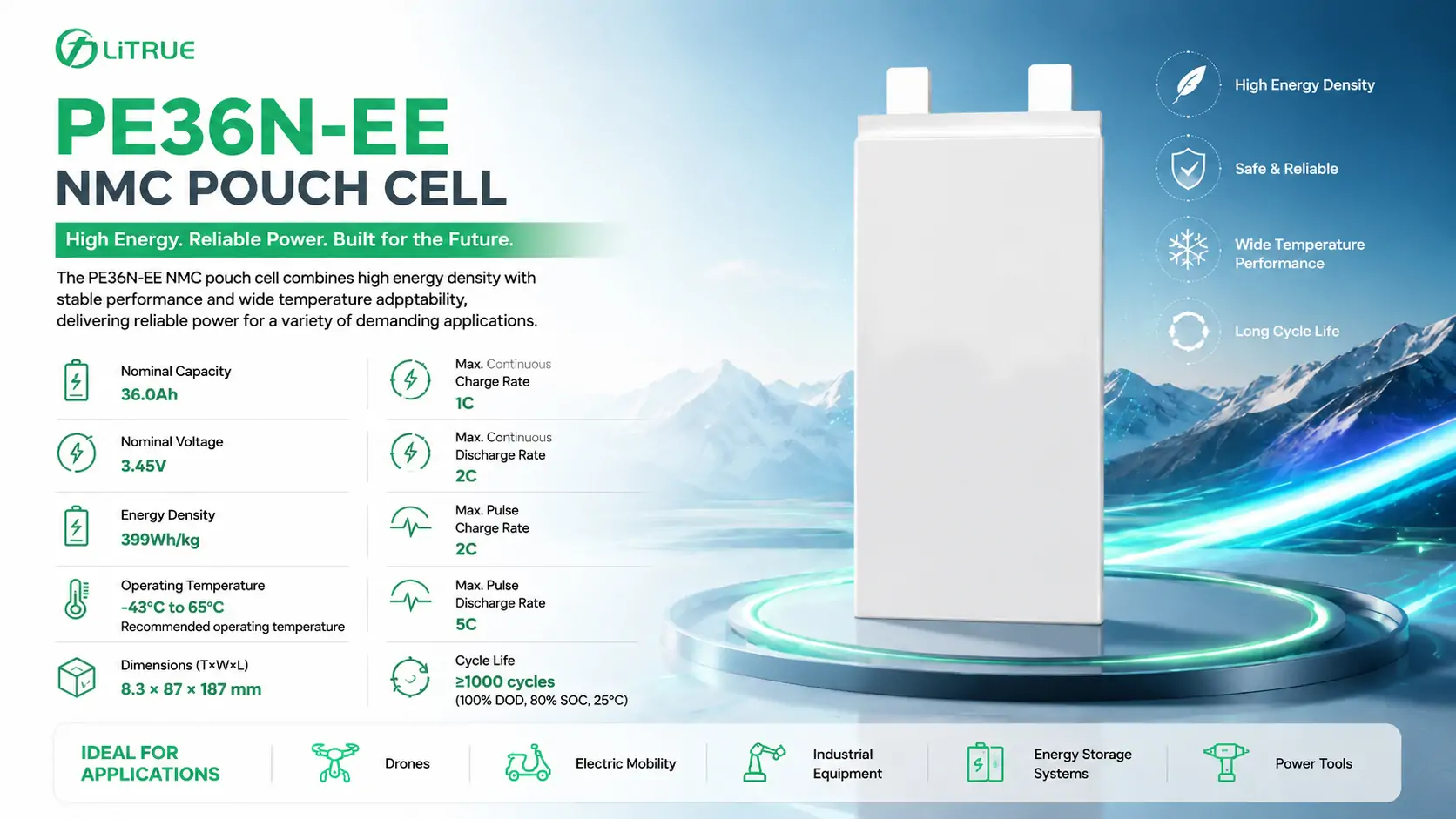
PE36N-EE Semi-Solid State NMC Pouch Cell — Specifications
| Field Name | Value |
|---|---|
| Model Number | PE36N-EE |
| Chemical Materials | NMC, semi-solid state electrolyte |
| Type | Pouch Cell |
| Nominal Capacity (Ah) | 36.0 |
| Nominal Voltage (V) | 3.45 |
| Energy Density (Wh/kg) | 319 |
| Max. Continuous Charge Rate | 1C |
| Max. Continuous Discharge Rate | 2C |
| Max. Pulse Charge Rate | 2C |
| Max. Pulse Discharge Rate | 5C |
| Cycle Life | ≥1000 cycles at room temperature, 100% DOD–80% SOC, 1C/2C |
| Operating Temperature | -43°C to 65°C recommended operating temperature |
| Dimensions (T×W×L, mm) | 8.3 × 87 × 187 |
Note the trade-off in the rate figures: this cell is tuned for energy, not high-rate discharge — 2C continuous / 5C pulse is modest next to a purpose-built high-rate NMC pouch cell. That's the expected shape for an energy-focused semi-solid design, not a shortfall; if your application needs both high density and sustained high current, that's a sizing conversation worth having with LiTrue's engineering team directly.
FAQs
What is an anode-free battery?
An anode-free cell ships from the factory with no lithium host material on the negative electrode at all — just a bare copper current collector. Lithium metal deposits directly onto that collector during the first charge cycle instead of intercalating into a pre-built graphite or silicon anode. Removing the anode's inactive mass is another route to higher energy density, but it puts much stricter demands on electrolyte stability and plating uniformity, since uneven lithium deposition is what drives dendrite growth and short cycle life. It's a related but distinct approach from semi-solid electrolyte design — some cells combine both, but the two innovations are separable.
What are the main applications for semi-solid state batteries?
The clearest fit today is anywhere weight or volume is the hard constraint rather than cost: heavy-lift and long-endurance UAVs, high-performance EVs, and portable equipment where every gram removed from the pack is worth a real premium. It's less compelling for stationary storage or cost-driven applications, where a standard LFP or NMC cell's lower price per kWh usually wins out.
Is a semi-solid state battery safer than a standard lithium-ion cell?
Generally yes, in the sense that less free liquid electrolyte means less fuel available if a cell is punctured or overheats, which typically raises the temperature threshold before thermal runaway propagates. It's not a substitute for proper pack-level protection — BMS, fusing, and thermal management still matter regardless of cell chemistry.
Can I get samples of LiTrue's semi-solid state cells for evaluation?
Yes. Sample quantities are typically available for engineering qualification ahead of a production order. Reach out to LiTrue's applications team to scope voltage, capacity, and configuration for your platform.