
Understanding custom battery pack ODM challenges
Sourcing the right battery pack for a specialized application is rarely straightforward. For drone manufacturers pushing payload limits, electric motorcycle brands chasing longer range, and BESS providers scaling grid-tied storage, the gap between what standard cells offer and what a real-world product demands can mean the difference between a competitive launch and a costly redesign.
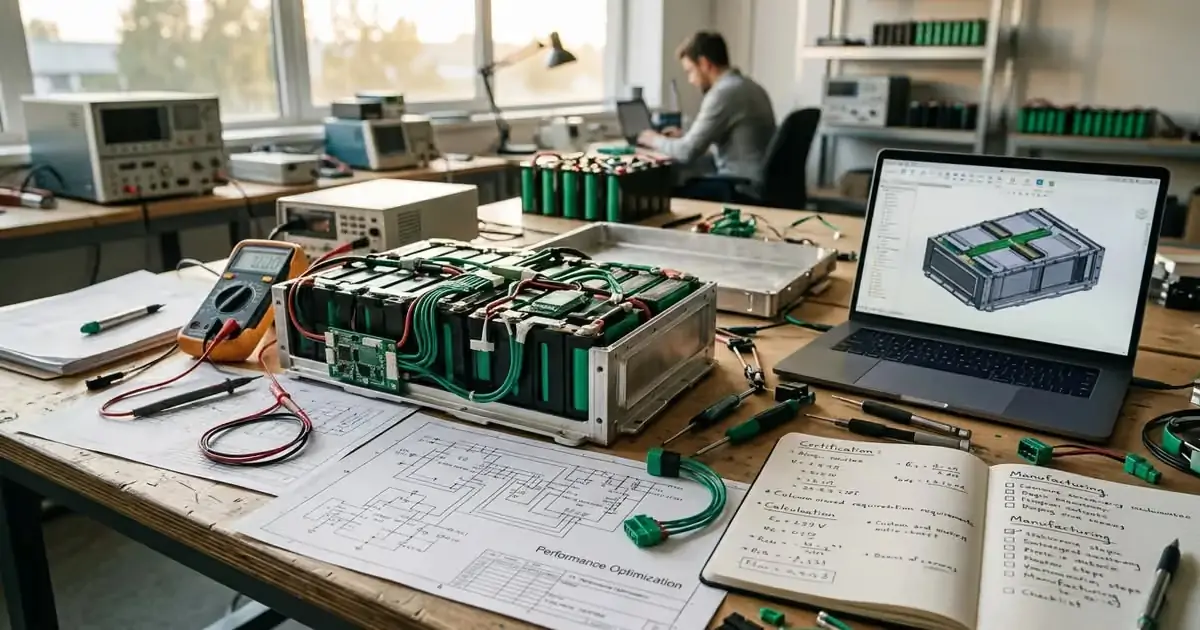
Why off-the-shelf packs consistently disappoint
Standard battery packs are engineered around the broadest possible use case. That design philosophy works for consumer electronics but creates serious problems for industrial and mobility applications. A logistics equipment manufacturer needs cells that survive warehouse temperature swings and high-cycle demands. A UAV developer needs the highest possible energy density in the smallest possible footprint. Neither requirement maps neatly onto a catalog product.
At LiTrue, our analysis shows that the majority of B2B customers arriving at the ODM stage have already spent months, sometimes over a year, attempting to adapt off-the-shelf solutions before accepting that a custom development path is unavoidable. That delay carries real cost: delayed product launches, compromised performance specifications, and compliance documentation gaps that stall regulatory approvals.
Custom ODM as a strategic decision
Custom battery pack ODM is not simply a procurement upgrade. It is a product development commitment that touches cell chemistry selection, mechanical integration, thermal management, BMS configuration, and certification planning simultaneously. Competitors in this space often lack end-to-end workflow documentation, leaving manufacturers to piece together requirements across multiple vendors.
This article provides a comprehensive roadmap covering every stage of that process, from initial ODM checklist to long-term supplier qualification, so your team can move from specification to production with confidence.
Quick fix: The essential ODM checklist for custom battery packs
Before diving into root causes and long-term strategy, here is an immediate reference framework for any engineering or procurement team evaluating a custom battery pack ODM partner. Use this checklist to filter suppliers quickly and avoid the most common sourcing mistakes.
Core qualification criteria
When assessing any ODM candidate, confirm these specifications match your application requirements before any deeper conversation:
- Energy density targets: Drone, EV two-wheeler, and industrial equipment applications increasingly demand cells above 400Wh/kg. Solid-state and anode-free chemistries, such as LiTrue 49Ah cell at 495Wh/kg, now make these targets achievable at production scale.
- C-rate requirements: Confirm continuous and pulse discharge ratings. High-demand applications may require 5C continuous or 8C pulse capability.
- Cycle life: Establish minimum acceptable cycle counts under your specific depth-of-discharge conditions, not just manufacturer headline figures.
- Certification status: Verify UN38.3, IEC 62133, UL, and any region-specific compliance relevant to your end market.
Three documents to request immediately
Request these before any technical call:
- Production capacity proof: Automated line output records confirming volume consistency
- Cycle-test logs: Third-party or in-house data showing real degradation curves
- Compliance certifications: Current, not expired, documentation covering your target markets
Chemistry decision framework
| Application | Recommended chemistry | Key reason |
|---|---|---|
| UAV / long-endurance drone | Solid-state anode-free | Maximum energy density, wide temperature range |
| Electric motorcycle | Semi-solid-state NMC | Balance of energy density and cycle life |
| BESS / industrial | LFP prismatic | Cycle longevity and thermal stability |
| High-rate logistics equipment | High-C-rate NMC pouch | Fast discharge and recharge capability |
Teams sourcing industrial lithium battery solutions should treat this table as a starting filter, not a final specification. Chemistry selection interacts with BMS design, thermal architecture, and mechanical packaging in ways that require deeper validation, which the following sections address in full.
Why custom battery pack ODM projects fail: Root causes and warning signs
Most custom battery pack ODM projects that stall or fail do so for predictable reasons. The problems rarely surface during initial design reviews. They emerge during thermal stress testing, certification audits, or first production runs, at which point the cost of correction multiplies significantly.
The specification mismatch problem
Generic battery packs are engineered to satisfy the broadest possible market, which means they satisfy no single application particularly well. A drone manufacturer sourcing a standard pack may find it meets nominal voltage and capacity requirements while failing entirely on gravimetric energy density, discharge curve shape, or low-temperature performance. The gap between what a datasheet promises and what a specific application demands is where most projects begin to unravel.
The three most common technical failure points
Engineering teams consistently encounter the same cluster of problems:
- Inadequate thermal design: Cells generating heat under high C-rate discharge without a matched thermal management strategy degrade faster and create safety risks that invalidate certifications.
- Insufficient BMS integration: A BMS specified in isolation from the cell chemistry and pack architecture produces inaccurate state-of-charge estimates, premature cutoffs, and unbalanced cell aging.
- Missing certification pathways: Regulatory requirements such as UN38.3, IEC 62133, and UL 2580 are not afterthoughts. Projects that reach prototype stage without a certification roadmap routinely face six-to-twelve month delays and complete redesigns.
The energy density tradeoff manufacturers underestimate
Lithium-ion cells can reach 330 Wh/kg compared to 75 Wh/kg for lead-acid, yet that headline figure obscures critical tradeoffs. Increasing energy density typically compresses cycle life or raises internal resistance under pulse loads. Advanced formats push this ceiling further: LiTrue solid-state anode-free cell achieves 495 Wh/kg, but realizing that performance in a finished pack requires matching thermal architecture, BMS tuning, and mechanical design to the cell's specific characteristics. Competitors rarely quantify these interdependencies across energy density, C-rate, cycle life, and safety validation simultaneously, leaving manufacturers to discover the gaps late in the program.
Solution 1: Define precise technical specifications and performance requirements
Closing the gap between a promising cell and a production-ready pack starts before a single component is selected. Precise, documented specifications give your ODM partner a fixed target to engineer toward, and they protect your program from the scope creep and late-stage redesigns that inflate cost and delay certification.
- Document your application's real operating demands. Start with the duty cycle. A drone running 12-minute high-throttle sorties followed by rapid ground recharging places fundamentally different stress on a pack than a BESS installation cycling once daily at moderate C-rates. Capture peak power demand, continuous discharge rate, charge rate, and the thermal envelope your product must survive. For industrial equipment operating in cold-chain logistics or high-altitude environments, that temperature range is non-negotiable from day one.
- Establish non-negotiable performance targets. Translate operating demands into hard numbers: minimum energy density (Wh/kg and Wh/L), required C-rate for continuous and pulse discharge, target cycle life at defined depth of discharge, and safety margins for thermal runaway containment. These become the filter through which every chemistry and cell format is evaluated.
- Build a chemistry comparison matrix. Not every application needs the same solution. A structured matrix comparing solid-state anode-free, semi-solid-state, and conventional NMC or LFP options makes trade-offs visible. LiTrue PE49N-EF solid-state anode-free cell delivers 495 Wh/kg across a -43°C to 55°C operating range, making it a strong candidate for weight-critical UAV and automotive applications. Where cost sensitivity is higher, the PE36N-EE semi-solid-state NMC pouch cell offers 321 Wh/kg with a more accessible price point. High-pulse applications such as electric motorcycles may prioritize the PR30N-P, which sustains 10C continuous and 20C pulse discharge at 30Ah.
- Validate specs against proven cell capabilities. Specifications written in isolation often collide with manufacturing reality. Cross-reference your targets against your ODM partner's verified cell portfolio and pack build history before finalizing anything.
- Lock everything in a technical requirements document. A formal TRD signed before design begins eliminates ambiguity. It records agreed performance targets, test conditions, certification requirements, and the specific cell formats under consideration, giving both teams a single source of truth throughout the program.
Solution 2: Select an ODM partner with proven manufacturing and certification infrastructure
Once your technical requirements document is signed, the next decision that determines program success is who builds the pack. Choosing the wrong manufacturing partner introduces risk at every stage, from inconsistent cell quality to failed certification audits. A proven custom battery pack ODM partner removes that risk by bringing verified production capacity, documented safety records, and end-to-end integration capability to the table.

- Verify production capacity and manufacturing automation. Start by auditing the facility itself. Automated electrode coating, cell stacking, and formation lines reduce human-error variability and support consistent quality at volume. Ask for production capacity figures and lead-time commitments in writing, not estimates.
- Request cycle-test logs and third-party certification documentation. Reputable ODM partners maintain traceable records. Request cycle-life test logs, abuse-tolerance reports, and third-party certification documentation covering UN38.3, IEC 62133, or application-specific standards relevant to your market. These documents reveal how cells and packs actually perform under stress, not just how they are rated on a datasheet.
- Confirm full-service OEM and ODM capabilities. The strongest partners offer BMS design, thermal management engineering, and complete pack integration under one roof. LiTrue, for example, provides both OEM and ODM services, covering everything from individual cell supply to fully integrated battery systems. With 18 or more years of engineering expertise behind its team, the company supports drone manufacturers, e-motorcycle brands, AGV developers, and energy storage integrators with application-specific pack architectures built around cells like the 49Ah 495Wh/kg solid-state anode-free PE49N-EF.
- Evaluate application-specific experience. A partner who has shipped packs into your target application understands the real-world constraints that datasheets miss: vibration profiles in drones, charge cycle patterns in fleet logistics, and thermal cycling in outdoor BESS installations. Request reference projects and test data from comparable deployments.
- Assess supply chain resilience. Raw-material availability directly affects your program timeline. Research suggests global lithium supply remains well below the industry capacity ceiling of 450 kt LCE, meaning partners with diversified sourcing strategies and strategic material reserves carry significantly less schedule risk. Confirm your ODM partner's raw-material sourcing strategy and their contingency plan for supply disruptions before committing to a production agreement. Review LiTrue cell portfolio and manufacturing capabilities as a starting benchmark for this evaluation.
Solution 3: Optimize pack architecture for energy density, C-rate, and thermal performance
Once you have confirmed your ODM partner's manufacturing credentials and supply chain resilience, the next step is translating your application requirements into a coherent pack architecture. This is where specification decisions compound quickly: a poor choice at the cell level creates thermal and balancing problems that no downstream design can fully correct.
- Match cell chemistry and form factor to your energy density target. Start by aligning cell chemistry with your primary constraint. Weight-sensitive platforms like UAVs and electric motorcycles benefit from high-density pouch cells, while stationary BESS applications often prioritize cycle life over gravimetric density. LiTrue solid-state anode-free cells reach 495 Wh/kg, making them a practical choice for applications where every gram of pack mass reduces payload or range. For high-throughput industrial equipment, the LFP prismatic LFL1-100P offers 3,000-plus cycle life, shifting the optimization toward longevity rather than density.
- Configure series-parallel topology for voltage, capacity, and balance. Series strings set your nominal voltage; parallel groups set your capacity and distribute current load across cells. The design challenge is managing cell-level imbalances that accumulate over hundreds of cycles. Work with your ODM partner to specify tight cell-matching tolerances at the production stage, which reduces the balancing burden on the BMS and extends pack life.
- Integrate a BMS calibrated to your duty cycle. A generic BMS is rarely adequate. Your duty cycle determines the balancing algorithm, protection thresholds, and thermal monitoring intervals the firmware must handle. For fast-discharge applications, LiTrue PR30N-P NMC pouch cell supports 10C continuous discharge, but realizing that capability safely requires a BMS with active balancing and real-time thermal cutoffs tuned to those rates.
- Specify thermal management based on peak power and environment. Passive cooling suits low-to-moderate C-rate applications. Liquid cooling or phase-change materials become necessary when peak power density or ambient temperature extremes push cell temperatures beyond safe operating windows. LiTrue anode-free cells operate across a range of -43°C to 55°C, which reduces the thermal management burden in many field conditions, but peak discharge events still require deliberate heat-path design.
- Validate through thermal modeling and accelerated cycle testing. No architecture is production-ready without validation. Thermal modeling identifies hotspots before tooling is cut; accelerated cycle testing confirms that capacity fade and impedance growth stay within specification across the intended service life. Buyers increasingly expect ODM partners to own this validation process end to end, covering cell-level innovation, pack integration, BMS tuning, and thermal design under one program. Confirm that your partner can deliver all five steps before moving to the next phase: certification.
Solution 4: Navigate certification and compliance requirements for your target market
Certification is where many custom battery pack ODM projects stall. Standards vary by application, region, and end-use environment, and a pack that performs brilliantly in the lab can be blocked from market if compliance gaps surface late in the program. A structured approach prevents costly redesigns.
- Identify all applicable standards early. Begin by mapping every standard that governs your product. IEC 62619 covers safety requirements for lithium cells used in industrial applications. UL 2054 applies to household and commercial battery packs sold in North American markets. Drone manufacturers must also account for UN 38.3 transport testing, while automotive OEMs typically face ISO 26262 functional safety requirements on top of cell-level standards. Listing every applicable standard before design freeze prevents scope creep later.
- Confirm your ODM partner's certification pathway. Not every ODM maintains active relationships with accredited third-party testing laboratories. Verify that your partner has established pathways to recognized labs and can provide documentation of prior certification successes. In our experience at LiTrue, B2B customers consistently request proof of manufacturability alongside compliance credentials, including automated production line records, cycle-test logs, and batch traceability reports. These documents are not optional for serious procurement teams.
- Build pre-certification design reviews into the schedule. Schedule formal compliance reviews at the schematic stage, before any tooling investment. These reviews catch issues such as inadequate cell spacing for thermal runaway propagation limits or BMS logic that does not satisfy overcharge cutoff thresholds.
- Budget accurately for safety validation testing. Thermal abuse, short circuit, overcharge, and crush tests each consume time and budget. Factor these costs into the program plan from day one rather than treating them as contingencies.
- Establish documentation protocols for the full product lifecycle. Traceability records, batch test reports, and field failure reporting procedures must be defined contractually. Robust documentation protects both parties and accelerates any future recertification when cell chemistry or pack configuration changes.
Solution 5: Establish a collaborative design and iteration process with your ODM partner
A structured collaboration framework transforms the ODM relationship from a transactional supplier arrangement into a genuine engineering partnership. Manufacturers who define clear review gates, ownership boundaries, and acceptance criteria before prototype builds begin consistently achieve faster time-to-market and fewer costly late-stage redesigns.

- Schedule design review gates at specification, prototype, and pre-production phases. Formal review gates at three milestones, specification lock, first prototype evaluation, and pre-production validation, create natural checkpoints where both teams confirm alignment before committing further resources. Each gate should produce a signed-off deliverable that prevents scope creep from accumulating silently between phases.
- Define roles and responsibilities for design ownership, testing, and failure analysis. Ambiguity about who owns a design decision is one of the most common sources of program delays. Assign explicit responsibility for cell selection, BMS firmware, thermal modeling, and failure analysis before work begins. With 18-plus years of OEM and ODM engineering experience, LiTrue teams are structured to take clear ownership of cell-level design while integrating seamlessly with a customer's system-level engineers.
- Create a change-control process to manage design modifications. Every design change, however minor, should pass through a documented change-control workflow that assesses impact on cost, schedule, and certification status. This discipline is especially critical when application-specific customization extends toward full system-level optimization, where a single cell geometry change can ripple through thermal management and structural packaging simultaneously.
- Establish performance acceptance criteria before prototype builds. Define pass and fail thresholds for capacity, internal resistance, cycle life, and temperature performance before a single prototype is assembled. Pre-agreed test protocols eliminate subjective disputes during evaluation and give both parties a shared definition of success.
- Plan for design-for-manufacturability reviews to optimize cost and yield. DFM reviews bridge the gap between engineering intent and production reality. Buyers increasingly ask for proof of manufacturability, including evidence of automated production lines and process capability data, before committing to volume orders. Scheduling a formal DFM review at the pre-production gate ensures that cell formats such as LiTrue 49Ah solid-state anode-free pouch cell are integrated into pack designs that automated assembly lines can build consistently and at yield rates that protect program economics.
Prevention: Best practices to avoid custom battery pack ODM delays and failures
Avoiding delays and failures in a custom battery pack ODM program is far easier than recovering from them mid-program. The practices below address the most common failure points, from partner selection through volume production, and apply directly to manufacturers sourcing advanced chemistries such as solid-state and ultra-high-energy-density cells.
Conduct early-stage technical due diligence
Before committing to any ODM partnership, verify your partner's process capability data, quality certifications, and production line automation levels. Ask for documented yield rates on comparable cell formats. Partners offering factory-direct access, as LiTrue does with its solid-state anode-free pouch cell lineup, eliminate intermediary uncertainty and give you direct visibility into manufacturing readiness.
Build schedule buffers for certification and iteration
Certification testing for drone, EV two-wheeler, and industrial equipment applications routinely adds weeks to program timelines. Build a minimum of two design iteration cycles into your schedule before targeting a certification submission date.
Establish communication protocols and escalation paths
Define meeting cadences, decision owners, and escalation triggers in writing before development begins. Ambiguity in communication is one of the most preventable causes of program drift.
Assess supply-chain risk continuously
Global lithium raw-material supply remains well below industry capacity of 450 kt LCE, making component availability a live risk. Conduct quarterly assessments covering critical materials, cell availability, and lead times, particularly as solid-state chemistries move from niche to mainstream sourcing.
Document every design decision and milestone
Maintain a living record of design choices, test results, and certification milestones. This documentation protects program continuity during personnel changes and accelerates future product updates built on the same platform.
When to seek expert help: Escalation criteria and support options
Knowing when to escalate beyond your internal team is as important as any technical decision in a custom battery pack ODM program. Certain performance thresholds, regulatory landscapes, and supply-chain conditions signal that specialist support is not optional but essential to program success.
Escalate when performance targets exceed standard boundaries
If your application demands energy density above 300 Wh/kg or continuous C-rates above 5C, standard ODM partners may lack the cell technology or process controls to deliver reliably. This is the threshold where purpose-built manufacturers become critical. LiTrue solid-state anode-free cells reach 495 Wh/kg, with high-rate NMC pouch cells supporting up to 8C pulse discharge, making them a credible escalation point for drone, e-motorcycle, AGV, and BESS programs pushing performance limits.
Engage specialists for unfamiliar regulatory approvals
If your target market requires certifications outside your team's experience, bring in third-party certification consultants early. Regulatory missteps at late-stage development are expensive to correct. ODM partners with established compliance documentation and automated production lines, like LiTrue, can accelerate this process considerably.
Distribute risk through parallel ODM evaluation
When technology is unproven or supply-chain concentration is high, running pilot production with more than one ODM partner reduces program exposure. Industry associations and standards bodies also provide practical guidance on emerging certification requirements, particularly as solid-state chemistries enter broader commercial adoption.
Reach out to LiTrue to discuss escalation support for high-performance applications.
Conclusion: Building a sustainable custom battery pack ODM partnership
Selecting the right custom battery pack ODM partner is not a procurement decision. It is a strategic engineering commitment that shapes product performance, certification timelines, and long-term supply-chain resilience across every application from UAV platforms to grid-scale BESS installations.
Recap: the five-step framework in practice
The path from specification to production-ready pack follows a clear sequence: define precise electrical and mechanical requirements, evaluate ODM partners against those requirements, optimize pack architecture for the target application, secure the necessary certifications, and maintain collaborative design engagement throughout the program. Each step reduces downstream risk and compresses the time between concept and market launch.
Alignment drives outcomes
Successful programs share one consistent characteristic: early alignment between the OEM's technical team and the ODM's engineering and manufacturing capabilities. Misaligned expectations on C-rate, thermal management, or certification scope are the most common sources of costly redesigns. Using the quick-fix checklist introduced earlier as a structured evaluation tool during initial partner conversations helps surface those gaps before they become program delays.
Why the right partner changes everything
With 18+ years of engineering expertise and a cell portfolio spanning solid-state anode-free technology, high-rate NMC, and LFP chemistries, LiTrue is positioned to support demanding custom pack programs from initial specification through volume production. Whether the application requires the 495 Wh/kg energy density of the 49Ah solid-state anode-free cell or the pulse discharge capability of the 50Ah 8C NMC pouch cell, factory-direct ODM engagement eliminates intermediaries and keeps engineering decisions close to the manufacturing process.
Explore LiTrue custom battery pack capabilities at litruebattery.com to begin a technical conversation around your specific application requirements.
Faqs
What is a custom battery pack ODM?
A custom battery pack ODM (original design manufacturer) designs and manufactures battery packs to a client's application specifications, handling everything from cell selection and BMS integration to mechanical packaging and certification. The client receives a finished, production-ready product under their own brand without maintaining in-house battery engineering resources.
What is the difference between OEM and ODM battery packs?
OEM battery packs are manufactured to a design provided by the client, while ODM packs are designed and built by the manufacturer based on the client's performance requirements. ODM partnerships are better suited to companies that lack internal battery engineering teams or need to accelerate time to market.
How do I choose a custom battery pack manufacturer?
Evaluate manufacturers on cell technology depth, BMS capability, certifications held, and application experience relevant to your industry. Verified production scale and engineering tenure matter: according to Battery Business Directory (2026), LiTrue operates with a team of 201 to 500 engineers and specialists supporting OEM/ODM development across UAV, e-motorcycle, AGV, and energy storage applications.
What certifications are required for custom lithium battery packs?
Requirements vary by market and application, but commonly include UN38.3 for transport, IEC 62133 for portable batteries, UL 2580 for EV applications, and CE or FCC marks for regional compliance. Medical and aerospace applications carry additional standards that should be confirmed with your ODM partner early in the design phase.
How long does it take to develop a custom battery pack?
Development timelines typically range from 8 to 20 weeks depending on complexity, cell availability, and certification scope. Simple reconfigurations of existing pack architectures move faster, while novel chemistries or new mechanical enclosures require longer validation cycles.
What are the minimum order quantities for custom battery pack ODM?
MOQs vary significantly by manufacturer and pack complexity. Prototyping runs can often start at low double-digit quantities, with volume production typically beginning at a few hundred units. Discussing MOQ requirements early ensures the engagement structure aligns with your ramp timeline.