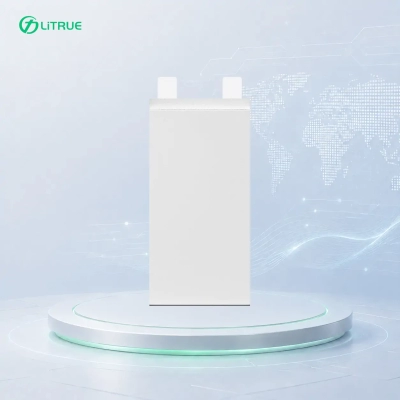
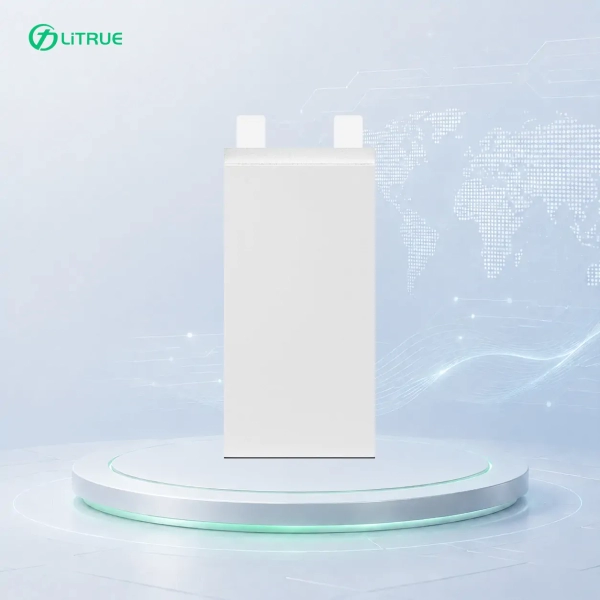
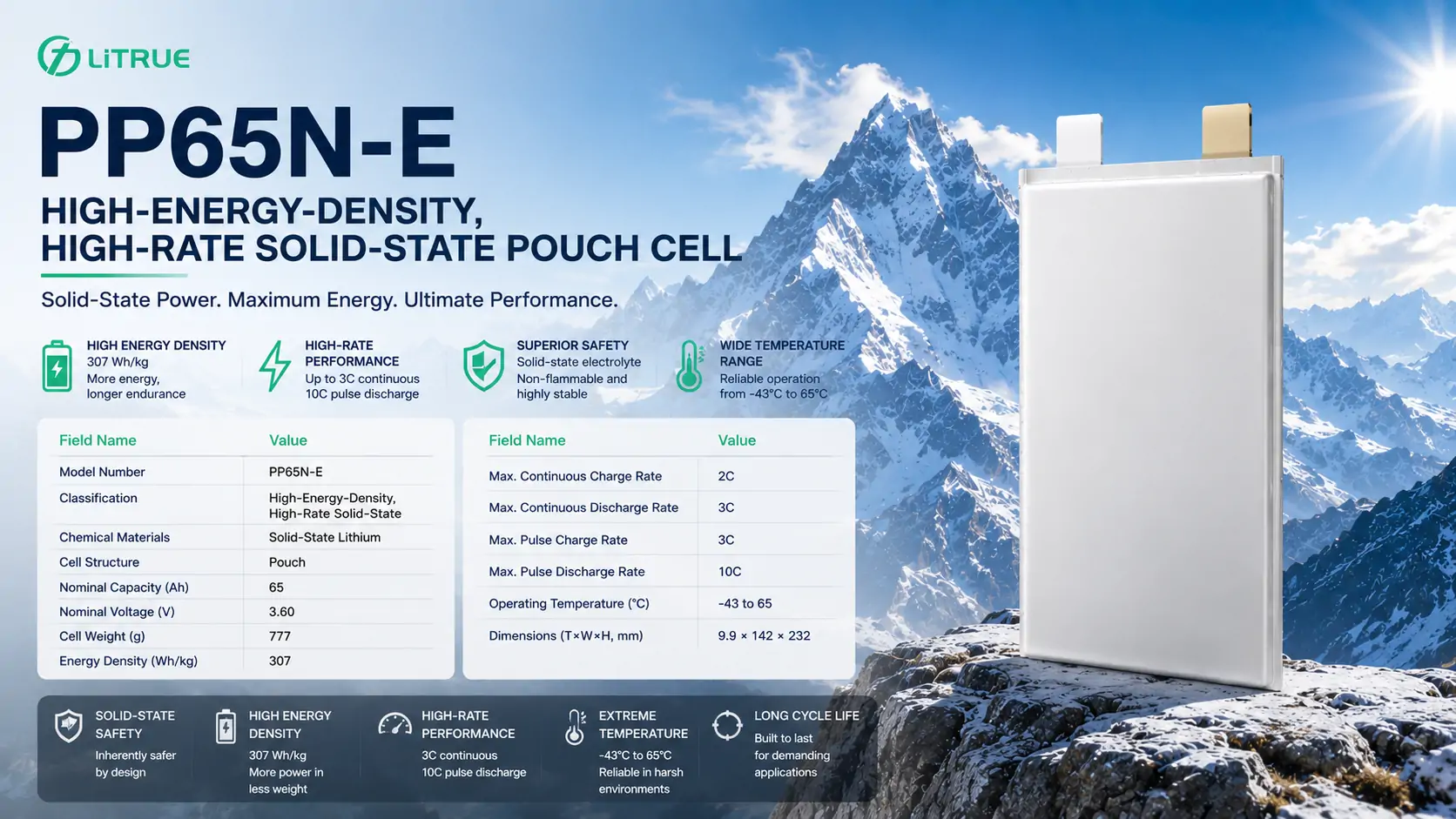
| Model | PP65N-E |
| Classification | High-Energy-Density, High-Rate Solid-State |
| Chemical Materials | Solid-State Lithium |
| Cell Structure | Pouch |
| Nominal Capacity (Ah) | 65 |
| Nominal Voltage (V) | 3.60 |
| Cell Weight (g) | 777 |
| Energy Density (Wh/kg) | 307 |
| Max. Continuous Charge Rate | 2C |
| Max. Continuous Discharge Rate | 3C |
| Max. Pulse Charge Rate | 3C |
| Max. Pulse Discharge Rate | 10C |
| Operating Temperature (°C) | -43 to 65 |
| Dimensions (T×W×H, mm) | 9.9 × 142 × 232 |
Other Cells in the High Energy Density High-Rate Solid-State Series
| Model | Capacity | Voltage | Weight | Continuous Rate | Pulse Rate | Operating Temp. | Dimension |
|---|---|---|---|---|---|---|---|
| PT18N-EB | 18Ah | 3.55V | 206g | 2C/5C | 3C/10C | -43℃~65℃ | 7.0×74×172mm |
| PT22N-EB | 22Ah | 3.55V | 250g | 2C/5C | 3C/10C | -43℃~65℃ | 8.5×74×172mm |
| PT25N-EB | 25Ah | 3.55V | 285g | 2C/5C | 3C/10C | -43℃~65℃ | 9.6×74×172mm |
| PT28N-EB | 28Ah | 3.55V | 313g | 2C/4C | 3C/10C | -43℃~65℃ | 10.5×74×172mm |
| PT30N-EB | 30Ah | 3.55V | 334g | 2C/4C | 3C/10C | -43℃~65℃ | 11.3×74×172mm |
| PE30N-EB | 30Ah | 3.60V | 336g | 2C/4C | 3C/10C | -43℃~65℃ | 8.8×87×187mm |
| PE32N-EB | 32Ah | 3.60V | 366g | 2C/3C | 3C/10C | -43℃~65℃ | 9.6×87×187mm |
| PE36N-EB | 36Ah | 3.60V | 404g | 2C/3C | 3C/10C | -43℃~65℃ | 10.5×87×187mm |
| PE40N-EB | 40Ah | 3.60V | 450g | 2C/3C | 3C/10C | -43℃~65℃ | 11.6×87×187mm |
| PE40N-PB | 40Ah | 3.50V | 427g | 3C/5C | 5C/15C | -43℃~65℃ | 11.4×87×187mm |
| PK50N-EB | 50Ah | 3.55V | 568g | 2C/4C | 3C/10C | -43℃~65℃ | 10.3×105×230mm |
| PP45N-E | 45Ah | 3.60V | 548g | 2C/4C | 3C/10C | -43℃~65℃ | 7.2×142×232mm |
| PP54N-E | 54Ah | 3.60V | 657g | 2C/3C | 3C/10C | -43℃~65℃ | 8.5×142×232mm |
| PP65N-E | 65Ah | 3.60V | 777g | 2C/3C | 3C/10C | -43℃~65℃ | 9.9×142×232mm |
| PT30N-EC | 30Ah | 3.50V | 308g | 1C/3C | 2C/6C | -43℃~65℃ | 10.5×74×172mm |
| PE40N-EC | 40Ah | 3.50V | 410g | 1C/3C | 2C/6C | -43℃~65℃ | 10.8×87×187mm |
Solution
High-power systems are often designed around a compromise: select a high-energy cell and accept reduced peak-current margin, or select a high-rate cell and add mass to recover runtime. That trade-off becomes more difficult when the system must also operate from -43°C to 65°C.
PP65N-E combines 65Ah capacity, 307Wh/kg energy density, 3C continuous discharge, and 10C pulse discharge in a 777g pouch cell. This gives integrators a usable starting point for applications where both sustained power and short high-current events matter. Explore LiTrue’s complete range of battery cells for additional capacity, format, and rate options.
Application Areas
- Heavy-Lift UAVs: supports sustained propulsion demand at 3C, with 10C pulse capability for takeoff and rapid maneuver events.
- eVTOL and Aviation Power Systems: 65Ah capacity and 307Wh/kg energy density help designers balance usable energy against system mass.
- High-Power Portable Equipment: accommodates applications that require repeated high-current loads rather than steady, low-rate discharge alone.
- Custom Battery Packs: the 3.60V nominal voltage supports series-parallel configurations for tailored DC system voltages; see LiTrue battery-pack solutions for pack integration support.
FAQs
What current can PP65N-E deliver?
At 65Ah, the 3C continuous discharge rating corresponds to 195A, while the 10C pulse discharge rating corresponds to 650A. Confirm pulse duration, cable sizing, thermal design, and protection settings for the final pack.
Can PP65N-E operate in cold and hot environments?
Yes. Its stated operating-temperature range is -43°C to 65°C. Actual capacity, charging behavior, and thermal performance should be validated under the project’s real load profile.
What nominal pack voltage can I build with PP65N-E?
Each cell is 3.60V nominal. A 12S configuration is 43.2V nominal, while a 14S configuration is 50.4V nominal. Contact LiTrue’s engineering team to scope a suitable series-parallel configuration.
What is the cycle life of PP65N-E?
Cycle-life data and test conditions for PP65N-E should be confirmed with engineering or laboratory documentation before being added to a customer specification. The result will depend on depth of discharge, current rate, temperature, and pack thermal management.