
Why battery service matters
Battery service is the structured practice of inspecting, testing, balancing, and maintaining battery systems to extend operational life and prevent unplanned failures. For industrial operators, fleet managers, and OEM engineers, a disciplined service program is one of the highest-return investments in any power-dependent operation.

Battery degradation is gradual but compounding
Lithium-ion cells degrade quietly. According to Recurrent Auto's analysis of EV battery health across millions of real-world miles, EV batteries typically lose capacity at roughly 1-2% per year under normal operating conditions. That rate sounds modest, but compounded across a five-to-ten-year service life, it translates directly into reduced range, shorter duty cycles, and eventual premature replacement. Catching degradation early, through regular service, is far less expensive than replacing a full pack.
Predictive maintenance is replacing the calendar-based approach
Traditional maintenance schedules run on fixed intervals. Modern battery service runs on data. Battery management systems (BMS) now stream real-time telemetry including state of health (SoH), cell voltage variance, temperature history, and charge cycle counts. At LiTrue, our analysis shows that operators who shift from time-based to telemetry-driven service intervals consistently identify stress events before they cascade into capacity loss or safety incidents. You can learn more about our manufacturing team and engineering methodologies across high-demand applications.
The business case is clear
Industrial and fleet operators who implement preventive battery service programs report saving 20-30% on replacement costs compared to reactive maintenance. Proper servicing also preserves warranty compliance, satisfies safety certifications, and keeps high-density cells, whether NMC pouch, LFP prismatic, or solid-state formats, operating within their validated performance envelopes.
What you'll need: Prerequisites and tools for battery service
Before beginning any battery service procedure, gather the right tools, data access, and safety equipment. Attempting diagnostics without complete instrumentation leads to incomplete assessments and missed fault conditions, particularly in high-density formats like solid-state or high-C-rate NMC pouch cells used across industrial lithium battery solutions.
BMS telemetry access and cloud dashboard
Your Battery Management System (BMS), the onboard electronics that monitor cell voltage, temperature, and state of charge, must be accessible before service begins. Confirm you have:
- Live telemetry access via a cloud dashboard or direct serial interface
- Historical cycle data covering at minimum the last 90 days
- Fault logs and state-of-health (SOH) trend reports exported and ready for review
Voltage and resistance testing equipment
A calibrated multimeter or dedicated battery analyzer is essential for verifying open-circuit voltage and internal resistance at the cell and pack level. Resistance drift is one of the earliest measurable indicators of degradation.
Battery health scoring and predictive maintenance software
Load your battery health scoring platform before the session. According to Battery University, tracking impedance growth and capacity fade over cycles is fundamental to predicting remaining useful life accurately.
Service documentation and manufacturer specifications
Keep the following on hand:
- Original manufacturer datasheets and diagnostic protocols for your specific cell format
- Previous service logs with cycle counts, temperature excursion records, and repair history
Safety equipment
Never begin battery service without:
- Insulated gloves rated for your pack voltage
- ANSI-rated eye protection
- A Class D or CO2 fire extinguisher within reach
- A non-conductive work surface and thermal barrier mat for pouch cell formats
Step 1: Perform initial battery inspection and data collection
Before any diagnostic software runs or a single cell is tested, a thorough physical and data-driven inspection establishes the baseline your entire service workflow depends on. This step captures the battery pack's current condition across visual, electrical, and thermal dimensions, giving you the evidence needed to make informed decisions in every step that follows.
Visually inspect the battery pack
Begin with a systematic external examination before connecting any diagnostic equipment.
- Check the enclosure for cracks, deformation, or impact marks that may indicate internal structural damage.
- Inspect pouch cells specifically for swelling or bulging, which signals electrolyte decomposition or gas generation inside the cell.
- Examine terminal connections and busbars for corrosion, discoloration, or signs of heat damage such as melted insulation or burn marks.
- Look for electrolyte leakage around cell edges or module seams. Even minor residue warrants immediate quarantine of the pack.
Document every finding with timestamped photographs. For high-density formats like NMC pouch cells, even subtle surface irregularities can indicate internal delamination.
Record ambient and operating conditions
Note the ambient temperature at the time of inspection. Lithium-ion chemistry is highly temperature-sensitive, and readings taken outside the 20-25°C reference range will skew your baseline comparisons. Log humidity levels if the pack operates in outdoor or industrial environments.
Access BMS telemetry and retrieve core data
Connect your diagnostic interface to the battery management system and pull the following parameters before any load is applied:
- Pack voltage and individual cell voltages to identify imbalance across the string
- State of health (SOH) percentage as reported by the BMS
- Cumulative cycle count and depth-of-discharge history
- Temperature distribution across all sensor nodes within the pack
- Historical fault codes or protection event logs
According to technical references on lithium degradation, cells self-discharge at roughly 1.5 to 2% per month under storage conditions, so a pack showing voltage depression beyond this range during idle periods points to an underlying cell-level fault rather than normal passivation.
Compare readings against baseline metrics
Cross-reference your retrieved data against the original manufacturer datasheet and any prior service records you gathered in the previous step.
- Flag any cell whose voltage deviates more than ±20 mV from the pack mean.
- Note temperature sensor readings that differ by more than 5°C from adjacent nodes, as uneven thermal distribution often precedes accelerated local degradation.
- Compare current SOH against the expected degradation curve for the cell's cycle count. Research suggests lithium-ion packs typically retain around 80% capacity at end-of-life thresholds, making any SOH reading that falls below this figure at low cycle counts a priority concern.
Record all anomalies in your service log before proceeding to BMS analytics in Step 2.
Step 2: Diagnose battery health using BMS analytics
With physical inspection complete and anomalies logged, shift your focus to the data layer. Pull the battery management system (BMS) logs and run structured analytics to quantify what visual inspection can only suggest. This step transforms raw telemetry into actionable health intelligence, giving you a defensible basis for every service decision that follows.
Pull and interpret BMS log data
Access the full historical log from the BMS, prioritizing three data streams: voltage curves across charge and discharge cycles, temperature profiles at the cell and module level, and discharge patterns showing capacity fade over time. Look for voltage curves that flatten prematurely during discharge, which typically indicate lithium plating or electrolyte degradation. Temperature profiles should be cross-referenced against the thermal anomalies flagged in Step 1 to confirm whether hotspots are systemic or isolated.
Export the raw data in a structured format before applying any filters. Unprocessed logs preserve edge-case events, such as brief over-discharge events or thermal spikes, that averaged data would otherwise mask.
Apply machine-learning analytics to detect degradation patterns
Standard threshold-based BMS monitoring catches obvious failures but misses subtle, progressive degradation. Apply machine-learning-enabled analytics to identify non-linear patterns across voltage, impedance, and temperature data simultaneously. Charge voltage has a compounding effect on cycle life: cells cycled to 4.20V typically deliver 300 to 500 cycles, while reducing the upper voltage limit to 3.90V can extend service life to 2,400 to 4,000 cycles. ML models can detect whether a pack's degradation trajectory matches a high-voltage stress pattern even when cycle count alone appears acceptable.
Calculate remaining useful life and generate a health score
Use cycle count, measured capacity, and voltage reduction data to calculate remaining useful life (RUL). Flag any cell showing elevated internal resistance or voltage drift beyond 20mV from the pack median, as these are leading indicators of imminent failure. Identify batteries approaching end-of-service thresholds and tag them for replacement planning in your asset management system.
Compile all findings into a health score report that benchmarks current performance against OEM specifications. This report becomes the reference document for Step 3, where cell balancing and charge voltage optimization will address the specific deficiencies the analytics have now identified.
Step 3: Balance cells and optimize charge voltage settings
With your health score report in hand, you now have a precise map of voltage disparities and capacity imbalances across the pack. Address these deficiencies directly by initiating cell balancing and recalibrating charge voltage parameters to match the actual condition of your cells.
Initiate cell balancing through the BMS
Activate either passive or active balancing through your BMS interface. Passive balancing dissipates excess energy from higher-voltage cells as heat, while active balancing redistributes charge between cells for greater efficiency. For high-capacity industrial packs such as the 100Ah high C-rate LFP prismatic battery cell or the 50Ah high-rate NMC pouch cell, active balancing is strongly preferred because it minimizes energy loss across a larger cell count.
Your target is a voltage spread within ±50mV across all cells, which is the typical manufacturer tolerance for a balanced, healthy pack. Document the total balancing duration and energy consumed during this process. These figures establish a baseline for future service intervals and help identify packs that are degrading faster than expected.
Monitor temperature throughout balancing
Keep a continuous watch on cell temperatures during the balancing cycle. Cells must remain within a safe operating range, typically between -43°C and 55°C, to avoid accelerated degradation. Elevated temperatures during balancing are an early warning sign of internal resistance buildup or compromised thermal pathways.
Reduce peak charge voltage to extend cycle life
Lower the peak charge voltage from the standard 4.20V to approximately 4.10V. Reducing charge voltage is one of the most effective levers for extending lithium-ion cycle life, with a full charge to 4.20V yielding roughly 300 to 500 cycles compared to significantly higher cycle counts at reduced voltage ceilings.
This single adjustment can extend usable pack life by 100 to 200%, a meaningful gain for OEMs operating large fleets or energy storage systems where replacement costs are substantial.
Update BMS firmware before finalizing settings
Check whether your BMS manufacturer has released updated firmware containing new balancing algorithms or voltage optimization profiles. Install verified updates before locking in your final charge voltage settings. Outdated firmware can undermine even well-calibrated hardware by applying suboptimal charge curves that accelerate cell stress over time.
Step 4: Execute preventive maintenance and thermal management
Preventive maintenance closes the gap between software-level optimization and real-world battery longevity. Physical upkeep of terminals, connectors, and thermal pathways directly determines how efficiently your cells charge, discharge, and shed heat under load.
Clean terminals and connectors to reduce resistance
Remove oxidation, corrosion, and debris from all battery terminals and connector interfaces using appropriate contact cleaner and non-abrasive tools. Even minor surface resistance generates localized heat that compounds under high-current draw. For high-C-rate cells like the 30Ah 5C fast-charging NMC pouch cell, clean contact surfaces are non-negotiable. After cleaning, verify connection torque values match manufacturer specifications.

Inspect and verify the thermal management system
Check cooling channels, heat sinks, and airflow paths for blockages or degraded thermal interface material. Confirm that all thermal sensors return accurate, consistent readings across the full operating temperature range. Replace thermal interface material wherever contact surfaces show dry spots or uneven compression marks. A compromised thermal path forces cells to operate at elevated temperatures, accelerating electrolyte degradation and capacity fade.
Test fast-charging behavior at reduced C-rates
Run a controlled fast-charge cycle at a reduced C-rate, typically 50 to 70 percent of the rated maximum, while monitoring cell-level temperature rise. According to the research paper on the impact of charging rates on battery life, higher charging rates correlate directly with accelerated capacity loss, making thermal monitoring during fast-charge testing a critical diagnostic step rather than an optional one.
Log all maintenance actions for compliance and warranty tracking
Record every maintenance action, including cleaning procedures, sensor readings, thermal material replacements, and fast-charge test results, in a structured service log. Accurate documentation supports warranty claims, regulatory compliance, and trend analysis across fleet deployments. Consistent logging also creates the baseline data your team will need in the next step when evaluating replacement criteria.
Step 5: Determine replacement criteria and end-of-life planning
With your maintenance logs and SOH data in hand, decide whether each battery continues to meet operational requirements or has reached the point where replacement delivers better value than continued service. This decision directly affects safety, system reliability, and total cost of ownership across your fleet. Sourcing engineers can reference our catalog of specialized lithium battery cells when planning scheduled pack overhauls.
Compare SOH against application-specific thresholds
Industrial and commercial applications typically set replacement thresholds between 70% and 80% SOH, but the right number depends on your specific use case. A drone platform requiring consistent hover performance may trigger replacement at 80%, while a stationary BESS buffer application may tolerate 70% before capacity loss meaningfully affects system output.
Pull your logged SOH trend data and plot the degradation curve. Lithium-based cells that have experienced frequent deep discharges or elevated temperatures degrade faster than cycle count alone would predict, making trend analysis more reliable than a single snapshot reading.
Assess cost-benefit of continued operation
Calculate the cost of keeping a degraded pack in service, including reduced runtime efficiency, increased thermal management demands, and the risk of unplanned downtime, against the capital cost of a replacement cell. In high-utilization commercial equipment, earlier cell replacement often reduces total operating cost by avoiding cascading failures.
Plan second-life use and recycling compliance
Batteries that fall below primary-use thresholds are not automatically end-of-life. Evaluate whether packs with 60-70% SOH qualify for lower-demand second-life applications such as backup power buffering. According to the UNDP Analysis of EV Battery End-of-Life, structured second-life pathways and documented recycling compliance are becoming regulatory expectations in major markets, not optional practices.
Document chemistry type, cell format, and disposal requirements for every retired pack, and coordinate with your OEM on warranty claims for any battery that fails before its rated cycle threshold.
Common mistakes to avoid during battery service
Even a well-structured battery service program can undermine pack longevity if routine errors go uncorrected. The six mistakes below are the most consequential ones encountered across drone, EV, BESS, and industrial applications. Identifying them early protects both your investment and your warranty position.
Ignoring BMS warnings until failure occurs
Battery management system alerts exist to trigger action, not to be logged and deferred. Dismissing repeated over-temperature, cell-imbalance, or over-discharge flags until a pack fails outright converts a minor service event into a full replacement cost.
Charging to maximum voltage continuously
High voltages and elevated temperatures are the two primary accelerants of lithium-ion degradation. Holding cells at 4.20V for every cycle measurably shortens calendar life. Where application duty cycles permit, target 4.10V or lower as your routine charge ceiling.
Neglecting thermal management
Allowing packs to operate regularly above 55°C compounds electrochemical stress with every cycle. For extreme environmental deployments, specifying robust chemistries like high-temperature LFP pouch cells helps mitigate accelerated electrolyte breakdown.
Skipping cell balancing
Unbalanced cells force stronger cells to compensate for weaker ones, accelerating uneven degradation across the pack. Always complete a full balance cycle before returning a pack to service.
Failing to document service history
Incomplete service records are the single most common reason warranty claims are disputed. Log every inspection, balance cycle, capacity test, and charger used, including the cell chemistry and format.
Using incompatible or uncalibrated service equipment
Chargers and diagnostic tools not matched to your specific chemistry, whether NMC, LFP, or solid-state anode-free cells, introduce voltage and current inaccuracies that accumulate into measurable capacity loss. Confirm equipment calibration before every service session.
Troubleshooting: Addressing common battery service issues
Even with careful preparation, unexpected problems surface during battery service. Knowing how to diagnose and resolve them quickly prevents minor anomalies from becoming permanent capacity loss or safety incidents. The subsections below map each symptom to a targeted corrective action.
Rapid voltage drop under load
A sudden voltage collapse typically signals increased internal resistance or cell imbalance rather than total cell failure. Run a full diagnostic test using calibrated equipment to isolate which cell or group is responsible, then assess whether a balancing cycle can recover the pack or replacement is required.
Inconsistent cell voltages reported by the BMS
Execute a complete balancing cycle and allow it to finish without interruption. If voltage spread persists, verify that BMS voltage sensors are correctly seated and recalibrate them against a known reference. Cell imbalance accelerates degradation and should be corrected at the earliest opportunity.
Inaccurate temperature readings
Inspect all thermal sensors for physical damage, corrosion, or loose harness connections. A single faulty sensor can cause the BMS to mismanage charge rates across the entire pack. Recalibrate sensors after any repair.
Battery fails to hold charge after service
Confirm that charger output voltage and current match the battery's specification exactly. If parameters are correct, test for an internal short using insulation resistance measurement before returning the pack to service.
Service software fails to connect to the BMS
Check communication cable continuity first. If the cable is intact, update driver software and firmware to the versions specified by your BMS supplier. Incompatible firmware versions are a frequent but easily overlooked cause of connection failures.
Swelling or physical deformation
Stop use immediately. Swelling indicates internal pressure buildup consistent with an internal short or electrolyte decomposition. Isolate the pack in a fireproof container, document the condition thoroughly, and initiate a defect assessment before any further handling.
Why this method works: The science behind battery service
Understanding the electrochemical principles behind professional battery service explains why structured maintenance protocols consistently outperform reactive, break-fix approaches. The science is clear: degradation is not random. It follows predictable chemical pathways that targeted interventions can slow, redirect, or in some cases partially reverse.
Charge voltage and cycle life
Voltage management is one of the highest-leverage variables in battery service. Reducing charge voltage from the maximum rated level to a conservative threshold can extend cycle life by 400 to 800%, because lithium plating and cathode stress increase sharply near full charge. For high-energy cells like anode-free solid-state chemistries, this effect is even more pronounced given their tighter electrochemical tolerances.
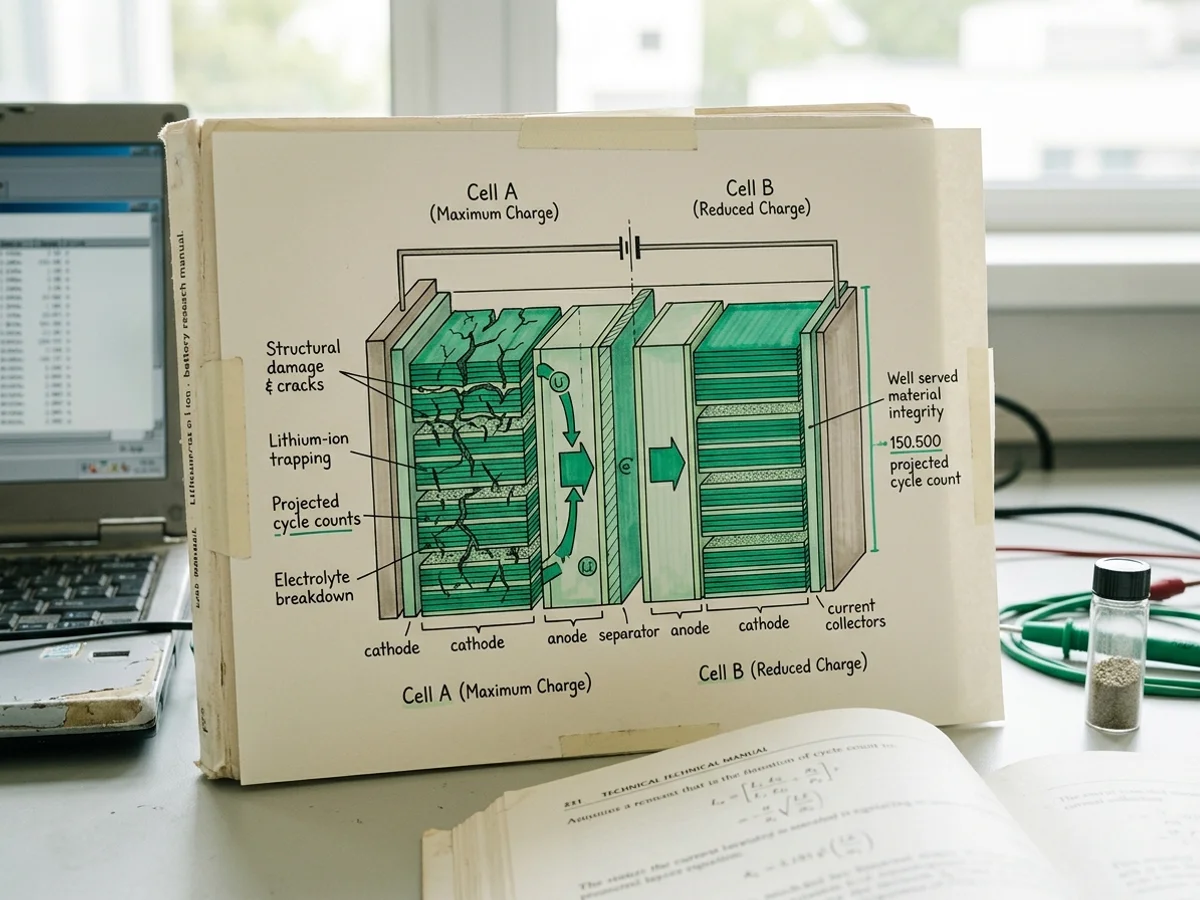
BMS telemetry and real-time cell health
Battery management system telemetry eliminates guesswork by continuously monitoring individual cell voltages, temperatures, and state-of-charge deltas. This granular data stream allows service technicians to detect early-stage capacity fade before it cascades into pack-level failure.
Cell balancing and uniform degradation
Regular balancing distributes charge and discharge stress evenly across all cells in a pack. Without it, weaker cells absorb disproportionate stress, accelerating their decline and dragging overall pack performance down with them.
Thermal management and reaction kinetics
Heat accelerates the chemical side reactions responsible for capacity fade, particularly electrolyte oxidation and solid electrolyte interphase growth. Maintaining cells within their optimal thermal window directly reduces the rate of these reactions, preserving usable capacity over thousands of cycles.
Machine learning and fleet-scale pattern recognition
At fleet scale, machine-learning analytics identify degradation signatures that no human technician could detect manually across thousands of data points. Predictive models trained on real-world telemetry can flag packs approaching end-of-life weeks before measurable performance loss appears, enabling proactive service scheduling rather than emergency replacement.
Alternative methods: Time-based vs. condition-based service
Choosing the right maintenance strategy directly determines how much value your battery service program delivers. The three primary approaches each suit different operational contexts, and selecting the wrong one means either overspending on unnecessary service or underprotecting critical assets.
Time-based maintenance
Time-based service schedules inspections and interventions at fixed intervals, typically every three or six months, regardless of actual battery condition. This approach is straightforward to administer and requires no monitoring infrastructure, making it a practical starting point for smaller fleets or operations with limited telemetry capability. The tradeoff is inefficiency: healthy packs receive unnecessary service while degraded ones may deteriorate between scheduled visits.
Condition-based maintenance
Condition-based maintenance triggers service actions when BMS health scores or diagnostic thresholds cross defined limits. Service only occurs when data justifies it, eliminating calendar-driven waste. This method suits mid-to-large fleets where monitoring hardware is already embedded in the pack architecture.
Predictive and hybrid approaches
Predictive maintenance extends condition-based logic by using machine-learning models to forecast failures before thresholds are breached. A hybrid approach combines scheduled physical inspections with continuous telemetry monitoring between visits, capturing the reliability of fixed schedules alongside the precision of real-time data. Research suggests condition-based and predictive strategies reduce unnecessary service costs by 30 to 40 percent compared to time-based programs alone. Operators can explore technical articles on our battery engineering blog to see how hybrid telemetry architectures are implemented in field fleets.
Select your approach based on three factors: fleet size, the operational cost of unplanned downtime, and the monitoring infrastructure your battery packs already support.
Real-world example: Battery service in an electric vehicle fleet
This scenario illustrates how structured battery service translates into measurable outcomes at scale. A fleet operator managing 250 electric vehicles, each carrying two battery packs, monitors 500 units through a centralized cloud dashboard that aggregates BMS telemetry in real time. Engineering teams can review similar commercial validation records across our OEM client case studies.
Identifying the outlier
During a routine health-scoring review, one battery pack flags a range loss of 3% over twelve months. Healthy EV batteries typically degrade at 1 to 2% per year, making this unit a clear statistical outlier against the rest of the fleet.
Diagnosing the root cause
Deeper diagnostic analysis reveals two compounding issues: unbalanced cells within the pack and a charge voltage ceiling set at 4.20V. Consistently charging to maximum voltage accelerates lithium plating and electrolyte stress, shortening overall pack service life.
Applying targeted service
The service team performs a full cell-balancing procedure and lowers the charge voltage ceiling from 4.20V to 4.10V. Both interventions are logged against the vehicle's digital service record.
Measuring the outcome
Post-service telemetry confirms the pack's degradation rate returns to the fleet average of 1 to 2% per year. The preventive intervention extends projected battery life by an estimated 18 to 24 months, avoiding a premature replacement cost of approximately $12,000 per vehicle.
Time and cost breakdown: What to expect
Understanding the time and financial investment in battery service helps OEMs and fleet operators plan maintenance budgets accurately. A complete service cycle typically runs 4 to 10 hours per battery and costs $200 to $500, a fraction of the replacement cost it protects against.
Initial inspection and data collection
Technicians begin by physically inspecting the pack and pulling historical usage data. This stage takes 30 to 45 minutes per battery and establishes the baseline for every decision that follows.
BMS diagnostics and health analysis
Automated BMS diagnostic software accelerates this phase considerably, compressing a detailed health analysis into 15 to 30 minutes. The software flags cell voltage deviations, capacity fade, and thermal anomalies without manual interpretation at every step.
Cell balancing
This is the most time-variable stage. Minor imbalances resolve in roughly 2 hours, while severe divergence across a large pack can require up to 8 hours of active balancing.
Preventive maintenance and thermal checks
Physical inspection of cooling systems, connector integrity, and thermal interface materials adds 45 to 60 minutes to the service cycle.
Cost and return on investment
| Service stage | Time estimate |
|---|---|
| Inspection and data collection | 30 to 45 min |
| BMS diagnostics | 15 to 30 min |
| Cell balancing | 2 to 8 hours |
| Thermal and preventive checks | 45 to 60 min |
| Total per battery | 4 to 10 hours |
At $200 to $500 per service cycle, the cost-benefit case is straightforward. Proactive management of charge thresholds and thermal conditions measurably extends lithium battery lifespan. Given that replacement costs for advanced packs typically range from $2,000 to $8,000 per unit, a single well-executed service cycle can deliver a return exceeding 10x the labor investment.
Conclusion: Implement battery service for long-term reliability
Battery service is not a one-time corrective action. It is a continuous operational discipline that compounds in value over time. The manufacturers and fleet operators who extract the most from their battery assets treat service as a strategic investment, not a reactive expense.
Shift from scheduled to predictive maintenance
Move beyond fixed-interval servicing. Use BMS telemetry, capacity trend data, and cycle logs to trigger service actions based on actual degradation rather than calendar dates. This approach reduces unnecessary interventions and catches genuine failures before they cascade.
Document every service action
Maintain detailed records of each service cycle, including capacity measurements, thermal readings, cell balance data, and any corrective actions taken. Accurate documentation supports warranty compliance, informs replacement planning, and provides the performance baseline your fleet needs for continuous improvement.
Partner with chemistry-specific service providers
Work with OEM-approved providers who understand your specific cell chemistry and pack architecture. When integrated systems reach end-of-life, sourcing turnkey custom lithium battery packs ensures optimized mechanical and BMS compatibility from day one.
Invest in training and service tooling
Equip your technical teams with the software, diagnostic hardware, and training to monitor degradation trends at the fleet level. Optimizing charging protocols based on real usage data can extend usable lifespan by 18 to 24 months and significantly defer replacement capital expenditure. For technical inquiries, custom diagnostic protocols, or replacement cell evaluations, contact our engineering team directly.
Faqs
What is battery service?
Battery service covers the full range of diagnostic, maintenance, and optimization activities performed on a battery system to preserve capacity, safety, and cycle life. It includes cell-level testing, BMS calibration, thermal inspection, and protocol adjustment. It is not limited to replacement.
How often should a lithium battery be serviced?
Service intervals depend on application intensity and chemistry. As noted by the Clean Energy Institute at the University of Washington, lithium-ion batteries are comparatively low maintenance and do not require scheduled cycling. For high-demand industrial or UAV applications, quarterly diagnostics are a practical baseline.
What are the signs a battery needs to be replaced?
Key indicators include capacity falling below 80% of rated value, swelling, rising internal resistance, and inconsistent cell balancing. Repeated thermal events or BMS fault logs that persist after recalibration also signal end-of-life.
Can a battery be repaired or reconditioned?
Individual cells showing early-stage degradation can sometimes be reconditioned through controlled discharge-charge cycling and BMS recalibration. However, cells with physical damage, lithium plating, or severe capacity loss typically require replacement rather than reconditioning.
How do you maintain lithium-ion battery health?
Avoid sustained high state-of-charge storage, limit exposure to elevated temperatures, and apply charging protocols matched to your cell chemistry. Reducing peak charge voltage meaningfully extends cycle life, with cells charged to conservative voltage thresholds delivering significantly higher cycle counts.
What does battery service include?
A complete battery service typically covers capacity testing, impedance spectroscopy, thermal imaging, BMS firmware review, connector inspection, and updated charge protocol recommendations. For fleet operators, it also includes trend reporting across multiple units.
How long does battery service take?
Routine diagnostic battery service on a single pack generally takes two to four hours. Full fleet audits or deep reconditioning workflows may require additional balancing time depending on string size and imbalance severity.