
An FPV Drone battery is not just a box of stored energy. For pilots, drone builders, fleet buyers, and OEM procurement teams, it decides throttle response, flight time, payload margin, charging downtime, warranty risk, and even whether the shipment clears transport review without a painful delay.
From our factory-side conversations with UAV customers, the same misunderstanding shows up again and again: buyers compare capacity first. They ask for more mAh, then wonder why the aircraft sags under load or why a pack that looked good on paper feels lazy in the air. FPV power is different. You are buying current delivery, weight control, cell matching, thermal behavior, connector design, and proof that the pack was built for the discharge profile you actually fly.
Author Perspective: This guide is written from LiTrue UAV battery engineering and factory quotation perspective, using published product specifications, B2B battery selection experience, and transport guidance from recognized aviation and hazardous-material sources.
Table of Content
1. What an FPV Drone Battery Must Do
2. What Batteries Do FPV Drones Use?
3. Product Deep Dive: 51.8V 28Ah NMC Drone Battery
4. Alternative Comparison: LiPo, Li-ion, LiHV, LFP, and Custom UAV Packs
5. FAQs
6. Summary
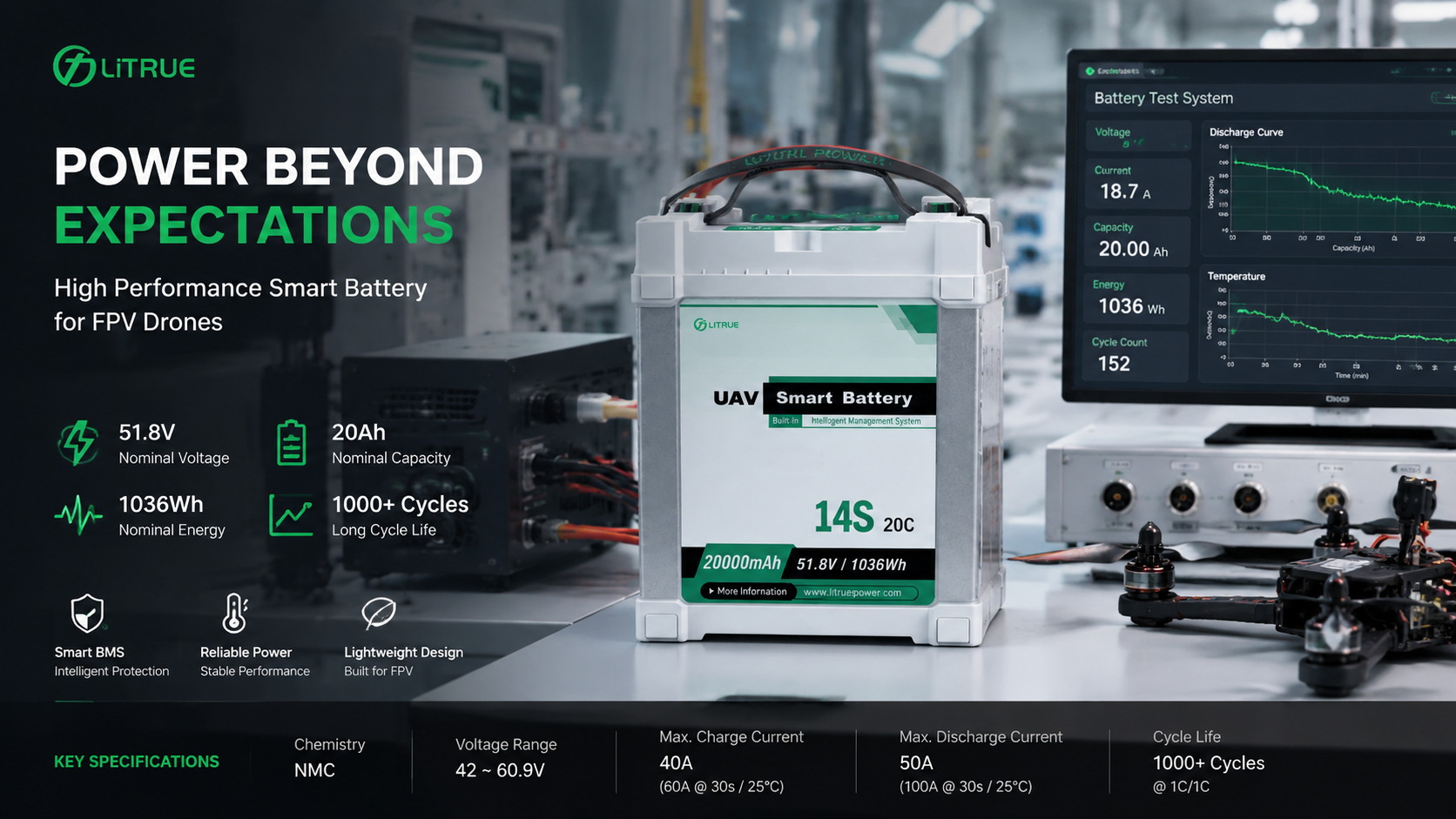
What an FPV Drone Battery Must Do
Key Features Buyers Should Check First
A good FPV power pack must deliver high current without a steep voltage drop. That is why a LiPo battery is still the common answer for racing, freestyle, cinewhoop, and many custom FPV platforms. The chemistry and pouch format give the pack strong discharge behavior in a compact shape. For B2B buyers, though, the real checklist is more specific: nominal voltage, usable voltage range, continuous discharge current, peak discharge current with time limit, weight, charge current, cycle life, connector rating, BMS design, operating temperature, and certification.
Missing Features That Cause Field Problems
Many FPV packs do not include a smart BMS, CAN communication, waterproof housing, traceable test summaries, or a pack-level enclosure. That is normal for hobby-class packs. It becomes a problem when the aircraft moves into inspection, mapping, industrial security, emergency response, agriculture, or logistics. At that point, buyers need more than a printed C rating. They need pack data that a technician, purchasing manager, and compliance team can all read without guessing.
Truth You Should Know Before Buying
The uncomfortable truth is that “more capacity” can make a drone worse. A heavier pack may extend hover time on a spreadsheet but reduce maneuverability, increase motor temperature, overload the frame, or push the takeoff weight into another compliance bracket. The better question is: how many amps does your aircraft pull at hover, climb, full throttle, and emergency return? Once you know that, battery selection becomes much cleaner.
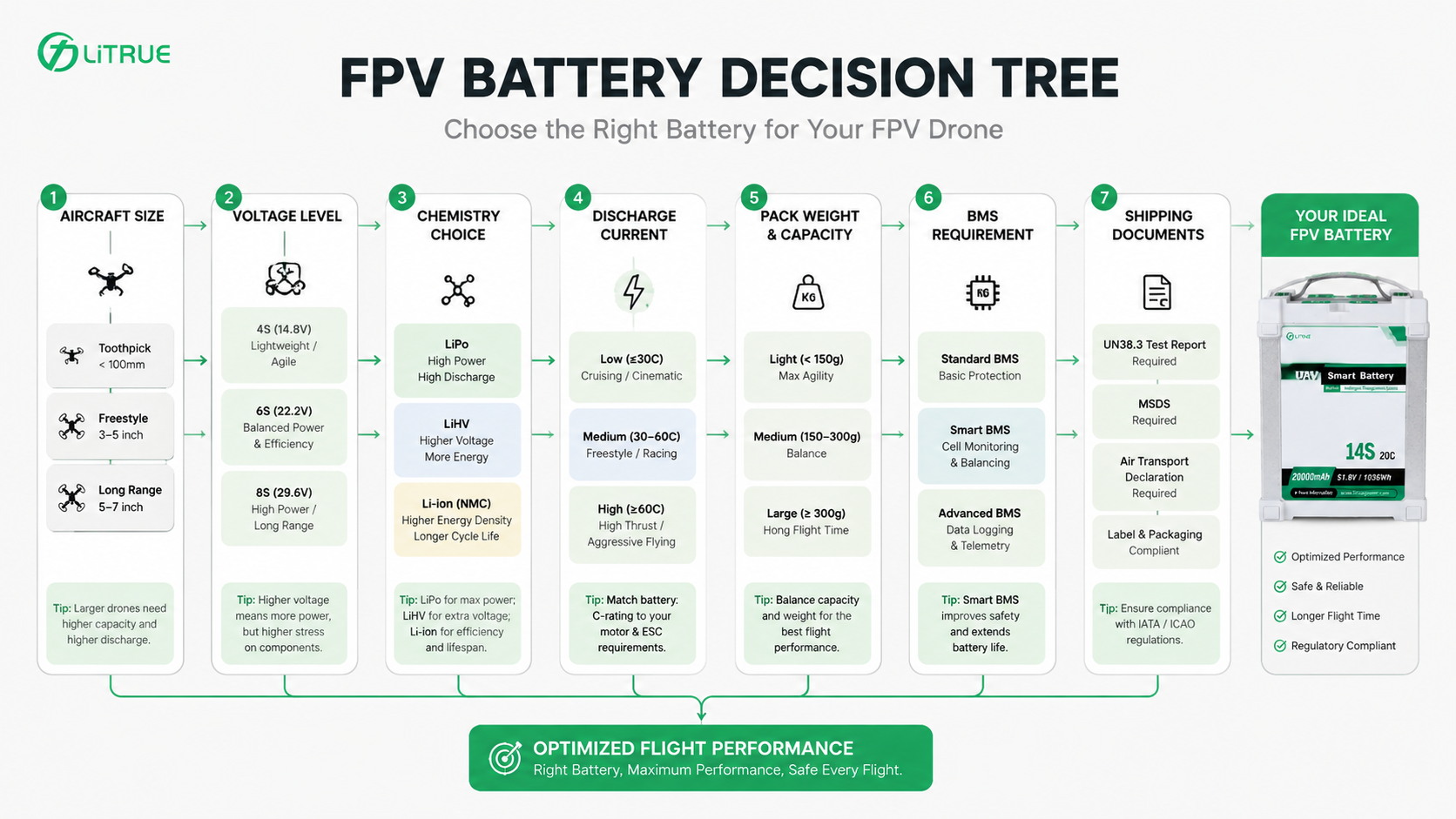
What Batteries Do FPV Drones Use?
LiPo Battery for Racing, Freestyle, and Cinewhoop Builds
Most FPV drones use lithium polymer packs, usually called LiPo packs. A tiny whoop may use a 1S pack. A 5-inch freestyle quad often uses 4S or 6S. Larger FPV platforms can move above that, especially when the aircraft carries cameras, sensors, lights, or a heavier airframe. The reason is simple: FPV motors can demand hard bursts of current. A LiPo battery handles those bursts better than a typical cylindrical consumer cell pack.
Li-ion Battery Pack for Long-Range FPV
A Li-ion battery pack makes sense when the mission is steady flight rather than aggressive throttle punches. Long-range FPV pilots often accept softer acceleration in exchange for better energy density. For a smooth cruise aircraft,that trade can work. For racing or heavy freestyle, it usually feels weak because the pack cannot deliver the same burst current without sag. Procurement teams should avoid mixing these use cases in one spec sheet.
LiHV and High-Rate Battery Cell Options
LiHV packs charge to a slightly higher cell voltage than standard LiPo packs, so they can give a fresh-pack voltage advantage. That advantage fades as the pack discharges, and it brings stricter charging discipline. For OEM development, the deeper issue is cell selection. A verified high-rate battery cell can be a better starting point than chasing a flashy label, especially when the aircraft has repeatable current peaks and the buyer needs batch consistency.
Battery C Rating: Useful, but Not Enough
Battery C rating is supposed to show how quickly a pack can discharge relative to its capacity. A 5Ah pack rated at 20C should theoretically provide 100A. In real purchasing work, we treat that as a starting clue, not the final answer. Ask for continuous current, pulse current, pulse duration, test temperature, voltage sag data, and connector rating. If a supplier cannot explain the test condition behind the rating, the number is marketing, not engineering.
Product Deep Dive: 51.8V 28Ah UAV-JP328L NMC Drone Battery
Unique Selling Points
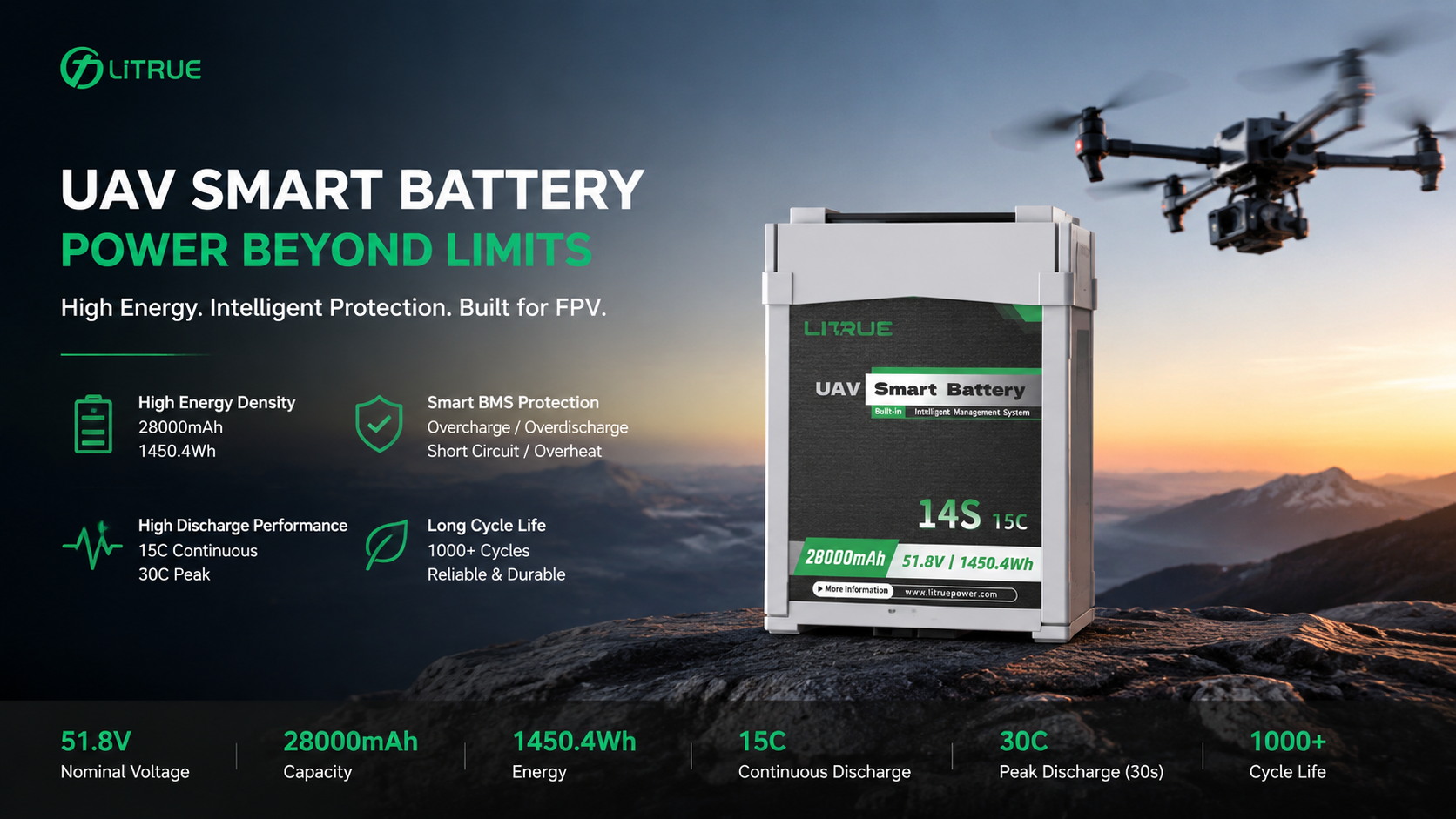
The LiTrue UAV-JP328L is a 51.8V 28Ah NMC pack built in a 14S1P configuration. Its published nominal energy is 1.45 kWh, with an operating voltage range of 42V to 60.9V. The pack weighs 8.7 kg and measures 238 x 129 x 332 mm. For current delivery, the specification lists 140A maximum continuous discharge and 280A peak discharge for up to 10 seconds at 25 degrees Celsius. That is the kind of data B2B buyers should ask for before they design around a pack.
The pack also includes CAN communication, overcharge alarm, over-discharge alarm, over-current alarm, IP65 protection, and a published cycle life of 1000 cycles at 1C/1C. The product page lists RoHS, UL 2054, and UN38.3 certifications, plus GB/T 38058-2019, GB 31241-2022, and GB/T 38930-2020 design standards.
Audience Intent Match
This product is a fit for industrial UAV teams, heavy-lift drone builders, mapping platforms, inspection aircraft, and B2B buyers evaluating a higher-voltage UAV lithium pack with smart communication and a protected enclosure. It is also a useful reference point for companies that came from small FPV packs and are now building a larger FPV-style platform for commercial work.
It is not the right intent match for a 3-inch cinewhoop, a 5-inch racing quad, or a backpack hobby kit. At 8.7 kg, this pack belongs to a different class of aircraft. That matters. Trying to use an industrial pack as a direct substitute for a small freestyle LiPo would be the wrong design path.
Performance Evaluation by Decision Factor
For voltage, 51.8V gives the aircraft a higher operating platform than common 4S or 6S FPV packs. For current, 140A continuous discharge and 280A peak discharge give engineers clear limits to model against. For energy, 1.45 kWh supports longer working missions than small-format FPV packs. For thermal planning, the discharge temperature range is published as -40 degrees Celsius to +60 degrees Celsius, while charging is listed from 0 degrees Celsius to +55 degrees Celsius.
For charging uptime, the maximum continuous charging current is 56A, with a peak charging current of 84A for up to 30 seconds at 25 degrees Celsius. For lifecycle planning, 1000 cycles at 1C/1C helps fleet operators estimate replacement intervals. For field handling, IP65 protection and CAN communication make the pack easier to integrate into a professional UAV system than a bare hobby pack.
Design & Usage
The design points toward industrial use: protected housing, communication, alarms, and a defined operating envelope. In practice, that means the user is not only flying the pack. The user is monitoring it, logging it, charging it in batches, assigning it to aircraft, and making maintenance decisions from data. That is the difference between a battery bought by a pilot and a battery bought by a fleet manager.
Customization
Custom pack work usually starts with voltage, capacity, current, dimensions, connector type, communication protocol, enclosure, mounting method, and certification needs. For a custom UAV battery, we would ask for motor data, ESC rating, maximum takeoff weight, expected flight profile, peak current duration, charger plan, and shipping destinationbefore recommending a pack shape.
Limitations: What Not to Expect From This Pack
The UAV-JP328L is not a small FPV racing battery. It is not designed for pocket-size builds, casual field charging, or pilots who only need a few minutes of freestyle flight. It also should not be selected by voltage alone. Buyers still need to confirm aircraft compatibility, connector requirements, mounting space, charger compatibility, communication integration, and final regulatory needs for the destination market.
Pros
Pros: 51.8V nominal voltage, 28Ah capacity, 1.45 kWh nominal energy, 140A continuous discharge, 280A 10-second peak discharge, CAN communication, IP65 enclosure, UN38.3 listing on the product page, and 1000-cycle specification at 1C/1C.
For industrial UAV teams evaluating a higher-voltage FPV-style power platform, review the factory specifications for this UAV lithium battery and request a quote with your aircraft current profile, connector requirement, and annual volume.
Similar Products
Similar references include higher-voltage smart drone battery packs, lighter 51.8V UAV packs, and agriculture drone packs for crop-sprayer platforms. Use them as comparison points, not automatic substitutes. A pack that works for mapping may be wrong for spraying, and a pack that works for spraying may be too heavy for inspection work.
Alternative of Comparison
Standard FPV LiPo Packs
Standard LiPo packs are the default choice for most FPV builds because they deliver hard current in a light package. They are easy to source and available in many cell counts. The downside is that many are bare packs with limited smart protection, limited traceability, and a service life that depends heavily on charging habits, storage voltage, crash damage, and heat. For a hobby pilot, that may be acceptable. For a business buyer, it needs tighter control.
Li-ion Long-Range Packs
Li-ion packs are attractive when the aircraft flies smoothly for distance. They can give better endurance per gram in the right use case. The tradeoff is current delivery. If your drone needs fast punch-outs, aggressive turns, or repeated climb bursts, a Li-ion pack may sag and feel underpowered. Long-range teams should test hover, cruise, and return-to-home current before scaling purchases.
LiHV Packs
LiHV packs can help pilots who want a little more voltage at the start of a run. They are common in some racing and performance circles. The penalty is stricter charging behavior and the need to verify whether the benefit holds across the real mission, not just the first 30 seconds. For OEM buyers, LiHV is a test decision, not a catalog shortcut.
LFP and Lithium Pouch Cells
LFP is often chosen for cycle life, thermal stability, and safety-focused applications, though it usually carries lower energy density than NMC. For B2B design teams, the better question is not “Which chemistry is best?” It is Which chemistry matches the aircraft’s current profile, weight budget, operating temperature, and service-life target?” If you are still at the cell-selection stage, start by comparing proven lithium cells before locking the mechanical design.
Smart Drone Battery Packs
Smart packs with BMS communication are better for fleets because they support data-driven maintenance. They can report pack status, alarms, and sometimes cycle information. They cost more than basic FPV packs, but they reduce guesswork. For a commercial drone battery program, that difference can matter more than saving a few dollars per pack.
Shipping and Compliance Comparison
Battery choice also affects transport. The FAAlithium battery resources explain that lithium batteries are treated carefully in air transport, including watt-hour limits for passenger travel. For commercial shipping, the PHMSA lithium battery transport guidance notes that lithium batteries are regulated hazardous materials and that lithium cells and batteries offered for transport must have passed UN 38.3 design tests. This is why serious buyers ask for documents early, not after the order is packed.
FAQs
What battery do most FPV drones use?
Most FPV drones use LiPo batteries because they deliver high current in a low-weight pouch format. Small whoops may use 1S packs, while 5-inch freestyle drones commonly use 4S or 6S packs. Larger commercial FPV-style UAVs may use custom NMC, LFP, or smart lithium packs depending on payload and flight profile.
Is LiPo better than Li-ion for FPV?
LiPo is usually better for racing, freestyle, and cinematic flying that needs fast throttle response. Li-ion can be better for long-range cruising where current demand is steadier. Neither option wins every mission. Match the chemistry to current draw, weight, runtime target, and temperature conditions.
What does 6S mean on an FPV battery?
6S means six cells in series. More series cells increase voltage. Higher voltage can reduce current for the same power level, but the aircraft’s motors, ESCs, flight controller, and accessories must be rated for it. Do not move from 4S to 6S unless the full power system supports the change.
How do I calculate battery C rating?
Multiply capacity in amp-hours by the C rating. A 1.5Ah pack rated at 100C would claim 150A. In real buying work, ask for test data because C ratings are not always measured the same way across suppliers. Continuous current and peak current with time limits are more useful for engineering decisions.
How long does an FPV drone battery last in flight?
Small racing and freestyle drones often fly for only a few minutes because they pull high current. Long-range FPV aircraft may fly much longer with the right Li-ion or custom pack. Industrial UAVs can run longer still, but only when the aircraft is designed around the battery weight, voltage, and discharge limits.
Can FPV drones use NMC or LFP batteries?
Yes, but usually in larger or custom platforms. NMC can provide strong energy density and power output. LFP can offer cycle-life and safety advantages in selected designs. For small hobby FPV builds, standard LiPo packs remain more common because they are light, available, and responsive.
What certificates should B2B buyers ask for?
Ask for UN38.3 documentation first when shipping is involved. Depending on the market and application, you may also need RoHS, UL-related documents, MSDS, IEC-related testing, or local transport paperwork. The exact requirement depends on destination, shipping mode, pack size, and how the battery is installed or sold.
When should I choose a custom pack instead of an off-the-shelf FPV battery?
Choose a custom pack when the aircraft has a fixed enclosure, unusual connector, defined fleet charger, smart communication need, high current peak, wide-temperature mission, or compliance requirement. Off-the-shelf packs are faster for prototypes. Custom packs make sense when the product moves toward repeat production.
Summary
So, what batteries do FPV drones use? Most small FPV drones use LiPo batteries. Long-range FPV aircraft may use Li-ion packs. Larger commercial FPV-style UAVs may move to smart NMC, LFP, or custom lithium pouch cell packs. The right FPV Drone battery is the one that matches current demand, voltage, weight, thermal range, charging plan,documentation, and the real mission profile.
For B2B buyers, the smartest next step is to stop comparing only mAh and start comparing usable power. Ask forcontinuous discharge, peak discharge with duration, voltage range, pack weight, cycle life, charging current,communication features, protection design, and transport documents. That is how you avoid a pack that looks good in acatalog but disappoints in the air.