
Last August, a marine mechanic from Florida called us. He'd been running a charter fishing boat — twin 250HP outboards — and he was replacing his lead-acid cranking batteries every season. Every. Single. Season. Salt air, heat, vibration. The batteries would die by October. He'd tried AGM. He'd tried gel. Same result. "I'm done with lead-acid," he told us. "Can I just throw a lithium battery in there and be done with it?"
We told him the same thing I'll tell you now: yes, you can use a lithium battery as a cranking battery. We've helped dozens of customers — motorcycle OEMs, generator rental companies, agricultural fleet operators, marine guys like him. But it's not a blind swap. There are three things you have to get right, and if you skip any of them, you'll have problems. The first is picking the right cell — not just any lithium cell, but one rated for high pulse discharge. The second is the BMS. The third is your charging system. Miss one and you'll be calling us back in four months asking why your pack shut down during a cold start. We've seen it happen. More than once.
Anyway. Let me walk through the whole thing properly.
Table of Content
- Overview / Truths
- Product Deep Dive: High C-rate LFP Pouch Cells for Cranking
- Alternative of Comparison
- FAQs
- Summary
Overview / Truths
So what does a cranking battery actually do? It's simpler than people think. You turn the key. The battery sends a huge spike of current to the starter motor — somewhere between 150A and 600A, depending on engine size. That spike lasts maybe 3 to 10 seconds. Then the alternator kicks in and the battery just sits there getting recharged. That's the whole job. The spec that defines this ability is Cold Cranking Amps, or CCA. Forget reserve capacity. Forget amp-hours. For starting, CCA is the only number that matters.
Now. Can a lithium cell deliver that kind of instantaneous punch? Yes — but only if it's the right kind of lithium cell. And this is where people get into trouble.
The lithium cells in your phone or laptop are energy cells. They're designed to discharge slowly — 0.5C, maybe 1C — and last a long time between charges. You try to pull 300A from one of those and the protection circuit trips instantly. Or worse, the cell overheats. For cranking, you need high C-rate cells. Cells specifically built to handle massive current spikes for short durations.
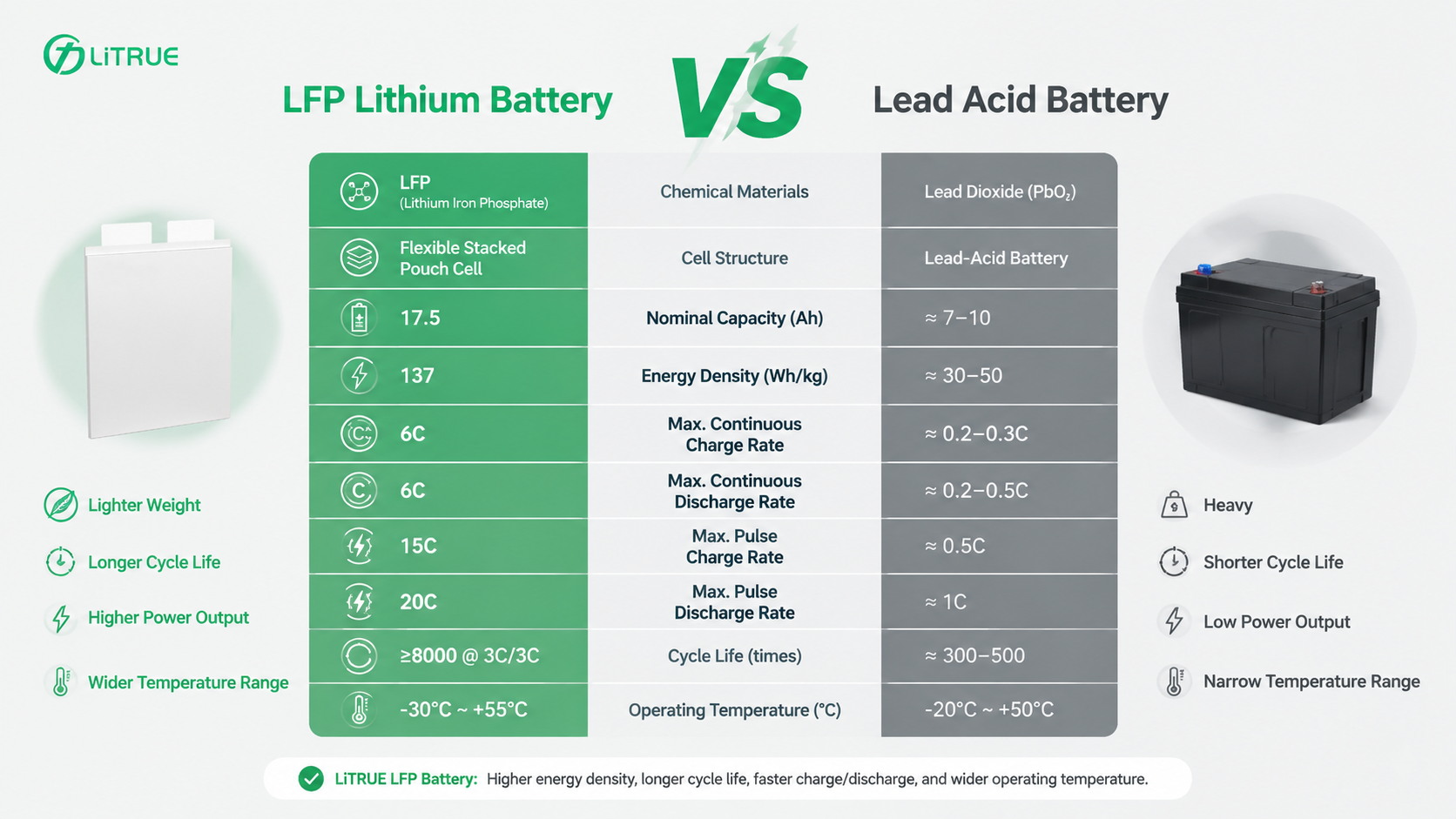
We make those cells at LiTrue. Our 17.5Ah LFP pouch cell is rated at 20C pulse discharge. One cell. 350A of peak current for 10 seconds. Four of those in series gives you a 12.8V cranking pack that weighs about 3.5 kg. A comparable lead-acid Group 27 battery? 25 to 30 kg. Same cranking power. Fraction of the weight.
But — and I keep telling people this until I'm blue in the face — the cell is not the part that fails. The BMS is. Two years ago we had a fleet customer in Southeast Asia. Forty agricultural tractors. He bought cheap lithium starter batteries from some online supplier. Within six months, twelve of them were dead. Not the cells. The BMS. The protection MOSFETs were undersized for the cranking current spikes. Every time a tractor tried to start in the morning cold, the BMS tripped and shut the whole pack down. Crops didn't get sprayed. Fields got missed. That's real money lost.
We rebuilt those packs with properly rated BMS units — 1.5x the peak current headroom — and every single one has run for over two years without a failure. Same cells. Completely different result. That's the story. The BMS matters more than the cell for cranking applications. Possibly more than everything else combined.
Product Deep Dive: High C-rate LFP Pouch Cells for Cranking Applications
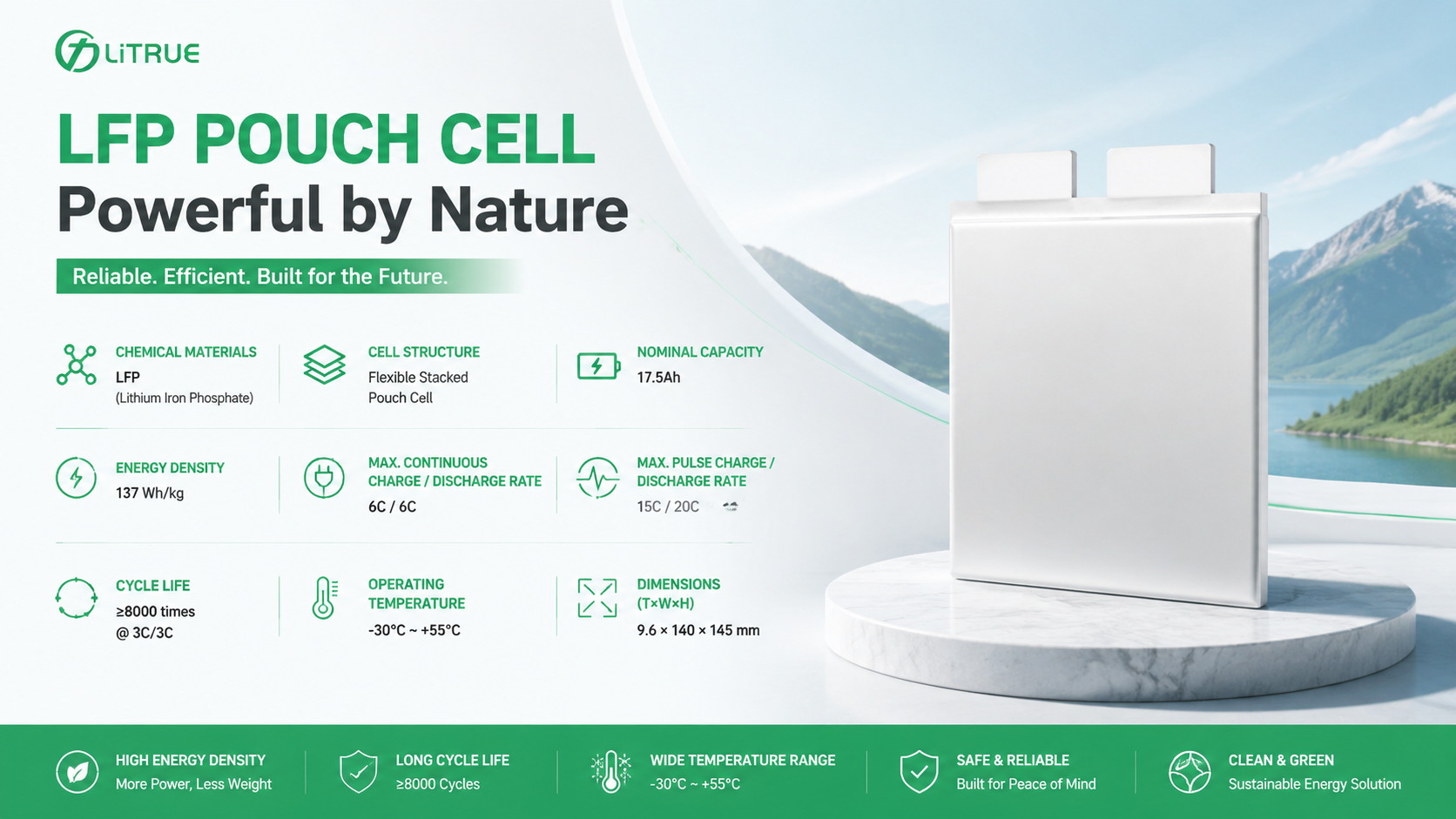
The cell we recommend for cranking applications is the 17.5Ah 6C/20C LFP pouch cell. Model P10E0E5-17500FP. We originally designed it for hybrid agricultural tractors — machines that start engines multiple times a day, run PTO systems, and cycle through heavy loads constantly. It turned out to be a really< good fit for pretty much any starting application. Let me explain why.
Unique Selling Points
The headline number is 20C pulse discharge. At 17.5Ah capacity, that means 350A of peak current from a single cell in a 10-second burst. We've verified this in our own test lab against GB/T 38058-2019 protocols — it's not a calculated estimate or a theoretical maximum. We actually ran the test. Multiple times. On multiple production batches.
For context, a standard 12V lead-acid cranking battery rated at 600 CCA uses six 2V cells internally. Four of our LFP cells in series — 4S configuration, 12.8V nominal — can match or beat that output. At 3.5 kg instead of 25+ kg. I keep repeating the weight numbers because they're the thing that makes people's eyes go wide when they first hear them.
The 6C continuous discharge rating matters too. Cranking is usually quick — a few seconds. But diesel engines in cold weather? Sometimes you're cranking for 15, 20 seconds. Maybe longer. At 6C, each cell pushes 105A continuously without overheating. In a 4S2P configuration — eight cells — you get 210A of sustained current at 12.8V. That covers most gasoline and small diesel engines comfortably.
Then there's the chemistry. LFP — Lithium Iron Phosphate. The cathode material has an olivine crystal structure that doesn't release oxygen at high temperatures. What that means practically: thermal runaway — the failure mode where a lithium cell catches fire — is essentially not a concern with LFP. You're putting this battery in an engine bay. It gets hot in there. 70, 80 degrees Celsius on a summer day. LFP handles that without drama. NMC chemistry? Different conversation. LFP is the safer choice for this application, full stop.
Cycle life: 3,000+ cycles at 1C/1C. We test every production batch and the data is consistent. At one engine start per day, that's over 8 years. At five starts per day — rental fleet, agricultural operation, generator cycling — you're still looking at 18+ months before any noticeable capacity drop. Lead-acid doing the same job? You're replacing it every 18 to 24 months. Sometimes sooner.
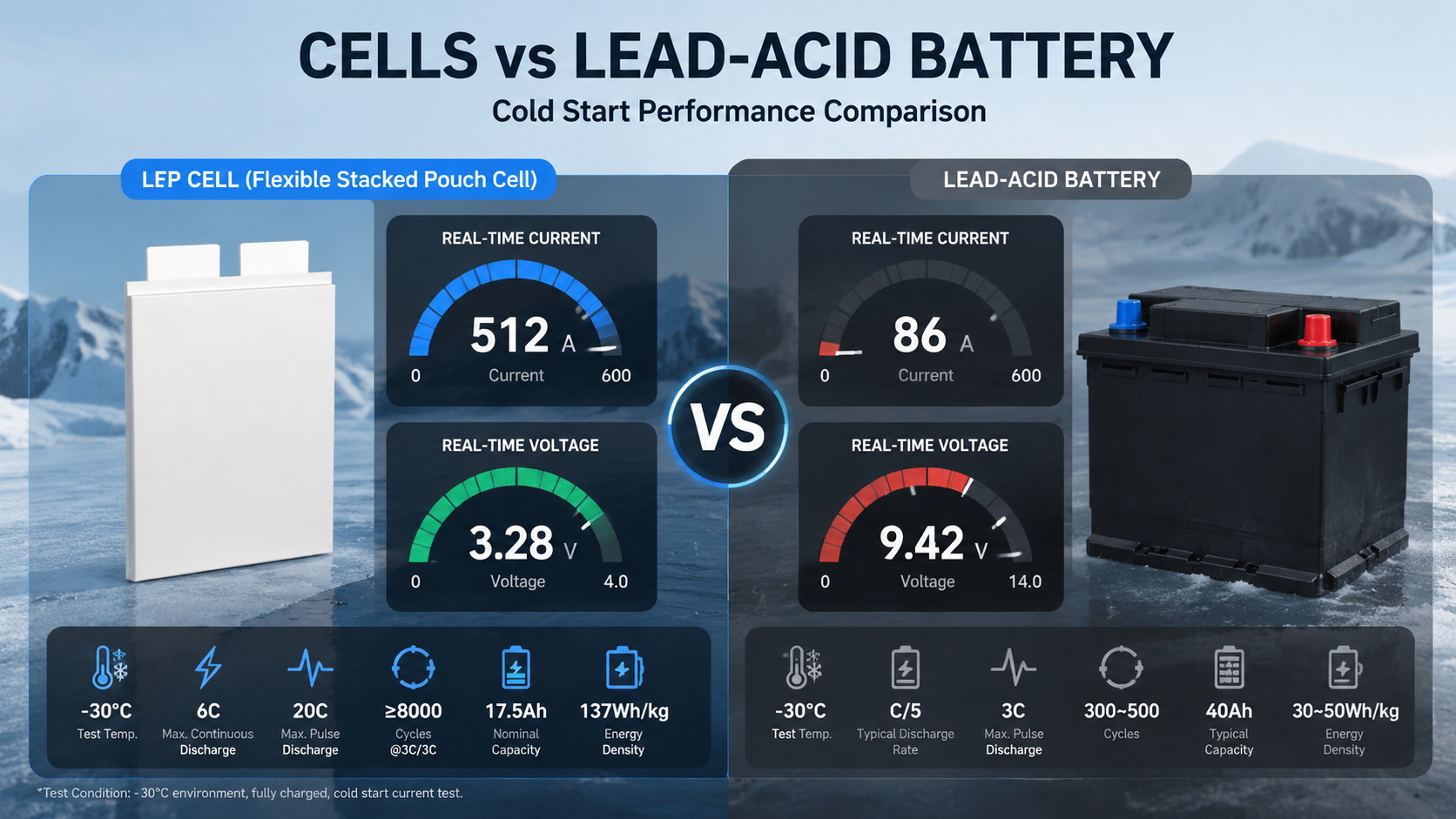
Operating temperature: −30°C to +55°C for discharge. We shipped a batch to a fleet operator in northern Canada running oil field generators. Ambient temps hitting −25°C regularly. The packs cranked fine. Peak current dropped maybe 20% compared to room temperature — that's just physics — but the voltage stayed flat and the engines started. Their lead-acid units in identical generators were failing weekly.
Audience Intent Match
This cell works for you if: You're an OEM engineer designing an electric motorcycle, a marine starter system, an industrial generator, or agricultural equipment — and you need a starting power source that's lighter and longer-lasting than lead-acid. Also works if you manage a fleet and you're tired of the replace-every-two-years cycle.
Doesn't work for you if: You want zero engineering involvement. Lithium cranking packs need BMS integration. Your alternator voltage has to be compatible. The battery tray might need modification. If you just want to buy something off a shelf and bolt it in — no thinking required — a retail lithium starter battery from brands like Shorai or Antigravity is easier. More expensive per unit, less customizable, but simpler installation.
Performance Evaluation
Cranking current. A 4S1P pack — four cells, 12.8V, 17.5Ah — delivers 350A peak. Enough for gasoline engines up to about 6.0L and diesel up to 3.0L. Need more? 4S2P gives you 700A. We had a marine customer running twin 4S2P packs in parallel for large inboard diesels. 1,400A peak cranking current from a combined pack under 15 kg. His old lead-acid setup weighed over 60 kg.
Weight savings: 65 to 75 percent. Group 27 lead-acid battery: 25–30 kg. Our 4S1P: 3.5–4 kg. For motorcycles, that changes handling. For marine, it improves fuel economy and trim. For portable generators, it means one person can carry the battery instead of two.
Charge speed. Lead-acid recharges at 0.1C to 0.3C. Our LFP cells take 2C continuous. Full recharge in 30–45 minutes instead of 6–8 hours. For fleet operations where machines cycle in and out all day, that's not a nice-to-have. That's more operational hours.
Voltage stability. Underrated advantage. Lead-acid voltage sags under load — noticeably worse at 50% state-of-charge. LFP holds a flat 3.2V per cell through 80% of its discharge. Your starter motor cranks at the same speed on the tenth start as it did on the first. Clean voltage for your ECU and fuel injection system too.
Design & Usage
Pouch format has practical advantages. The cell is 9.2mm thick — flat, wide, easy to stack. You can build thin packs that slide under a motorcycle seat, fit into tight marine compartments, conform around engine components. We've designed L-shaped and T-shaped cranking packs for customers with weird battery bay geometries. Try doing that with cylindrical cells.
Heat dissipation is good too. Large surface area relative to volume. In our testing, a 4S1P pack under repeated 300A cranking pulses — 10 seconds on, 50 seconds off, 20 cycles — stabilized at ambient plus 14°C. Lead-acid under the same test hit 65°C at the terminals. That temperature difference matters for terminal corrosion, cable degradation, and everything nearby in the engine bay.
For the BMS: rate it for 1.5x your peak cranking current minimum. We integrate CAN bus, RS485, or UART communication. Pre-configured to your system. Some customers want Bluetooth diagnostics for fleet monitoring — we do that too.
Customization
We're a direct manufacturer. Fifteen years in the business. 60+ in-house patents. 230+ global partners. Everything built in our own facility. So when we say custom, we mean actual engineering customization — not picking from a dropdown menu.
Voltage: 12.8V (4S), 25.6V (8S), anything you need. We've built 48V cranking packs for marine diesels and compact 12.8V packs for snowmobiles.
Capacity: 1P through 4P+. Scale your CCA target linearly. 700A peak? 4S2P. 1,400A? 4S4P.
BMS: Your choice of communication protocol. Configurable peak current limits. Temperature-compensated cutoffs. State-of-health monitoring. Tell us what your controller expects.
Enclosure: Your dimensions, your terminal type — M8 bolt, Anderson, whatever you need — IP65 or IP67 sealing. We work from CAD drawings or physical samples.
Charging profiles: CC/CV curves matched to your alternator or charger. We pre-program the BMS so overcharge isn't something you have to worry about.
Limitations
Alternator compatibility. Most modern alternators output 13.8V–14.4V. That works with 4S LFP (12.8V nominal, 14.6V full). But older vehicles with unregulated alternators can spike to 16V+. That'll damage lithium cells. Check your alternator output with a multimeter before you commit. Two minutes of testing. Could save you a ruined pack.
Don't charge below 0°C. LFP discharges fine at −30°C. Charging below freezing causes lithium plating — permanent capacity loss. If your equipment charges in sub-zero field conditions, you need pre-heating or a BMS with low-temp charge lockout. We build both into custom packs. Just tell us your operating conditions upfront.
Upfront cost. 2–3x more than lead-acid. Payback comes in 2–3 years through longer life and zero maintenance. But if you're buying one battery for one vehicle you don't plan to keep long, the math might favor lead-acid. For fleets? It always favors lithium. Always.
Pros
- Pros: 65–75% lighter than lead-acid — genuinely transformative for motorcycles and marine
- Pros: 3,000+ cycles means one purchase instead of four or five over the same period
- Pros: 20C pulse discharge — 350A per cell, tested and verified, not marketing
- Pros: LFP chemistry won't thermal runaway in a hot engine bay — the safety difference is real
- Pros: 2C charging gets you from empty to full in 30–45 minutes
- Pros: Flat voltage curve — consistent cranking regardless of state-of-charge
→ Get the Full Spec Sheet & Request a Factory Quote for the 17.5Ah LFP Cell
Alternative of Comparison
Lead-acid. The incumbent. Cheap. Available at any auto parts store on earth. Works with any charging system without modification. But it's heavy — 30–50 Wh/kg versus 120–167 Wh/kg for LFP. Cycle life: 300–500 cycles at best. Self-discharge: 4–6% per month just sitting there. Cold weather: loses 30–50% of its CCA at −20°C. For a single vehicle you replace every few years, it's fine. For fleets or anything weight-critical, it's a cost you keep paying over and over.
NMC lithium. Higher energy density than LFP — 150–200 Wh/kg. Better for range. But lower thermal stability and only about 1,000 cycles. For cranking, where you need high pulse current in a hot environment over many years, LFP is the better chemistry match. NMC is what you want in a UAV lithium battery where every gram affects flight time. Different application, different tradeoff.
Supercapacitors. Essentially unlimited cycle life. Enormous pulse current. Some engineers combine supercaps for the burst with a small lithium pack for sustained voltage. Interesting concept. But supercaps store very little energy per kilogram — they can't sustain a long cranking event alone. Complement, not replacement.
Pre-built retail lithium starter batteries. Antigravity. Shorai. EarthX. They make drop-in units for motorcycles and powersport. Convenient. No engineering required. But expensive — 3–5x lead-acid — and you get whatever configuration they decided to build, not necessarily what your application needs. For B2B buyers, fleet operators, or OEMs, sourcing cells or custom packs from a lithium battery manufacturer like LiTrue gets you better per-unit pricing and exact-fit specifications.
FAQs
Q: Can I use any lithium battery for cranking?
A: No. This is the mistake that costs people money. Standard lithium cells — the ones in consumer electronics, EVs — are energy cells. 1C, maybe 2C discharge. Cranking needs 10C to 20C pulse. You specifically need high C-rate cells. Our 17.5Ah LFP cell does 20C pulse — 350A from one cell. A laptop 18650 cell? Maybe 20A. Completely different animal. Always check the pulse discharge spec, not just the capacity number on the label.
Q: Will I need to change my alternator?
A: Most likely not. Modern alternators with voltage regulators sit at 13.8V–14.4V, which works fine with 4S LFP. But — and this caught one of our customers off guard last year — older vehicles with unregulated alternators or high-output racing alternators can spike above 14.8V. That's bad for lithium cells. Before you order anything, check your alternator output at idle and at 3,000 RPM with a multimeter. Takes two minutes. Worth it.p>
Q: What about cold weather?
A: Discharge is fine. Our cells discharge at −30°C. Peak current drops maybe 15–25% at −20°C versus room temperature — that's just how electrochemistry works — but the voltage stays flat and the engine cranks. We've confirmed this with field customers in Canada and northern China. The issue is charging. Don't charge lithium below 0°C. It causes lithium plating on the anode — permanent, irreversible capacity loss. If you need to charge in freezing conditions, get a pack with pre-heating or a BMS that locks out charging below 0°C. We build both options.
Q: What certifications should I look for?
A: Three. GB 31241-2022 — Chinese national safety standard, covers thermal abuse, overcharge, short circuit, mechanical shock. UN38.3 — mandatory for international shipping by air, sea, or ground. Without it, your battery shipment gets stuck at customs. And RoHS for environmental compliance, especially for European markets. All LiTrue cells ship with these certifications and complete test reports. We've been doing this for 15 years — the paperwork is not something you'll have to chase us for.
Q: What's the real cost difference over time?
A:``` Real numbers from a real customer. Fleet of 60 agricultural tractors in Brazil. Lead-acid cranking batteries: $140 each, replaced every 2 years. Over 5 years, that's 3 rounds of replacement × 60 tractors × $140 = $25,200 in battery costs alone. Lithium packs using our LFP cells: $450 each, lasting 5+ years. One-time cost: $27,000. Sounds like more, right? But factor in zero maintenance, zero dead-battery downtime during harvest season (which was costing them an estimated $8,000–$12,000 per year in missed spraying windows), and the lithium option came out roughly $14,000 ahead over 5 years. The math gets even better if you extend to 8 or 10 years.
Q: Can LiTrue build a complete pack for me, or just cells?
A: Both. Some of our customers are engineering teams who want cells, spec sheets, and BMS guidance — they build the packs in their own facility. Others want a fully integrated solution: cells, BMS, enclosure, terminals, charging profile, all pre-configured and ready to install. We do both. Tell us your voltage, CCA target, dimensions, and communication protocol. Our engineering team will spec it out. Start here.
Summary
So. Can you use a lithium battery as a cranking battery? Yes. And for most commercial, industrial, and high-performance applications, you probably should. The numbers speak for themselves: 65–75% weight savings. 3,000+ cycle life versus 300–500 for lead-acid. Flat voltage under load. Fast recharge. And LFP chemistry gives you all of this without the thermal runaway risk that makes people nervous about lithium in engine bays.
The gotcha is doing it right. High C-rate cells — not random lithium cells from the internet. A BMS rated for your actual peak cranking current with headroom to spare. A charging system that's compatible with lithium voltage profiles. And if you're operating in cold climates, a plan for the charging-below-zero limitation. Nail those four things and you'll have a starting battery that outlasts anything lead-acid can offer, at a fraction of the weight.