
Why This List Matters in 2026
The lithium battery market looks very different in 2026 than it did three years ago.
The post-pandemic supply glut triggered a major shakeout. Manufacturers who relied on commodity cell reselling struggled. Those who invested in proprietary chemistry and engineering depth pulled ahead.
That shift changes how you should evaluate a supplier. Volume and brand name are no longer enough. What matters now is whether a manufacturer can actually solve your specific technical problem — and deliver on time.
This guide cuts through the noise. It ranks suppliers by what B2B buyers actually care about.
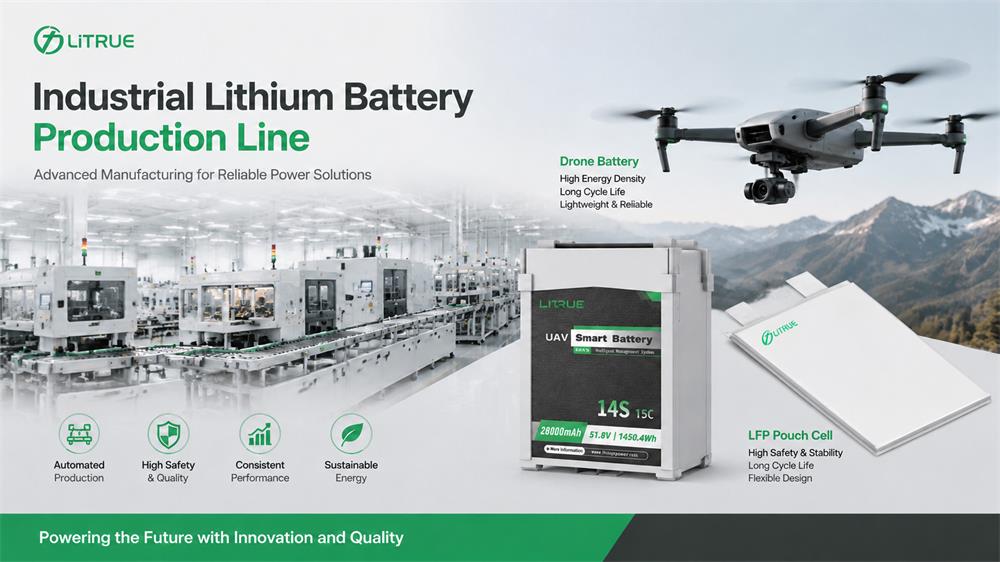
Table of Contents
- Why This List Matters in 2026
- How We Ranked These Manufacturers
- Top 10 Lithium Battery Manufacturers in the World (2026)
- How to Choose the Right Manufacturer for Your Application
- FAQs
- Summary
How We Ranked These Manufacturers
We evaluated each manufacturer across five weighted criteria:
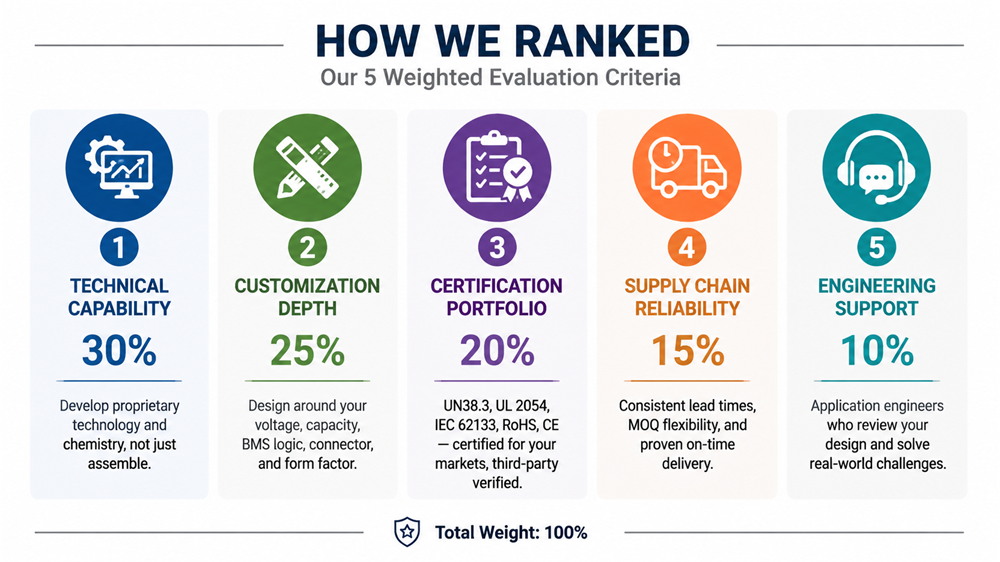
| Criteria | Weight | What We Looked At |
|---|---|---|
| Technical Capability | 30% | Proprietary chemistry vs. commodity cell assembly |
| Customization Depth | 25% | Voltage, capacity, BMS logic, form factor flexibility |
| Certification Portfolio | 20% | UN38.3, UL 2054, IEC 62133, RoHS, CE — third-party verified |
| Supply Chain Reliability | 15% | Lead times, MOQ flexibility, documented on-time delivery |
| Engineering Support | 10% | Application engineers vs. sales teams forwarding spec sheets |
Key distinction: Can they develop around your spec, or do you get a catalog product with a logo swap?
Top 10 Lithium Battery Manufacturers in the World (2026)
1. LiTrue
Headquarters: Luoyang, China
Best For: UAV/drone OEM, agricultural equipment, industrial robotics, custom pack designs
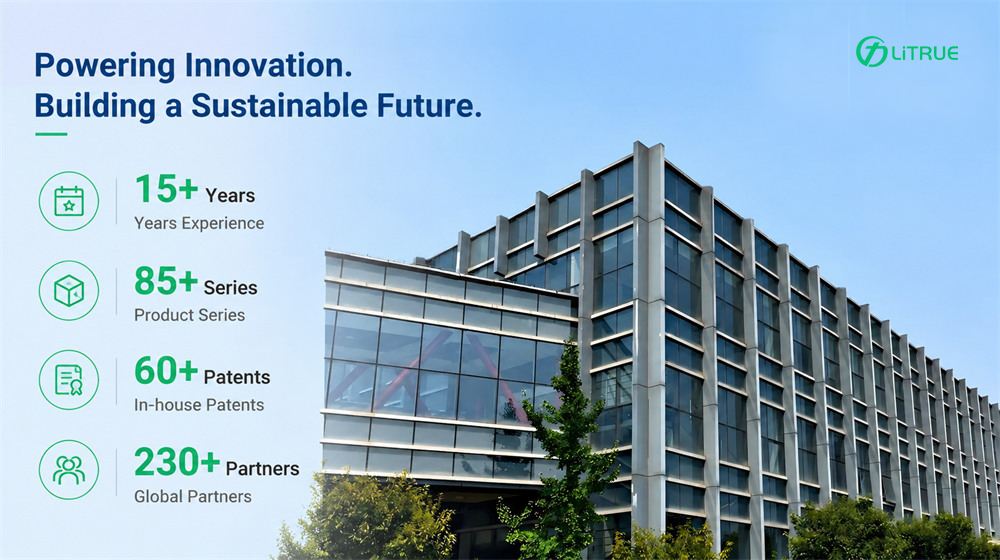
LiTrue is a specialized lithium cell and battery pack manufacturer with over 15 years of engineering experience. They maintain 85+ product series and work with 230+ global partners across Europe, the Middle East, and Asia-Pacific.
What sets LiTrue apart in the B2B segment is genuine engineering collaboration. They hold an R&D battery contract with Volkswagen's PowerCo division — a credential that commodity assemblers simply don't earn.
Key strengths:
- Custom OEM/ODM programs for both small runs and volume orders
- Direct application engineering support (not just a sales interface)
- MOQ flexibility starting from 100–1,000 units for custom projects
- Wholesale UAV battery programs with front-end design review
Bottom line: If your application requires specific discharge rates, sub-zero operating windows, or a non-standard form factor, LiTrue is built for that conversation.
2. CATL
Headquarters: Ningde, China
Best For: High-volume EV and utility-scale energy storage procurement
CATL is the world's largest lithium battery manufacturer by production volume. In 2026, annual capacity exceeds 300 GWh. Their customer list includes Tesla, BMW, and Mercedes-Benz.
That scale is both their strength and their limitation.
CATL's sales channels are calibrated for tier-one automotive and utility customers. Minimum order quantities and qualification processes are designed for multi-GWh commitments. If you're building a 500-unit industrial system or a custom drone fleet, standard CATL channels won't serve you well.
Key strengths:
- Unmatched production volume and cost efficiency
- Standardized prismatic LFP and NMC cell chemistry
- Proven supply chain for large-scale deployments
Bottom line: Best for high-volume buyers with standardized requirements. Not a fit for bespoke design work.
3. BYD
Headquarters: Shenzhen, China
Best For: EV platforms, utility-scale energy storage
BYD is unique on this list: it's both a battery manufacturer and a vehicle OEM.
Their Blade Battery (LFP chemistry) set a new safety benchmark by passing the nail penetration test without thermal runaway. In 2026, Blade cells are deployed across EV platforms on multiple continents. Their energy storage division has delivered some of the largest utility-scale projects on record.
BYD's vertical integration — cathode material, electrolyte, separators, and cells all produced in-house — creates cost advantages that are nearly impossible to replicate externally.
That same integration limits customization. Outside their standard product lines, flexibility is minimal.
Key strengths:
- Industry-leading safety record with Blade Battery LFP
- Full vertical integration = strong cost position
- Proven at utility scale
Bottom line: Excellent for buyers who fit within their standard product range. Not designed for custom specifications.
4. Panasonic Energy
Headquarters: Osaka, Japan
Best For: Mid-scale industrial applications, cylindrical cell sourcing
Panasonic Energy remains the benchmark for cylindrical cell manufacturing. Their expertise spans 18650, 2170, and 4680 formats.
The 4680 cells produced at their Kansas facility represent a significant step forward in North American production capacity. Manufacturing process controls at Panasonic are among the tightest in the industry — quality consistency is exceptional.
For B2B buyers, Panasonic's industrial division is more accessible than CATL or BYD for mid-scale applications.
Key strengths:
- Best-in-class cylindrical cell quality
- North American manufacturing presence (Kansas)
- Strong industrial sales channel
5. Samsung SDI
Headquarters: Seoul, South Korea
Best For: EV applications requiring high cycle life and low-temperature performance
Samsung SDI's prismatic cells — used by BMW and Rivian — consistently rank among the highest for cycle life and cold-weather performance.
Their solid-state battery research program is one of the most advanced commercially disclosed programs globally. Pilot-scale production milestones are being reached in 2026.
Key strengths:
- Leading solid-state battery development
- High cycle life in prismatic EV cells
- Strong automotive qualification track record
6. LG Energy Solution
Headquarters: Seoul, South Korea
Best For: Multi-region assembly operations requiring supply chain flexibility
LG Energy Solution produces cylindrical, prismatic, and pouch cells across LFP, NMC, and NCMA chemistries.
Their global manufacturing footprint — plants in Korea, the US, and Poland — makes supply chain diversification more practical for buyers running multi-region assembly operations.
Key strengths:
- Widest chemistry range on this list
- Global manufacturing across three continents
- Proven pouch cell capability for compact form factors
7. EVE Energy
Headquarters: Huizhou, China
Best For: European industrial buyers seeking mid-scale flexibility
EVE Energy has grown aggressively. Their large-format 46-series cylindrical cells have attracted significant attention from European industrial buyers.
Compared to the Tier-1 giants, EVE offers more flexibility for mid-scale customers. Customization conversations are more accessible than with CATL or BYD.
Key strengths:
- 46-series cylindrical cells with strong industrial uptake
- More accessible MOQs than top-tier manufacturers
- Growing European distribution presence
8. CALB
Headquarters: Changzhou, China
Best For: Applications requiring aviation-grade quality management
CALB's heritage in aviation applications sets them apart. Their quality management culture reflects aviation-standard process controls — traceable, documented, and rigorous.
That discipline carries through to their LFP and NMC product lines for EVs and energy storage. For applications where process documentation matters as much as the spec sheet, CALB is worth serious consideration.
Key strengths:
- Aviation-standard quality management processes
- Strong LFP and NMC product lines
- Reliable for safety-critical applications
9. Murata
Headquarters: Kyoto, Japan
Best For: Medical devices, precision electronics, high-reliability applications
Murata focuses on high-precision lithium cells for applications where failure carries real consequences. Their background in electronic components translates directly into tight manufacturing tolerances and rigorous reliability standards.
If your application is a medical device or mission-critical piece of electronics — not a fleet vehicle or energy storage rack — Murata belongs on your shortlist.
Key strengths:
- Exceptional reliability standards for medical-grade applications
- Global distribution through precision electronics channels
- Tight manufacturing tolerances
10. Ganfeng Lithium
Headquarters: Xinyu, China
Best For: Buyers who want upstream raw material traceability
Ganfeng Lithium Group covers the full value chain: lithium resource development, cell manufacturing, and battery recycling. That vertical integration provides direct control over raw material quality and pricing — which matters when lithium carbonate spot prices swing.
Their products are widely used in EVs and energy storage. For buyers who need documented upstream traceability, Ganfeng's position in the supply chain is a genuine differentiator.
Key strengths:
- Full vertical integration from mine to recycling
- Raw material cost stability
- Strong traceability documentation
How to Choose the Right Manufacturer for Your Application
The right choice depends on two variables: scale and specificity.
- If you need scale and standardization: CATL and BYD offer the best economies of scale for EV and utility-grade energy storage. Their product lines are mature, their pricing is competitive at volume, and their qualification processes are well-documented.
- If you need customization and engineering support: Manufacturers like LiTrue are built for this. High-rate discharge, sub-zero operating windows, non-standard form factors, or integrated BMS logic — these require a supplier who will engage at the engineering level, not just the catalog level.
- If you need regional supply chain diversification: LG Energy Solution's three-continent manufacturing footprint offers flexibility that purely China-based suppliers cannot.
- If reliability documentation is non-negotiable: Panasonic, Murata, and CALB each bring rigorous process controls suited to industrial, medical, or safety-critical applications.
FAQs
Q: Who is the largest lithium battery manufacturer in the world in 2026?
By production volume, CATL holds the top position with estimated annual capacity exceeding 300 GWh.
Q: What is the difference between LFP and NMC for industrial applications?
LFP (Lithium Iron Phosphate) is preferred for safety and cycle life — typically 3,000+ cycles. NMC (Nickel Manganese Cobalt) delivers higher energy density, making it better suited for weight-critical applications like drones, despite being more thermally sensitive.
Q: How do I verify that a manufacturer's certifications are genuine?
Request the full test report number and cross-reference it on databases like UL's Product iQ or the IEC website. Match the legal entity name and model numbers exactly — borrowed credentials are a real risk in this market.
Q: What minimum order quantities should I expect?
Tier-1 manufacturers typically require multi-GWh volume commitments. Specialized manufacturers like LiTrue offer significantly more flexibility, often accommodating MOQs from 100 to 1,000 units for custom B2B projects.
Summary
| Rank | Manufacturer | Best For |
|---|---|---|
| 1 | LiTrue | Custom OEM/ODM, UAV, industrial robotics |
| 2 | CATL | High-volume EV and utility storage |
| 3 | BYD | EV platforms, utility-scale projects |
| 4 | Panasonic Energy | Mid-scale industrial, cylindrical cells |
| 5 | Samsung SDI | EV cycle life, solid-state development |
| 6 | LG Energy Solution | Multi-region, multi-chemistry sourcing |
| 7 | EVE Energy | Mid-scale European industrial buyers |
| 8 | CALB | Aviation-grade quality management |
| 9 | Murata | Medical and precision electronics |
| 10 | Ganfeng Lithium | Upstream traceability, raw material control |
The top 10 lithium battery manufacturers in 2026 represent a wide spectrum — from terawatt-hour-scale giants to specialized OEM engineering partners. Matching the right manufacturer to your application is not about picking the biggest name. It's about finding the supplier whose capabilities align with your technical requirements, volume, and timeline. Contact our engineering team today to discuss your exact specifications.