
A LiFePO4 battery for drone use makes sense when cycle life, safety, and heat tolerance matter more than flight time per kilogram. That describes heavy-lift agricultural drones and industrial fleets that fly many sorties a day. It is a poor choice when maximum endurance or minimum weight is the priority.
This guide compares LiFePO4 (LFP) with NMC for drone use, explains the voltage and discharge-rate details that surprise many builders, and walks through a real high-rate LFP pouch cell spec sheet so you can judge the trade-offs with real numbers.

What Is a LiFePO4 Battery for a Drone?
LiFePO4 is the chemical formula for lithium iron phosphate, the cathode material in LFP cells. An LFP cell has a nominal voltage of 3.2V, compared with about 3.7V for NMC, and it stores less energy for the same weight.
In return, LFP offers strong thermal stability and a long cycle life. Battery University describes lithium phosphate as having excellent safety and a long life span, with moderate specific energy and a lower voltage than other lithium-ion types. Those traits are exactly what a drone designer has to weigh against the cost of every extra gram in the air.
LiFePO4 vs. NMC and LiPo for Drones
Energy per Kilogram
This is LFP biggest drawback for drones. The example cell later in this guide is rated at 137Wh/kg, while high-energy NMC pouch cells commonly exceed 200Wh/kg at the cell level.
For the same cell weight, that means LFP carries about a third less energy. Five kilograms of LFP cells hold roughly 685Wh in this example, compared with about 1,000Wh for NMC cells at 200Wh/kg. In the air, that translates directly into shorter flights or less payload.
Cycle Life
LFP strength is how many cycles it lasts. The example cell is rated for 8,000 or more cycles at 3C charge and 3C discharge, while NMC drone packs are commonly rated around 1,000 cycles. For a fleet that flies three sorties a day, 8,000 cycles is about 7.3 years on paper.
Test conditions differ between datasheets, so compare ratings at the same charge and discharge rate before drawing conclusions.
Safety and Heat Tolerance
LFP is more thermally stable than nickel-based chemistries, which gives a larger margin in hot climates and in hard-working fleet operations. Agricultural drones that fly in summer heat are a natural fit. For a broader look at the factors that wear packs out, our guide to drone battery durability covers heat, charging habits, and storage.
Voltage and Cell Count
Because an LFP cell is 3.2V nominal, you need more cells in series to match a given system voltage. Sixteen LFP cells in series give 51.2V nominal, which is close to the 51.8V of a 14-cell NMC pack. The maximum charge voltage differs too: 16 LFP cells reach about 58.4V at a typical 3.65V per cell, so check that your ESCs, flight controller, and charger support that window.
LFP also has a very flat discharge curve, which means voltage alone is a poor way to estimate remaining charge. Use a battery management system that counts current rather than relying on voltage readings.
Discharge Rate
Older LFP cells had a reputation for weak power delivery, but modern high-rate LFP pouch cells have closed much of that gap. The example below supports 6C continuous and 20C pulse discharge, which is the kind of current headroom a heavy-lift drone needs for takeoff and gusts.
When a LiFePO4 Battery for Drone Use Makes Sense
LFP fits agricultural spraying fleets that fly many sorties a day and care about cost per flight, drones that operate in high ambient temperatures, and industrial platforms where safety margin and service life matter more than endurance.
It can also serve as the battery in ground equipment around a drone program, such as charging stations and power buffers, where weight does not matter. For agricultural platforms, see our guide on choosing an agricultural drone battery, which compares NMC and LFP options in the field.
When It Does Not
Avoid LFP for long-endurance mapping, small consumer-style drones, racing, and any aircraft close to its weight limit. In those cases, every extra gram costs flight time, and NMC packs are the better fit. Our guide to the UAV lithium batteries used in heavy-lift aircraft covers the NMC side of that comparison.
Also remember that a drone designed around an NMC pack cannot simply swap in LFP. The voltage window, charger profile, and battery management settings all differ.
A Cost-per-Flight Illustration
LFP can still win on cost over time, even with less energy per kilogram. Here is an illustration in relative units, not real prices. Say an LFP pack costs 1.3 times as much as an NMC pack of the same weight, carries 31.5 percent less energy, and delivers 8,000 cycles compared with 1,000 for NMC.
The NMC pack works out to 1.0 divided by 1,000 cycles, or 0.001 per unit of energy delivered. The LFP pack works out to 1.3 divided by 0.685 times 8,000, or about 0.00024. In this example, LFP is about four times cheaper per unit of energy delivered, but only if the fleet actually uses those cycles and the shorter flights still fit the mission.
A Real Example: 17.5Ah 6C/20C High-Rate LFP Pouch Cell
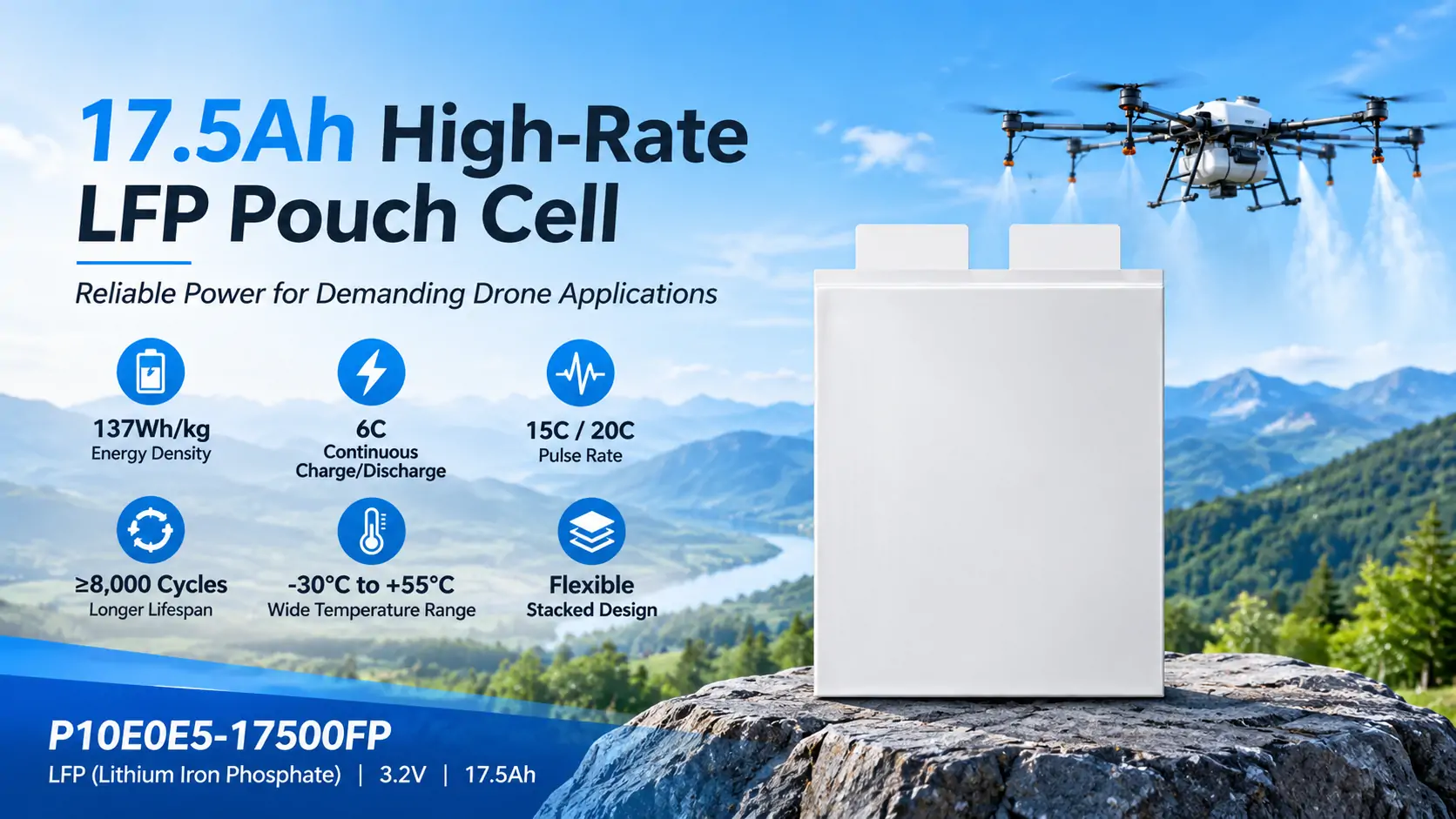
Specs are easiest to judge against a real product. LiTrue 17.5Ah high-rate LFP pouch battery cell (model P10E0E5-17500FP) is a flexible stacked pouch cell. Its product page positions it for hybrid agricultural tractors and heavy-duty industrial vehicles, and it lists heavy-lift agricultural drones among the electrified farming machinery it suits. It is sold as a cell for OEM pack builders, not as a finished drone battery.
| Model Number | P10E0E5-17500FP |
| Chemistry | LFP (Lithium Iron Phosphate) |
| Cell Structure | Flexible Stacked Pouch Cell |
| Nominal Capacity | 17.5Ah |
| Nominal Voltage | 3.2V |
| Energy Density | 137Wh/kg |
| Max. Continuous Charge Rate | 6C |
| Max. Continuous Discharge Rate | 6C |
| Max. Pulse Charge Rate | 15C |
| Max. Pulse Discharge Rate | 20C |
| Cycle Life | ≥8,000 cycles @ 3C/3C |
| Operating Temperature | -30°C to +55°C |
| Dimensions (T×W×H) | 9.6 × 140 × 145mm |
| Certifications | UN38.3, CE, MSDS |
| Standards | GB/T 38058-2019, GB 31241-2022 |
| Sample MOQ | 10 pcs (negotiable) |
| Sample Lead Time | 7–15 working days |
| Bulk Lead Time | 45 days (subject to volume and requirements) |
Here is what those numbers mean for a drone pack. At 17.5Ah, a 6C continuous rating equals about 105A per cell, and the 20C pulse rating equals about 350A. A 2.0kW cruise on a 51.2V pack draws about 39A, or roughly 2.2C, so the cell has a lot of headroom.
Sixteen cells in series (16S1P) make a 51.2V pack with 17.5Ah, which is about 896Wh. At 137Wh/kg, each 56Wh cell weighs roughly 0.41kg, so the sixteen cells together weigh about 6.5kg before the BMS, wiring, and enclosure are added. With a 15 percent reserve, that energy supports about 23 minutes at a steady 2.0kW draw, an illustrative figure that depends entirely on the aircraft.
Cycle life is the standout. The 8,000-cycle rating is stated at 3C/3C, a demanding test condition, which is the level of detail to demand from any supplier. At three flights a day, it works out to about seven years on paper, though real life depends on temperature, charging practice, and the capacity level that defines end of life.
Remember that this is a pouch cell. It needs mechanical support and compression inside the pack, and the product page notes that the final pack design must control heat, tab welding, busbars, and BMS settings. The page also says charging strategy should be validated for temperature and cell balancing. Engineers who need a finished drone pack typically work with high-rate LFP cells from a manufacturer that can also supply the pack design.
How to Choose a LiFePO4 Battery for Drone Use
Start with your weight and endurance targets. If the aircraft cannot spare the extra weight LFP requires, choose NMC. If cycle life and heat tolerance matter more, LFP deserves a serious look.
Next, check voltage compatibility. Confirm that your ESCs, flight controller, and charger support the voltage window of the LFP configuration you plan to use, and that the BMS provides accurate state of charge for a flat-curve chemistry.
Then ask for documentation: cell datasheets with stated test conditions, UN38.3 transport reports, and certifications for the finished pack. Finally, order samples and test them on your own aircraft before you commit to volume.
FAQs
Can I use a LiFePO4 battery in a drone?
Yes, but it works best in heavy-lift and fleet applications where cycle life and safety outweigh weight. For small or endurance-focused drones, NMC or LiPo packs are usually a better fit.
Is a LiFePO4 battery heavier than a LiPo for a drone?
For the same energy, yes. LFP cells store less energy per kilogram, so a LiFePO4 pack that matches a LiPo pack energy will weigh noticeably more.
Can LiFePO4 deliver the high current a drone needs?
Modern high-rate LFP pouch cells can. The example cell above is rated for 6C continuous and 20C pulse discharge, though the finished pack current limit depends on the BMS, wiring, and cooling.
Is LiFePO4 safer than other lithium batteries for drones?
LFP is more thermally stable than nickel-based chemistries, which gives a larger safety margin. Good pack design, battery management, and handling still matter just as much.
Can I swap a LiPo for LiFePO4 without changing anything?
No. The nominal voltage per cell, charge voltage, and discharge curve all differ, so the cell count, charger profile, ESC compatibility, and BMS settings must be checked first.
Where can I source LFP cells for a drone battery project?
OEMs and pack builders can request samples, datasheets, and certification documents from a lithium battery supplier that offers engineering support.
Summary
A LiFePO4 battery for drone use is a specialist choice. It gives up energy per kilogram in exchange for cycle life, heat tolerance, and safety margin, which pays off for agricultural and industrial fleets but not for endurance flights.
If you are developing a drone platform, working with an experienced lithium battery manufacturer that can share validated test data and discuss your duty cycle will help you choose between LFP and NMC with confidence.