
Diesel trucks have relied on the same starter-battery formula for decades: a heavy lead-acid block that struggles in cold weather, wears out in a few years, and does nothing but sit there between cranks. A truck lithium battery changes that equation. It weighs a fraction as much, survives thousands more charge cycles, and in electrified and hybrid trucks it doubles as a real power source rather than just a starter.
This guide walks through what a truck lithium battery actually is, the chemistry and specs that matter for heavy-duty use, and how to size a pack correctly before you commit to a supplier.
What Is a Truck Lithium Battery?
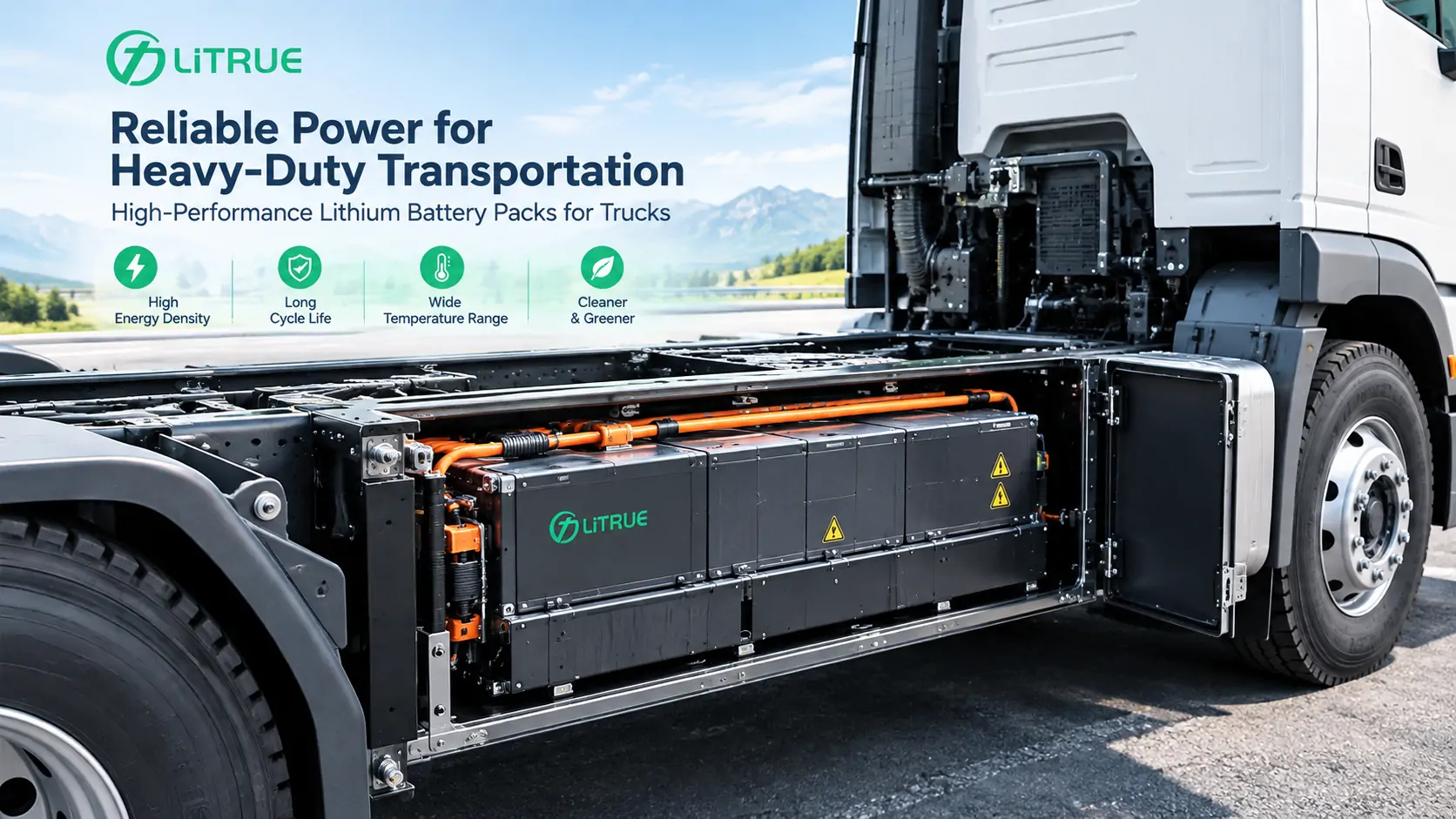
A truck lithium battery is a lithium-based cell or pack engineered for the electrical demands of commercial vehicles — starting, cranking, hotel loads (cab electronics, refrigeration, sleeper HVAC), and in electric or hybrid trucks, the traction system itself.
Most truck applications use lithium iron phosphate (LFP) chemistry rather than the nickel-based chemistries common in consumer electronics. LFP trades a bit of energy density for much better thermal stability, a longer cycle life, and a safety margin that matters when a battery is mounted under a chassis and exposed to vibration, heat, and road debris every day.
Why Fleets Are Switching to Lithium
Weight Savings and Payload Capacity
A lithium starter or auxiliary battery typically weighs 50 to 70 percent less than a lead-acid equivalent of similar capacity. For a fleet running dozens of trucks, that weight reduction adds up to real fuel savings and extra payload capacity per trip.
Faster Charging, Less Downtime
Lithium cells accept a much higher charge current than lead-acid, which means idle time at a depot charger drops significantly. For electrified trucks, this is often the difference between one charging window per shift and two.
Longer Service Life
A quality LFP cell is commonly rated for 3,000 or more full charge-discharge cycles, compared with 300 to 500 cycles for a typical lead-acid battery. Over a truck operating life, that difference translates directly into fewer replacements and less unplanned maintenance.
Key Specs to Check Before You Buy
Voltage and Capacity
Truck electrical systems commonly run on 12V, 24V, or higher pack voltages for hybrid and electric platforms. Capacity, measured in amp-hours (Ah), needs to match both the daily energy draw and the physical space available in the chassis or battery box.
Discharge Rate for Cranking and Hotel Loads
Cranking a diesel engine in cold weather demands a short, heavy burst of current, while hotel loads draw a steady, lower current for hours at a time. This is where a cell C-rate matters: it defines how much continuous and pulse current a cell can safely deliver relative to its rated capacity.
Operating Temperature Range
Trucks operate in far harsher thermal conditions than passenger vehicles — engine-bay heat on one end, sub-zero winter starts on the other. A pack rated only for mild indoor temperatures will underperform or degrade quickly in real fleet conditions.
A Real Spec Example: 100Ah LFP Prismatic Cell
To make these numbers concrete, it helps to look at an actual cell built for high-current, wide-temperature service. LiTrue 100Ah LFP prismatic battery cell (model LFL1-100P) is a good reference point for truck and heavy-equipment engineers evaluating what a modern LFP cell can deliver.
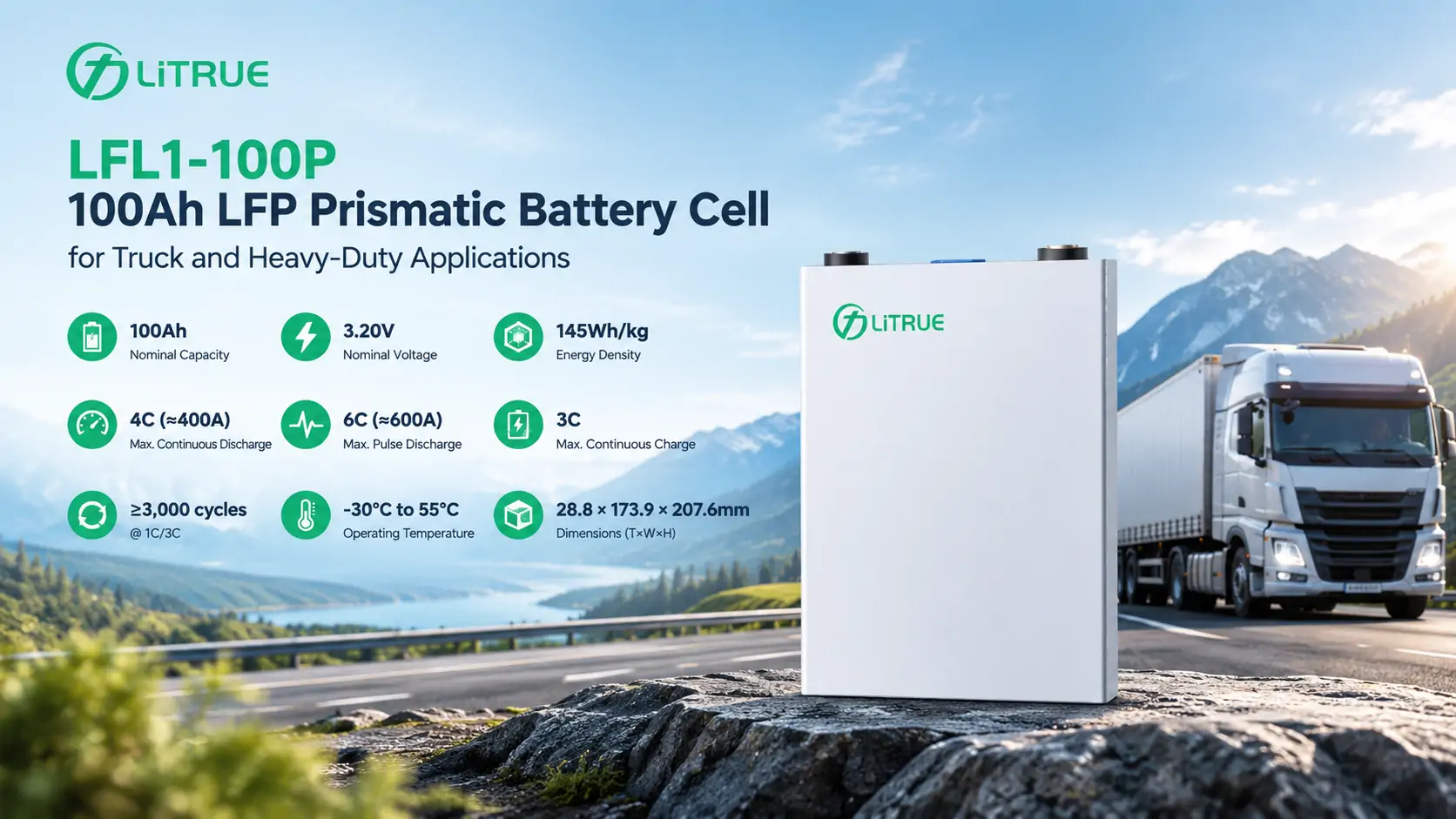
The cell carries a 3.20V nominal voltage and 100Ah nominal capacity, with an energy density of 145Wh/kg. It supports 4C continuous discharge and 6C pulse discharge — roughly 400A continuous and 600A in short bursts — which covers both steady hotel-load draw and momentary cranking demand in a single cell.
Cycle life is rated at 3,000 or more cycles at a 1C charge / 3C discharge profile, and the operating range spans -30°C to 55°C, wide enough for most North American and European winter and summer extremes. The prismatic can format also simplifies mechanical mounting in a rigid chassis compartment compared with a flexible pouch cell. The full spec sheet is below:
| Model Number | LFL1-100P |
| Chemistry | LFP (Lithium Iron Phosphate) |
| Cell Structure | Prismatic Can |
| Nominal Capacity | 100Ah |
| Nominal Voltage | 3.20V |
| Energy Density | 145Wh/kg |
| Max. Continuous Discharge | 4C (≈400A) |
| Max. Pulse Discharge | 6C (≈600A) |
| Max. Continuous Charge | 3C |
| Cycle Life | ≥3,000 cycles @ 1C/3C |
| Operating Temperature | -30°C to 55°C |
| Dimensions (T×W×H) | 28.8 × 173.9 × 207.6mm |
How to Size a Lithium Pack for Your Truck
Start with your actual duty cycle rather than a generic capacity target. Add up cranking current, continuous hotel-load draw, and any traction or auxiliary demand, then check that both the continuous and pulse discharge ratings of your chosen cell cover the peak, not just the average.
Series and parallel configuration determines your final pack voltage and capacity. A cell rated at 3.2V nominal, for example, reaches roughly 12.8V in a 4S string or 25.6V in an 8S string, which lines up with common 12V and 24V truck electrical systems once you account for the battery management system and protection circuitry.
Because duty cycles vary so much between long-haul trucks, refrigerated trailers, and vocational trucks, most fleets work with a lithium battery manufacturer directly rather than buying an off-the-shelf pack sized for a different application. An experienced engineering team can turn a duty-cycle spec sheet into a configuration that actually fits the vehicle space, weight, and thermal constraints.
Faqs
Can a lithium battery replace a lead-acid starter battery directly?
In most cases, yes, provided the replacement pack includes a battery management system rated for the truck charging system and cold-cranking requirements. A direct swap without proper BMS protection is not recommended.
How cold can a truck lithium battery operate?
LFP cells built for wide-temperature service, such as the example above, are commonly rated down to -30°C, though available capacity and power taper somewhat at the extreme low end due to normal electrochemistry behavior.
Is LFP or NMC better for truck applications?
LFP is the more common choice for truck starter and auxiliary batteries because of its thermal stability and long cycle life. NMC chemistry offers higher energy density and is sometimes used in electric truck traction packs where maximizing range per pound of battery weight is the priority.
What is the typical lifespan of a truck lithium battery?
A well-specified LFP cell rated for 3,000 or more cycles can last 8 to 10 years or longer under typical fleet duty cycles, compared with 2 to 4 years for a lead-acid equivalent.
Can I get a custom pack built for my truck exact space and voltage?
Yes. Most commercial fleets need a configuration that doesn't exist off the shelf. Working with a supplier that offers custom battery packs lets you match voltage, capacity, and physical dimensions to your specific vehicle rather than compromising on a generic pack.
Summary
A truck lithium battery is no longer an experimental upgrade — it is the practical, proven choice for fleets that want less downtime, lighter vehicles, and a power source that survives years of hard duty cycles. The details that matter most are the same ones that matter in any demanding application: verified C-rate, a wide operating temperature range, and a cycle life that actually holds up to daily use.
If you're evaluating options for a new build or a fleet-wide upgrade, working directly with a lithium battery supplier that can share real test data — not just a datasheet — is the fastest way to avoid an underperforming pack.