
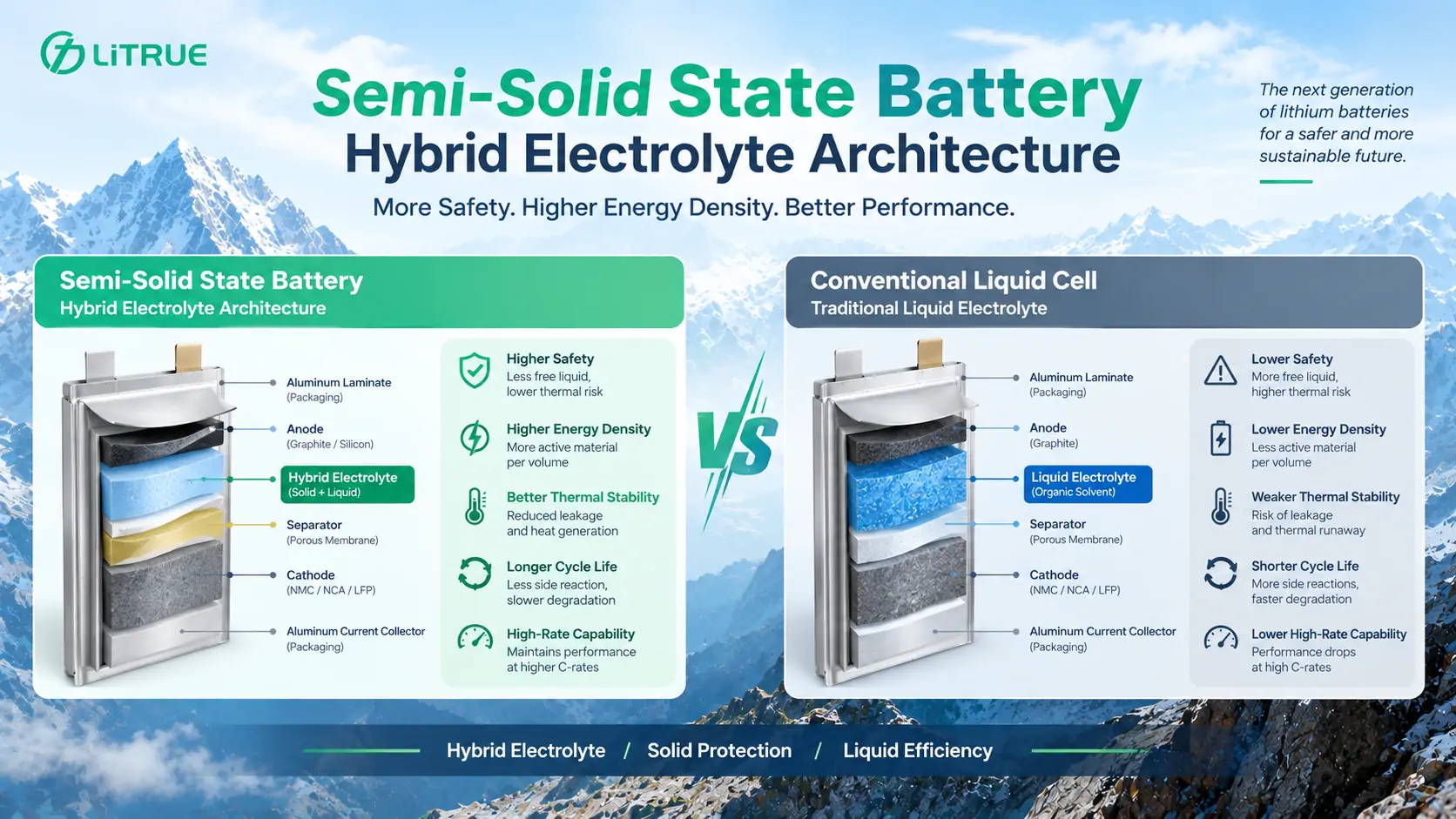
Semi solid state batteries are hybrid electrochemical cells that replace the vast majority of volatile liquid solvents with a solid or gel-like electrolyte matrix, retaining only 5% to 10% wetting liquid by weight. This hybrid architecture achieves high gravimetric energy density (360+ Wh/kg) and exceptional thermal runaway resistance while maintaining drop-in compatibility with existing lithium-ion gigafactory lines.
What Are Semi Solid State Batteries?
As the electrification of transportation, aerospace, and commercial equipment expands, traditional lithium-ion batteries are confronting their physical and chemical ceilings. Conventional liquid cells struggle to deliver gravimetric energy densities beyond 280 Wh/kg without incurring severe fire hazards and thermal runaway risks.
While all-solid-state batteries (ASSBs) are often presented as the ultimate end-state, massive manufacturing barriers—such as high solid-solid contact impedance, fragile brittle ceramic membranes, and exorbitant cleanroom capital expenditures—have delayed widespread commercial rollout.
This is where semi solid state batteries (also known as condensed batteries or solid-liquid hybrid batteries) enter as the practical commercial solution. By combining solid electrolyte membranes with a minimal fraction of liquid or gel conductor, they deliver the safety and energy density perks of solid-state systems without sacrificing ion conductivity. For engineers seeking next-generation high-density battery cells, semi-solid chemistry represents an immediately available upgrade path.
How Semi Solid State Batteries Work: The Hybrid Architecture
Traditional lithium-ion cells rely entirely on an organic liquid solvent to transport lithium ions between cathode and anode. In semi solid state batteries, this setup is fundamentally transformed through three key innovations:
1. Ceramic Scaffold with Wetting Agents
The cell incorporates an inorganic solid ceramic electrolyte layer—commonly oxide-based materials like LLZO (Lithium Lanthanum Zirconium Oxide) or LATP. A residual 5% to 10% liquid electrolyte fraction is introduced specifically to wet the interface between the solid electrolyte and active electrode materials, ensuring low charge-transfer resistance.
2. In-Situ Polymerization
To avoid complex manufacturing setups, leading producers utilize in-situ polymerization. Monomers are injected into the cell in liquid form during assembly, wetting every microscopic pore of the electrode. Once the cell is vacuum-sealed, controlled heat activates polymerization, curing the liquid into a stable, non-flammable gel matrix directly inside the cell.
3. Lithium Dendrite Suppression
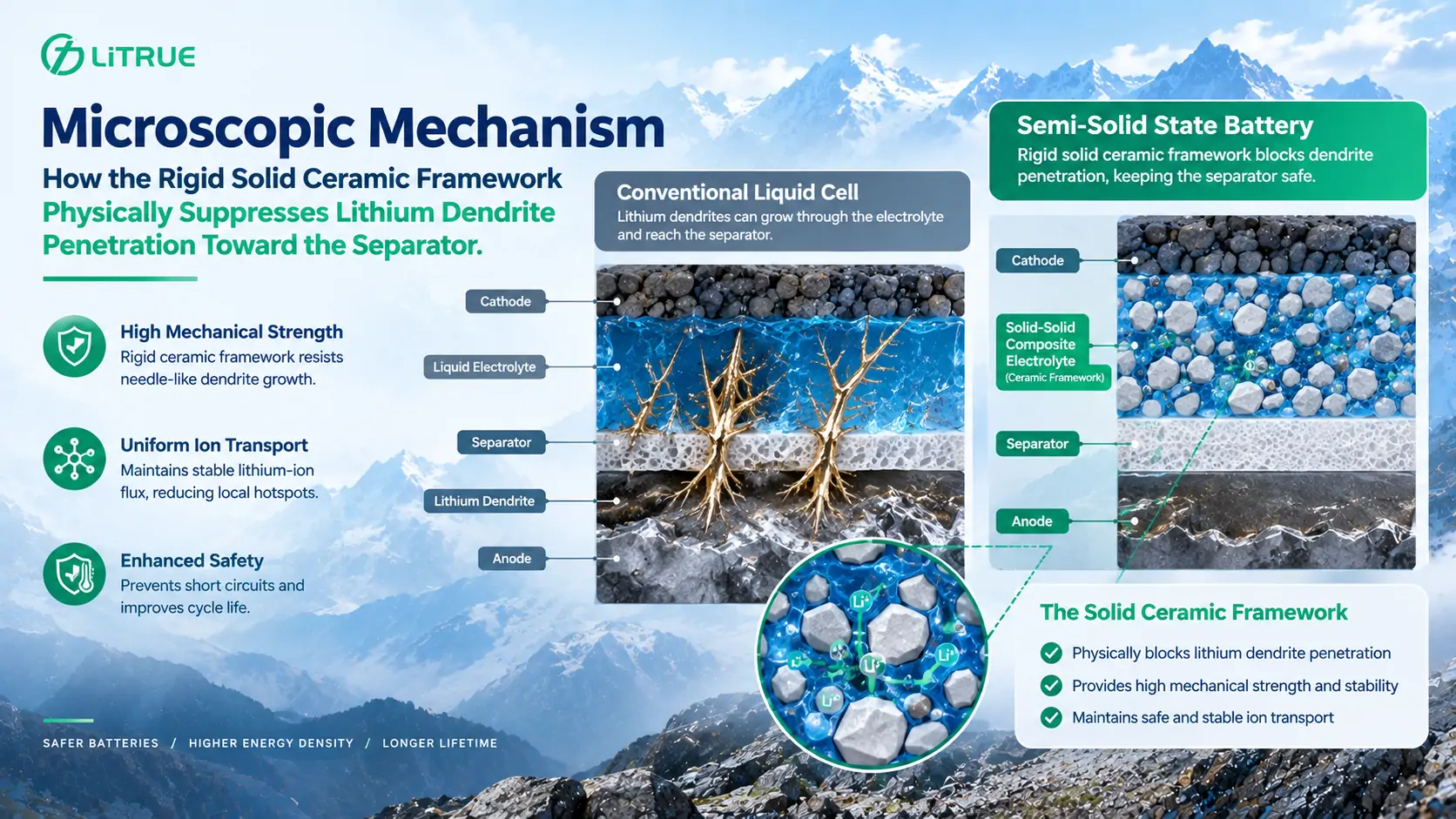
Under repeated rapid charging, metallic lithium can form needle-like crystals (dendrites) that pierce conventional polyolefin separators, causing short circuits and fires. The solid matrix in a semi solid battery provides the mechanical shear modulus required to physically halt dendrite propagation.
Semi Solid State vs. Lithium-Ion vs. All-Solid-State Comparison
The table below summarizes how semi solid state batteries compare across critical performance dimensions against conventional liquid cells and experimental all-solid-state alternatives:
| Performance Attribute | Traditional Liquid Li-ion | Semi Solid State Battery | All-Solid-State Battery (ASSB) |
|---|---|---|---|
| Electrolyte Formulation | 100% Flammable Liquid Solvent | Hybrid (Solid Scaffold + 5–10% Liquid/Gel) | 100% Solid (Oxide, Sulfide, or Polymer) |
| Gravimetric Energy Density | 200 – 280 Wh/kg | 360 – 420 Wh/kg | 400 – 500+ Wh/kg |
| Thermal Runaway Temperature | ~150°C – 180°C | > 260°C – 300°C | > 350°C (Inherently Non-flammable) |
| Gigafactory Compatibility | 100% (Industry Standard) | 75% – 85% Machinery Reuse | < 20% (Requires entirely new Capex) |
| Interfacial Impedance | Very Low | Low to Moderate | High (Contact degrades over cycles) |
| Estimated Production Cost | ~$80 – $100 / kWh | ~$130 – $160 / kWh | > $250+ / kWh (Pilot/Lab batches) |
| Commercial Status (2026) | Mature Mass Market | In Commercial EV & Device Production | Pilot & Demonstration Stage |
Key Advantages of Semi Solid State Batteries
1. Gravimetric Energy Density Exceeding 360 Wh/kg
By preventing short-circuits and stabilizing interfaces, semi-solid designs allow engineers to pair high-capacity silicon-carbon composite anodes with high-nickel cathodes (such as NMC 811). This pushes cell density to 360–400 Wh/kg, enabling passenger electric vehicles to exceed 1,000 kilometers of driving range on a single charge.
2. Superior Thermal Safety
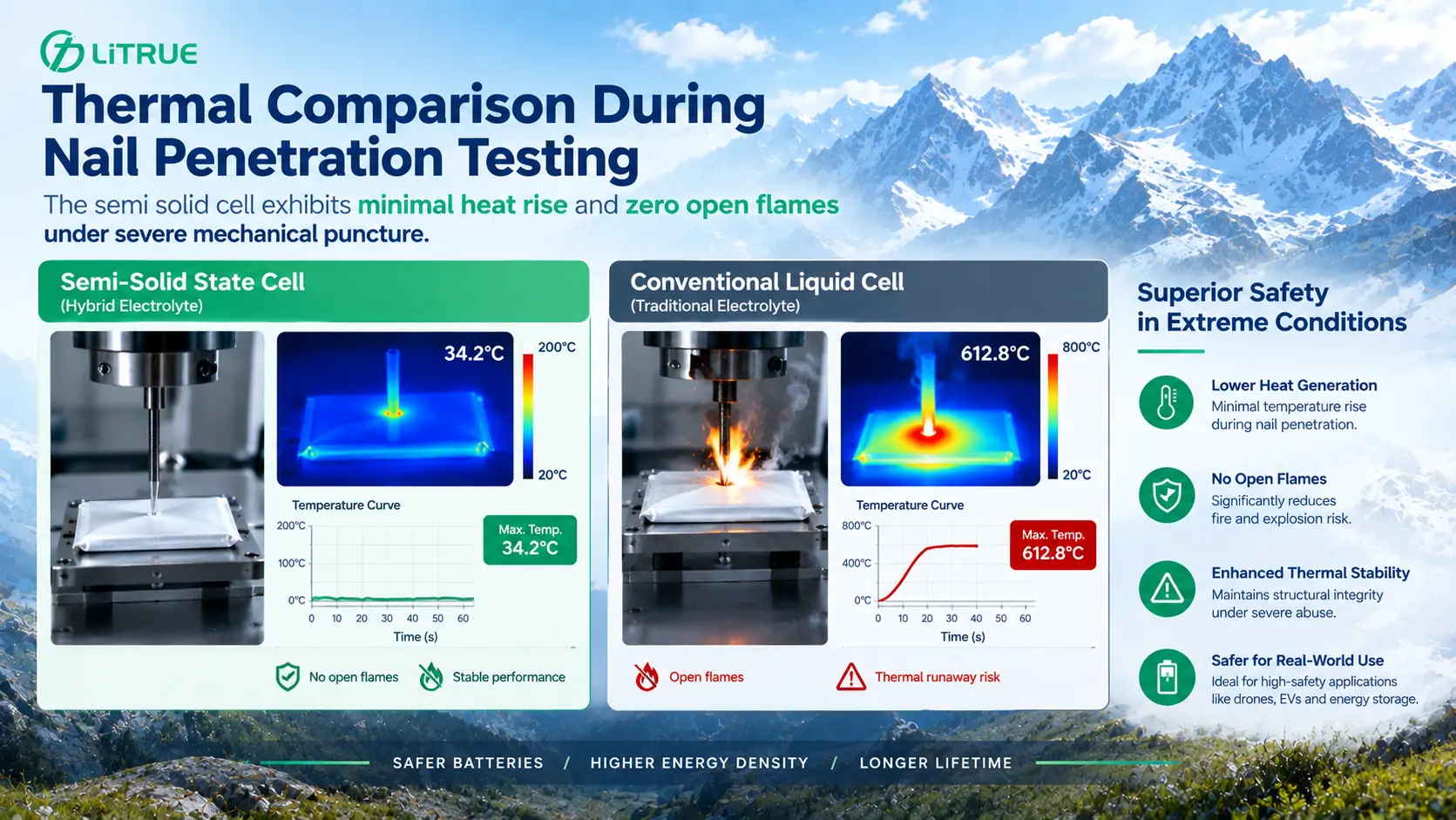
Liquid solvents are the combustible fuel that feeds battery fires. Replacing the bulk of these solvents with ceramic or cross-linked polymer matrices dramatically curtails the generation of flammable gases during physical trauma.
3. Drop-In Production Compatibility
All-solid-state cells demand entirely new vacuum sintering lines and ultra-dry assembly rooms. Semi solid state cells, by contrast, can be built on 75% to 85% of existing lithium-ion production lines. Coaters, winders, stackers, and formation systems can be repurposed with minimal tooling modifications, keeping capital expenditure in check.
4. Dependable Cold-Weather Operation
Freezing temperatures cause conventional liquid electrolytes to thicken, degrading conductivity and reducing winter range by up to 40%. Engineered solid-liquid hybrid matrices sustain high ionic conductivity down to -20°C and -30°C, dramatically improving cold-climate performance.
Technical Challenges and Practical Limitations
Despite clear advantages, semi solid state technology presents practical hurdles that manufacturers continue to address:
- Interfacial Contact Resistance: Repeated charge-discharge cycles cause electrode materials to expand and contract. Maintaining continuous solid-solid contact requires precise internal mechanical pressure within the module.
- Initial Manufacturing Cost Premium: Cell-level costs are currently 30% to 50% higher than mass-produced LFP cells, primarily due to precursor ceramic synthesis costs and lower production volumes.
- Fast-Charging Limitations: With slightly higher internal resistance than ultra-thin liquid cells, most current semi solid batteries operate optimally at 2C to 3C charging speeds rather than extreme 4C+ fast charging.
Real-World Deployments and Commercialization
Semi solid state technology is already powering commercial vehicles and high-performance equipment in the field:
1. Automotive Battery Packs
Automakers have successfully integrated 150 kWh swappable semi-solid packs into production vehicles. In highway evaluations, these vehicles have verified continuous driving distances of over 1,044 km (648 miles) on a single charge. Explore our documented application cases to see how custom integration addresses range and safety demands.
2. Drones, Marine, and Custom Energy Storage
Beyond passenger EVs, semi solid cells are being integrated into commercial drones, marine propulsion systems, and aerospace platforms where weight savings and fire safety are non-negotiable requirements. When developing specialized custom battery packs, semi-solid cells provide the ideal balance between energy density and thermal resilience.
Leading Manufacturers in the Market
Several major manufacturers are driving the commercialization of semi solid state batteries:
- Beijing WeLion New Energy: Primary supplier of the 360 Wh/kg cells used in commercial 150 kWh automotive battery packs.
- Gotion High-Tech: Industrializing 360 Wh/kg semi-solid cells for passenger vehicles and developing 400 Wh/kg lab prototypes.
- SES AI: Pioneering high-energy lithium-metal hybrid architectures in collaboration with global automotive OEMs.
- Ganfeng Lithium & ProLogium: Operating operational production lines producing solid-liquid hybrid cells for mobility and industrial sectors.
FAQs
Can I buy an EV with a semi solid state battery today?
Yes. Commercial vehicles such as NIO models equipped with 150 kWh packs, as well as select models from Dongfeng and Voyah, currently offer semi solid state battery options in regular production.
Are semi solid state batteries safer than traditional lithium-ion?
Yes. By replacing over 90% of volatile organic solvents with non-flammable solid or gel scaffolds, these cells demonstrate high resistance to thermal runaway and maintain structural stability during severe puncture or nail-penetration events.
What is the difference between semi solid state and solid state batteries?
Semi solid state batteries feature a hybrid electrolyte with a solid scaffold plus 5% to 10% wetting liquid or gel to facilitate low interfacial impedance. True all-solid-state batteries contain 0% liquid electrolyte.
What is the expected cycle life of a semi solid state battery?
Commercial-grade cells typically deliver between 1,200 and 2,000 full charge-discharge cycles before dropping to 80% capacity retention, corresponding to over 1.5 million kilometers of service life in a long-range EV.
Why are semi solid state batteries more expensive?
The cost difference is driven by specialized precursor materials like ceramic powders and lower production volume during early factory ramp-up. As economies of scale expand, costs are projected to drop significantly.
Summary
Semi solid state batteries provide an effective and immediate solution to the energy density and fire safety bottlenecks that have constrained electric mobility. By combining the microscopic advantages of solid electrolytes with the manufacturing scalability of conventional lithium-ion lines, this technology is powering a new generation of high-range, fire-safe applications.
If you are engineering next-generation energy storage solutions or evaluating cell chemistry options for your project, contact our battery engineering team for technical consultation and custom development.