
Ask five suppliers this question and you'll get five different numbers. Two years. Five hundred cycles. "It depends." None of that helps if you're specifying a battery for a product that ships in six months, or trying to figure out why the pack in your warehouse robot lost 15% of its runtime after one summer.
I've spent the last several years on the pack-assembly floor at LiTrue, watching cells go from incoming QC through formation, grading, and cycle testing before they ever reach a customer's drone or e-bike. A single 3.7V lithium-ion battery cell doesn't have one lifespan — it has a range, and where it lands depends on things most spec sheets never mention: how hard you pull current from it, how hot the room gets, and whether anyone ever lets it sit at 100% charge for a month.
This article walks through what actually determines runtime and cycle life for a 3.7V lithium-ion battery, using real pack data instead of the usual "up to 500 cycles" filler line you see everywhere else.
Table of Contents
- The Core Truths About 3.7V Lithium-Ion Cells
- What Actually Kills Cycle Life (Factory Data)
- Who This Chemistry Fits — And Who Should Look Elsewhere
- Design, Customization, and the Limits of a Single Cell
- Lithium-Ion vs. LFP: Which Lasts Longer?
- FAQs
- Summary
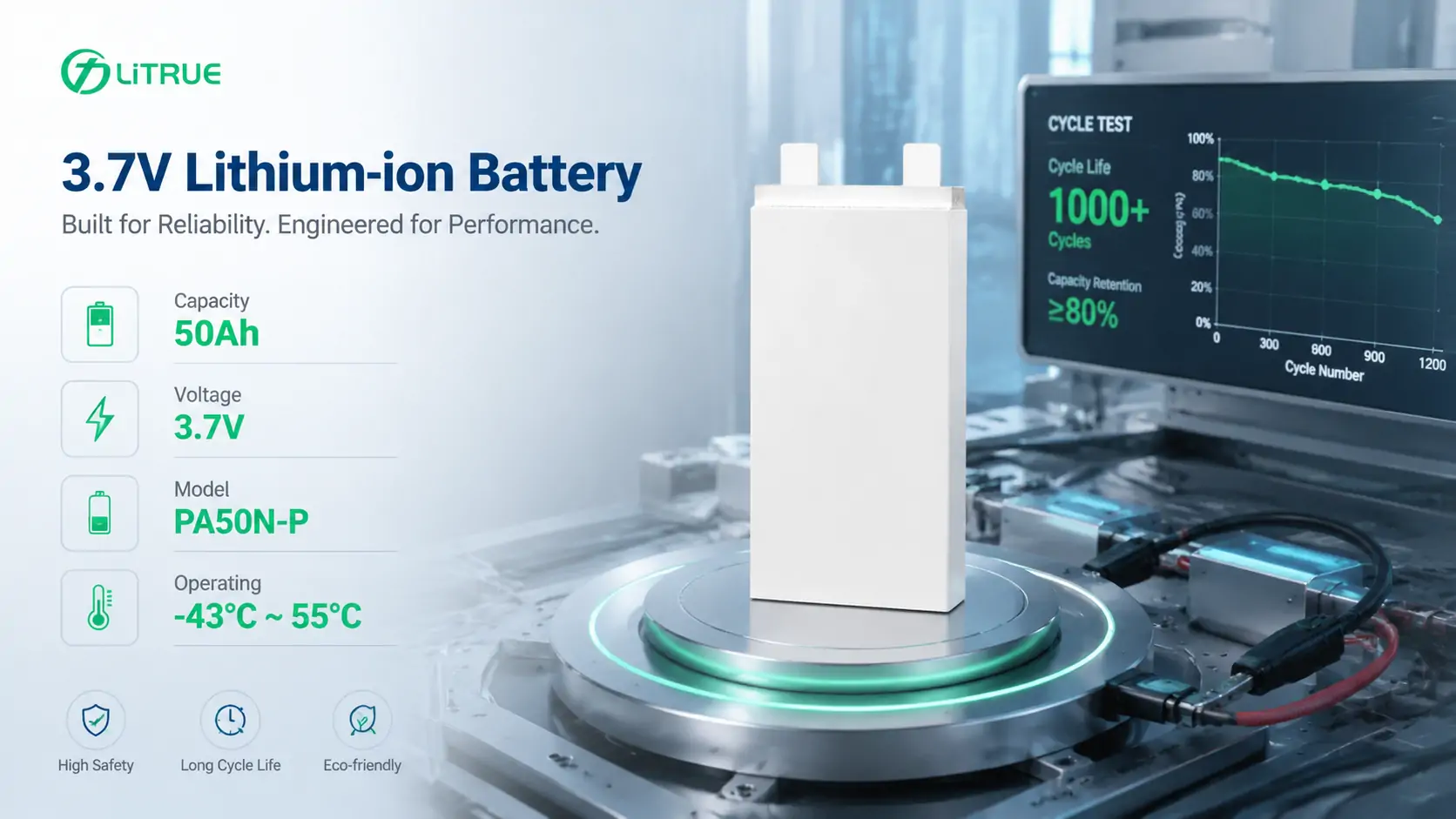
The Core Truths About a 3.7V Lithium-Ion Battery
Before the deep dive, here's the part that gets lost in most articles: 3.7V isn't a fixed number, it's a nominal average. A fresh cell sits closer to 4.2V at full charge and drops to around 3.0V near empty. "3.7V" is just the midpoint manufacturers print on the label — the chemistry is NMC (nickel manganese cobalt) or LCO (lithium cobalt oxide), not LFP, which nominal-rates at 3.2V instead.
A few things worth knowing before you buy anything:
- Cycle life is not calendar life. A cell rated for 500-1000 cycles can still fail from age (calendar fade) even if you barely use it.
- Depth of discharge matters more than most people assume. Running a cell from 100% to 0% every time wears it out faster than cycling between 20% and 80%.
- Temperature is the single biggest factor outside of the user's control. Heat accelerates the internal chemical breakdown that reduces capacity.
- "Last" has two meanings: how long a single charge lasts (runtime, measured in hours) and how many charges the cell survives before it's no longer usable (cycle life, measured in cycles or years).
Both matter. A phone battery and a drone battery pack can share the same nominal 3.7V chemistry and still land at completely different lifespans because of how the current is pulled.
What Actually Kills Cycle Life — Factory Data, Not Guesswork
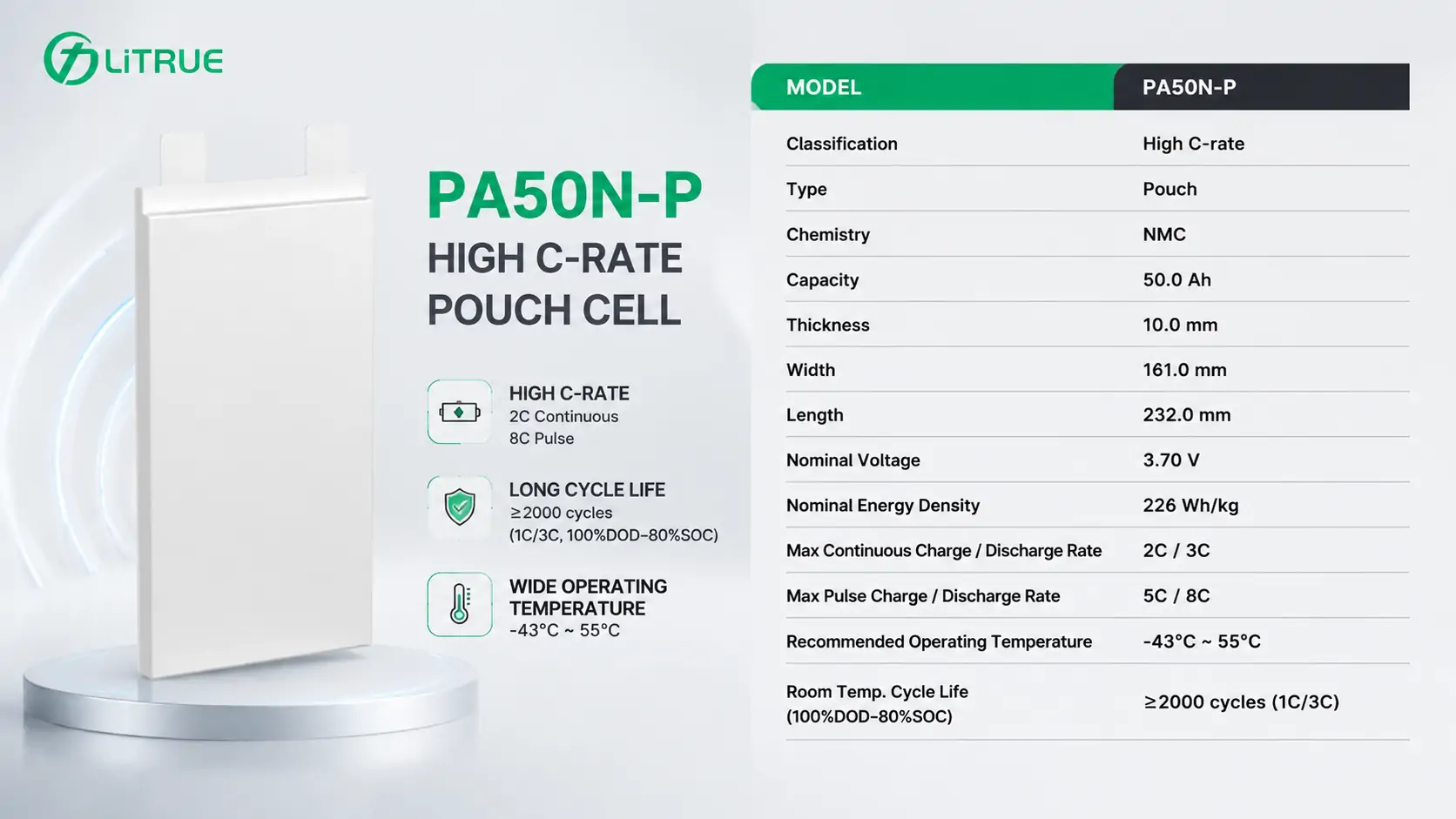
Here's a concrete example from our own line, because a single-cell datasheet is worth more than another paragraph of generalities. Take the LiTrue PA50N-P, a bare 50Ah high-rate lithium cells product:
| Specification | PA50N-P |
|---|---|
| Chemistry & Nominal Voltage | NMC / 3.70V |
| Capacity & Energy Density | 50Ah / 226 Wh/kg |
| Max Continuous Charge / Discharge | 2C / 3C |
| Peak Pulse Discharge | 8C |
| Cycle Life | ≥2000 times (tested at 1C charge / 3C discharge) |
| Operating Temperature Range | -43°C to +55°C |
That ≥2000-cycle figure is the number worth anchoring on if someone tells you "lithium-ion only lasts 500 cycles." However, it depends entirely on how you use it. That 2000-cycle figure holds at 3C continuous discharge — already a harder load than most electronics see. But push the same cell to its 8C pulse ceiling repeatedly instead of using it as a short burst, and sustained high current generates more internal heat, accelerating electrode degradation. We see this on the test bench constantly: hold a cell closer to 6-7C continuously, and its capacity retention curve visibly separates from the rated curve well before cycle 1000.
The operating temperature range tells the same story. The -43°C to +55°C window is wide enough for cold-region outdoor equipment, but that covers the cell's survivable range — not a blanket charge/discharge guarantee. Charging a lithium-ion cell near the bottom of that range still risks lithium plating on the anode, which permanently reduces capacity and creates safety risks. This isn't theoretical; it's exactly why any pack we build around this cell keeps a tighter charge-temperature cutoff in the BMS than the bare cell's absolute rating would suggest.
Who a 3.7V Lithium-Ion Battery Fits — And Who Should Look Elsewhere
If you're building consumer electronics, e-bikes, power tools, or mid-size UAV platforms where energy density and moderate cost matter more than absolute cycle count, standard 3.7V NMC or LCO cells are the practical default — they're what most of the industry already designs around, and supply chains are mature.
If your application needs thousands of deep cycles — grid storage, high-frequency commercial drone fleets doing 3+ flights a day, or e-motorcycles clocking daily commutes — you're better served by a chemistry built for cycle count over raw energy density, which is where LFP enters the conversation (more on that comparison below).
And if your product runs in sustained sub-zero or desert-heat environments, don't buy on nominal voltage alone. Ask for the charge and discharge temperature windows specifically, the way LiTrue documents them on every lithium cells spec sheet — that number will tell you more about real-world lifespan than the cycle-life figure will.
Design, Customization, and the Limits of a Single Cell
One thing that surprises first-time buyers: a single 3.7V cell almost never ships as the final product for anything beyond small electronics. Take the PA50N-P above — stack fourteen of them in series and you land at roughly 51.8V nominal, which is exactly why so many mid-size UAV packs on the market cluster around that voltage. Series and parallel configurations let manufacturers hit target voltages and capacities, and this is also where customization happens — connector type, BMS communication protocol (CAN, RS485, or basic UART), enclosure rating, and physical footprint can all be adjusted for a specific airframe, vehicle chassis, or equipment bay. LiTrue own custom battery packs line exists for exactly this reason: customers send us a voltage window, peak current draw, and available space, and get back a pack layout built from cells like the PA50N-P rather than a generic catalog item.
What a 3.7V lithium-ion cell can't do on its own: survive a hard short circuit without protection circuitry, balance charge across a series string without a BMS, or hold rated capacity indefinitely in storage. These aren't flaws — they're why battery packs, not bare cells, are the actual product most buyers need.
Pros and Cons at a Glance
- Pros: High energy density for the weight (226Wh/kg on the PA50N-P), mature manufacturing base, wide availability of standard form factors, strong performance at moderate-to-high discharge rates (well-built cells hit 2000+ cycles at 1C/3C rather than the 500-cycle figure often quoted for generic cells), broad operating voltage compatibility with existing chargers and electronics.
- Cons: Cycle life still drops faster than LFP under sustained high discharge or high heat, charge-temperature control matters more than discharge-temperature control in cold conditions, calendar aging continues even in storage, and full-charge storage above 25°C accelerates capacity loss noticeably within a year.
Lithium-Ion (NMC) vs. LFP: Which Actually Lasts Longer?
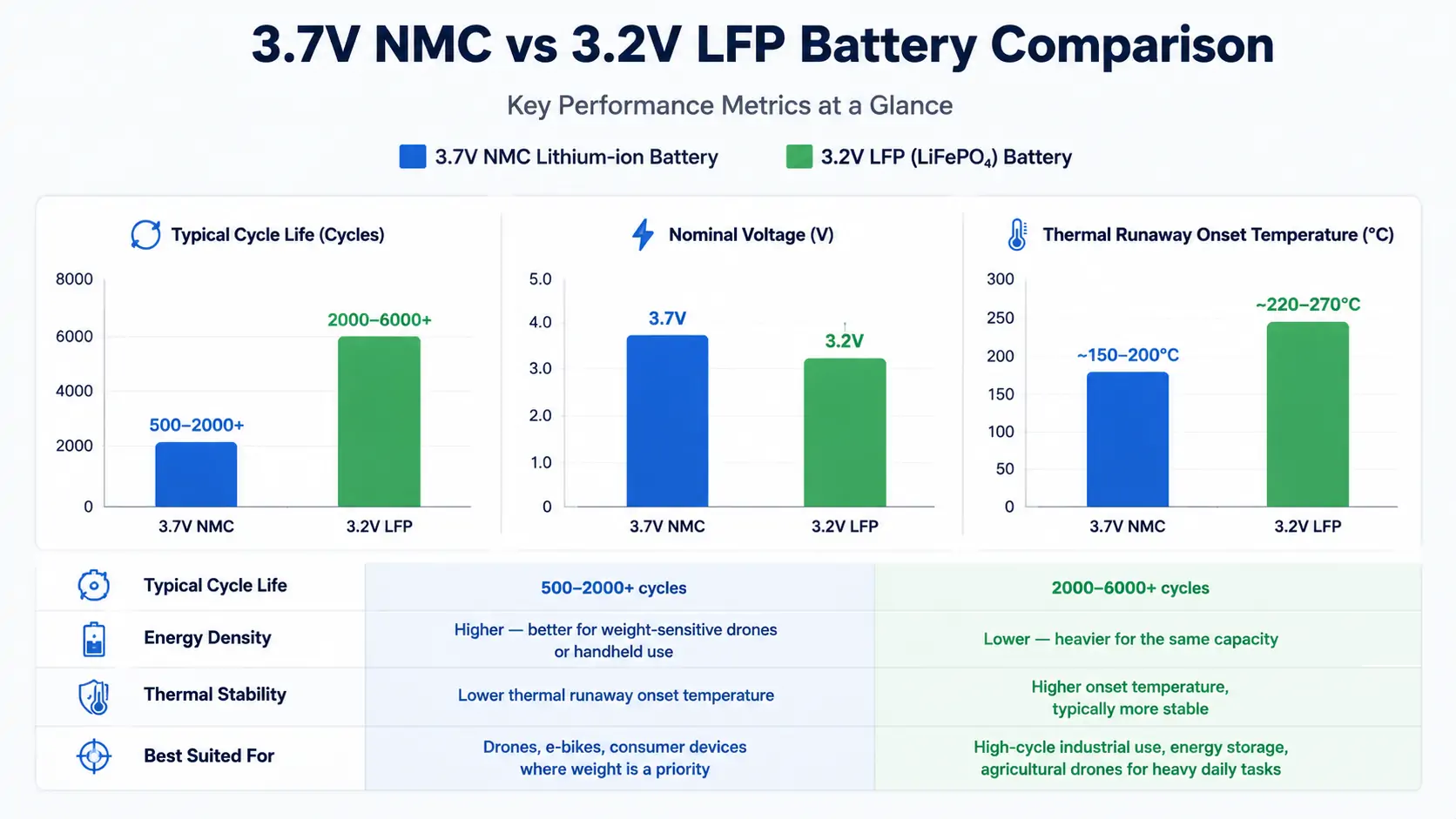
| Factor | 3.7V Lithium-Ion | 3.2V LFP |
|---|---|---|
| Typical cycle life | 500-2000+ cycles | 2000-6000+ cycles |
| Energy density | Higher — better for weight-sensitive UAV or handheld use | Lower — heavier for the same capacity |
| Thermal stability | Lower onset temperature for thermal runaway | Higher onset temperature, generally more stable |
| Best fit | Drones, e-bikes, consumer devices where weight is the priority | High-cycle industrial use, energy storage, agriculture drones flying multiple daily missions |
LiTrue produces both families side by side, including high-cycle LFP pouch cells rated well beyond what standard 3.7V chemistry can deliver — the honest recommendation depends entirely on whether your project is weight-constrained or cycle-constrained.
FAQs
How many hours will a single 3.7V lithium-ion battery run a device?
Runtime depends entirely on the cell's Ah rating and the device's current draw — divide capacity (Ah) by average current draw (A) for a rough hour estimate. A 3.7V, 2.5Ah 18650 cell powering a 0.5A load runs roughly 5 hours before hitting the low-voltage cutoff, though real-world runtime is usually 10-15% lower due to voltage sag under load.
How many charge cycles before a 3.7V lithium-ion battery needs replacing?
It varies by cell design and test condition far more than most buying guides admit. Basic consumer-grade NMC or LCO cells often land around 500 cycles to 80% capacity retention, while higher-spec cells built for sustained high current — LiTrue PA50N-P is rated ≥2000 cycles at 1C/3C, for example — can run well past that. Ask for the cycle-life figure alongside the exact test C-rate before comparing two cells; a 500-cycle spec at 1C and a 500-cycle spec at 5C are not the same claim.
Does storing a lithium-ion battery at full charge shorten its life?
Yes. Storing a cell at or near 100% state of charge, especially in warm conditions, measurably accelerates capacity fade compared to storing it around 40-60%. This is why most BMS-equipped packs, including UAV battery packs, ship at partial charge from the factory.
Is a 3.7V lithium-ion battery the same as a 3.2V LFP battery?
No. They're both lithium-ion chemistries in the broad sense, but NMC/LCO cells nominal-rate at 3.7V with higher energy density, while LFP (lithium iron phosphate) cells nominal-rate at 3.2V with generally longer cycle life and better thermal stability. They aren't drop-in substitutes for each other in a pack designed around one voltage.
Can LiTrue build a custom pack around 3.7V cells for my product?
Yes. Send your target voltage, peak and continuous current draw, physical size limits, and communication protocol requirements to our engineering team through custom lithium battery inquiries, and we'll return a pack configuration rather than a generic catalog suggestion.
Summary
A 3.7V lithium-ion battery doesn't have a single answer for "how long will it last" — it has two answers. Runtime per charge comes down to Ah capacity versus your device's draw. Cycle life comes down to discharge rate, temperature control, and how the cell is stored between uses, and our own bench data on cells like the PA50N-P backs that up: ≥2000 cycles at a controlled 1C/3C, fewer if you push the discharge rate past its rated 3C continuous / 8C pulse ceiling or skip temperature management.
If weight is your priority, standard 3.7V NMC chemistry, sourced from an established lithium battery manufacturer, still makes sense for most drone, e-bike, and consumer-device projects. If cycle count and thermal margin matter more than raw energy density, it's worth comparing against LFP before locking in a spec. Either way, ask for the actual charge/discharge temperature windows and cycle-test conditions before you buy — the nominal voltage on the label won't tell you that.
According to the Wikipedia entry on lithium-ion batteries, commercial cells of this chemistry were first brought to market by Sony in 1991, and the underlying intercalation mechanism hasn't fundamentally changed since — what's changed is manufacturing precision and BMS sophistication, which is where most of today's real-world lifespan gains actually come from. Research from the National Renewable Energy Laboratory on battery lifespan echoes the same pattern we see on our own test benches: temperature control and depth-of-discharge management move the needle on cycle life more than chemistry tweaks alone.